Audio Book: The Broposal

by Sonora Reyes
Read by André Santana & Alejandro Antonio Ruiz
Support your local independent bookstore: buy it there!
Or listen at Libro.fm
Content: There is domestic abuse, swearing (including multiple f-bombs), threats of ICE reads, talk of drug abuse, and on-page sex. It’s in the Romance section of the bookstore.

Alejandro – Han for short – and Kenny have been best friends since second grade. Han’s an undocumented immigrant, and Kenny has been in a long-term on-and-off again relationship. When Kenny breaks up with his girlfriend (she was making him choose between her and Han) and then witnesses some of the discrimination and uncertainty that Han goes through as an undocumented person, he gets this idea: why don’t he and Han get married? It’ll help Han get his green card and head toward citizenship, and no one ever needs to know it’s fake, right?

Except, as they get more into it, they discover that they have deeper feelings than “just” best friends. But a conniving boss and a desperate ex-girlfriend threaten to throw a huge wrench in their plan. Will they be able to get to their wedding day with their relationship still intact?

I liked this one a lot. I liked how Reyes tackled tough subjects like abuse and discrimination against undocumented people. I liked the support of both Han’s and Kenny’s families. I liked that these men were 23 and still trying to figure everything out. I really liked the narrators; they probably made the book for me. It was sweet and charming, hitting the tropes without being overly fluffy, which I also appreciated.

Definitely a good one to pick up.
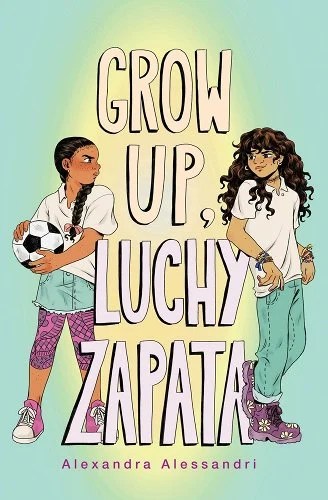
Grow Up Luchy Zapata

by Alexandra Alessandri
First sentence: “It’s a well-known fact that Colombians living outside the motherland will find a way toward each other like magnets.”
Support your local independent bookstore: buy it there!
Review copy pilfered off the shelves at work.
Content: There is some bullying. It’s in the Middle Grade (grades 3-5) section of the bookstore.

Luchy and Cami have been friends their entire lives – it comes from being Colombian in Miami and having parents who are good friends. But, the summer before sixth grade, Cami goes to Colombia and comes back different: she’s into make-up and boys, and wants to “reinvent herself” now that they’re in middle school. Except Luchy likes things the way they are. She’s content with herself and where she is, and she doesn’t want things to change.

But what starts as a change becomes a huge rift, and things escalate until they get out of control. How does Luchy figure out how to navigate middle school without her best friend.

I was talking to a librarian of a K-8 school in a nearby town at the store the other day, and we were lamenting how many middle-grade books had characters who have crushes in them. It’s all fine and good to write characters with crushes, but sometimes, you just need to have a story about kids who are friends and not make it about relationships. Thankfully, Alessandri stuck to the friendship element of the story (Cami has crushes, but it wasn’t a big deal to the story) and doesn’t go down the “who likes who” road. I’m not saying there’s not a place for that; I’m just a little tired of reading books where that is a main element. I like that this one focused on Luchy’s struggle with her heritage – her parents didn’t speak Spanish at home and so she never learned, and she doesn’t really feel connected to Colombia – as well as her friendship with Cami. It’s a good portrayal of the struggle that sixth grade and middle school often is, and I’m glad Alessandri didn’t gloss over the friendship struggles that come along with that.

A really solid middle grade book.

Ultraviolet

by Aida Salazar
First sentence: “Who invented love, anyway?”
Support your local independent bookstore: buy it there!
Content: There is some sexual objectification of middle-school girls by middle-school boys. It’s in the YA section (grades 6-8) of the bookstore.

At the start of eighth grade Elio Selis starts noticing changes. Specifically girls. There are other changes too, with his body and with his friends, but all of a sudden girls are on his radar. Camellia in particular. He most definitely likes her, and she likes him back. Things are perfect for a while – ultraviolet, Elio things – but then things go south. Camellia takes up with a guy that Elio thinks is trash, and his heart is broken. He discovers he has an undetected heart problem that needs to be fixed. His parents decide that he and his dad need to join a Circle as a way to express and learn about masculinity. It’s all very confusing.

In the afterword, Salazar says she wrote this for her son, once she realized that there weren’t many books out there depicting what it’s like for boys to go through puberty, to feel their feels, to explore what it means, and how to be a man, and she wanted to write one. Which she nails. I didn’t particularly like puberty or being 13 or eighth grade, but I think Salazar gets all the big emotions and the big feelings and the confusion that goes along with that time in one’s life. She handles it all with grace and with compassion: Both Elio and Camellia make mistakes as they try to figure out what “relationships” and “liking” and just what feeling feelings mean. And it’s wonderfully age-appropriate. It’s an excellent book to hand kids in the 11- to 12-year-old range, on the cusp of all of this, to help them navigate it. I’m not sure there are many adults who would buy this for their boys, but honestly: they should. It’s an excellent book about growing up, learning to be a compassionate and kind person, and how to navigate an incredibly confusing and difficult time of life.

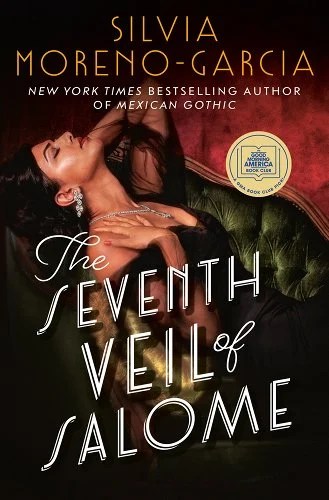
Audiobook: The Seventh Veil of Salome

by Sylvia Moreno-Garcia
Read by Caitlin Kelly, Atlanta Amado, Victoria Villarreal, Arthur Morey, Andrew Eiden, Kristen DiMercurio, Frankie Corzo, Lauren Fortgang, Javier Prusky, Fred Sanders, Lee Osorio & Cassandra Campbell
Support your local independent bookstore: buy it there!
Or listen at Libro.fm
Content: There is violence, sexual harassment, racist slurs, and swearing, including a few f-bombs. It’s in the fiction section of the bookstore.

It’s 1955 and Hollywood is all-in on big-budget Biblical films. In this case, the story of Salome, the woman who danced for Herod and asked for John the Baptist’s head on a platter. The problem the director is having, though, is finding the right woman to play the title character. Enter Vera Larios, a newbie from Mexico City. She’s the perfect person, except…. she won’t entertain the advances of the playboy leading man. And she “took the role” from another aspiring actress. (And she also “took” the aspiring actress’s boyfriend.) And, worst of all: she’s Mexican.

One of the things we have said about Moreno-Garcia at the store is that she doesn’t write the same book twice. A big, sweeping historical drama was not really on my bingo card for her, but that’s not to say she didn’t do it well. It’s very character-driven, especially the three female characters: Vera, of course; but also Nancy (the aspiring – and failing – actress); and Salome herself. At first, I thought the Salome chapters were a bit weird, but as the book went on, I saw the parallels between that story and the one playing out around the movie. I ended up thinking about halfway through that this was a book about the ways women use their sexuality to gain power, and maybe that’s so. I’m not entirely sure, though, now that I’m done.

The full cast recording was really well done, however. There are no chapters, just narratives by various people – from other cast members to the director, a screenwriter, and other Hollywood notables – and the full cast helped distinguish that. I did wonder why most of the narratives were in first-person, kind of documentary-style, but the Nancy, Vera, and Salome sections were in third-person. Again, it was a choice, and while I did not mind it, I was a bit put off initially.

I am glad I read it, though, even if it’s not my usual fare.

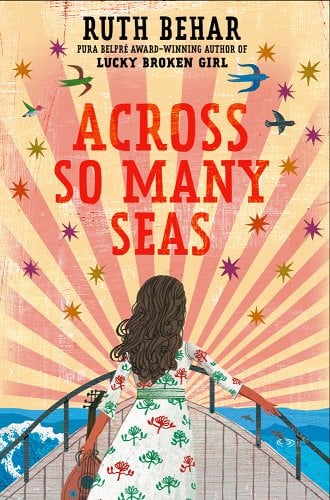
Across So Many Seas

by Ruth Behar
First sentence: “The sound of trumpets coming from the direction of our town gates tears me from sleep, my dreams forgotten as I jolt out of bed.”
Support your local independent bookstore: buy it there!
Content: There are some instances of hatred toward Jews, deaths of parents, and overly strict fathers. It’s in the Middle Grade (grades 3-5) section of the bookstore.

These inter-connected short stories follow girls in the same Sephardic Jewish family from their exile in Spain in 1492, to their lives in Turkey and one girl’s exile from there to Cuba, to finally landing in Miami in present times. Three of the stories follow a direct mother-daughter line; the fourth is their ancestor in Spain. While there isn’t much of a plot except for these girls’ experiences, there is a lot of history here, much of which I didn’t know. 

Behar is a talented writer, capturing quite a lot in a few words. It’s an elegant little book, and I appreciated that it was interconnected stories rather than trying to be one long novel. It was just enough to keep me interested and yet dense enough that I felt I connected with the characters are well as learning something new. 

I’m not entirely sure it’s for kids, but maybe some out there will find an interest in this story. It’s a good one. 

City Girls

by Loretta Lopez
First sentence: “My body is still getting used to hers.”
Support your local independent bookstore: buy it there!
Content: While this is super short, and the main characters are eleven, it deals with some pretty heavy themes (including sexual and physical abuse, divorce, sickness, and death). It’s in the Middle Grade (grades 3-5) section of the bookstore.  

This slim book is three interconnected short stories, each one following a girl in a Manhattan Middle School. Elisa is fresh from El Salvador and is petitioning the US government for asylum so she can stay in the United States with her mom, so she doesn’t have to go back to her abusive grandmother and the predator she calls “chicken man”. Lucia accidentally catches her father in an affair and has to deal with the weight of that, and then the aftermath when she confronts him. Alice is constantly acting out in class, but her father is distant and her mother is dying of cancer. The three girls become friends over their sixth-grade year, as they deal with their trials individually and collectively. 

I wanted to like this book. (Well, I started out listening to the audiobook, but the first narrator, the one who voiced Elisa, made some annoying narrative choices.) I like the idea of interconnected short stories, I like the idea of looking at race and culture from different perspectives. And I do understand that children go through trauma. But I wonder who the audience is for this book. The trauma is not spelled out, though a smart reader could figure it out (maybe not an 11-year-old one, though). It’s short, so maybe it’s geared at younger readers? But, the content isn’t really appropriate for 2nd and 3rd graders. It’s a conundrum. 

That said, I think the book is good to have out there, and it’s always good to have stories about Hard Things for kids who need them. 

Canto Contigo

by Jonny Garza Villa
First sentence: “I want to grab this guitar by the neck and smash it on the floor.”
Support your local independent bookstore: buy it there!
Release date: April 9, 2024
Review copy sent by the publisher.
Content: There is a lot of swearing, in both English and Spanish, and a number of f-bombs. There is also fade-to-black sex and some teenage drinking. It will be in the Teen (grades 9+) of the bookstore.

Rafie was raised to be a Mariachi singer. His father was one, and his beloved grandfather was one. He’s been the star of the North Amistad High School’s award-winning Mariachi band for three years. And then his life fell apart: his abuelo died and his parents uprooted and moved to San Antonio. Rafie is upset and devastated, especially when the school he’s being sent to is the perpetual Number two to his Number one. He’s grieving, he’s alone, and then the absolute kicker: he’s no longer the lead singer of a Mariachi band.

This is the story of how Rafie finds his way, finds love, and learns to trust other people.

I really liked this one. I love the way Villa is writing about LGBTQ people inside of Mexican culture and challenging the hyper-masculinity of it. The perpetual Number two – Todos Colores – is a very gay Mariachi band: they have trans men and women and proudly gay people in the band, and they embrace it. They are pushing against the cultural stereotypes that Mariachi’s a man’s world. I also appreciated following Rafie’s grieving process. There was a bit of magical realism which was done incredibly well. I also appreciated that the conflict was all internal: Rafie’s parents were incredibly supportive and loving.

Villa is definitely quickly becoming one of those authors whose books I will read, no matter what.

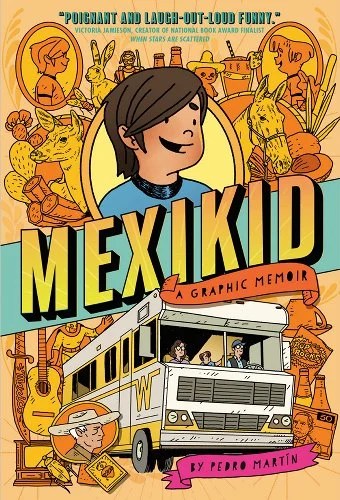
Mexikid

by Pedro Martín
Support your local independent bookstore: buy it there!
Review copy pilfered from the ARC shelves at work.
Content: There is some bullying and teasing by siblings, and talk of death. It’s in the Middle-Grade Graphic Novel section of the bookstore.

Pedro is one of nine children, the son of immigrant parents – he and his younger siblings were born in the US; his parents and older siblings immigrated from Mexico – which makes him, a “Mexikid”. Not really Mexican enough, but also not really American enough. And then, one Christmas break, Pedro’s family drives back to their hometown to fetch his abuelito and bring him back to live with them. It’s a life-changing trip, not only because of the adventures Pedro has but because of the things he learns about his family.

I thought this was a lot of fun! I loved how Martin portrayed his boisterous, big family; you could tell that family is super important to him. Sure, the siblings fought and teased, but there was genuine affection there. And I liked how he brought in his family history while relating the events of the trip they took. It was entertaining, funny, and thoroughly enjoyable to read about this particular time in history. I liked the art – and the ways Martin used the art to tell his story.

Highly recommended.

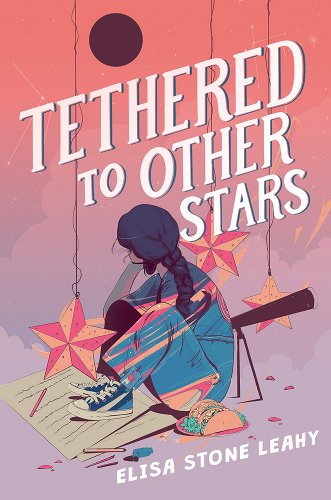
Tethered to Other Stars

by Elisa Stone Leahy
First sentence: “Wendy and Tom sat on the plastic-wrapped sofa in the middle of the sidewalk and stared up at the crooked house.”
Support your local independent bookstore: buy it there!
Content: There is bullying and name calling and both racist microagressions as well as racist behavior. It’s in the Middle Grades (grades 3-5) section of the bookstore.I read this book for the Cybils, and this reflects my opinion and not that of the whole panel.

Wendy’s family used to live in a bustling Latine neighborhood of their Ohio town, one where there were lots of families like hers. But then La Migra – ICE – started taking more and more people; parents would disappear, families gone overnight. And Wendy’s parents became unnerved. So they found the cheapest fixer-upper in a nearby town, one that was more white, in hopes that La Migra would leave them alone. Because, while Wendy’s dad was adopted by an American relative when he was little, and Wendy and Tom were born in America, Wendy’s mom has a green card, and maybe that’s not quite enough for ICE. The best thing is to keep their heads down and not make any waves.

Except, at Wendy’s new, mostly white, school for gifted student, she’s finding it hard to keep her head down. She make friends with a Black girl, K. K.; and a Muslim one, Yasmin; and the daughter of a white pastor who is giving sanctuary to a woman whom ICE is trying to deport. And when their little group becomes targets for the richer, whiter kids in school, things get, well, a bit messy.

It sounds like a lot, and it is, but Leahy makes it work. Wendy is the first-generation daughter of immigrant parents, and Leahy weaves that in. She weaves in treating those who are looking for a new, better home in America humanely. She weaves in STEM – Wendy is fascinated with space and astronomy and wants to be an astrophysicist. And she weaves in the real ways in which white kids absorb the opinons and actions of their parents. You can tell what kind of parents the kids have by the way their kids treat those not like them.

It’s a good book with a good heart, and some tense moments. And in the end, I loved how everyone grew, learned, and changed for the better.

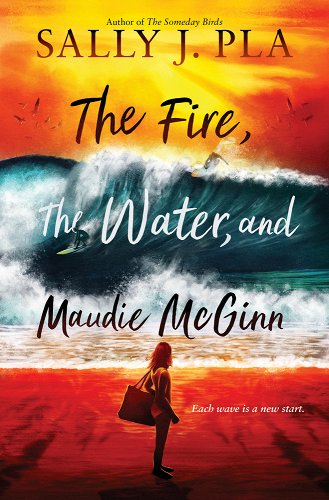
The Fire, the Water, and Maudie McGinn

by Sally J Pla
First sentence: “I learned this great calm-down trick recently.”
Support your local independent bookstore: buy it there!
Content: There is on-page physical abuse by a stepparent as well as neglect and shaming by a parent. It’s in the YA section (grades 6-8) of the bookstore, but I’d give it to some 4th and 5th graders. I read this book for the Cybils, and this is a reflection of my opinion and not that of the whole panel.

For Maudie’s whole life, she has spent summers with her Dad in his cabin in California and the rest of the year with her mom in Texas. But her mom recently go remarried, and her stepdad, Ron, has an explosive temper. So much so that he hurts Maudie, whom he doesn’t seem to want around. And her mother isn’t doing much to help. Especialy since Maudie has autism and needs more time and allowances to get things done. But her mother told her not to tell her dad, so she’s keeping the secret.

This summer, though, there’s a wildfire in the mountains around her dad’s cabin, and they have to flee. They’re left with nothing, so they head south to the beach to stay with one of her dad’s high school friends. There, Maudie discovers surfing, makes friends, and gains confidence. Will she have enough to tell her dad the secret and to tell him what she really wants: not to go back to Texas at all?

I really liked the autism representation in this. I liked the way Pla described what Maudie was feeling, and the sensations that made her anxious and unsettled. She had panic attacks and meltdowns, and the author described them just as if they were parts of life, which they are. I liked that her dad was also neurodivergent. And I liked that Maudie found something she could focus on in the surfing, and that the community was so welcoming.

Things were unsettling though. I disliked Maudie’s mom, who didn’t care about what Maudie needed to thrive, but more on what she (the mom) wanted. I think one could blame it on Maudie’s mom being a teenager when she had Maudie, but maybe not. She was horrible, her new husband was horrible, and Pla leaned into that. I also wondered about the representation. I liked that the town was populated with all sorts of people, but some of it felt stereotypical. Maudie’s dad is half Venezuelan, and his mom died soon after Maudie was born, so he doesn’t really have a connection to that. His friend is Latine, and they meet an Indian/Pakistani (assuming from the name, there’s nothing that gives it context) woman who runs an alternative school for neurodivergent kid. And Maudie’s surving mentor is Etta Kahuna, who is Black? Polynesian? Her only defining feature is her gray “dreadlocks” which is a big red flag.

That said, I did like how the overall message was trusting yourself and believing in (some of) the adults around you. And I did like watching Maudie learn to surf. I’m just not sure it’s that great with representation.