City Girls

by Loretta Lopez
First sentence: “My body is still getting used to hers.”
Support your local independent bookstore: buy it there!
Content: While this is super short, and the main characters are eleven, it deals with some pretty heavy themes (including sexual and physical abuse, divorce, sickness, and death). It’s in the Middle Grade (grades 3-5) section of the bookstore.  

This slim book is three interconnected short stories, each one following a girl in a Manhattan Middle School. Elisa is fresh from El Salvador and is petitioning the US government for asylum so she can stay in the United States with her mom, so she doesn’t have to go back to her abusive grandmother and the predator she calls “chicken man”. Lucia accidentally catches her father in an affair and has to deal with the weight of that, and then the aftermath when she confronts him. Alice is constantly acting out in class, but her father is distant and her mother is dying of cancer. The three girls become friends over their sixth-grade year, as they deal with their trials individually and collectively. 

I wanted to like this book. (Well, I started out listening to the audiobook, but the first narrator, the one who voiced Elisa, made some annoying narrative choices.) I like the idea of interconnected short stories, I like the idea of looking at race and culture from different perspectives. And I do understand that children go through trauma. But I wonder who the audience is for this book. The trauma is not spelled out, though a smart reader could figure it out (maybe not an 11-year-old one, though). It’s short, so maybe it’s geared at younger readers? But, the content isn’t really appropriate for 2nd and 3rd graders. It’s a conundrum. 

That said, I think the book is good to have out there, and it’s always good to have stories about Hard Things for kids who need them. 

Canto Contigo

by Jonny Garza Villa
First sentence: “I want to grab this guitar by the neck and smash it on the floor.”
Support your local independent bookstore: buy it there!
Release date: April 9, 2024
Review copy sent by the publisher.
Content: There is a lot of swearing, in both English and Spanish, and a number of f-bombs. There is also fade-to-black sex and some teenage drinking. It will be in the Teen (grades 9+) of the bookstore.

Rafie was raised to be a Mariachi singer. His father was one, and his beloved grandfather was one. He’s been the star of the North Amistad High School’s award-winning Mariachi band for three years. And then his life fell apart: his abuelo died and his parents uprooted and moved to San Antonio. Rafie is upset and devastated, especially when the school he’s being sent to is the perpetual Number two to his Number one. He’s grieving, he’s alone, and then the absolute kicker: he’s no longer the lead singer of a Mariachi band.

This is the story of how Rafie finds his way, finds love, and learns to trust other people.

I really liked this one. I love the way Villa is writing about LGBTQ people inside of Mexican culture and challenging the hyper-masculinity of it. The perpetual Number two – Todos Colores – is a very gay Mariachi band: they have trans men and women and proudly gay people in the band, and they embrace it. They are pushing against the cultural stereotypes that Mariachi’s a man’s world. I also appreciated following Rafie’s grieving process. There was a bit of magical realism which was done incredibly well. I also appreciated that the conflict was all internal: Rafie’s parents were incredibly supportive and loving.

Villa is definitely quickly becoming one of those authors whose books I will read, no matter what.

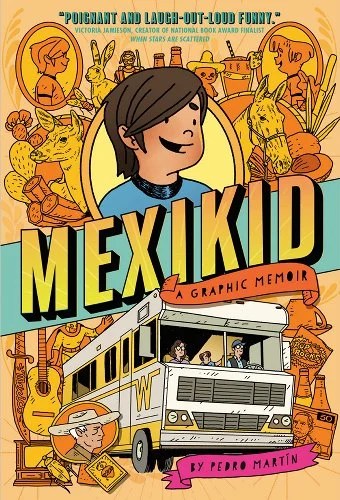
Mexikid

by Pedro Martín
Support your local independent bookstore: buy it there!
Review copy pilfered from the ARC shelves at work.
Content: There is some bullying and teasing by siblings, and talk of death. It’s in the Middle-Grade Graphic Novel section of the bookstore.

Pedro is one of nine children, the son of immigrant parents – he and his younger siblings were born in the US; his parents and older siblings immigrated from Mexico – which makes him, a “Mexikid”. Not really Mexican enough, but also not really American enough. And then, one Christmas break, Pedro’s family drives back to their hometown to fetch his abuelito and bring him back to live with them. It’s a life-changing trip, not only because of the adventures Pedro has but because of the things he learns about his family.

I thought this was a lot of fun! I loved how Martin portrayed his boisterous, big family; you could tell that family is super important to him. Sure, the siblings fought and teased, but there was genuine affection there. And I liked how he brought in his family history while relating the events of the trip they took. It was entertaining, funny, and thoroughly enjoyable to read about this particular time in history. I liked the art – and the ways Martin used the art to tell his story.

Highly recommended.

Tethered to Other Stars

by Elisa Stone Leahy
First sentence: “Wendy and Tom sat on the plastic-wrapped sofa in the middle of the sidewalk and stared up at the crooked house.”
Support your local independent bookstore: buy it there!
Content: There is bullying and name calling and both racist microagressions as well as racist behavior. It’s in the Middle Grades (grades 3-5) section of the bookstore.I read this book for the Cybils, and this reflects my opinion and not that of the whole panel.

Wendy’s family used to live in a bustling Latine neighborhood of their Ohio town, one where there were lots of families like hers. But then La Migra – ICE – started taking more and more people; parents would disappear, families gone overnight. And Wendy’s parents became unnerved. So they found the cheapest fixer-upper in a nearby town, one that was more white, in hopes that La Migra would leave them alone. Because, while Wendy’s dad was adopted by an American relative when he was little, and Wendy and Tom were born in America, Wendy’s mom has a green card, and maybe that’s not quite enough for ICE. The best thing is to keep their heads down and not make any waves.

Except, at Wendy’s new, mostly white, school for gifted student, she’s finding it hard to keep her head down. She make friends with a Black girl, K. K.; and a Muslim one, Yasmin; and the daughter of a white pastor who is giving sanctuary to a woman whom ICE is trying to deport. And when their little group becomes targets for the richer, whiter kids in school, things get, well, a bit messy.

It sounds like a lot, and it is, but Leahy makes it work. Wendy is the first-generation daughter of immigrant parents, and Leahy weaves that in. She weaves in treating those who are looking for a new, better home in America humanely. She weaves in STEM – Wendy is fascinated with space and astronomy and wants to be an astrophysicist. And she weaves in the real ways in which white kids absorb the opinons and actions of their parents. You can tell what kind of parents the kids have by the way their kids treat those not like them.

It’s a good book with a good heart, and some tense moments. And in the end, I loved how everyone grew, learned, and changed for the better.

The Fire, the Water, and Maudie McGinn

by Sally J Pla
First sentence: “I learned this great calm-down trick recently.”
Support your local independent bookstore: buy it there!
Content: There is on-page physical abuse by a stepparent as well as neglect and shaming by a parent. It’s in the YA section (grades 6-8) of the bookstore, but I’d give it to some 4th and 5th graders. I read this book for the Cybils, and this is a reflection of my opinion and not that of the whole panel.

For Maudie’s whole life, she has spent summers with her Dad in his cabin in California and the rest of the year with her mom in Texas. But her mom recently go remarried, and her stepdad, Ron, has an explosive temper. So much so that he hurts Maudie, whom he doesn’t seem to want around. And her mother isn’t doing much to help. Especialy since Maudie has autism and needs more time and allowances to get things done. But her mother told her not to tell her dad, so she’s keeping the secret.

This summer, though, there’s a wildfire in the mountains around her dad’s cabin, and they have to flee. They’re left with nothing, so they head south to the beach to stay with one of her dad’s high school friends. There, Maudie discovers surfing, makes friends, and gains confidence. Will she have enough to tell her dad the secret and to tell him what she really wants: not to go back to Texas at all?

I really liked the autism representation in this. I liked the way Pla described what Maudie was feeling, and the sensations that made her anxious and unsettled. She had panic attacks and meltdowns, and the author described them just as if they were parts of life, which they are. I liked that her dad was also neurodivergent. And I liked that Maudie found something she could focus on in the surfing, and that the community was so welcoming.

Things were unsettling though. I disliked Maudie’s mom, who didn’t care about what Maudie needed to thrive, but more on what she (the mom) wanted. I think one could blame it on Maudie’s mom being a teenager when she had Maudie, but maybe not. She was horrible, her new husband was horrible, and Pla leaned into that. I also wondered about the representation. I liked that the town was populated with all sorts of people, but some of it felt stereotypical. Maudie’s dad is half Venezuelan, and his mom died soon after Maudie was born, so he doesn’t really have a connection to that. His friend is Latine, and they meet an Indian/Pakistani (assuming from the name, there’s nothing that gives it context) woman who runs an alternative school for neurodivergent kid. And Maudie’s surving mentor is Etta Kahuna, who is Black? Polynesian? Her only defining feature is her gray “dreadlocks” which is a big red flag.

That said, I did like how the overall message was trusting yourself and believing in (some of) the adults around you. And I did like watching Maudie learn to surf. I’m just not sure it’s that great with representation.

Audiobook: Barely Floating

by Lilliam Rivera
Read by Victoria Villarreal
Support your local independent bookstore: buy it there!
Or listen at Libro.fm
Release date: August 29, 2023
Content: There are a couple of mild swear words. It will be in the Middle-Grade section of the bookstore.

Nat has been out-swimming kids at her neighborhood pool for ages. She uses the money to go with her friend to the Anime Con. But one day, she catches a performance of the synchronized swimming team the L.A. Mermaids and she’s hooked. The problem? Her activist parents think synchronized swimming is too white and too focused on appearance for Nat to participate in. The solution? Lie to her parents, get her older cousin involved, and use her money to join the team anyway.

This is going to end badly. (Mild spoiler, there, but you see it coming).

On the one hand: this was so full of representation! There’s a not-skinny Latinx girl at the center of it, someone who is strong and fierce and not the person you think of when you think of synchronized swimming. There’s a boy on the team! It’s made up of not-super-rich kids! And, yet I was super anxious the whole way through because Nat was making some Choices. I get the choices – she felt like she couldn’t do anything else because her parents, who said they were open-minded, didn’t want to listen to her. But ALSO, from a parent’s perspective: AAAAAAHHHHH really!? How did she not get caught sooner?? How clueless are you?! So, mixed feelings to say the least. I did love Villarreal’s narration, though. She was a delight to listen to and brought all the characters to life. Will kids like this? Maybe? I love that the main character is a non-white girl who doesn’t fit the usual swimming stereotype. And maybe kids will like all the subterfuge she goes through to get what she wants.

I hope it finds its audience if only so we get more books like this.

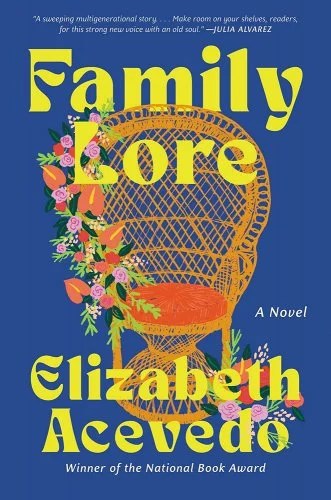
Audiobook: Family Lore

by Elizabeth Acevedo
Read by the author, Sixta Morel & Danyeli Rodriguez del Orbe
Support your local independent bookstore: buy it there!
Or listen at Libro.fm
Release date: August 1, 2023
Content: There was a lot of swearing, including multiple f-bombs, talk of sex and p0rn, and abuse by adults towards children. It will be in the Fiction section of the bookstore.

I have a tumultuous history with magic realism. A lot of the time, it doesn’t sit well; if there’s going to be magic, my brain reasons, then why don’t we have it be magic. Give me someone pulling cars out of their dreams, if you want to set it in the real world. But the idea that someone’s “magic” can predict death, or tell if you were lying, or – heaven help me – have a magical vagina, you lose me. 

On the one hand: I have really loved Acevedo’s books in the past. I think she’s a brilliant writer and I’ve really enjoyed the tales she’s had to tell. I was excited by this one: the stories of sisters who have immigrated from the Dominican Republic, and their reflections on their lives and loves as they lead up to the living wake of the oldest sister. Sounds good, right? 

But, the narrator is Ona, an anthropologist, and the book’s framework is her collecting and telling these stories. I was fine when it was the stories, but Ona? Ona – she of the magic vagina – I intensely disliked. That’s an understatement. I loathed it when she was around when she interrupted the story with her own observations and her own narrative. I wished I could have skipped it – I was listening to it on audio; I suppose I could have, but it’s not the same as skipping pages in a book – and moved on with the part of the story I was interested in. 

I finished it. But, in the end, my dislike of Ona and magical realism trumped whatever good the book had.

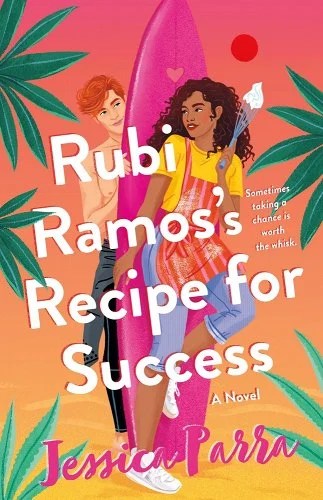
Audiobook: Rubi Ramos’s Recipe for Success

by Jessica Parra
Read by: Karla Serrato
Support your local independent bookstore: buy it there!
Or listen at Libro.fm
Content: There is some kissing. It’s in the YA section (grades 6-8) of the bookstore.

Graduation is fast approaching and Rubi Ramos has everything all planned out. She is going to go to Alma college and study pre-law, and do Great Things. The only problem? She’s been waitilsted at Alma. And what she really wants to do is bake. However, for her Cuban immigrant parents who own two bakeries, baking for Rubi isn’t an option. So, Rubi has a plan: she’s going to get a math tutor to help pull her class standing up (who turns out to be really cute), and she’s going to compete in the Bake Off (without her parents knowing) and hopefully win – which comes with a trip to Cuba.

Of course, things don’t go smoothly, and there are bumps along the way.

This was a delightful romp. It’s got a baking competition! It’s got a surfer dude! It’s got immigrant parents! It’s got Cuban heritage! I liked the relationship Rubi had with her parents; they were firm and wanted a lot for Rubi, but in the end weren’t unreasonable about working with what she wanted. I loved Rubi’s friends, and the support system she had. And the whole baking competition – which was quite definintly a reference to the Great British Bake Off – with it’s baking puns and Johnny Oliver judge, was charming and silly.

The narrator was quite good as well, and I enjoyed the time I spent listening to this one. A good, fun, summery YA book.

Audiobook: Ander & Santi Were Here

by Jonny Garza Villa
Read by: Avi Roque
Support your local independent bookstore: buy it there!
Or listen at Libro.fm
Content: There is a lot of swearing, including many f-bombs, marijuana use, and mention of sex (it’s not quite on-screen, but not entirely off- either)

Ander is taking a gap year after they graduated high school to figure things out. They’ve been accepted into a prestigious art school in Chicago, but for right now, they’re doing an internship with a non-profit in their hometown of San Antonio. But then their parents and grandmother hire Santi at their taquira, and Ander’s world turns upside down. But it’s not just first love: Santi is an undocumented immigrant, which poses all kinds of complications for their relationship.

I really enjoyed this one, especially on audio. The narrator was fantastic, and kept me interested the whole way through. But, it was also about art and finding one’s voice (can you find a voice in art?) and expressing the true version of oneself. It’s about this country’s messed-up immigration system. But it was also about family, and being there for and supporting each other.

I loved how effortless that Latinx elements were, and how much Villa just sprinkled it with Spanish. it felt very authentic and real, and I could just imagine Ander and Santi at different places around San Antonio. An excellent read.

The Lesbiana’s Guide to Catholic School

by Sonora Reyes
First sentence: “Seven years of bad luck can slurp my ass.”
Support your local independent bookstore: buy it there!
Content: There is homophobia, swearing – including multiple f-bombs, teen drinking, and suicidal ideation. It’s in the Teen (grades 9+) of the bookstore.

Yamilet is about to start her junior at a Catholic school, rather than the public school she’s been attending. It’s not for her own good; her brother, Cesar, has been getting into fights and their mother has decided that they need to transfer to help him avoid trouble. The problem is that Yamilet is a closeted lesbian, and the one person she came out to – her best friend – not only outed her to all their friends, after which they shunned her for being “nasty”. 

Side note: I know homophobic kids and parents exist, and I applaud Reyes for exploring those beliefs in the Mexican/Latinx community, but still part of me was like, “Really?” Someone would really shun, make fun of, ostracize, etc. someone for coming out as gay? In 2022? If so, we’ve not progressed as much as I hoped. 

Anyway, at the Catholic school, it looks like Cesar is adjusting okay, but Yamilet is struggling. There are mean white girls who are super racist, but there’s a nice one – Bo – who is an out lesbian, who Yami not only likes but likes. It’s up and down as, over the course of the year, Yami figures out how to come out, how to be proudly out, as well as how to be first Bo’s friend, and then expresses to Bo just how much she likes her. It’s not a smooth road, but Yami finds that it’s worth it 

I really liked this one, first and foremost, for the representation. Not only do we have LGBTQ representation, but it is in a darker-skinned, half-Indigenous (her father was super proud of their Indigenous roots), Mexican girl who is proud of her heritage. As I mentioned before, I liked that Reyes explored homophobia within the Latinx community, but not every Latinx person in the book was homophobic. The book also explored the latent homophobia in the church, and confronted it really well, I think. But, it was also a good story, with Yami figuring out her relationship with her mother, her brother, and with Bo. I really enjoyed this one (finished it pretty much in one sitting!), and can’t wait to see what Reyes does next.