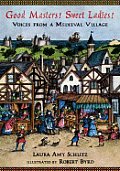
Good Masters! Sweet Ladies!

In a word: delightful.

Other words to describe this: gem, fascinating, funny, captivating, beautiful.

Amazing.

It’s amazing how much information Laura Amy Schlitz packed into 81 pages. There are 22 captivating characters, each one with their own story, separate, yet interconnected. It’s a well-researched (but never dull) peek back in to Medieval times, the harshness of it, as well as the simple little joys. I liked that Schlitz didn’t glamorize the lives of these children, but I liked that she kept it accessible to kids of today. I liked that much of it was poetry: beautiful, simple, powerful. (And this is from someone who isn’t necessarily a fan of poetry.)

I want to own this book. I have a feeling that M and C will enjoy it, too. I can even see them putting on one or two of the plays themselves. It’s a treasure, and well worth the Newbery it won this year.

Loving Will Shakespeare

I picked this up on a whim at the library a month or so ago, partially because Erin reviewed it and liked it well enough (at least I remember her reviewing it, but now I can’t find the link) and partially because I’ve read and like some of Carolyn Meyer’s other stuff.

And this one was okay. Nothing spectacularly brilliant, but nothing really bad either. It’s the story of Anne (Agnes) Hathaway, and how she came to marry Will Shakespeare. It’s an interesting enough story, but a less-than engaging one. I liked Agnes/Anne, but I really didn’t feel that connected to her. I was interested in her life at the beginning, but after a while I just got bored. So her mother died when she was little, and her father married a shrew. So she fell in love with a rogue and accidentally set fire to her father’s barn. So a man she was engaged to died from a fever. So she was 26 when she married an 18 year old because he got her pregnant. I really wasn’t all that interested. Which is sad; I should have been. There is so little known (the author’s note, while brief, was fascinating) about Shakespeare and Anne, that this really could have been a compelling love story. But it wasn’t. Maybe it was because of the length of time involved: the book covers 47 years, beginning with Will’s birth and ending when he comes back to Stratford-on-Avon from London five years before his death. Maybe I just wanted more… I seem to be wanting that from a lot of YA books these days. (Well, maybe not “a lot”, but this isn’t the first time.) But it just felt like a very long list: this happened, then this happened, then several months passed and this happened. And that doesn’t make for a very engaging story.

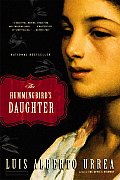
The Hummingbird’s Daughter

I have had a hard time with Latin@ (see, turtlebella? I do learn!) literature in the past. Magical realism and I have not been good friends. I hear over and over again people loving these books and I read them, and… I think they’re just weird.

But this one, by Louis Alberto Urrea, is different. Maybe it’s because though the magic is there, it’s not nearly as prevalent as in other books. But I think it’s mainly because it’s a work of historical fiction, and more than that: it’s a work of love.

The story is that of Urrea’s great-aunt Teresa. She was the bastard daughter of Thomás Urrea, a patrón of a ranch in Mexico. She flies under the radar for the most part during her early life, living in squalor and unloved by her aunt (her mother left when Teresa was small) until she came under the guidance of the local healer, Huila. Then she learns the secrets of the Indians (of which she is half), and how to heal and dream and guide. Eventually, after the ranch moves north to a different location, he and her father become reconciled (though it’s more like “become introduced”) and she moves in the main house with him. She learns to read, her life is pretty quiet. Until one day, when a vaquero attacks her in her sacred grove of trees. She dies… and is resurrected. And from there, we see the evolution of Santa Teresa, the woman who will help the masses rise in revolution against the dictatorship.

Writing that, it sounds very simple, but this book is anything but. It’s immense. It’s lyrical. It’s funny. It’s sorrowful. The one thing I could tell is that Urrea really cared about his subject. The love and respect he has for Teresa, as well as all the years of research he did, is evident in every page. And because of that, the book (for me, at least) soars. I couldn’t put it down. I hung on every beautiful descriptive word. An example:

Only rich men, soldiers and a few Indians had wandered far enough from home to learn the terrible truth: Mexico was too big. It had too many colors. It was noisier than anyone could have imagined, and the voice of the Atlantic was different than the voice of the Pacific. One was shrill, worried, and demanding. The other was boisterous, easy to rile into a frenzy. The rich men, soldiers, and Indians were the few who knew that he east was a swoon of green, a thick-aired smell of ripe fruit and flowers and dead pigs and salt and sweat and mud, while the west was a riot of purple. Pyramids rose between llanos of dust and among turgid jungles. Snakes as long as country roads swam tame beside canoes. Volcanoes wore hats of snow. Cactus forests grew taller than trees. Shamans ate mushrooms and flew. In the south, some tribes still went nearly naked, their women wearing red flowers in their hair and blue skirts, and their breasts hanging free. Men outside the great Mexico City ate tacos made of live winged ants that few away if the men did not chew quickly enough.

It’s books like this that make me glad I read as much as I do.

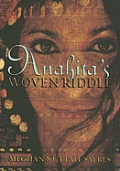
Anahita’s Woven Riddle

Say you are a 16-year-old Afshar girl, daughter of the kadkhuda (he’s the tribal leader). Your father has decided to arrange a marriage with the kahn (he’s the tribal chief who represents the tribe with the government)… except the kahn’s old(ish), has buried three wives, and is arrogant and self-absorbed. You don’t want to marry him. What do you do?

What Anahita proposes to her father is this: every Afshar girl weaves a wedding qali (that’s a rug). She proposes to weave a riddle into the rug, and she will marry whomever can solve the riddle. With that, you have the premise of this engaging book by Meghan Nuttall Sayres.

I have to admit, that this book is a bit clunky to start with. Sayres weighs down the first section with information about the place (Iran), culture (Persian), language (Farsi), as well as nomadic life. Much of this information was necessary in order to understand Anahita and her world, as well as the suitors who would most likely have a chance to win her hand. But I felt like I had to push through the early chapters; all the extra elements slowing me down.

After I got through that section, though, the book soared. Anahita — who has a bit of a reputation for being outspoken — has to convince her father first that marrying the kahn is a bad idea. Then she has to convince him that a riddle contest is a good idea. Then she has to deal with the repercussions of that decision, which effect not only her but the entire tribe. I enjoyed that part; I felt like Sayres was very honest with Anahita by not letting any minuscule part of her rash — and unorthodox — decision go unexplored. I felt that Anahita’s responses were honest, too. Her unwillingness to settle for anyone which gives way to the slow realization of how her stubbornness affects other people. She matures very beautifully.

But what I enjoyed most was the love story. Anahita has three serious suitors, and Sayres makes each one of them desirable and worthy of Anahita’s hand. We meet them in snatches: there’s the prince who meets Anahita only briefly; the good friend who sees her every day; and then the scholar and teacher who comes into the picture late. In this book, there’s is only one bad choice (the kahn); everyone else is varying degrees of good. I was, in turn, hoping for each one of the suitors to win her hand, even though I suspected that there was one true front-runner. However, I was very satisfied with the way it turned out.

It’s also a book for weavers and spinners. Sayers (who’s a weaver herself) takes the qali-weaving through the entire process, from carding and spinning the wool, through dying (all-natural; no synthetic dyes here), and finally through weaving the pattern. Even though I’m not a weaver, I know a few, and I thought of them as I was reading those passages. I could tell that Sayres has an affection for the craft, for it came through in those passages. I’m not sure it made me want to weave, though it did give me an appreciation for all that goes into the process.

One last thing. In the authors note at the end (very informative, by the way), Sayers mentions that she’s donating proceeds from this book to help the people of Iran in recovery from a December, 2003 earthquake in Bam. If you do decide to purchase it, the royalties will go to development enterprises in Bam that serve women and children.

Just think: you get a good story and can help people at the same time. Happiness all around.

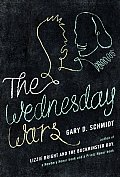
The Wednesday Wars

I first heard about this book by Gary Schmidt back in April, when Fuse so eloquently raved about it. I thought that it sounded good, but since it wasn’t due out for a couple months, I forgot about it. Then Becky chimed in with her praise in July, and reminded me that I really ought to pick it up. It wasn’t until a month or so ago, when I was checking my Amazon wish list against the library catalog and I discovered that they finally had it, that I picked it up. Then it languished on my bedside table for weeks until I realized that the due date was imminent. So, I finally picked it up.

And I immediately kicked myself for waiting so long.

I used description “perfect book” for Elijah of Buxton, but I have to say that it fits here, as well, though not for the same reasons. It’s a perfect book. Funny, poignant, touching, interesting…I couldn’t imagine getting to know Holling Hoodhood (great name!) any other way. It’s 1967, and in the town of Camillo, Long Island, Wednesday afternoons are for religious instruction — either Hebrew School or Catechism. And in Holling’s class everyone is off to one or the other. Except him. And so, on the first day of school, he’s convinced his teacher — Mrs. Baker — hates him. (Well, who wouldn’t, if they had to stay behind for one kid?) As a result, she puts him to work. First, doing chores. Then, when that has somewhat disastrous (and hilarious) results, she turns to Shakespeare. Over the course of the year — and the book — Holling reads several of Shakespeare’s plays, which not only affect his school life, but also his outside-of-school life.

There is no “best part” of this book. I loved it all. I found it laugh-out-loud funny (and my laughs are hard-earned; I don’t usually laugh when reading!); I loved Holling as a narrator, and as a person. The not-so-funny parts (it is 1967, after all, and the Vietnam War does play a prominent part in the book) were genuine and touching. And the end was well-earned and fitting. It’s an all around good book.

I’ll leave you with one of my favorite parts. Holling’s convinced that Mrs. Baker’s hired Doug Swieteck’s brother to kill him during a soccer game. The brother (we never do learn his name, one of the many charms of the book) was coming right at Holling, determined to plow into him, and Holling, at that minute, sidesteps (except for his right foot) and trips up Doug Swieteck’s brother.

Then there came an iron thunk against the goal post, which bent at a sudden angle around Dough Swieteck’s brother’s head.
And everything was quiet.
I opened my eyes again.
Doug Swieteck’s brother was standing and sort of wobbling. Mrs. Sidman was running over — though, properly speaking, what she did wasn’t really running. It was more a panicky shuffle. She probably saw “Negligent Playground Monitor” headlines in her future. When she got to him, Dough Swieteck’s brother was still wobbling, and he looked at her with his eyes kind of crossed. “Are you all right?” Mrs. Sidman asked, and held on to his arm.
He nodded once, then threw up on her.
He had eaten a liverwurst-and-egg sandwich for lunch. No one ever wants to see a liverwurst-and-egg sandwich twice.

Snow Flower and the Secret Fan

Perhaps it is a joke that only girls and women can understand. We are seen as completely useless. Even if our natal families love us, we are a burden to them. We marry into new families, go to our husbands sight unseen, do bed business with them as total strangers, and submit to the demands of our mothers-in-law. If we are lucky, we have sons and secure our positions in our husbands’ homes. If not, we are faced with the scorn of our mothers-in-law, the ridicule of our husbands’ concubines, and the disappointed faces of our daughters. We use a woman’s wiles — of which at seventeen we girls know almost nothing — but beyond this there is little we can do to change our fate. We live at the whim and pleasure of others…

This quote is the crux of Snow Flower and the Secret Fan, by Lisa See. It’s a book by women, about women’s lives, women’s pains, women’s loves, and women’s heartaches. I’ve been thinking about this book ever since I finished it, and yet I’m having a difficult time figuring out what to write. It’s heart-rendering, it’s challenging, it’s painful, it’s hopeful. It’s a lot like life.

The book takes place in rural China, where the culture is not kind to women. Lily is a Second Daughter, a position in life that’s really not good at all. Yet, when it comes time for her feet to be bound (in the few chapters that were the most difficult for me to get through; I almost gave up the book on chapter 5, it was so painful to read), her life takes a different direction. She ends up with perfect, 7 centimeter “golden lilies” for feet, a laotong (an “old same”) and prospects for a better life than what her parents have. It’s the relationship with her laotong, Snow Flower, though, that makes up the plot of the novel. How they go from innocent 7 year olds, with much in common; to young marrieds, with less in common; to middle age women facing the hardships of life.

It’s a book about survival: of women in a male-dominated world; of the nu shu writing — the women’s language; of friendship against all odds. It’s also a story about regret and heartache. It’s not a happy one; I had to go check out a book of humorous essays just to get me through the book. I needed something to balance out the depressing lives Lily and Snow Flower led.

All that said, I’m not sorry I read this book. It’s enlightening — I can’t believe people survived in situations like this, yet they did. Lily and Snow Flower were not only admirable in the fact that they survived, but that they tried to make a better life for themselves. And in the end, that’s the best I could hope for from this book.

Liszt’s Kiss

I’m a pianist, of sorts. I used to be really pretty good — not professional or anything, but good enough. But since I haven’t practiced regularly in years, I can only say I’m probably above average now. Enough to play when asked at church, but that’s about it.

But this book, by Susanne Dunlap, made me want to practice again.

I’m not sure that was her intended outcome…. it’s a historical romance and mystery (of sorts). It’s set in Paris during the cholera epidemic of 1832 (what’s it with me and French books?). Anne, the daughter of marquis de Barbier-Chouant, recently lost her mother to the cholera epidemic. Her mother’s friend, Marie d’Agoult, takes Anne under her wing in spite of Anne’s fathers’ disapproval. From there, she engages noted pianist and composer Franz Liszt to give Anne’s natural talent for the piano some polish. And from there, of course, things develop.

While the story itself was quite intriguing, the real power of this book, for me, was in it’s musical passages. My only regret is that I don’t know music well enough to know what “lively Schubert dances” or “sonata by Beethoven” or even the work by Chopin that Anne plays at her salon debut was. I feel like the book should have come with a CD of all the music played (I’m even deficient enough that I didn’t know which aria from Don Giovanni was being quoted at one point.) That said, though, I completely related with Anne’s relationship to the piano. She played to express herself. When she was heartbroken, she played. When she was angry, she played. When she was upset, she played. When she was happy, she played. In fact, the greatest harm her father ever did was shut her off from playing the piano. It was Anne’s desire for the piano that woke up my own latent pianist. When I finished this book, I dug out my Liszt and Chopin and Beethoven and spent a wonderful 20 minutes playing. (I would have spent longer, but that was as long as I got before K decided that she needed to practice with me, ending all my hopes for a long session.)

The other intriguing thing about this book was that it was told from at least five different points of view — there was Anne, Marie, Pierre (a medical student), Liszt, Armand (Anne’s cousin) and possibly others. Often an event would happen, and then the next section would back up and retell the same event from a different perspective. I have found that this is a hit and miss idea for me; sometimes it works, others it falls flat. This time, it worked. I enjoyed getting to know each of these characters, from the budding Anne, to the passionate Liszt, to the concerned doctor to the hesitant Armand, to the very intriguing and independent Marie. Each character had something interesting to contribute to the story and the story would have been less without each perspective.

I did know enough music history to know that the characters of Liszt (of course) and Marie were based historical figures. But, Dunlap managed not to let the history get in the way of the story. And she chose to make both Liszt and Marie less central to the story, which also allowed the other characters to shine through.

In all, a wonderful way to spend a summer day.

Kite Runner

I’ve never been one to ride the wave of a trend; which is why I’m just now getting around to this book, by Kahled Hosseini, at least two years after it made a splash in the blog world. (I’m still waiting for my turn at Twilight; that’ll be the closest I’ve ever gotten to reading a trendy book.) But I’m in between library piles right now (I need to get to the library today and pick up the eight books that are waiting for me) and needed something to read. A friend had loaned me this one a while back, and so I decided to give it a try.

Going in to this book, the only thing I remembered about it was Julie’s assertion that if you liked Life of Pi (which I did), that you wouldn’t like Kite Runner. And then, there’s the Chinaberry description: “It is at once spellbinding, tender and heart-opening. A remarkable story of love and courage. It is one of those books that make you a better person for having read it.” (Um… gag.) So, perhaps I was biased against it from the start. (Granted, some review of Life of Pi claimed that it would make one believe in God, which is pretty outrageous if you think about it.)

I found it troublesome, depressing and formulaic.

I’m not one for facing all the depressing and disturbing aspects of life (but I’ve been over that before). I do read books that throw all of humanity’s evils in my face, but I’m never a better person for it. I do ask this: is there a book out there about Afghanistan that doesn’t include horrible things?? Perhaps not. It’s been a horrible 25 years for the country, and the fiction will most likely reflect that. It did pull my guilt-strings; perhaps I should be giving money to some sort of organization (like the Central Asia Institute) that is helping make the horrible situation over there somewhat better. (But given the corruption over there, would it help?)

On top of reading horrible things (well, okay, one horrible thing at the beginning, three horrible things at the end), it was just plain formulaic. It was an easy read (I started it Monday night, and I really only read a couple hours a day, if that); nothing terribly long or difficult or demanding to get through. But on top of that, I knew the ending before I got there. I hate that. I knew (sorry — spoliers here, but since I’m the last person to read the book… 🙂 that Hassan would die and that Amir would take Hassan’s son back with him. I new that the Talib that was so brutal would be the same bully that was so brutal in the beginning. I knew that when Amir finally got good news, that something horrible would happen (that’s the way these things work). It’s about atonement and forgiveness, but it’s not really effective at that. I liked Amir, as a character, but not really enough to care what happened.

So in the end, perhaps Julie’s right: I would recommend Life of Pi to anyone. But Kite Runner just isn’t that good.

March

First. It’s been a whopper of a week. We closed on our house on Monday, the 20th, and then spent the rest of the week prepping the house for our move on Saturday. Carpet people, vinyl/laminate people, cleaning (if you EVER sell a house, PLEASE clean it for the next owner. It SUCKS having to clean a house just to make it livable, and it’s still not done!), painting (the room was such a mess, M refused to move in until it was painted), packing, moving, hauling trash, and unpacking. Which gets us to today. Things are mostly unpacked. I’m happy to see our books, which have been in storage for the last four months. It makes me feel like I’m finally settled.

On top of all that, I tried to read Geraldine Brook’s March. I was excited about this one: she takes Mr. March from Little Women, imagines a backstory and fills in for the time that he’s missing in the book, until he gets ill and Marmee comes and gets him. Granted, I only got about 5 chapters in (it was a busy week), but I never could get into the book. It just didn’t feel right. I know, I didn’t exactly love Little Women. Still. I think it’s one of those books that everyone has their opinions about, and reactions to, and to… well, mess with the book is just wrong. Mr. March was too extreme in his views — too vegetairan, too abolitionist, too… too! — to make him the loving, caring, quiet father of the March girls. And Brooks tried to weave in the story line from Little Women, and it just didn’t fit with the wartime scenes, and the flashes of backstory that she gave him.

In the end, I put it down. It didn’t hold my interest, and at the end of some very long days it wasn’t what I wanted to be reading. Maybe someday I’ll try again. But probably not.

Year of Wonders

I was skeptical about this book. While I have enjoyed Geraldine Brooks’ writing in the past, I doubted that a book on the plague could be interesting. (Granted, I’d forgotten that I’d really enjoyed Doomsday Book, which is essentially a book about the plague.) Okay, so I was wrong to doubt. Year of Wonders is, while not an exquisite book, a very engaging one.

It follows Anna — a servant in the rector’s household in a fictional English mountain town (based on a real town, Eyam, in Derbyshire) — for a year, from the fall of 1665 to the fall of 1666, while her town battles the plague. Nothing new here, except that the rector — Mompellion — convinces the town to quarantine itself from the neighboring communities, thereby controlling the spread of the plague. And the book deals with the aftermath of that decision. There’s heartbreak (no mother of an infant should read the chapter where Anna’s baby dies. Much too hard.), there’s greed — both taking advantage of the ignorant and the weak; there’s anger; there’s more heartbreak. But in the end, there’s life and hope. Remarkable.

And Anna is an incredibly sympathetic main character. She’s strong, but she doubts. She does good by others, but not all the time. And she has desires, the biggest one being the will to live. Okay, I admit that she was probably more modern than the time period warrants, but for some reason this didn’t bother me. The ending — which was a bit abrupt — did bother me either. Perhaps because I’m lowering my historical fiction standards? Or maybe it was because the storytelling was so vivid that I didn’t let the little things nag at me like they sometimes do.

At any rate, it’s worth the read.