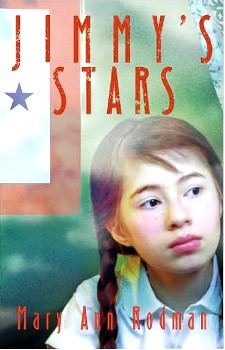
Jimmy’s Stars

True: There are a LOT of books about World War II out there.

True: There is also a lot of books about kids dealing with war and the effects it has on daily life.

True: Jimmy’s Stars is one of those books.

However, even though it’s a WWII book about a child, Ellie (age 11), dealing with how the war touches everyday American life, it doesn’t come off as trite, or overdone, or sentimental. True: it’s a very touching portrait of a girl trying to come to grips with her brother, Jimmy, entering the war. It’s simultaneously a very simple book and a very complex one.

The thing that carries this book from the beginning, is Ellie. She’s so real, so believable, so heart-breakingly hopeful that she literally leaps off the page and into your heart. You want her life to be okay, everything to go on as normal, and yet nothing can because of the war. It touches her life in so many ways — from the big: Jimmy going away, her Aunt Toots coming to live with them, her mother and sister going to work; to the little: to the dreaded summer canning, a girl’s bragging about her brothers being heros.

Interestingly enough it’s both an anti-war book (war does things to people that aren’t very good; is war really worth it), as well as one that subtly chastizes those who don’t appreciate what the soldiers — especially the ones who were just the line soldiers — have done (and do) for the safety of the country (and the world). It’s not often you see those two sentiments paired in a book, but it works well here. And it made me think not only about those who served in World War II, but those that are currently serving. And the sacrifices their families make so I can type here on my computer in relative saftey and freedom, telling you to go read this book.

You won’t regret it.

(Just for the record: because this is a Cybils nominee, I’ve been asked to make sure y’all know this is my opinion only, and not that of the panel. Thank you.)

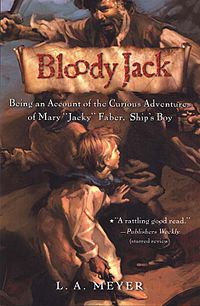
Bloody Jack

Leila mentioned this book on her blog a while ago, and I stuck it on my list. But, honestly, I completely forgot about it. Then, I was wandering the aisles, looking for books for M, and it jumped out at me. (It was only later that I realized it was one that Leila had recommended…) She loved it, and passed it my way with a “You HAVE to read this!” So, taking a break from middle grade books, I did.

Jacky Faber was orphaned at an early age and grew up with the rest of the orphan scrabble on the streets of 18th-century London. One day, however, when Jacky’s gang leader, Charlie, was brutally murdered, Jacky decides to make a career change. Hiking down the Thames to the sea, Jacky enlists in His Royal Majesty’s Navy, becoming a ship’s boy. The hitch (and you probably figured this one out): Jacky is a girl. She not only has to deal with not being detected, but she — in an incredibly hilarious twist — ends up going through puberty while on the ship, which only complicates things. She does make a bit of a name for herself, battling against pirates, and ends up stranded on an island (but doesn’t get there the usual way), and falls in love. In short, she’s quite busy.

As far as seafaring/piratey/girls-masquerading-as-boys books go, this one’s a winner. A rip-roaring adventure book, it’s not for the faint of heart (boasting battles, fights, an almost-rape-scene, among other things). But it is: humorous, witty, exciting, thrilling… and has something for just about everyone. And, M’s right: you HAVE to read this. (Well, you don’t have to, but you won’t be sorry if you did.)

Nobody’s Princess

It’s not a common problem of mine, but there have been instances in the past where I’ve enjoyed the afteword to the book much more than the book itself. This one, as much as I wanted to really like it, was along those lines. It was kind of just blah until I got to the afterword, which was full of information, humor, and held my interest in a way that the novel didn’t.

The idea behind this book was to explore how Helen of Sparta became to be Helen of Troy. We don’t get that far in this book (there is a sequel, Nobody’s Prize), though. Helen is the oldest daughter of the King of Sparta, thereby making her the heir. But she’s also a free spirit, only wanting to do what she would like with her life, hang the expectations that society (even a women’s lib-ish one like Sparta) puts on her. She finds a way to learn to fight. She talks her parents into letting her go with her brothers and twin sister when said sister is sent to Mykenae to get married. She tricks said Mykenaen king out of arranging a marriage for her. She accompanies her brothers along to hunt a wild boar at her mother’s childhood land of Calydon, where she befriends huntress Atalanta and learns to ride a horse. She tags along with her brothers when they go to Delphi and finds a way not only to befriend the oracle, but finds a way for her and her friend/freed slave Milo to go on the same adventure.

I liked Helen well enough; I liked her spunk and determination. I liked how she was willing to do anything to become more “educated” and how she wasn’t willing to let society’s expectations stop her. But that wasn’t enough for me. I wanted some grand conflict and resolution, something to thrill me and keep me gripped to the edge of my seat (granted, having just finished Dracula had something to do with this feeling) and all I got was a series of vingnettes where Helen learned something or did something. I never really became involved in the plot, partially because by the time it got interesting, Helen up and moved on, and we had to start all over again building relationships, creating conflict. I wanted some overarching story, something to tie it all together and to the story of Helen I know.

I do have some hope, though, that this could all be a grand set up and the pay off very well could be in the next novel. At the very least, though, the afterword is fascinating. As for the rest… I’m crossing my fingers that the sequel is better.

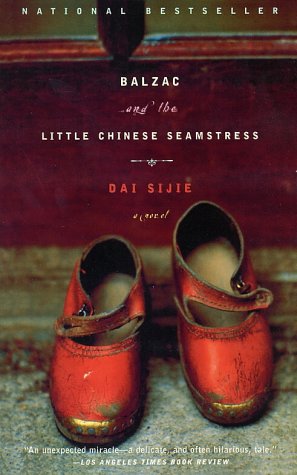
Balzac and the Little Chinese Seamstress

I won’t profess to be an expert on Chinese Revolution/Mao literature, but I have read a few books based on/about that time in Chinese history. And the one thing that really struck me was how tame it was compared to the other books. The only reference to the time was that the main character and his friend, Luo, were in the mountains because they were being re-educated. Sure, the revolution is there in the background, but it’s not a forceful presence. In the end, then, this novel is a gentler, kinder look at the harshness of the re-education program. I’m not sure if it’s a good thing, but it was interesting.

The basic plot of the story is when our narrator (whose name you never find out) and Luo discover that their friend, Four Eyes (don’t you love Chinese names?), has a leather suitcase full of Chinese translations of forbidden Western novels. The friends decide that they want to read them, do all sorts of interesting (and possibly stupid) things in order to get Four Eyes to give them a book. They start with a novel by Balzac, which they love. Luo takes it to the next village to read to their friend, Little Seamstress, and that ends up in an affair between the two (well… not really an affair, since neither was married, but you get the point). This book leads to a desire for more, and so they steal the suitcase from Four Eyes. They devour the books, manage not to get caught, but because of them, their lives — and especially the life of Little Seamstress — is changed forever.

Aside from the gentle tone of the book, and the general promotion of freedom of stories (or storytelling; that should be a basic right: to be able to tell all kinds of stories without censorship… though I guess that’s covered in freedom of the press!), the book wasn’t one that I could sink my teeth in to. It was a quick read, and I didn’t dislike it… I just didn’t find myself caring much one way or the other for most of the book. I did care at one point, near the end, but then the ending came so abruptly, I was kind of thrown. I’m still trying to figure it out. Thankfully, though, it was a read for my online book group, so there’s lots of opportunity for discussion. Becuase I think that’s one thing that can be said for this book: it’s a good one to discuss.

Suite Francaise

I’ve spent the past week in France, enjoying the lyrical and evocative writing of Irene Nemirovsky. Amira highly recommended it a (long) while back, and so I was excited that my in person book group (which sometimes does pick really good books!) chose it this month.

It took me a bit to get into the book, but once I realized that there was no real plot, no real character development, but that it was a portrait of a time and a place and how individuals dealt with the time and place, I lost myself in it. And it was easy to do. The first part, Storm in June, dealt with the exodus of Paris in the wake of the German invasion. Nemirovsky followed a dozen or so people in the exodus, how they reacted to the crisis, how they managed to deal with an extreme situation. Some managed admirably, some horribly; some were noble and respectable, some were petulant and miserly. It was fascinating watching it all unfold, interesting to see how each individual person reacted to each individual situation.

The second part, Dolce, was my favorite of the two. It was the portrait of a country village after the German occupation and how the villagers responded to their German occupiers. My heart went out to Lucile, living with a horrible mother-in-law, and falling in love with the German who was living in her house. There was less going on in the second part, but I really thought Nemirovsky perfectly captured the emotions of a human being trapped between two realities.

And, then there’s the note at the end, about Nemirovsky’s history and how this book came to be. It shed a lot of light on how she treated some of her characters, especially wealthy and upper-middle-class women, and it made the whole book much more tragic.

And, because these popped out at me, I’ll include some of my favorite quotes…

From early on in Storm in June:

“I keep telling you, you don’t pay enough attention to the minor characters. A novel should be like a street full of strangers, where no more than two or three people are known to us in depth.”

And from Dolce:

She said “we” out of that sense of propriety which makes us pretend we share other people’s misfortunes when we’re with them (although egotism invairoable distorts our best inetntions so that in all inocencewe say to someone dying of tuberculosis, “I do feel for you, I do understand, I’ve had a cold I can’t shake off for three weeks now”).

Let them go where they want; as for me, I’ll do as I please. I want to be free. I’m not asking for superficial freedom, the freedom to travel, to leave this house (even thought aht would be unimaginably blissful). I’d rather feel free inside — to choose my own path, never to waver, not to follow the swarm. I hate this community spirit they go on and on about. The Germans, the French, teh Gaullists, they all agree on one thing: you have to love, think, live with other people, as part of a state, a country, a political party. Oh, my God! I don’t want to! I’m just a poor useless woman; I don’t know anything but I want to be free!

The Redheaded Princess

I suppose, after being Tudored out, it would seem a bit odd that I would even bother to pick up a book about Elizabeth I. But, there were two reasons I did. One, it’s by Ann Rinaldi, whom I really like. And two, I actually like Elizabeth’s story. It’s her dad that drives me nuts.

Anyway, as far as Elizabeth books go, I think that this one’s okay. It pretty much skims across Elizabeth’s life from the time Henry VIII dies to the time she becomes queen. But, other than that, it’s lacking. I think Rinaldi tried to do too much, cover too much time. Only 208 pages for 16 years just doesn’t really work. I missed details, descriptions, conversations that could have been written about. Granted, then it would have probably become an adult novel. But, maybe even Elizabeth’s teenage years deserved that. She was never really a “teenager” after all.

Then there was Elizabeth herself. She was always saying how she thought of herself as a queen, carried herself as a queen, but I never got much of a sense of whom Elizabeth really was, or what she really wanted. She spent her time reacting to events rather than acting on her own. Perhaps that’s the way it was, but it doesn’t make for terribly engrossing reading. And her relationships with other people — even the ones she was supposed to be close to like Cat Ashley and Roger Ascham and Robin Dudley — lacked intimacy and connection. If I hadn’t been told over and over again that Elizabeth was in love with Robin, I never would have figured that out. Not a sign of a really good work of fiction.

As an introduction to Elizabeth’s life, this works just fine. But, I’ll wager, that it’ll leave readers longing to know more, and search out other books about Elizabeth. Maybe that’s what Rinaldi had in mind all along.

The Other Boleyn Girl

I tried, a few years back (almost exactly), to read this one by Philippa Gregory, to no avail; I had read a couple other fiction books on Anne Boleyn and the Tudors (albeit YA fiction), and I was Tudored out. I went on and enjoyed two others by her, but this one was always lurking in the background; I figured I’d get around to it someday. The release of the movie prompted me to pick it up again. But, 230 pages into it, I realized something: I really don’t like these characters. In fact, I loathe them. I don’t mind naked ambition so much, but combine naked ambition with wantonly using people and loose morals, and you’ve got a bunch of people I’d rather not be reading about.

So, I bailed. Sometime after Mary Boleyn was pushed aside as King Henry VIII’s lover and Anne was squirming her way in, I decided that I’ve had enough of the Boleyn and Howard family. I mean, really: it’s one thing to be an object of the king’s desire, and to have him literally lust after you in front of his wife, the Queen. It’s entirely another to be practically pushed on him by your family (father and uncle specifically) and told to go have sex with Henry because it’s good for the family, while your poor husband (which your family arranged for you to marry in the first place) is shunted to the sidelines. Ugh. And so, since I know how the book ends anyway (everyone knows how the book ends; that’ s not the point), why bother spending time with such disagreeable people?

It’s not Philippa Gregory; as I said, I enjoyed both The Queen’s Fool and The Virgin’s Lover (though I remember liking the former better). Rather, it’s the Tudors, Howards and Boleyns. They were just despicable people (well, in historical fiction, anyway, they’re made out to be despicable people). And I think I’d rather not read about them. (Though I do have to admit, I’m intrigued enough by the time period that I’m rather curious about HBO’s The Tudors. I don’t know if I’ll ever get around to getting the DVDs, though… maybe after I forget how annoying and amoral these people were…)

This does mean, however, that I’m not going to count this one for the Once Upon a Time Challenge. I think I’ll substitute American Gods by Neil Gaiman, instead. I’ve been meaning to read another Gaiman. It’s got to be better than the Tudors, anyway.

A Drowned Maiden’s Hair

I’ve heard nothing but good about this one, by Laura Amy Schlitz. I liked the Newbery winner she wrote, and so I figured with those two recommendations, I couldn’t go wrong with this one.

Thankfully, I was right. I loved this little story. Schlitz deftly weaves a bit of mystery, some beautiful scenery and a lot of longing into a not-so-traditional orphan story. Wonderful.

Maud, an 11-years-old orphan, is singing in the outhouse of Barbary Asylum on the best day of her life: the day that Hyacinth Hawthorne decides that it’s Maud she wants to adopt. She has always longed for a home, or at least ever since she was 5 and someone adopted her older brother and younger sister and not her. She goes home with Hyacinth, meets her two sisters Judith and Victoria, and then discovers that she’s to play a part in the “family business”. She makes the best of it, vying for Hyacinth’s attention and affection, and eventually finds happiness in the bargain.

That’s a terrible plot summary, but I don’t know how to do the book justice while not giving too much away. I loved Maud as a character: feisty and spunky yet with so much longing to be loved it made my heart break. I thought it was an interesting look at family and death and separation and surviving… and so much. I liked the relationship that Maud had with Muffet (the deaf house maid in the Hawthorne home); how Maud came to understand Muffet and how their relationship developed. I really liked the ending, even though I saw it coming. I thought it was just perfect, and very satisfying.

M’s only quibble with the book was the subtitle: A Melodrama. She finished the book and said that it didn’t really read like a melodrama (or at least how Hubby defined a melodrama to her). (My only quibble is that Schlitz seems to like colons in her titles. They all have one.) According to trusty old Webster, a melodrama can mean both “a work characterized by extravagant theatricallity and by the predominance of plot and physical action over characterization” (doesn’t quite fit) or something “appealing to the emotions” (fits better). Maybe M’s right: it’s not quite a melodrama (though I think it was melodramatic at some parts). But it is a really wonderful book.

The Book Thief

Things I can say about Markus Zusak’s best-seller: I admire it. I thought it was brilliantly written. I thought Death as a narrator was an intriguing premise. I thought it was interesting that the story was set in Nazi Germany, but was about ordinary Germans just surviving. And yes, I cried at the end.

Things I can’t say about The Book Thief: that I like it. (Oh, and that I can spell thief the first time, without a spell-checker. Just can’t do it.)

This bothered me. I read the book — all 550 pages — and two-thirds of the way through I was still unsure what I thought of it. I didn’t hate it; I had no desire to stop reading. I did want to “find out” — though I already knew — what happened to Liesel and Rudy and Max and Hans. I don’t consider it time wasted, or time lost. So I didn’t hate it, or even really dislike it. About 100 or so pages before the end I finally decided that this book would have to be a toss: I was going to admire a book, to recognize it’s literary worth, and yet not like it.

I think my fundamental problem with this story is that it’s not really a cuddly or accessible one. Not that stories set in Nazi Germany can ever be cuddly. And a story about a pre-adolescent girl during this time isn’t necessarily accessible or enjoyable. It is an interesting, and possibly important story — but like “Schindler’s List” or “The Pianist” or Elie Wiesel’s books — it’s not one you want to cuddle up with, to read and reread. The final moral is something along the lines of: words can do good as well as harm, some people are good even in a bad situation, and some people survive. That’s life. In the end, I feel like this is an English class book; one to be respected and studied and analyzed and possibly imitated.

Just not really liked, at least by me. I’m okay with that.

The Painted Drum

This is me exercising my right to give up on a book that I just am not enjoying.

This is me giving up on trying to enjoy Louise Erdrich’s books (this is the second one I’ve disliked).

This is me not writing what I really think about this book (though Hubby dared me to).

I had fairly high hopes for this one. I know I didn’t like Birchbark House, but I figured maybe it was that because Erdrich is usually an adult-fiction writer, that she just didn’t quite know how to write well for kids. It’s not that she doesn’t write well — some of her passages were quite beautiful. It’s just that there was nothing else. And after a while I lost interest in the whole first section — the story of Faye and how she came to have the drum. So, I skimmed to the second section, the story of how the drum came to be, hoping that it would be better. It was, but only marginally. And not enough for me to even care about the last two sections of the book. I wasn’t moved, I wasn’t touched, I wasn’t captivated.

So, I abandoned it. I’ve got better things to do with my time.