The Boy Who Dared


by Susan Campbell Bartoletti
ages 12+

I’m not sure how many people know the story of Helmuth Hübener. He was a boy during the rise of Hitler to power, and a teenager during the war. He was a member of my church, The Church of Jesus Christ of Latter-day Saints (the Mormons). He was increasingly disturbed by Hitler and the Nazis and the war, and decided to do something about it: distribute leaflets and paphlets, being helped by two of his friends, with information gained from the BBC. For which he was arrested. And executed.

He was 17.

I was familiar with Hübener’s story before reading this book; soon after I left to college, my two brothers were in a production of a play about Hübener’s efforts and outcome. I never saw the production, but I had one brother playing an SS officer and the other was one of Hübener’s friends (Karl Schnibbe). Needless to say, it was a pretty emotional event for everyone (including my mother, who sat in the audience and watched one son torture the other!), something so monumental that it made it into letters to me.

Needless to say, I was pretty interested in this book, not only because of the church connection but because of the play. Especially since I only knew the barest outline of Hübener’s life and what he had done, or tried to do. And on top of all that, there’s issues of church and state, and patriotism and doing one’s best. Not to mention is freedom of speech more important than obeying the law. It’s a complex story.

Bartoletti handled the whole thing marvelously. Told in flashback from Hübener’s reminsinces on his last day of life, she basically covers 10 years of his life… from Hitler’s initial rise to power in 1932 through to Hübener’s death in 1942. She treated Hübener’s beliefs and our church well, and accurately, and never made anyone out to be more than human. Hitler was evil, of course, but Bartoletti balanced the evil of Hitler’s deeds with the desire of the German people to save face, and their belief that Hitler’s promises would make everything better. She also addressed the complexities of obeying the law versus doing what one believes to be right, and Hübener’s efforts to fight the propeganda of the Nazis.

The only thing that I didn’t like — and it’s a minor quibble — is that because this is a book for younger readers, Bartoletti glanced over a lot of the harshness and violence. I felt like the trial and torture and prisonment of Hübener was glanced over, and almost downplayed. I think I would have liked a bit more, but that would have made this book more young adult than I think Barotoletti was going for. (Though my library has it shelved in the YA section.)

As I said, though, that’s a minor quibble. The afterword is fascinating, and the book is gripping. And I think this is one World War II story that deserves to be wider known.

(Just for the record: because this is a Cybils nominee, I’ve been asked to make sure y’all know this is my opinion only, and not that of the panel.)

A Thousand Never Evers

by Shana Burg
ages 12+

Over the years, when I have told people that the year we lived in Mississippi was hell for me, they always ask me what made it so hard. I have struggled to try and find the perfect answer… it’s a combination of moving from a huge city to a smallish rural town combined with the blatant racism of our neighbors that we encountered that made it the worst place on earth for me to live.

Now, when people ask, I’m just going to refer them to this book. Burg — no stranger to the situation, being both Jewish and the daughter of a Civil Rights lawyer — captured, for me at least, the hate that some white people down south had (and have) for African Americans so perfectly that it was both uncanny and disturbing.

It’s the summer of 1963, and Addie Ann just wants to figure out how to survive seventh grade. Then her boss, Old Man Adams, dies, and leaves his six acre garden to all of Kuckachoo — both whites and blacks. Of course, that doesn’t sit well with the mayor or the sheriff, so they conveniently forget to inform the white side of town that Mr. Adams wanted it that way. So, later in the fall, when the garden is discovered to be destroyed, the person that the town decides is at fault is Addie’s Uncle Bump. Being Mississippi, no one expects the trial to come out right, and it’s up to Addie to find the missing pieces in order to set Uncle Bump free.

Actually, this book isn’t that easy to sum up in one paragraph: there’s an awful lot going on. A lot of it centers on the basic conflict between white and black: in employment, in housing, in voter registration, in the administration of justice. Everything negative you’ve ever heard of makes an appearance: the Klu Klux Klan, cross burnings, home bombings. But, I think Addie’s narration has a softening influence — she’s an engaging main character, one who’s vulnerable and tough at the same time. Her voice makes this book worth getting through; without her, it would be too depressing.

It was a very tough book for me to get through at points. But, I think it’s the toughness that comes from a well-written, and honest, book.

(Just for the record: because this is a Cybils nominee, I’ve been asked to make sure y’all know this is my opinion only, and not that of the panel.)
Little Audrey

by Ruth White
ages 9-12 (though my library has it shelved in the Teen section…)

There are some books that just floor you when you read them. Either they’re so fabulous that they draw you into their world. Or because the so horrible that you wonder how on earth people existed like that. Little Audrey is the latter. When I read The Glass Castle this summer, I was moved by Jeannette Walls’s courage in dealing with her less-than-ideal living situation. I had much the same reaction to White’s book: it’s deeply saddening that anyone would have to live like they did, and it’s remarkable that they survived and thrived as much as they did.

Little Audrey is the story of a part of White’s childhood. Told (and somewhat fictionalized) though the eyes of White’s oldest sister, Audrey, this is the story of the White family in a mining “holler” in southwest Virginia in 1948. It’s not a pretty life: their father is a drunk, taking the scrips (they don’t get money) and spending most of it on alcohol. They’re barely making it from week to week. Audrey’s recovering from the scarlet fever, and is supposed to be gaining weight, but it’s hard when there’s not enough food to go around. Yet, through it all, and through the tragedy that happens in their life, they find hope. Audrey learns about the inner strength of her mother. She also finds kindness in those around her, from her neighbors to her schoolteacher to her friend, Virgil. It’s an inspiring and hopeful book, something which you don’t expect from the subject matter.

This is a book for younger readers, after all, and White only glances on the wreck that was her father. It’s probably a good thing — Audrey was young enough not to really notice or understand what was going on, but at the same time, she’s an incredibly perceptive girl. She knows her mother is trying to make do even though her father is trying to drink them all into oblivion. She knows her father beats her mother. She knows when to stay out of his way. And she knows that she will make do in spite of it all.

It’s a good book, one that surprised me how much I was drawn in and moved by it. And the fact that it’s a true story made it all the more powerful.

(Just for the record: because this is a Cybils nominee, I’ve been asked to make sure y’all know this is my opinion only, and not that of the panel.)

Little Leap Forward

by Guo Yue
ages 7/8-12

Little Leap Forward is a boy in Bejing, China in 1966. It is the height of Chairman Mao’s reign, but it hasn’t really touched Leap Forward’s life much. He still plays by the river with his best friend, Little-Little, and he still enjoys his silkworms and the music he hears around him. One day, the boys capture a little yellow bird, which Leap Forward calls Little Cloud. He takes the bird home, intending on taming it and enjoying it’s music. The bird, once caged, won’t sing. Then the Red Guards arrive and Leap Forward’s life — and perspective — change.

This is a small autobiographical novel that while not detailed, I think caputures something different about the Cultural Revolution and China during that time. Leap Forward isn’t running from anything, he isn’t being oppressed; he’s mostly just trying to be a kid. Yet, because of the bird and a bamboo flute and a desire, his life was changed. There is a simple humanity and kindness to the book that I don’t remember finding in the other books I’ve read about this time.

Additonally, I loved the paintings, done by Clare Follows, Gue’s wife; they’re simple, yet beautiful. Something that I could spend time absorbing. But I have to admit, what I enjoyed most was the author’s note at the end where Gue tells part of his story. It’s touching and sad and sweet and just perfect. He as also released a CD called Music, Food and Love, which I’d love to find and listen to. He sounds like a remarkable man, one with a fascinating story to tell.

(Just for the record: because this is a Cybils nominee, I’ve been asked to make sure y’all know this is my opinion only, and not that of the panel.)

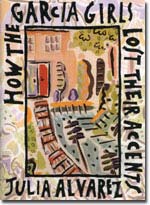
How the Garcia Girls Lost Their Accents

by Julia Alvarez
age: adult

Look, a non-Cybil’s book! (And an adult one at that!) I’ve been reading this at nights (by eliminating my TV watching — only one hour of the John Adams miniseries and a 1/2 hour 30 Rock this week…) for my on-line book group. It wasn’t earth shattering, but I did like parts of it.

The four Garcia girls are the daughters and granddaughters of a fairly powerful clan in the Dominican Republic. However, their father, Carlos, was involved in a plot to overthrow the dictator Trujillo, they have to flee to the United States. There, they try to adjust: Papi finding new patients, Mami taking the lead because she went to school in America for a few years. The girls — Carla, Sandi, Yolanda and Sofia — each make their own way, for better or for worse.

The real “gimmick” of this book is that it’s told backwards. You find out how the girls fared, before you find out how they got to where they ended up. It worked for me, at times, but I think, ultimately, it was more confusing than intriguing. I kept having to flip back to figure out which girl ended up which way (the copy I read had notes in the margins just for that purpose; initially, I was annoyed, but by the end, I was grateful). I think I would have rather a story told with flashbacks to their Dominican childhood.

There was much good about the book, though, especially when it addressed the immigrant experience. Alvarez captured both the initial intrigue of the unknown (near the end of the book, the children would long for the new and unexpected and fascinating things brought back for them from the States) to the challenging and finally accepting of their new culture. I enjoyed some of the individual stories, too, from the descriptions of the compound in the Dominican Republic, to the experiences of each of the girls.

In the end, though the thing that struck me most was that Alvarez writes with honesty and with love for the characters and both their countries. The book made me think about all the immigrant experiences, and the challenges they face when they arrive in a new country. Which is something worth thinking about.

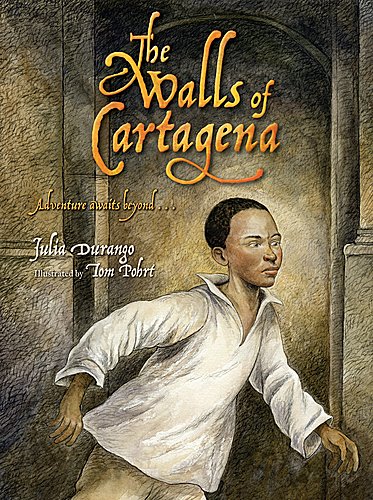
The Walls of Cartagena

by Julia Durango
ages 10+

Calepino has an easy life, especially for one born as a slave. Taken in by Dona Isabel after his mother died when he was born, Calepino has learned to speak eleven languages, can read in several, and spends most of his days lazing around the Dona’s house. That is, until he turns 13. Then Father Pedro, the local Jesuit priest, decides that Calepino needs to earn his keep. So, he is drafted to help translate for the captured Africans who have arrived to be sold into slavery. It’s there that he meets Mara and Tomi, who, along with Dr. Lopez and the San Lazuro leper colony, will change the course of Calepino’s life.

I liked this book — it’s a good, solid piece of historical fiction. Many of the characters, including Father Pedro who was canonized by the Catholic Church in the 1800s (according to the author’s note), were either real, or based on real people. Durango touched upon the evils of slavery, the horror of leprosy, and the Spanish Inquisition and did so in a manner that was serious, but humane and delicate. You understood the importance and horror of the events, but without going into detail that a child couldn’t handle. It’s a good introduction to the topics and the time period, one in which I could see spurring many discussions. In addition, I really liked Calepino as a narrator. He was a likable person, and an eventually diligent and willing one, which made the circumstances that he found himself in (and the ones he propelled) all the more compelling.

Good reading.

(Just for the record: because this is a Cybils nominee, I’ve been asked to make sure y’all know this is my opinion only, and not that of the panel.)

Tennyson

Tennyson lives in the backwoods of Mississippi and is perfectly happy. That is, until her mother, Sadie disappears. Her father, Emery Fontaine, decides to go looking for her and leaves Tennyson and her sister, Hattie, with their Aunt Henrietta, who runs the Fontaine family house, Aigredoux. Once there, Tennyson is faced with an aunt who can’t live in the present, a house that’s falling apart, the fact that her mother may never come back, and most interesting (and haunting) of all, the dreams of her family’s past that she keeps having.

This book is a hard one to pin down. I liked it; there’s a lot going for it in terms of mood and Tennyson is a good, strong main character. I liked the portrait of the deep South, both in the 1930s and the glimpses into the height of the Civil War. It’s full of tragedy and mood and discovery and dreams. I think out of all of it, I liked the dreams the best — Blume captured the essense of the High South, the grand ladies, the southern mannerisms, the Gone-With-The-Wind fierceness in the face of destruction and betrayal. I found the dream sequences fascinating.

Real life was less so. I was pained by Sadie; I cringed even though Blume just skirted the top of the iceberg when it came to Sadie’s mothering. I felt so terrible for the girls, and for Emery who was just trying to keep it all together. There were so many deeper issues in the book; I’m not sure how many would come across to a child reading this, or if it’s just my life and wide reading that makes the neglect and jealousy and betrayal pop out at me.

For that reason, though, the ending worked for me. I could see what Blume was doing with it. Yes, it ended abruptly, but I think this part of Tennyson’s life was finished, and she was moving on. Therefore, the book needed to end, even if the story wasn’t ended. I could see, though, how it can be unsettling, leaving all the ends dangling, the story unfinished.

It’s at the very least a good mood book, and a good Southern book. And a very good one for a cool fall day.

(Just for the record: because this is a Cybils nominee, I’ve been asked to make sure y’all know this is my opinion only, and not that of the panel. Thank you.)

Jimmy’s Stars

True: There are a LOT of books about World War II out there.

True: There is also a lot of books about kids dealing with war and the effects it has on daily life.

True: Jimmy’s Stars is one of those books.

However, even though it’s a WWII book about a child, Ellie (age 11), dealing with how the war touches everyday American life, it doesn’t come off as trite, or overdone, or sentimental. True: it’s a very touching portrait of a girl trying to come to grips with her brother, Jimmy, entering the war. It’s simultaneously a very simple book and a very complex one.

The thing that carries this book from the beginning, is Ellie. She’s so real, so believable, so heart-breakingly hopeful that she literally leaps off the page and into your heart. You want her life to be okay, everything to go on as normal, and yet nothing can because of the war. It touches her life in so many ways — from the big: Jimmy going away, her Aunt Toots coming to live with them, her mother and sister going to work; to the little: to the dreaded summer canning, a girl’s bragging about her brothers being heros.

Interestingly enough it’s both an anti-war book (war does things to people that aren’t very good; is war really worth it), as well as one that subtly chastizes those who don’t appreciate what the soldiers — especially the ones who were just the line soldiers — have done (and do) for the safety of the country (and the world). It’s not often you see those two sentiments paired in a book, but it works well here. And it made me think not only about those who served in World War II, but those that are currently serving. And the sacrifices their families make so I can type here on my computer in relative saftey and freedom, telling you to go read this book.

You won’t regret it.

(Just for the record: because this is a Cybils nominee, I’ve been asked to make sure y’all know this is my opinion only, and not that of the panel. Thank you.)

Bloody Jack

Leila mentioned this book on her blog a while ago, and I stuck it on my list. But, honestly, I completely forgot about it. Then, I was wandering the aisles, looking for books for M, and it jumped out at me. (It was only later that I realized it was one that Leila had recommended…) She loved it, and passed it my way with a “You HAVE to read this!” So, taking a break from middle grade books, I did.

Jacky Faber was orphaned at an early age and grew up with the rest of the orphan scrabble on the streets of 18th-century London. One day, however, when Jacky’s gang leader, Charlie, was brutally murdered, Jacky decides to make a career change. Hiking down the Thames to the sea, Jacky enlists in His Royal Majesty’s Navy, becoming a ship’s boy. The hitch (and you probably figured this one out): Jacky is a girl. She not only has to deal with not being detected, but she — in an incredibly hilarious twist — ends up going through puberty while on the ship, which only complicates things. She does make a bit of a name for herself, battling against pirates, and ends up stranded on an island (but doesn’t get there the usual way), and falls in love. In short, she’s quite busy.

As far as seafaring/piratey/girls-masquerading-as-boys books go, this one’s a winner. A rip-roaring adventure book, it’s not for the faint of heart (boasting battles, fights, an almost-rape-scene, among other things). But it is: humorous, witty, exciting, thrilling… and has something for just about everyone. And, M’s right: you HAVE to read this. (Well, you don’t have to, but you won’t be sorry if you did.)

Nobody’s Princess

It’s not a common problem of mine, but there have been instances in the past where I’ve enjoyed the afteword to the book much more than the book itself. This one, as much as I wanted to really like it, was along those lines. It was kind of just blah until I got to the afterword, which was full of information, humor, and held my interest in a way that the novel didn’t.

The idea behind this book was to explore how Helen of Sparta became to be Helen of Troy. We don’t get that far in this book (there is a sequel, Nobody’s Prize), though. Helen is the oldest daughter of the King of Sparta, thereby making her the heir. But she’s also a free spirit, only wanting to do what she would like with her life, hang the expectations that society (even a women’s lib-ish one like Sparta) puts on her. She finds a way to learn to fight. She talks her parents into letting her go with her brothers and twin sister when said sister is sent to Mykenae to get married. She tricks said Mykenaen king out of arranging a marriage for her. She accompanies her brothers along to hunt a wild boar at her mother’s childhood land of Calydon, where she befriends huntress Atalanta and learns to ride a horse. She tags along with her brothers when they go to Delphi and finds a way not only to befriend the oracle, but finds a way for her and her friend/freed slave Milo to go on the same adventure.

I liked Helen well enough; I liked her spunk and determination. I liked how she was willing to do anything to become more “educated” and how she wasn’t willing to let society’s expectations stop her. But that wasn’t enough for me. I wanted some grand conflict and resolution, something to thrill me and keep me gripped to the edge of my seat (granted, having just finished Dracula had something to do with this feeling) and all I got was a series of vingnettes where Helen learned something or did something. I never really became involved in the plot, partially because by the time it got interesting, Helen up and moved on, and we had to start all over again building relationships, creating conflict. I wanted some overarching story, something to tie it all together and to the story of Helen I know.

I do have some hope, though, that this could all be a grand set up and the pay off very well could be in the next novel. At the very least, though, the afterword is fascinating. As for the rest… I’m crossing my fingers that the sequel is better.