Sweetness in the Belly

by Camilla Gibb
ages: Adult
First sentence: “The sun makes its orange way east from Arabia, over a Red Sea, across the volcanic fields and desert and over the black hills to the qat- and coffee-shrubbed land of the fertile valley that surrounds our walled city.”

This was a buddy read with Kailana — and if it seems a little weird, it’s because she has the first half of the conversation up on her blog. Go visit it, then come back for the second half…

Melissa: That’s funny. I don’t know of many white Muslims, but I do have friends (who are white) who are very interested in Islam, so I knew a bit about the religion going into the book. I do like the portrait that Gibb painted of the religion: how there are some extremes (like the female circumcision, which was very difficult for me to read!) but most Muslims are just trying to find their path back to God. I liked how she looked upon Christians as “misguided”. That made me chuckle.

Kelly: Yeah, I have always had trouble with female circumcisions. It is so horrifying to hear described, and I know I never want to experience it first-hand! In other cultures the male circumcisions can be pretty graphic, too. Then it is less about religion and more about making the men feel less manly, but still, I will never understand the practice!

Melissa: Me, either! I got into an argument with my husband over it: I compared it to foot-binding in China (he disagreed that there were similarities), and wondered why women put their girls through such things for the sake of a “good marriage”. I’ve never encountered this in a book before (pretty sheltered reading, I guess): it was horrifying. One of the other things I liked about the religion is how much of it was cultural; how much of her religion when she got to Britain was almost more Ethiopian than what we’d consider (as an outsider) to be “Muslim”.

Kelly: It is actually China that is one of the places that would cut off men’s manly parts to make them better servants… And, women put themselves through that because it has become a norm that it is what is desired. So, it really is the men’s choice as much as the women’s. Women are worthless in many cultures if they don’t marry, and men won’t marry them if they don’t abide by cultural norms for what a woman is supposed to be!

Melissa: Very true. And very unfair! So… one of the things I noticed about the book was the language. Usually, it stands out to me and grates on me when a writer is so very effusive? technical? with language — like they’re trying to be flowery and trying to show that they have a mastery of it — but this felt very natural, very poetic. I loved it. What did you think?

Kelly: Oh, so happy you brought this up because I never would have thought to. I totally agree, though. Flowery writing is something I have never been a big fan of, but Gibb did it so well that I didn’t even pay attention. Normally I would also find writing like that slows the book down, but once I got into the book I found it was over with really fast. For the style it was actually a pretty fast read. I was impressed. I learned a lot, too, which was great. She says in the note in the back that it is mixed with fiction, so obviously not a true story, but I think she captures well what a character in Lilly’s position would be thinking. Would you agree?

Melissa: I totally agree. I have had problems with current “classics” in the past because the way the writer’s written the book is distracting from the story and the characters. I like the way you put it: that Gibb captures well the character of Lilly. I also felt like she gave a real sense of what it was like to be living in Ethiopia; the feel, the rhythm, the smell. It almost felt like I was there.

Kelly: I know! I really felt like I got a sense for everything, which is always a good thing in a fiction novel. Was there anything that you didn’t like about the book?

Melissa: Aside from the circumcisions and the medical stuff in general (I have a weak stomach!)? No. I think that’s one of the things that really surprised me about the book: there wasn’t anything that stood out as being really negative? How about you?

Kelly: I know! It is great, huh? I have read a bunch of good books in a row. I think I have another book by her on my TBR pile, so I am really looking forward to it! I can’t remember what book actually won the Giller the year she was nominated, but it must have been some book for her to lose to it! Medical stuff doesn’t really bother me, but I am bothered by the ways that women try and make themselves ‘appealing’ for men. Anything else that you want to mention?

Melissa: You have a stronger stomach than I do! You’ll have to let me know how her other book is; I’m not sure the library here has anything else by her. It was good reading this; thanks for introducing me to her books!

Kelly: Welcome! I am glad this worked out so well!

The Evolution of Calpurnia Tate

by Jacqueline Kelly
ages: 10+
First sentence: “By 1899, we had learned to tame the darkness but not the Texas heat.”
Support your local independent bookstore: buy it there!

Calpurnia Virginia Tate (Callie Vee for short) is the only daughter of seven children, positioned smack dab in the middle of all those boys. It’s not an enviable position, even though she’s her oldest brother, Harry’s, only pet. It’s made even less enviable because Calpurnia is not a huge fan of anything domestic: sewing, tatting, knitting, cooking… no, she’d much rather be outside.

Then, the summer of 1899, she and her grandfather (who has been living with them all the time) discover each other. Her grandfather is a naturalist of sorts — a founding member of the National Geographic Society and all — and Callie discovers that studying the world around her is what she really wants to do. She spends as much time as possible with her grandfather — in between piano recitals, forced sewing, school, and managing her brothers’ crushes for her best friend — living for and thriving off of the time spent studying and observing.

Of course, since this is 1899 and Texas, Callie couldn’t be allowed (allowed!) to proceed this way: good, proper, well-off girls just didn’t tromp through the underbrush looking at bugs. For me, this was the heart of the novel, this pull for Callie to do what she wanted and not what everyone expected of her:

I clomped through the kitchen on the way to washing up and said to Viola, “How come I have to learn how to sew and cook? Why? Can you tell me that? Can you?

I’ll admit it was a bad time to ask her — she was beating the last lumps out of the gravy — but she paused long enough to look at me with puzzlement, as if I were speaking ancient Greek. “What kind of question is that?” she said, and went back to whisking the gravy in the fragrant, smoking pan.

My Lord, what a dismal response. Was the answer such an ingrained, obvious part of the way we lived that no one stopped to ponder the question itself? If no one around me even understood the question, then it couldn’t be answered. And if it couldn’t be answered, I was doomed to the distaff life of only womanly things. I was depressed right into the ground.

The other things about the novel are true: Callie’s mom is a bit much (though I think I understood where she was coming from), and her father is little more than a cardboard cut-out. But, I adored the brothers — especially J.B., Travis and Harry — and her grandfather more than made up for her parents in character. Callie is, yes, spunky, but she’s more than that: she’s curious and observant, and — the thing that really got to me — doesn’t really want everyone to grow up and change. A girl after my own heart.

I also liked the way Kelly evoked a particular feel; the sense of anticipation, of change that must have accompanied the time period was quite palpable in the book. It’s a historical novel that actually felt like it. Callie was modern, sure, but she was struggling with her modernity against all the traditional values that were around her, and that dichotomy was intriguing.

A good story.

Little House in the Big Woods

by Laura Ingalls Wilder
ages: 8+
First sentence: “Once upon a time, sixty years ago, a little girl lived in the Big Woods of Wisconsin, in a little gray house made of logs.”
Support your local independent bookstore: buy it there!

I just finished reading this to A last night; her first time meeting Laura and Mary and Ma and Pa. My… I don’t know how many times I’ve read this book. I first cracked the cover when I was about eight, and I fell in love with the Ingalls family. I admired Laura’s spunk, and the fact that she was so not-perfect. I wanted to experience what she experienced, live the life that she lived.

And so, it’s one of those books that is a must read for my girls. (Granted, so far, M and A are the only two that expressed interest. C preferred to read Wizard of Oz, so I forgave her for not being interested in Little House.)

What I noticed this time around — aside from A’s questions about life back then (playing with a pig’s bladder? Making cheese? Really?) and her constant “Is it really real?” — is the affection that Laura had for her childhood and her family. She loved her parents — her Pa especially — and it comes through loud and clear. And — this year at least, I know things get hard once they leave the big woods — she had a wonderfully idyllic childhood. Sure, they worked hard and things weren’t cushy for anyone, but they were happy. And that happiness leaps off the page.

I’m just glad for the chance to share the book with my girls. I don’t know if they’ll be as entranced with it as I was, but at least they got to experience a different sort of life, if only through a book.

On top of that, I got to share a little piece of me with them.

Troubadour

by Mary Hoffman
ages: 12+
First sentence: “A small group of monks was making its way down to the river crossing.”
Review copy sent to me by publisher.

I generally like historical fiction. I generally like the pre-Renaissance time period. I generally like stories set in France. I sometimes like unrequited love. I generally like girls who know their own minds and set out to do what they want in spite of the odds.

But, even though this book had all those elements, it just didn’t do anything for me. In fact, it did so little that I abandoned it a third of the way in.

Perhaps it was me; it is August, I’m a bit distracted in my life right now, and I’m not focusing terribly well on complex books. Fluff is about my speed…

But, it also could be the book: there’s so much that Hoffman’s trying to bite off here. Not only is it a sweeping work of historical fiction, but there’s freedom of religion conflict, portraits of troubadour life, Medieval French politics… perhaps it was a bit much for a single story. That, and the narrator kept flipping between Elinor — our heroine who leaves her noble life for that of a troubadour so she won’t have to marry the man her father picked out; Bertran — the troubadour Elinor loves who is also a follower of the religious sect the Cathars whom the Catholic Church persecuted; and Pope Innocent II. It was a bit much for me.

And, perhaps the story would have picked up as it went along. I didn’t have the patience or fortitude to stick it out, though. And, perhaps that means I’ll be missing out on an excellent historical novel.

But then, maybe not.

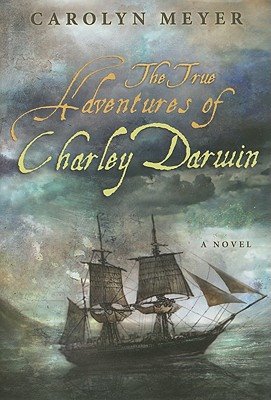
The True Adventures of Charley Darwin

by Carolyn Meyer
ages: 10-14
First sentence: “Odd, isn’t it, how a trivial thing can turn out to be a matter of greatest importance in one’s life.”
Support your local independent bookstore: buy it there!

I had high hopes for this one.

I found it at the library while reading the evolution book, and I thought: a historical fiction book about Darwin. That’s got to be fascinating. Maybe it’ll shed more light on the whole evolution debate. Maybe it’ll be good historical fiction (Carolyn Meyer is a good writer). Maybe I’ll like it.

And I did. Well, the first third anyway. Meyer begins with Darwin being sent to boarding school, chronicling his education and interests. Education, he despised and (even though quite smart) did little for. Interests, though, he had many of. Including collecting, shooting, walking… but nothing that (he or his father thought) would lead towards a suitable career for a well-off but not noble English man.

Then, when he was 22, he was recommended to go on a surveying voyage around the world with a Captain FitzRoy. It was on this trip that he not only began to formulate the theory of evolution, but figured out what he wanted to do with his life. But, it’s also where the book fell apart for me. I enjoyed learning about Charley’s childhood. He’s a fun and fascinating kid, and Meyer has captured his voice in such a way as to bring him to life. But, once on the voyage, he’s bogged down in seasickness and collecting that it became much less interesting. And so, by the time the four year voyage was over, I had completely lost interest in the book.

Yes, it is really the adventures of Charles Darwin. It’s just too bad that they’re not terribly interesting.

Here Lies Arthur

by Philip Reeve
ages: 13+
First sentence: Even the woods are burning.
Book 4 for the 48 HRC

I am a sucker for all things Arthurian. I love the myth recreated (but not the myth retold, as I discovered last year), the sweeping themes of loyalty and betrayal and unity.

Philip Reeve takes it all and turns it on its head, and I found that I still love it.

Gwyna is just a girl when Arthur — war-lord, Bear, and bully — ransacks her house, burning it to the ground because her lord Ban wouldn’t pay tribute to Arthur. She escapes, swimming downstream until she’s far enough away. Except she’s discovered by Myrddin, and taken into his service. From this point, the threads of the legends are there — the lady in the lake, Gwenhwyfar and Lancelot (though under a different name), the battles, Cei, the betrayal, Arthur’s death — but not in the way that it’s normally presented. Through Gwyna, everything takes on a different, harsher light, but really, that’s not the point of the book.

The real point, I found when I turned the last page, is all about stories. See, Myrddin’s job in this book was to go around trying to boost Arthur’s reputation by spreading stories about him. Which worked for a while, but eventually, it all fell apart. But, by that time, Gwyna was so — enraptured by? devoted to? sold on them? — the stories, she couldn’t let them die. I liked this quote from the end:

I didn’t tell what really happened, of course. At first I felt ashamed to be telling lies for a living, and it stung me that I could not tell the truth. But as the year ripened and our road wound west I came to see that it didn’t matter what the truth had been. The real Arthur had just been a little tyrant in an age of tyrants. What mattered about him was the stories.

And always at the end someone would ask, ” Is it true he’s not dead? Not really dead? Will Arthur return?” And I’d think, “Christ, I hope not!” But they weren’t thinking of the Arthur I’d known. It was Myrddin’s Arthur, the wisest and fairest and best king they had ever heard of. You can’t blame people for wanting to believe there’d been a man like that once, and might be again.

So. In the end, Arthur was just a petty tyrant, and all that’s left of him is glorified stories of days long ago. Then again, it’s the stories that really matter.

Right?

Buy it at Amazon, Powell’s, or your local independent bookstore.

The Painter from Shanghai

by Jennifer Cody Epstein
ages: adult
First sentence: “When the session is over, Yulaing retreats to the chipped sink in the atelier’s corner.”

I don’t know how to start this. After my recent experience with historical fiction, you would think I would be more wary about reading more. But, perhaps my experience was that I was too close to the subject, and that hindered my enjoyment of it.

Well, nothing could be further from my life than that of the Chinese painter Pan Yuliang.

Epstein’s book reads like a good Zhang Yimou movie — a harsh, brutal, lush, hopeful, soaring, and gripping glimpse into China’s past. Yuliang was sold into prostitution at age 14 by her uncle, in order to pay off opium debts. After several years in the brothel, she is rescued by Pan Zanhua, a government worker who ends up taking Yuliang as his second wife in order to avoid scandal. It’s through Zanhua, though, that Yuliang was introduced to art, and because of him that she managed to find her true calling in life.

Not that it was easy: it was difficult for a woman in China in the 1920s to get into an art program, it was controversial for artists to paint nudes, and after she got a scholarship to Paris and later Rome, it was difficult and controversial for her to go back again. But, through it all, she stayed true to her art, her passion, even when it cost her dearly.

Sure, there’s probably that line-blurring, and perhaps someone will even complain that Epstein didn’t get it “right”. But, for me, Epstein’s novel is a lush look into the world of postmpressionist art, the politics of China as well as Yuliang’s life over several decades. It might sound like a lot to handle in one novel, but Epstein makes it work. She even makes present tense narration — something which usually grates on me — work beautifully. It’s a lyrical first work, and makes one hopeful for what Epstein has to offer us in the future. My only complaint is that it didn’t come with pictures; thankfully, Epstein has rectified that by putting samples of the artist’s work up on her webpage.

Of course, as always with a TLC tour, there are a myriad of opinions to choose from. Be sure to check them all out:

Tuesday, June 2nd: The Literate Housewife Review
Wednesday, June 3rd: Book-a-Rama
Monday, June 8th: She is Too Fond of Books
Tuesday, June 9th: S. Krishna’s Books
Wednesday, June 10th: Becky’s Book Reviews
Thursday, June 11th: Redlady’s Reading Room
Monday, June 15th: Dolce Bellezza
Tuesday, June 16th: Peeking Between the Pages
Wednesday, June 17th: A Work in Progress
Thursday, June 18th: Beth Fish Reads
Monday, June 22nd: Pop Culture Junkie
Tuesday, June 23rd: Do They Have Salsa in China?
Wednesday, June 24th: Bookworm with a View
Thursday, June 25th: So Many Precious Books, So Little Time
Friday, June 26th: Savvy Verse and Wit
Monday, June 29th: Nerd’s Eye View

Buy it from: Amazon, Powell’s, or your local independent bookstore

The 19th Wife

by David Ebershoff
ages: adult
First sentence: “In the one year since I renounced my Mormon faith, and set out to tell the nation the truth about American polygamy, many people have wondered why I ever agreed to become a plural wife.”

Three bloggers, whose opinions I respect and who are all members of my church, have read and reviewed this book. Two had positive reactions to it; the other didn’t. Needless to say, it made me curious, and when Lisa Munley of TLC Tours offered me the chance to be a part of another tour of The 19th Wife, I accepted.

My dad once said, when we were watching Chariots of Fire and I made some sort of comment about how amazing it was that something happened “that way”, that the movie makers were out to make a good drama. And good drama isn’t always good history.

That thought ran through my mind quite often as I read The 19th Wife.

The story is both basic and complex: it’s a historical “biography” of a real person, Ann Eliza Young, the 19th polygamous wife of Brigham Young. It’s also a murder mystery: Jordan Scott, who has been kicked out of the Firsts’ polygamous compound in Southern Utah, is drawn back to his home because his mother has been accused of killing his father. The two stories are interwoven and intertwined (in more ways than one) as the book unfolds.

The problem I had with the novel was not with its portrayal of the LDS church’s past, or its portraits of our first two prophets, its portrayal of an early form of something I hold sacred, or even its implied criticism of the church’s present stance on gay marriage. No, the thing that bothered me most was that the line between history and fiction was incredibly blurred. Chalk this up to Ebershoff being a great writer, or my being overly paranoid, but I couldn’t tell, especially in the Ann Eliza sections, where history stopped and fiction began. Which led me to wonder what Ebershoff’s motivations in writing the book were. To tell an interesting story, obviously, but what else? Why does he compare the early church to a modern polygamous cult? Is he exploring the nature of faith and belief? Or how far people will go in following an egomaniacal leader? Is he passing judgment on the LDS Church for its history with polygamy (or suppressing women), and comparing that, to a lesser degree, to its stance on gay marriage?

Am I just reading too much into this novel?

Okay, yeah, I know it’s a novel, and the job of a novel is to blur the lines between fact and fiction. But, while reading this, I also thought of the myriad of reactions to The Da Vinci Code when it first came out; a friend of mine told me to read it, because it was brilliant, because she’d never been told the truth before. I wondered if this book — for both members of our church and those who aren’t — might serve the same purpose. It’s not that we shouldn’t question our history, or that Ebershoff doesn’t have a right to rewrite it for us, but that it’s a fiction book, a story being told, and I wonder if people won’t take it as “truth”.

Which brings me to what I felt was the crux of the novel. It’s a “letter” from Ann Eliza’s son, Lorenzo Dee, to a fictional scholar, circa 1939:

Even so, history has one flaw. It is a subjective art, no less so than poetry or music. The true historian has two sources: the written record and the witness’s testimony. This is as it should be. Yet one is memory and the other is written, quite often, from memory. There is nothing to be done about this defect except acknowledge it for what it is. Yet this is your field’s Achilles’ heel. You say in your letter the historian writes truth. Forgive me, I must disagree. The historian writes a truth. The memoirist writes a truth. The novelist writes a truth. And so on. My mother, we both know, wrote a truth in The 19th Wife — a truth that corresponded to her memory and desires. It is not the truth, certainly not. But a truth, yes.

I should note that Ebershoff is coming to Wichita and will be at Watermark Books on June 9th at 7 p.m. (Hey, Bobby, can you help spread the word?) I am planning on going, not only because I was asked as part of this tour, but because now that I’ve finished the book, I’m quite curious to meet the author — and his motivations for writing this — behind this book.

For more opinions, head over to the other stops on the tour:

Monday, May 18: Hey, Lady! Whatcha Readin’?
Wednesday, May 20th: A Guy’s Moleskin Notebook
Thursday, May 21st: Becky’s Book Reviews
Tuesday, June 2nd: Biblioaddict
Thursday, June 4th: A Life in Books
Friday, June 5th: Bookgirl’s Nightstand
Monday, June 8th: Live and Let Di
Tuesday, June 9th: Ramya’s Bookshelf
Wednesday, June 10th: As Usual, I Need More Bookshelves
Thursday, June 11th: A Novel Menagerie
Monday, June 15th: The 3 R’s: Reading, ‘Riting, and Randomness
Tuesday, June 16th: The Book Faery Reviews
Wednesday, June 17th: Shelf Life
Friday, June 19th: In the Shadow of Mt. TBR

Flygirl

by Sherri L. Smith
ages: 12+
First sentence: “It’s a Sunday afternoon, and the phonograph player is jumping like a clown in a parade the way Jolene and I are dancing.”

Ida Mae Jones has always wanted to fly. Ever since she was put behind the wheel (is it a wheel?) of her daddy’s Jenny and taught how, she knew that this was what she was born to do. Except, she’s an African American (yes, I am being politically correct here), and lives in the outskirts of New Orleans. Not only can she not get a pilot’s license because she’s a woman; she can’t get one because she’s the wrong color.

It’s only when her younger brother spies and article about the Army’s WASP program (that’s Women’s Airforce Service Pilots), and that there was a Chinese-American woman in it, that Ida gets an inkling of an idea. She forges her daddy’s pilot’s license, and since she’s light enough skinned to pass for white, she applies. And gets in.

The part in the program is what interested me the most about Smith’s book. I thought that while the conflict between black and white, and Ida’s internal conflict about lying about who she really is, was interesting (and probably worth some thought), I really liked Ida learning how to fly military planes. I liked the challenges posed by the program, the obstacles she had to surmount in order to succeed in a man’s world. It was not only historically interesting, but had a universal appeal: what woman hasn’t faced the “you can’t do it because you’re a girl” and fought her way to success in whatever that is?

It’s books like these that make one grateful for the pioneers, the women who were courageous enough to break the race, sex, or whatever barrier, and achieve their dreams. And it’s good to have a book like this to remind us of it. As well as being a cracking good story.

Chains

by Laurie Halse Anderson
ages: 10+
First sentence: “The best time to talk to ghosts is just before the sun comes up.”

Isabel is a slave. But this is not a plantation in the Civil War South; it is 1776, and New York is bristling with the news of an impending British invasion. Isabel and her younger sister Ruth’s former master died, and instead of being set free, like they thought they were, they are sold to a couple of Tories: Mr. and Madame Lockton, and taken to New York, where they are caught in the middle of the revolution. It’s just a matter of time, and circumstances, before Isabel decides which side she will be on. And what price that will cost her.

First: this book is beautiful. I’m not usually a tactile reader, but in this instance, I kept looking at the more-than–perfect cover, stroking the pages, and loving the font. Especially the blurb on the back cover. I could tell much care was taken with the design of the book. And I, for one, appreciated it.

Moving on…

In the interview at the back of the book, Anderson says that the whole slave issue cannot be broken down into “good guys” and “bad guys”. Which is an understatement. There are sympathetic characters on both sides of the revolution — while the politics of the revolution play a role in this book, it is not an indicator of character. (Nor should it ever be.) Chains is thoroughly complex and unflinching, presenting the issues at hand — freedom, slavery, revolution — with honesty. Anderson doesn’t write down to the reader; the book is quite brutal at times. That’s not to say the book is harsh. Rather, interspersed with all the brutality are moments of absolute poignancy. The book just about ripped my heart in two at parts. Isabel as a character is not just compelling, she’s strong and captivating, and honest. I felt for her, I adored her, I cheered for her.

In short, it’s historical fiction at its finest. But then, it’s Laurie Halse Anderson.

(And yes, I do need to read her other books. I know that. Which one to start with, though?)