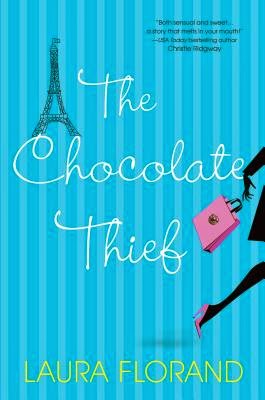
The Chocolate Thief

by Laura Florand
First line: “Sylvain Marquis knew what women desired: chocolate.”
Support your local independent bookstore: buy it there!
Review copy snagged from the ARC shelves at my place of employment.
Content: Very little swearing (in English; perhaps if I knew French, this would be higher), but it’s most definitely a Blush Book. I may never think about climbing stairs the same. It would be in the adult fiction section of the bookstore, if we carried it.

I was pursuing my TBR shelf, looking for something light to read, when my eye caught this. I remember a bunch of YAckers loving it (and plus: CHOCOLATE and PARIS), so I picked it up. It is most definitely light and fluffy. And sexy. And not much else.

Cade Corey is the daughter of a Hershey’s-like family. They’re in the basic chocolate bar business, and own a huge percentage of the market. While she’s not the CEO, she’s being groomed to take over the company. But what she really wants is Parisian chocolates. Artisan chocolates. Sylvain Marquis’s chocolates, since they’re the best. But she quickly discovers that while money can buy a whole lot it can’t buy her Sylvain. He’s much, much too proud of his French chocolates and much much too disdainful of her American crap. So, she does the only logical thing (right.): breaks into his store, and pilfers through his chocolates, tasting, eating, leaving hints of herself behind.

Which totally turns him on.

From there, the plot is immaterial. It’s all sex. sex. sex. and then more sex. Mostly tastefully written (but not-off screen) sex. And there’s chocolate. Descriptions of luscious, rich, delicate, expensive chocolate. I found myself craving chocolate while I read, so I think Florand did her job. I did have issues with the way that Cad wanted Sylvain to control her… part of me rebelled at the idea of a man being SO in charge of sex, of wanting to master a woman, but to each their own. It did what I wanted to do: transport me to Paris (not enough of that, though), indulge me in chocolate, and be eye candy.

I have no interest in reading the others, though. And I may need some non-fiction to follow up on all that candy. But it was enjoyable while it lasted.

Fat Boy vs. The Cheerleaders

by Geoff Herbach
First sentence: “Shortly before midnight on June 15, Gabriel Johnson, a sixteen-year-old from Minnekota, MN, was apprehended outside Cub Foods by Officer Rex McCoy.”
Support your local independent bookstore: buy it there!
Review copy pilfered from the ARC shelves at my place of employment.
Content: There’s a lot of swearing, none of it strong. I put it in the Teen (grades 9+) section of the bookstore primarily because I like to keep the YA section toned down. Also, because that’s where all of Herbach’s other books are. I’d say, depending on your kid, it’s good for as young as 7th graders.

In high school, there are two types of people: the jocks and everyone else. Gabe is everyone else.  Actually, Gabe is a band geek, and a mostly friend-less loser. He’s been going downhill since his mom ran off with a Japanese guy a few years back, and his grandpa moved in. It’s not just that he has only two friends, it’s that he’s overweight. Massively so. In fact, everyone (including his friends) call him Chunk. And he’s okay with that.

Gabe spends his days chugging Code Red, primarily because the money in the school’s soda vending machine goes to support the band that is Gabe’s lifeline. He figures he can chug 5 bottles of the stuff, if the money goes to fund his program. Then he finds out that a Super Sekrit school board meeting took away the vending machine money from the band and gave it to the Brand Spanking New dance team. Which makes Gabe mad. Eventually.

There’s more to the plot, of course, but it’s more about Gabe gaining self-respect than any eventual result. You know from the start — the whole book is his confession; a one-sided conversation with a Mr. Rodriguez — that he’s gotten arrested for doing something. You assume it’s for stealing money out of the vending machine. But, things are more complex than that.

Part of the charm of this book is the format; I was entertained by hearing only one side of the conversation, and imagining what Mr. Rodriguez’s side was. But, it was also Gabe. He was such a loser to start with, and it’s empowering to see how he regains control over his life, in spite of the people — from his friends to his father — who are trying to hold him back. Everyone needs a summer in which they find their best selves, and this story of Gabe’s was a truly fun one.

So Long a Letter

by Mariama Ba
First sentence: “Dear Aissatou, I have received your letter.”
Support your local independent bookstore: buy it there!
Content: It’s pretty serious and deals with issues of infidelity and polygamy and out-of-wedlock pregnancy. But there’s no swearing, sex, or violence. It’d be in the adult section of the bookstore.

Recently widowed, Ramatoulaye sits down to write a long letter to her best friend about all the events that led up to Ramatoulaye’s husband’s death. It was a happy story:  for 25 years, they were happily married. Ramatoulaye spent her life in devotion to her husband, bearing 12 children. Then one of his daughter’s friends caught his eye, and he woos her, and takes her as a second wife (as is permitted in Islam). That simple act wrecks Ramatoulaye, but she manages to survive as a single mother.

It’s a slim novel, and an interesting one. I didn’t particularly like the format –why, if she’s writing to her best friend, would Ramatoulaye need to recount her friends’ history (which was much like her own; her husband took a second wife. The difference is that Aissatou left her husband)? It didn’t make sense to me, logically, some of the things Ramatoulaye included in her letter. That said, if when I was able to get past that, I found the story was simultaneously enlightening and disheartening.

Enlightening, because that’s an area of the world I know very little about. And through Ramatoulaye, Ba brings to life the ordinary lives of Senegalese women. And disheartening because they have so few rights, as we have come to think of them. I read this book in the middle of the #WeNeedDiverseBooks campaign, and this is a prime example why I need to read more books like this. In my privileged home in my privileged country, it’s easy for me not to think about Senegalese women and their lives. But books like these help me. It helps that Ba is a good writer (aside from the format, of course), and was able to draw me into Rmatoulaye’s life.

And that’s what makes this book worthwhile.

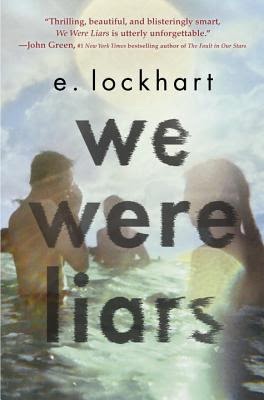
We Were Liars

by E. Lockhart
First sentence: “Welcome to the beautiful Sinclair family.”
Support your local independent bookstore: buy it there!
Release date: May 13, 2014
Review copy snagged from the ARC shelves at my place of employment.
Content: There were multiple f-bombs and some mild swearing. It’s also a very intense book, emotionally, so be prepared for that. It will be in the Teen section (grades 9 and up) of the bookstore, but I think a mature 13-year-old could handle it.

There is a problem with writing a review for this book. It’s best if you know absolutely nothing going in. Nothing. Nada.

In fact, the back of the ARC says “If anyone asks you how it ends, just LIE.”

I will tell you this. Cady is one of the Beautiful Sinclairs, an old-money family in Boston that vacations every summer on a small island near Martha’s Vineyard. Her grandfather is the patriarch of this family but her mother and her two sisters have not really lived up to the family name. Cady is also one of the four Liars: she, her cousins Johnny and Mirren, and Johnny’s mother’s boyfriend’s (Indian) nephew, Gat. Something happened two summers ago, and Cady lost her memory. No, the summer that she’s 17, she needs to figure out what happened.

I will also tell you this: read it. Just read it. Lockhart is amazing. This book is haunting and so gorgeous in its simplicity and so powerful.

I promise that’s not a lie.

Popular: Vintage Wisdom for a Modern Geek

by Maya Van Wagenen
First sentence:”‘School is the armpit of life,’ my best friend Kenzie once told me.”
Support your local independent bookstore: buy it there!
Content: Because eighth graders aren’t exactly the nicest creatures in the world, there is some language, all of it mild and very infrequent. It’s in the YA section (grades 6-12) of the bookstore, but honestly, anyone who can handle the subject matter (she does talk about taking sex ed and drug inspections and lockdowns at her school), should read this one.

The summer before she starts eighth grade, Maya Van Wagenen discovers in a box a copy of “Betty Cornell’s Guide to Teenage Popularity”, circa the 1950s  Her mom suggests, offhand, that maybe Maya should follow the advice in the book, write it down, and see what happens.

This book is the result of that year.

There aren’t the words to express my love here.  Perhaps it’s because I have a daughter just finishing eighth grade, and it’s been a rough year for her. Perhaps, it’s because I was much like how Maya started eighth grade: socially awkward, at the bottom of the social hierarchy, trying to fit in my small, conservative, Michigan middle school. (I had just moved there two years before, and still hadn’t figured out how to fit in with kids who’d known each other since kindergarten.)

But my enjoyment went beyond just being able to relate to Maya. She tackled a chapter or two of Betty’s book each month during the school year, and the chapters were divided up with her reflections of her progress. Along the way, I got to know her family (she has terrifically cool parents; my favorite side story of hers was the list of answers you’re not supposed to say when crossing through a U.S./Mexico border patrol. My favorite was “I am, but I’m not too sure about the kids in the trunk.”) and her school mates (she lives in Brownville, TX, and to say that she has a rough school, is an understatement). At first, she’s very humorous about he whole project. For instance, when she hits the dress chapter, she takes it literally, dressing like someone from the 1950s, getting stared at and teased for dressing like someone’s grandma. It’s easy to think that Betty’s guide really doesn’t fit in today’s world.

Somewhere along the way, Maya — and I, as well– discovered that Betty’s book is really still applicable, and maybe she really does have the secret to “popularity”.  I was touched by Maya’s insight, her observations, and her maturity. By the time I closed the book, I wanted to cheer for her — she’s an amazing girl, one I’d be proud to call my daughter — and to thrust this book in the hands of everyone I know, grownups and teens alike.

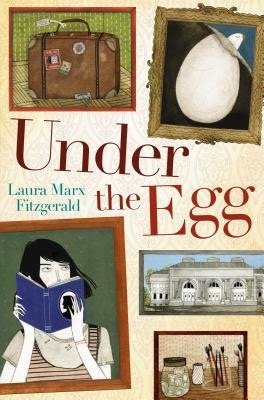
Under the Egg

by Laura Marx Fitzgerald
First sentence: “It was the find of the century.”
Support your local independent bookstore: buy it there!
Content: There some descriptions of horrible events, but nothing graphic. I think younger readers might have problems with the languages — there’s French and Latin, though translations are provided — and some of the names, but it’s in the middle grade (grades 3-5) of the bookstore, and I think it fits there.

Theodora (call her Theo) Tenpenny is the granddaughter of an artist and the daughter of an extreme introvert. She lives in what was once a grand old New York City house, but over the years has become neglected. Her grandpa Jack has kept everything reasonably in shape over the years and has managed to keep the family afloat by being mostly self-reliant. But since he was hit by a car and died (which seems overly gruesome for a guy in his mid-80s), Theo’s been in charge. And she’s struggling.

That is, until she takes her grandfather’s last words — “Look under the egg” — literally, and discovers that he’s been hiding a very old painting underneath the one of an egg that’s been hanging over their mantelpiece for years. Because she’s spent her life in her grandfather’s shadow, going to the Met and other art museums, Theo has a good eye, and realizes at once that this painting is something special. Something, perhaps, worth a lot of money.

However, as she and her new friend, Bodhi, find out, declaring a painting a lost work by a master is easy. Proving it is another matter. Especially when it turns out that this could be looted Nazi treasure.

On the one hand, there’s a lot of information to be had in this slim book. Both art history as well as WWII history play a major role in the plot. But I think that Fitzgerald handles it well, even if all the information and history might make it harder for younger readers to get into the book. But, she gave us a couple of great characters in Bodhi and Theo; they really are a team that works well together. I enjoyed the old-fashioned sleuthing to solve the mystery of the painting, and I liked how the history fit into the larger picture. I did find the ending to be a bit convenient, but even that was explained in a reasonable (if somewhat implausible) manner.

In the end, a highly enjoyable book.

The Shadowhand Covenant

by Brian Farrey
First sentence: “It was exactly the funeral Nanni always wanted.”
Support your local independent bookstore: buy it there!
Others in the series: The Vengekeep Prophecies
Content: There’s some intense action-related moments, and a small amount of violence, but nothing else. It’s perfectly happy in the middle grade (3-5th grade) section of the bookstore.

When we last left our fair Grimjinx family, they were trying to leave behind thieving. Jaxter was off to the Dowager’s estate to become apprentice to her, and the rest of the family was becoming (mostly) clean. Six months later, things aren’t exactly happy. Jaxter and the Dowager are fighting and he’s seriously considering giving up the internship altogether. So, when he heads back for Nanni’s “funeral” (it’s Par-Goblin custom to throw a funeral when a thief retires), he’s pretty much sure that he’s going to try and find another line of work.

But then, he, his Ma and Da get summoned by the Shadowhand, a super-secret organization of thieves. Someone’s making them disappear. And it seems to be tied up with valuable relics that were stolen from the High Laird. And the Sarosans — a group of gypsy-like people who are against magic and the Palatinate, the group of mages who seem to be grabbing too much power.

Of course, Jaxter gets involved (though not because he wants to; his hand is kind of forced), and he uses his knowledge of plants and powers of deduction to help him — and his friends — out.

Much of what I loved about the first book in this series is back: I adore the Grimjinxes as a family. They’re fantastic. It’s not very often that you have amazing parents in middle grade, but Ma and Da are them. Sure, Farrey has to find a way to separate Jaxter from them so he can have adventures. But they’re so supportive and just plain good people (thieving aside, of course). And I still love how bookish Jaxter is. He’s not athletic, and he’s terrible at magic, but somehow he makes his book knowledge work for him.

I also liked the action in this one; Farrey has a good sense of action sequences, and there were a couple of moments when I was on the edge of my seat, wondering what’s going to happen next.

And Farrey does a series right: each of these books have their own plot, wrapping it up by the final pages, while having a slower over-arcing plot weave them together. The writing’s smart, the characters fun. It’s fantastic.

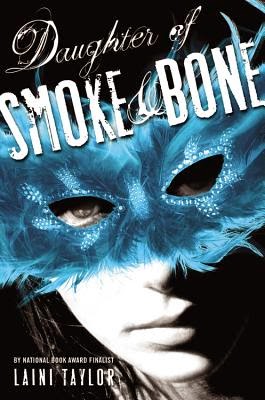
Audio Book: Daughter of Smoke & Bone

by Laini Taylor
read by Khristine Hvam
Support your local independent bookstore: buy it there!
Content: There is some talk about sex (though all the actual sex is off screen), a lot of violence, and some mild swearing. Is in the teen (grades 9 and up) section of the bookstore, though I didn’t have any problems with C (now 14) reading it.

I’ve been wanting to reread this (and Days of Blood & Starlight) in anticipation of Dreams of Gods & Monsters coming out. And so, when I saw that this one is out in audio, I snatched it up. (You should have seen me; I was fangirling all over the place. Kind of like when a customer came in to preorder Gods & Monsters. We were just gushing.) Anyway. I don’t have much to add about the story that I didn’t already say when I first read this.  But the audio was glorious. Hvam captured all the voices perfectly. To a spunky Zuzanna (love her best still) to Akiva and Karou, to the various chimera and seraphim that run throughout the book. (Brimstone is EXACTLY like I heard him in my head.) It was a joy to listen to. And one of those books that made you want to sit in the car, listening for hours on end.

If you haven’t had a chance to experience Taylor in all her awesomeness, you need to. And with the third coming out, take a weekend and splurge and read all three. You won’t regret it.

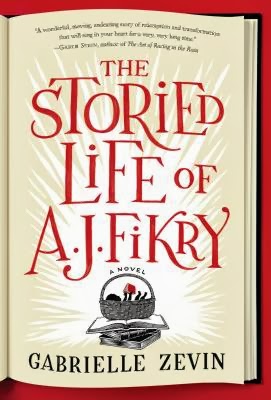
The Storied Life of A. J. Fikry

by Gabrielle Zevin
First sentence: “On the ferry from Hyannis to Alice Island, Amelia Loman paints her nails yellow and, while waiting for them to dry, skims her predecessor’s notes.”
Support your local independent bookstore: buy it there!
Review copy is the one that’s being passed around the bookstore staff.
Content: There’s a lot of language, including a handful of f-bombs. I would give it to a bookish teenager, if they expressed interest.

A.J. Fikry is the owner of Island Books on Alice Island (off the coast of Massachusetts), and it’s not something he’s terribly fond of. In the twenty-one months since his wife’s accidental death after an author event, he’s become increasingly more reclusive and cranky. Then two things happen: someone steals his first edition copy of Tamerlane, by Edgar Allen Poe and someone leaves a two-year-old girl on the doorstep of the bookstore. The first is significant because selling Tamerlane was A. J.’s retirement fund. Without it, he’s stuck on the island, running this bookstore, for the unforeseeable future.  The second is significant because it changes his life.

He is a reluctant father, mostly because his wife was pregnant when she died, and he hasn’t quite gotten over the loss. But his daughter, whom he names Maya Tamerand Fikry when he finally adopts her, gets under his skin and the skin of the community. It’s through concern for her (and for A. J. as her father) that the bookstore finds a second life. As does A. J. Through taking care of Maya and getting involved in the community, he finds that running a bookstore isn’t half bad. Even if you sometimes have to sell pulp fiction in order to carry the literary fiction.

It’s really a love song to community and to bookselling, and the connection between the two. And even though I didn’t find it to be deep or meaningful, I did (as a bookseller) relate to it, finding it charming. It was one of those books where you like everything, wanting to live next door to these quirky characters because they’re so interesting. However, it lacked the emotional punch at the end that I think Zevin was going for; I wasn’t even the tiniest bit sad. (Maybe that’s more me than Zevin. Even though I liked the characters, I didn’t feel emotionally connected enough to be moved.)

In the end, though, it was simply delightful.

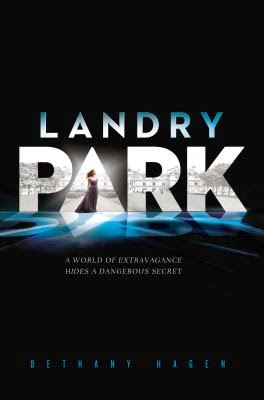
Landry Park

by Bethany Hagen
First sentence: “Two hundred years ago, America found itself at a crossroads.”
Support your local independent bookstore: buy it there!
Review copy snagged from the ARC shelves at work.
Content: There’s some talk of violence, though it’s all offscreen; a few mild swear word; and an illusion to an affair. It’s in the YA section (6-8th grade) of the bookstore, but I’d have no problems giving it to a younger child if they were interested.

Madeline Landry has grown up in a luxurious world: she’s the only child of an elite family and surrounded with opulence. She’s not particularly happy: she has struggles with her father over her education. She wants to got to university; he (and his will, not to mention the law) wants her to stay home, get married, run the estate, and pop out an heir. But she’s not entirely unhappy either: she loves her family and her home and the life. That is, until David Dana — the un-landed son of a gentry — comes into her life. Then, the things that have been skirting around her life — the class issues, the environmental concerns, especially with the lowest class, the Rootless — come front and center. Not to mention that David’s pretty dreamy.

In many ways, Hagen is treading the same ground as every dystopian book before her. America falls to the Eastern Empire, only managing to hang on by a thread. In the aftermath, a class system is formed — not based on race, as Hagen is so careful to point out — based on money and influence. And at the bottom are the Rootless, who handle the nuclear charges the gentry’s energy — and much of the wealth, especially the Landry wealth — comes from. And they’re getting restless. Where Hagen’s dystopian diverges from the pack is in the focus: Madeline is one of the elite, not the underclass. And when she has her eyes opened, she stands to lose everything. And I respected that.

I also really loved the world Hagen built, even though she never really gave us an explanation why the women were corseted and shoved into ball gowns and paraded around like it was Victorian England. I’m sure I could come up with some hypotheses — fancy dresses are synonymous with wealth? the women are as shackled as the Rootless? — but they are just that. No matter: Hagen is tackling issues that aren’t (readily, I think) usually seen in dystopia. Also, she doesn’t have a Romeo & Juliet love story going on here: both Madeline and David are from the gentry, and have to come to terms with their increasingly dissenting opinions.

It’s not a perfect beginning, but it is an intriguing one. I’m going to be curious to see where the rest of this series goes.