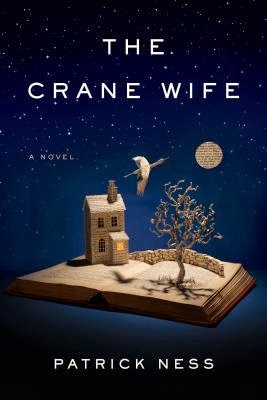
The Crane Wife

by Patrick Ness
First sentence: “
Support your local independent bookstore: buy it there!
Review copy given me by the Penguin rep.
Content: Multiple f-bombs and other language, some off-screen sex. Rightly sits with the adult fiction at the bookstore.

George is your very typical kind-of-loser guy. He’s divorced (nine years) with a child (who’s in her 20s) and can’t seem to keep a relationship (he’s too nice; they always break it off, but he’s always friends with them after). Even though he’s the owner of a print shop, he’s a bit of a pushover, letting his one employee, Mehmet, push him around. But, because he’s nice, because he’s George, when a crane with an arrow piercing its wing unexpectedly lands in his suburban London backyard in the middle of the night, he helps it out.

The next day, a woman named Kumiko shows up in George’s print shop. And suddenly, George’s life — and the life of his daughter, Amanda — are irrevocably changed.

Yes, this is a fairy tale. A very charming, sweet, wonderful fairy tale. Ness divides its time between George, Amanda, and Kumiko’s tales, but does so in a way that doesn’t feel awkward or forced. But it’s not just a fairy tale — or at least not just a one-dimensional fairy tale — art (in this case, paper cuttings) and a slight Japanese-inspired tale within a tale play major roles, which gives the book depth and substance.

But what I enjoyed most with this one was Ness’s use of the language. The fact that one of his characters, Rachel (who is very confused and not at all nice), speaks entirely in questions. Or the way he uses “…” to represent silence. Or the way George and Amanda think of themselves. And descriptive sentences like “He loved physical books with the same avidity other people loved horses or wine or prog rock.” (60) or “Stories do not explain. They seem to, but all they provide is a starting point. A story never ends at the end.” (141-142) or “She stopped, her face scrunching up in some really, really unattractive crying.” (161) There were others, but those are the ones that I marked.

It did all the things I want a book to do: it gave me characters to care about, and transported me away from the dreary winter months. It delighted me, and made me wish I was even a tiny bit artistic.

Delightful.
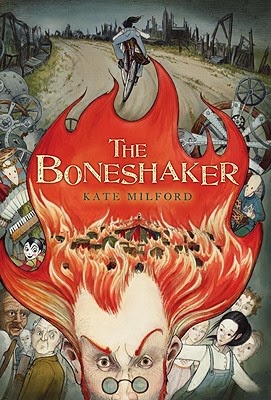
Audiobook: The Boneshaker

by Kate Milford
Read by: Erin Moon
Content: some intense moments (the Devil’s pretty scary), some violence, some disturbing images (if it were a movie). Language is probably suitable for someone reading on a 5th grade level. Has the feel of an older Middle Grade book, so I’d probably put it in the YA section (grades 6-8) at the bookstore.
Support your local independent bookstore: buy it there!

It’s 1914, and 13-year-old Natalie Minks has a pretty good life. Her father is the local mechanic — bicycle, mostly, but he’ll tinker with cars — and her mother tells the most amazing stories about their town, Arcane. Natalie herself has a predisposition for both: she loves tinkering with her father as well as listening to her mother’s stories.

Then one day Dr. Jake Limberleg’s Nostrum Fair and Technological Medicine Show comes to town. It was a fluke — their front wheel came off at the crossroads, and they decided to set up shop while they waited for Mr. Minks to fix their wagon. And that’s when the Trouble starts. Natalie, for better or for worse, is tuned into it and with her frienemy Miranda (I think that’s what her name was; I can’t look it up in the book!) and her trusty Chesterlane Eidolon bicycle (a bone shaker of an old thing that would be the fastest in the world, if Natalie could ever ride it), she decides to take on Limberleg and solve the mystery, saving her town. If she can.

I don’t know how I can write about the way this captured my attention. Sure, I was on a long drive to Austin, and it had my full attention anyway, but I didn’t want to stop listening. Milford has taken the idea of a Faustian Bargain — you know: those stories where a character meets the Devil and then outsmarts Old Scratch? — and elevated it. Not only is there two elements to this bargain, but we get historical elements thrown in as well. The traveling medicine show (I loved the Paragons of Science, even though they were Evil), the bicycles, the references to the “war” (which took me a minute to realize they meant the Civil War): it all added Atmosphere, which made the fantasy element, the bargains with the Devil at the Crossroads, that much creepier.

(It also helped that I kept thinking about this song:)

In short: a winner of a book.

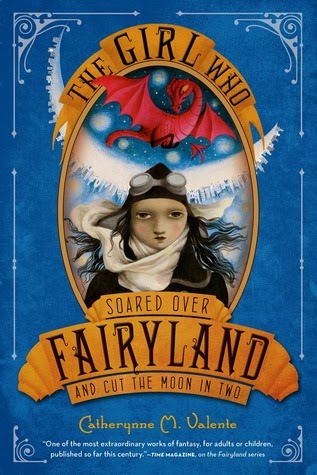
The Girl Who Soared Over Fairyland and Cut the Moon in Two

By Catherynn M. Valente
ages: 11+ (I’m not sure the younger set would like this one. Just saying.)
First sentence: “
Support your local independent bookstore: buy it there!
Others in the series: The Girl Who Circumnavigated Fairyland in a Ship of Her Own Making, The Girl Who Fell Beneath Fairyland and Led the Revels There
Review copy snagged off the ARC shelves at work.

It’s been a year since September has left Fairyland Underneath, and she aches to return. The Real World just isn’t as fun or as interesting as Fairyland. And she’s been told that she can return every year, so she waits. And waits. But no one comes. Until, one day, long after she’s expecting them, someone does come, but won’t let her in. So, desperate as she is, she breaks in. Which means she’s a Criminal. She finds that things aren’t the same as they were, encounters the Blue Wind (who’s quite obnoxious), gets sent on a Mission, and tries to fight a Yeti on the moon. Yes, it is as weird as it sounds.

But, even though there were passages I found amusing (most specifically, the description of the Lopsided Library) and characters (like the car Aroostook) I liked, I just wasn’t as charmed with this one as I was with the other two. Maybe it’s because September is Getting Older, and Valente tried to bring in not only romance (Saturday, the Marid, is in love with September), but also the Trials of Getting Older, and it just didn’t Work. (This book makes me want to Emphasize with Capital Letters. It’s an unfortunate side effect.) I skimmed more than I read, I rolled my eyes more than I laughed. I wanted to Love Ell the Wyvery and Saturday again; I wanted to Enjoy September’s journey. But my heart wasn’t in it.

I don’t know if that means it’s the writing or just that I’m getting tired of this series. Could be either. Or both.

(Just for the record: because this is a Cybils nominee, I’ve been asked to make sure y’all know this is my opinion only, and not that of the panel.)

A Grimm Conlcusion

by Adam Gidwitz
ages: 11+
First sentence: “
Support your local independent bookstore: buy it there!
Others in the series:  A Tale Dark and GrimmIn a Glass Grimmly

If you’ve read the other two books, you pretty know what to expect with this one. Some pretty grisly awesome bloody violence, a winding fairy tale-inspired story, with a very snarky narrator. This time, it’s twins Jorinda (YOUR-inda) and Joringle (YOUR-ingle) whose story we follow.

I should say up front that if C’s language arts teacher last year hadn’t been insistent on her students learning some of the more obscure Grimm tales, I wouldn’t have believed that this one was really based on a real fairy tale. But it is, and it’s one of the more, um, gross ones. See, the twins’ stepfather doesn’t like them, and so he kills off Joringle, makes Jorinda feel like it’s her fault, and then cooks Joringle and serves him to his mother. Seriously. Ew.

But, since that one is not enough, Gidwitz smashes it up with the real Cinderella (actually, the narrator’s side notes on the meaning of Cinderella — or, rather Ashputtle — is quite hilarious), Sleeping Beauty, and several tales I don’t even know. It’s all very gruesome, all very weird.

In the middle, however, this one turned… well… odd. Gidwitz went meta on me, and Jorinda and Joringle left the story world, and actually started interacting with the narrator, who turned out to be an elementary school teacher named Adam. He read the characters A Tale Dark and Grimm and In a Glass Grimmly in order to help them solve their current crisis. Additionally, the narrator/Adam got all moralistic on us. He had Lessons that Needed to Be Taught, and was actually — surprisingly — heavy-handed with them. And, for the first time in this series, I got pulled out of the story. The intrusive narrator was no longer funny and witty, but rather truly intrusive. And it bothered me. I didn’t mind how the story resolved itself; Jorinda and Joringle were actually good Middle Grade Heroes and did what they needed to do to resolve the story happily. But, after the point where they met the narrator, I wasn’t that interested in how the story resolved itself.

Which is too bad. Because, for the most part, this is a really good series. And I do like the way Gidwitz plays with the Grimm tales. I just wish he could have gotten there without bringing the narrator fully into the story.

(Just for the record: because this is a Cybils nominee, I’ve been asked to make sure y’all know this is my opinion only, and not that of the panel.)

Wildwood Dancing

I was supposed to get this one done before June 21st, for the Once Upon a Time challenge, but I didn’t, thanks to the library. But, better late than never, right?

This book, by Juliet Marillier, has gotten mixed reviews across the blogosphere. Some people love it. Some people not so much. I think I fall in the not-so-much category.

It’s not that the book was bad. In fact, it was a quick read. (For plot summaries, you can check out Becky’s and/or Erin’s reviews.) But, for me, it just didn’t sit well. For one, it just seemed too long. Even though it went quickly, I kept checking to see how much more left to go. Usually not a good sign. For two, I have little patience for “true love”. Especially when characters waste away because of it. I’m not terribly romantic (as my hubby often remarks), and I don’t have much tolerance for the heartbreak and heartsickness of true love. So when Tati, the oldest sister, lay dying because she couldn’t see her true love — an almost-Night Person (I totally missed that there were vampires in this book. Vampires are the in thing, aren’t they?) — I just gritted my teeth and plowed through. Please. Girls wasting away because they can’t be with someone they love? Not my idea of a good time. (Maybe having four girls has warped my sense of romance. I wouldn’t want them to think this was an acceptable way of handling disappointment or longing. Eating cake, however….)

And, I have to admit, I didn’t really care for the main character, Jena. I liked her a bit — she was feisty and quite capable, but she was just so practical. So sensible. The opposite of Tati. Which isn’t bad. (Ah! I’ve hit upon it here: Tati and Jena were opposites, both with their loves but not knowing how best to obtain that.) But she had to have EVERYTHING spelled out to her before she was able to act. It seemed for someone as capable as Jena, she ought to be able to do something without waffling about everything. Especially the important things.

The only thing I really enjoyed was loathing Cezar. He was a good villain — one of those that just give you the creeps. Not evil because he’s a monster, but because he’s a man who went wrong. (He didn’t get a good end, though; he just kind of petered out.)

The one redeeming factor is the absolutely beautiful cover. But then, we’re not supposed to judge a book by it’s cover, are we?

East

I had a hard time finishing this book by Edith Pattou. Not because of the book, though. Because my life wouldn’t let me sit down and just savor this book like a wanted to. I finally did, about 3/4 of the way through, because it was just too compelling. So, I let the home and Christmas stuff wait for a night. 🙂

The story is a retelling of the old fairy tale East of the Sun and West of the Moon. When I first read about this book in Chinaberry, I had no idea about the fairy tale, so we checked it out from the libarary as well. It’s a simple Norweigan fairy tale, one I think I’ve heard before. A white bear takes a girl from a poor family in exchange for wealth. He then takes her to live with him in his enchanted castle. It’s a fairly uneventful time, except that every night, someone comes to sleep with her in the bed. After a while, she aches to go home, and the white bear relents, with one condition: she must not be alone with her mother. She breaks this condition, tells her mother about the stranger in the bed, and her mother gives her a candle. Back at the castle she lights the candle and sees that it’s a man in the bed with her. Unfortunatly, though, with this act, she seals his fate: he’s taken away to marry the troll queen in the castle east of the sun and west of the moon. The girl then sets out to search for the man (whom she realized, too late, was the white bear). She walks for ages, picks up a golden spinning wheel, loom and harp, until the north wind takes her to the castle. There she trades the wheel, loom and harp for visits to the prince, finally succeeding in waking him up and breaking the troll queen’s curse.

East follows the basic fairy tale fairly well, but since I wasn’t attached to the original tale, I had no problems with Pattou’s changes to the story. She fleshes out the family, giving them reasons and motivations behind the departure of the girl (Rose, in the book). The relationship between Rose and the white bear is fleshed out. And the whole journey to find the bear is completely different. Rather than relying on magic, Rose relys on friends, common sense, and plain old inginuity. And, yes, she finally succeeds in the end, and it’s a completely satsifying success. Even the little (mostly unecessary) epilogue in the end doesn’t detract from the great ending to the story.

It was a wonderful book. Perhaps it was good that it took me so long to read. Maybe I enjoyed it more that way.