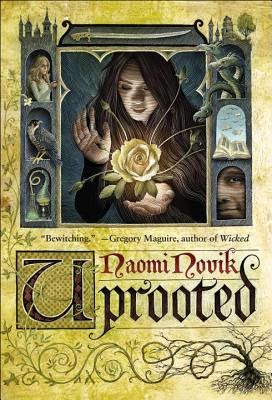
Uprooted

by Naomi Novik
First sentence: “Our Dragon doesn’t eat the girls he takes, no matter what stories they tell outside our valley.”
Support your local independent bookstore: buy it there!
Review copy given to me by the publisher rep.
Content: There’s one graphic, but not explicit, sex scene. It’ll be in the science-fiction/fantasy section of the bookstore.

I picked this one up because our Random House rep said it was based on Beauty and the Beast, and we all know how much I love a fairy tale retelling. But, I didn’t count on how engrossing this book would be.

The rep was right: it is loosely based on Beauty and the Beast, but it’s so much more than that. In this valley in Polyna, their resident wizard, who goes by the Dragon, takes one girl every ten years to his tower. When he’s done with them, they don’t come back to the villages, so everyone (of course) assumes the worst. This year, a picking year, everyone guesses that he will take Kasia, our narrator’s, Neishka, best friend. But the Dragon comes, and he picks Neishka instead.

At first, this is terrifying: Neishka isn’t refined, she isn’t skilled for much of anything (except getting dirty), and she doesn’t want to be in the castle with this scary magician. But, as the book goes on, she discovers hidden talents inside herself: she’s a witch, one that is just as powerful as the Dragon, albeit wielding a different sort of magic from him. And its the combination of their magic that is able to confront the real evil in their country: the Wood.

I don’t want to give away much more than that, because this one is best discovered page by page. Novik has a way of pulling one into the story; this started out as a treadmill book (read twice a week for a half hour), but soon became the one I was spending all my time with. I wanted to experience Neishka’s story as it unfolded, with all the twists and turns and slow reveals and intricate pay offs.

M texted, recently, looking for a “Laini Taylor-esque” book, and honestly, this is what I thought of when she asked for that. Novik’s world-building is solid and always in the service of the story, rather than something separate. And, while her words aren’t gorgeous or lyrical, they’re more than pedestrian. They serve the characters and the plot, and make the whole work together just marvelously.

Just about perfect.

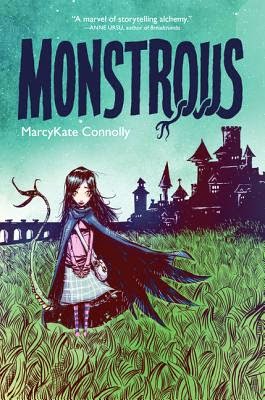
Monstrous

by MarcyKate Connolly
First sentence: “I will never forget my first breath.”
Support your local independent bookstore: buy it there!
Content: It’s long and slow and while the romance is fairly age-appropriate, it’s not just alluded to. It’s in the middle grade (grades 3-5) section of the bookstore, but I’d gear it to the older end of the age range/young YA.

Kymera is a newly formed creation of her Father’s.She’s part girl, yes, but also part bird and part.. something else with a scaled, stinging tail. Her purpose, her father tells her, is to rescue the girls that have been imprisoned by the wizard. She heads into Bryre every night, stinging the guards and bringing out one girl which her father then tells her is being taken to the safety of Belladoma, a nearby country.

If you’re not getting huge creeper undertone vibes from this, I’m really not doing it justice. See: everything is not what it seems. One of the best things about the first half of this book is the unease that Connolly writes into it. I just KNEW something wasn’t right, that Kymera was being too trusting (then again, being new-born she didn’t know any better), that something would go horribly wrong.

And, once she meets a boy, Ren, against her father’s wishes, it does.

I  won’t tell you how it all unravels; the twists and turns are best left to surprise. So, even though this is a slow book, with a lot of internal dialogue and musings, I was still interested enough to keep reading. I loved the dark Frankenstein-like aura it has, though it has a very Grimm-like overlay. Like Connolly couldn’t decide whether to tell a fairy tale or a monster story. But, the mashup works.

Until the end.

See, it turns fairy tale in the end, and I think we were supposed to be Moved by the ending, but I felt cheated. I suppose I wanted some sort of middle-grade happily ever after, and I should be happy Connolly refused to give it to us, but it felt… forced. And that made me dissatisfied.

But, overall, it was a well-done, dark middle grade fantasy.

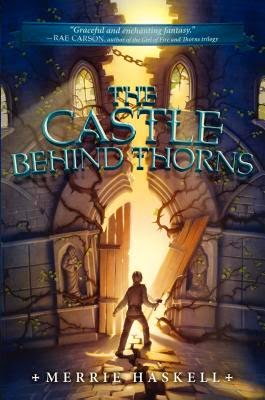
The Castle Behind Thorns

by Merrie Haskell
First sentence: “Sand woke, curled in the ashes of a great fireplace.”
Support your local independent bookstore: buy it there!
Content: There’s death and betrayal and politics, and lots of funny French names, so maybe it’s not for the most reluctant of readers. It’s in the midde grade (grades 3-5) section of the bookstore.

Sand, short for Alexandre, is the son of the local smithy in a small French duchy. (Well, it’s in one of those offshoots just when France was becoming, well, France.) The duchy castle has been in disrepair for longer than Sand’s 13 years, and surrounded by thorns. No one has gone to see what could be seen  inside.

Then Sand, who has been arguing with his father about attending university (he doesn’t want to), throws a token in Saint Melor’s wishing well, and ends up inside the castle. With no clue how he got there or how he will get out.

A brief aside here: we discover things right along with Sand, and while that generally annoys me, in this book it works to great effect. Sand is disoriented and alone, and Haskell captures that perfectly, transferring Sand’s anxiety and his slow realization that he’s stuck there and no one is coming to get him to the reader. All of which is followed up by his determination to survive and make things work.

During his explorations, Sand finds a body of a dead girl, and straightens her up. And because this place is magical (something which comes on very slowly, and quietly), she wakes up. Suddenly, Sand is not alone, and he and Perrotte — who happens to be the daughter of the long-dead Count — have to work together to find their way out of the castle.

I know it sounds boring, but it’s not. Haskell is a gifted writer, and she captures so many inner emotions and struggles and makes them not only real but captivating. I loved the friendship that developed between Sand and Perrotte (and that it wasn’t a romance!). I loved how they worked together to figure out how to get out of the castle. I loved that Sand’s strengths and Perrotte’s strengths were different and they found a way to compliment each other.

Yeah, all of this is really introspective for a middle grade fantasy novel, but in Haskell’s talented hands, it works well.

More than just well: it works wonderfully.

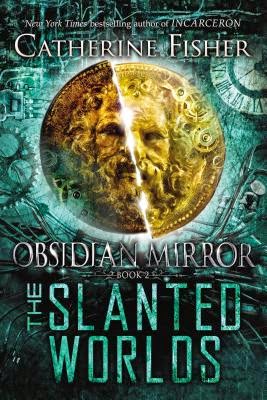
The Slanted Worlds

by Catherine Fisher
First sentence: “The Bomb fell in a split second of silence.”
Support your local independent bookstore: buy it there!
Others in the series: Obsidian Mirror
Content: There’s some violence and (much like the first one) this takes some effort to follow. Not for the reluctant of readers. It’s in the YA (Grades 6-8) section of the bookstore.

A few spoilers for the first one, obviously. You’ve been warned.

Both Jake and Venn have become increasingly desperate to use the mirror, to make it work right. Jake, in order to find his father. Venn, because he wants to turn back the clock to get his wife back. Neither of them know of the outside forces controlling the mirror — that’s a knowledge known intimately to Maskelyne, an old, old time traveler, who may have been the one who invented the mirror — but both are willing to do whatever it takes to keep the mirror safe, and bring back the ones they love. Including involving Summer, the leader of the Shee, the fae-like creatures.

I have realized while typing the above that I could recount the plot of the entire book and it probably wouldn’t make any sense to those who haven’t read it.

There are other factors, as well: Sarah’s still around, trying to destroy the mirror and rid the world of Janus, and she’s willing to involve the Shee as well.  In fact, the Shee is the wild card here: Summer is the chaotic evil here, working toward her own end, but we have no idea what that end it.

There’s a lot of wibbly wobbly timey wimey stuff in this book, time looping in and back and forward on itself in incredibly fascinating ways. Jake is the real focus of the book; its his quest to find his father that we follow most closely. It was a good thing to focus on one arm of the conflict, though I did miss having Sarah around.

But at the end, I was left wondering: how is this all going to come together in the next book? How are we going to resolve the tension between needing to rescue those trapped in time and the need to destroy the mirror to save the world?

I suppose I’m just going to have to read the third one and find out.

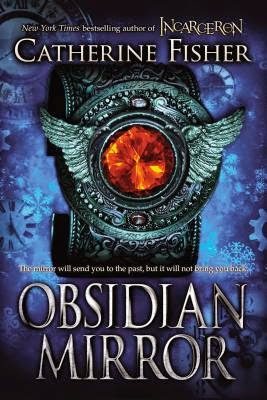
Obsidian Mirror

by Catherine Fisher
First sentence: “The boy put on the mask outside the door.”
Support your local independent bookstore: buy it there!
Content: Nothing objectionable, but it’s slow to start and is a  bit confusing. Not for the reader who gives up easily. It’s in the YA (grades 6-8) section of the bookstore.

This has been on my shelves for a long time. Seriously. I had the ARC, but gave that up, and finally, again, decided that I really needed to read this one. And I was in the mood this past weekend to indulge myself.

I shouldn’t have put it off. (Or maybe I should have: I’ve got the second one waiting to be picked up at the library. Shhhh. I know I said I wasn’t going to. But it’s CATHERINE FISHER.)

There’s three parts to this story. One is Oberon Venn, a very wealthy explorer who has spent the last two years in a depression because he was he cause of the accident that killed his wife, Leah. He will do anything to get her back. Including time travel. He and his trusty slave — there’s more to that than meets the eye — Piers are hidden out at Venn’s estate, trying to do just that: travel through time through the Obsidian Mirror.

The second player in this drama is Jacob, the son of Venn’s best fried. Who is missing and presumed dead. Or at least that’s what Jake thinks. So he’s headed, along with his unsuspecting teacher, Wharton,  to Wintercombe Abbey to force answers from Venn. Little does he know the web he will be tangled in.

The final player is the most complicated one: Sarah is possibly an escapee from an insane asylum. Or perhaps she’s a traveler from the future, a future where the mirror has destroyed the world, in order to destroy the mirror and prevent Venn from bringing his wife back.

There’s so much going on in this one, it’s hard to know where to begin. Yes, it’s slow and incredibly confusing to start with. I kept thinking “HUH?” But, I know Fisher’s work, so I stuck it out, and was richly rewarded. It’s time travel mashed with a mystery mashed with faery stories (yes, the Fey show up, and play a role), and if you give it time, it will begin to play out — it’s the first of a trilogy — in some incredible ways.

I can’t wait to read the next one.

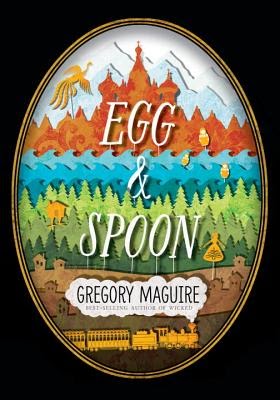
Egg & Spoon

by Gregory Maguire
First sentence: “The heels of military boots, striking marble floors, made a sound like thrown stones.”
Support your local independent bookstore: buy it there!
Review copy provided by the publisher.
Content: There’s nothing objectionable, but it’s a bit long and slow for all but the most advanced middle grade readers. It’s not a Teen book, either, so it’s ended up in the no-man’s land of YA books (grades 6-8) at the bookstore. I’m wondering how it would go as a read-aloud, though.

Elena Rudina is a peasant in pre-Revolution Russia. Her father died in a freak accident, and her mother never quite recovered from that. Her oldest brother is a servant in the baryn’s household and is away in Russia. So when her other brother gets conscripted into the Tsar’s army, Elena decides she needs to do something about that.

Ekaterina is the daughter of semi-noble parents who have dropped her in a London boarding school and gone off gallivanting around the world. The only person who cares about her is her Great-Aunt Sophie, and she’s determined that Ekaterina is going to show up at the Tsar’s party for his godson and be presented as a possible match, which is something Ekaterina does not want.

So, it was quite fortuitous when Elena and Ekaterina meet by accident — the train stops in Elena’s village when the bridge is out — and then (again by accident) switch places. Each get exposure to a different world and are led on the adventure of a lifetime.

I really wanted to like this one. And I did, sometimes. I loved Baba Yaga in all her snarkiness. (In fact, I bookmarked a bunch of her lines. Like: “You’re not going to drink the Kool-Aid?” and “Dumb Doma remodels itself. A nasty habit, like binge shopping.” and “No wonder they call these fairy tales. Tolstoi woudl know better, and a fast train comign into a station would be involved. Blood, tears, regrets. All the fun stuff.”) I sometimes liked the adventure that Elena and Ekaterina were having. (Madame Sophia ended up being a favorite of mine as well.) But, something seemed… off… about this one. Usually I don’t mind intrusive narrators, but this time, he (though I wonder why Maguire chose that particular narrator) was annoying enough that I just wanted him to go away. And that (along with Baba Yaga) got me wondering if this is really a kids’ book, or rather a book for adults who like kids’ books. I found myself hard-pressed to come up with a kid who would enjoy this.

It reminded me most of The Girl Who Circumnavigated Fairyland in tone and style (though it’s much, much longer), And K really liked having that one read aloud to her. So, maybe there is some hope for this one. I just wish I liked it better.

Poisoned Apples

by Christine Heppermann
First sentence: “The action’s always there.”
Support your local independent bookstore: buy it there!
Content: There’s some mild swearing and one (very well placed) f-bomb. The content is about female empowerment, so if you give it to younger readers, be ready for questions. (Not a bad thing at all!) We have a kids poetry section at the store, but this doesn’t really fit. I could put it with the adult poetry but it might get lost. So, I might just shelve it in the YA section (grades 6-8), though it could go for any age.

I picked this up because Anne Ursu (whose work I’ve enjoyed, and who is fast becoming one of my favorite people on Twitter/Tumblr) told me I needed to. I don’t generally read poetry; I’ve never quite “gotten” it, and I don’t particularly want to curl up with a collection of poetry. But I couldn’t resist the draw of modern fairy tale retellings, even if it was poetry. (Plus: Anne Ursu!)

I didn’t know what to expect, but what I got was a weird, wonderful, empowering collection of poems. Hepperman mixes fairy tale retellings with modern issues, from anorexia and photoshopping to the everyday over sexualization of women. It’s a seamless transition from fantasy to reality. One of my favorites was “Retelling”, which is about what the miller’s daughter should have done. Thankfully, Heppermann got a bunch of people to read this, so you don’t have to listen to me sum it up.

But my favorite, the one I texted a picture to M about, was this:

But what really makes this book (aside from the awesome poems) are the weird and wonderful photographs that accompany the poems. They add a fantastical element that just makes this slim collection absolutely perfect.

C has already devoured this several times over and has declared that we need to own it. I agree.

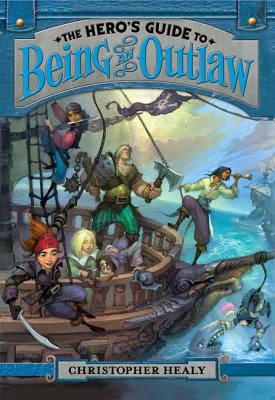
The Hero’s Guide to Being an Outlaw

by Christopher Healy
First sentence: “Outlaws have too many feathers in their hats.”
Support your local independent bookstore: buy it there!
Others in the series: The Hero’s Guide to Saving Your KingdomThe Hero’s Guide to Storming the Castle
Content: There’s some kissing, a bit of violence (and almost violence), and it’s long for a middle-grade novel. It’d be in the middle grade section (grades 3-5) of the bookstore; don’t let the length fool you; it goes fast.

I don’t even remember what our Fair Heroes were doing at the end of the second book. But, honestly: it doesn’t matter. I fell right back into the silly stupidity (and I say that with all loving kindness in my heart) of this book, snorting and giggling as The League of Princes (and the Ferocious Female Freedom Fighters — or FFFF) try to save the Thirteen Kingdoms from Lord Rauber’s (who they thought they killed in the last book) evil plan to take over the world.

The point to the book, I think, is not the plot. Sure, there is a plot: The whole gang is branded as outlaws because they were supposed to have murdered Briar Rose (sure, she’s annoying, but they wouldn’t literally kill her. Only figuratively) so everyone’s on the run and trying to prove their innocence. But the point is for the guys to be dorky (ah, Duncan), the girls to be awesome (bonus: pirate captain Jerica! Double bonus: Gustav trying to flirt), and for super-silly jokes and asides (like the prisoner Val Jeanval. Get it??). Yes, it was stupid. But, I love it.

Full of action (and stupid jokes), and perfect for just about anyone who doesn’t mind a bit of fairy tale adventure.

Graphic Novel Round-up, May 2014

Hilda and the Bird Parade
by Luke Pearson
Support your local independent bookstore: buy it there!
Content: It’s a bit intense at parts, with Hilda getting lost and some interesting monsters. But that’s it. It’s in the middle grade graphic novel section of the bookstore.

I don’t think this was a first in a series — googling Luke Pearson led me to a number of other Hilda titles. But it’s a perfect place to start. Hilda is a spunky, blue-haired girl who has been raised in the mountains before her mother moved them to Trolberg. Hilda doesn’t like the confines of the city, mostly because her mother never lets her go anywhere anymore.

Then, on the day of the Bird Parade, Hilda is invited out by some classmates. They take her to all of the (not-so) cool spots, but she bails on them when they start throwing stones at a raven. She rescues the raven, who 1) happens to talk, and 2) has amnesia. They wander the city and have adventures while the raven tries to get his memory back.

That plot summary doesn’t do Hilda any justice. It’s an absolutely adorable book. Sweet and fun, full of action and adventure as well as playing off of Norse myths (which seem to be the in-thing these days). I loved it, K loved it, Hubby loved it. I’m definitely going to get more Hilda books and see what other adventures she has.

Fairy Tale Comics
edited by Chris Duffy

Support your local independent bookstore: buy it there!
Content: Fairy tales, in their original form, are quite violent and weird. While this collection tones it down, there’s still some violence and weirdness. That said, K didn’t have any problems with it, though she didn’t “get” some of it. It’s in the fairy tale section of the bookstore, but I’m wondering if it’d get more exposure with the middle grade graphic novels.
Fairy tales are weird. (Or as the narrator in A Tale Dark and Grimm would say, “awesome”.) And what better way to showcase the weirdness than to get a bunch of illustrators to reinterpret ? different fairy tales in graphic novel form?
On the one hand, this is a terrific way to get reluctant/struggling readers interested in fairy tales. K picked it up, and thoroughly enjoyed perusing the pages, reading all the stories. Also, in its favor, there is a Japanese folk tale, a Br’er Rabbit story, and  tale from 1001 Nights, though it was too heavy on the Grimm for my taste. Even so, some of the tales were cleverly re-imagined — The 12 Dancing Princesses (Emily Carroll), Give Me the Shudders (David Mazzucchelli), Little Red Riding Hood (Gigi D. G.), and The Boy Who Drew Cats (Luke Pearson)  were among my favorites.

Others, though, were not as well done. Snow White (Jaime Hernandez) was just weird (then again, so is the fairy tale) and Rapunzel (Raina Telgemeier) disappointingly “borrowed” from Rapunzel’s Revenge/Tangled. I think I was also hoping for more of the unusual ones, Snow White and Rose Red or something from Hans Christian Anderson, or my favorite French tale The White Cat. It was very much, for the most part, the known tales retold, and while that was all fine and good, I was hoping for something… more.

The Lost Boy
by Greg Ruth
Support your local independent bookstore: buy it there!
Content: This has gone back and forth between the teen graphic novels and the middle grade graphic novels. It’s not as kid-friendly — it’s intense, and a bit difficult for the eye to follow — as some others we have in middle grade, but it’s a bit simplistic — it’s a straight-up fantasy-adventure — for teen.

When his family moves into a new house, Nathaniel Castle (just call him Nate) has no idea what’s in store for him. When, under a loose floorboard, he finds an envelope with his name on it next to an old-fashioned tape recorder, he can’t resist the odd message — Find Him — and the lure of a mystery. Little does he know that he will be dragged into solving a 50-year-old disappearance of a local boy, Walt, and be immersed in a world where dolls and insects talk, and a mysterious force called the Vespertine is trying to take over.

The art in this one is gorgeous: done in shades of black and white, it’s realistic, even in the fantasy elements. No cartoons here. And that gives it a seriousness that I don’t think the story would have otherwise had. It’s quite eerie and chilling in parts. That said, it’s also a straight-up adventure; the hero does win the day, with some help of his friend Tabitha, and all is happily-ever-after, even though there’s a slightly ominous coda.

I do hope Ruth writes another one, though. I’m quite fascinated by this world he’s created.

Explorer: the Lost Islands
edited by Kazu Kibuishi
Support your local independent bookstore: buy it there!
Content: There’s some weird stuff going on, but none of it is inappropriate for the younger reader. (K handled it just fine.) It’d be in the middle grade graphic novel section of the bookstore, if we carried it.

I picked this up solely because of Kibuishi’s name (why, yes, I AM waiting impatiently for the next Amulet installment) without knowing anything about it, or this series. (I guess it is a series, since this says Book 2 on it..) It turns out it’s a series of short stories from a handful of artists on a theme, this one being “islands”.

Like any other short story collection (see above!), it’s a wide range of stories ranging from the silly — a group of bunnies on an island who work until someone invents a robot that will do all of their jobs (but it has disastrous results) to the weird — Kibuishi’s Moby Dick-esque story or Chrystin Garland’s weird devil-party (I know there’s a term for this, but it’s escaping me. There were touching ones — particularly “Desert Island Playlist” from Dave Roman & Raina Telgemeir, that illustrates how the past, present, and future are all necessary in one’s life. Or “Loah” by Michel Gagne, which is a gorgeously illustrated story of how differences matter.

It’s a good solid collection, and it makes me want to hunt out the first one in the series to see what the theme and stories are. A great introduction, too, to a wide range of artists.

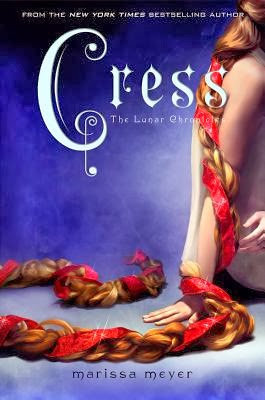
Cress

by Marissa Meyer
First sentence: “Her satellite made one full orbit around planet Earth every sixteen hours.”
Support your local independent bookstore: buy it there!
Content: Some violence, none of it gruesome. It’s shelved in the YA section (grades 6-8th), but I’d have no problems giving it to a capable younger reader.
Review copy given me by our MPS rep, who likes to enable my addictions.
Others in the series: Cinder, Scarlet

Obviously: If you haven’t read the other two, there will be spoilers.

So, our fearless (of sorts), rag-tag crew of a cyborg, a scruffy-looking nerfherder of a pilot, a disembodied android, a human girl, and a Lunar wolf-man operative are on the run from the Commonweath government. What are the most-wanted on Earth supposed to do? Especially when there’s an insanely evil queen who’s trying to take over the world by marrying the super-hot emperor? (“Tyrone, you know how much I love watching you work, but I’ve got my country’s 500th anniversary to plan, my wedding to arrange, my wife to murder and Guilder to frame for it; I’m swamped”) Well, hang out in space, of course. And then go rescue Rapunzel in her tower. Or Cress in her satellite, that is.

Except the rescue operation goes wrong, and our group of rag-tag outlaws are split up. Scarlet ends up on Lunar (and doesn’t figure much in the story), Cress and Captain Thorne end up in the satellite, crashing in the Sahara desert. And Cinder, Wolf, and the New Guy end up looking for the crazy Dr. Erland. As the plot thickens….

C’s biggest complaint with this one was that there were too many plot lines. Which is true, to an extent. Meyer is juggling a LOT of balls here. And there are at least 5 (if not more) story threads running through the book. BUT. I thought she managed all her threads well. With the exception of Scarlet, who really wasn’t interesting until nearly the end of the book (oh, but then her story line is tantalizingly interesting, setting up the last book in the series, Winter, well), I thought what all the characters were doing were fascinating. My favorites — probably goes without saying — are the two MAIN main characters in this one, Cress and Thorne. I adored Cress as a character: she’s a bit insecure around people, having been trapped in a satellite for 7 years. And she’s a total fangirl. But she’s also a smart hacker, and a resourceful and determined (if a bit naive) girl. And Thorne, well, let’s just say Thorne is that perfect mix between all the roguish bad good guys in all the books and movies I’ve ever loved. (It’s hard NOT to have a crush on him.)

And even though Cinder’s finally coming into her own, and there are some brilliant moments, it’s still a middle book in a series. It doesn’t stand as well on its own as Scarlet did, but I wasn’t disappointed with where the story is going. Meyer has created a terrifically interesting world, and is doing some fun things mixing the fairy tales in with the cyborg/futuristic elements. I can’t wait to see how it all ends.