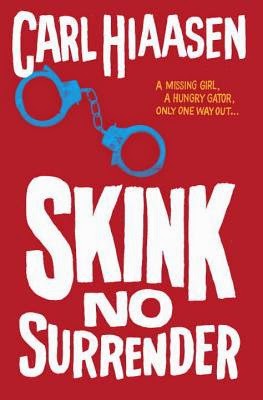
Skink No Surrender

by Carl Hiaasen
First sentence: “I walked down to the beach and waited for Malley, but she didn’t show up”
Support your local independent bookstore: buy it there!
Content: Even though the reading level isn’t very difficult, the nature of this book solidly lands it on the YA (grades 6-8) shelves. Not for the young or the faint of heart.

Richard has grown up in a little beachside town in Florida his whole life. And it hasn’t been a bad life; even though his father died in a freak accident a few years ago, Richard has his mother, older brothers, an okay stepfather, and his best friend — his cousin Malley.

Richard and Malley had a long-standing nighttime ritual on the beach: walking and looking for turtle nests. Then one night, two things happen: Malley doesn’t show up, and Richard meets former-governer-turned-ecoterrorist Clint Tyree, otherwise known as Skink.

It turns out that Malley has run away with a guy she met online in a chat room. And even though it started out okay — there was video of her willingly getting in his car — it took a turn south. And the people on tap to rescue her? Richard and Skink.

I wanted to like this. And sometimes, I did. I really did laugh at the oddness of Skink, at the adventures that Richard found himself in. But I couldn’t get past the whole SHE RAN AWAY WITH A GUY SHE MET IN A CHAT ROOM problem. And it’s corollary: SHE NEEDED A GUY TO RESCUE HER. Aren’t we past all this? I do have to give Hiaasen one bonus point: when the guy tried something on Malley she punched him in the nose, breaking it. She also said that he needed to be caught and punished because the next girl might not be as strong as her. So, she’s not completely helpless. And Richard rescued her not as part of some macho thing, but because he truly cared for her. So, there’s that as well.

And I did like the environmental trivia that Hiaasen threw in, as well; he really does make Florida come alive. So, I didn’t hate the book in the end. I just wish there was a better premise for it.
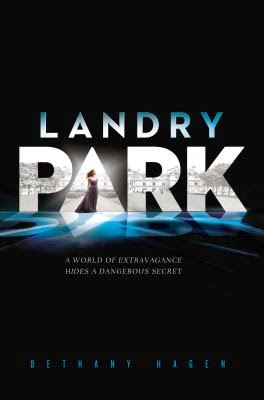
Landry Park

by Bethany Hagen
First sentence: “Two hundred years ago, America found itself at a crossroads.”
Support your local independent bookstore: buy it there!
Review copy snagged from the ARC shelves at work.
Content: There’s some talk of violence, though it’s all offscreen; a few mild swear word; and an illusion to an affair. It’s in the YA section (6-8th grade) of the bookstore, but I’d have no problems giving it to a younger child if they were interested.

Madeline Landry has grown up in a luxurious world: she’s the only child of an elite family and surrounded with opulence. She’s not particularly happy: she has struggles with her father over her education. She wants to got to university; he (and his will, not to mention the law) wants her to stay home, get married, run the estate, and pop out an heir. But she’s not entirely unhappy either: she loves her family and her home and the life. That is, until David Dana — the un-landed son of a gentry — comes into her life. Then, the things that have been skirting around her life — the class issues, the environmental concerns, especially with the lowest class, the Rootless — come front and center. Not to mention that David’s pretty dreamy.

In many ways, Hagen is treading the same ground as every dystopian book before her. America falls to the Eastern Empire, only managing to hang on by a thread. In the aftermath, a class system is formed — not based on race, as Hagen is so careful to point out — based on money and influence. And at the bottom are the Rootless, who handle the nuclear charges the gentry’s energy — and much of the wealth, especially the Landry wealth — comes from. And they’re getting restless. Where Hagen’s dystopian diverges from the pack is in the focus: Madeline is one of the elite, not the underclass. And when she has her eyes opened, she stands to lose everything. And I respected that.

I also really loved the world Hagen built, even though she never really gave us an explanation why the women were corseted and shoved into ball gowns and paraded around like it was Victorian England. I’m sure I could come up with some hypotheses — fancy dresses are synonymous with wealth? the women are as shackled as the Rootless? — but they are just that. No matter: Hagen is tackling issues that aren’t (readily, I think) usually seen in dystopia. Also, she doesn’t have a Romeo & Juliet love story going on here: both Madeline and David are from the gentry, and have to come to terms with their increasingly dissenting opinions.

It’s not a perfect beginning, but it is an intriguing one. I’m going to be curious to see where the rest of this series goes.

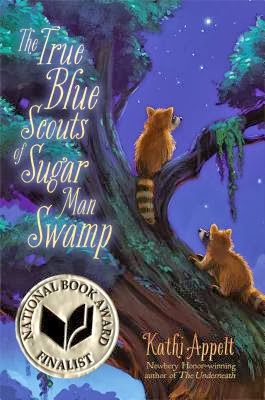
The True Blue Scouts of Sugar Man Swamp

by Kathi Appelt
First sentence: “From the rooftop of Information Headquarters, Bingo and J’miah stood on their back paws and watched Little Mama and Daddy-O trundle away; their stripy gray and black silhouettes grew smaller and smaller in the deepening dusk.”
Support your local independent bookstore: buy it there!
Review copy snagged from the ARC shelves at my place of employment.
Content: There’s a few difficult words but it’s pretty appropriate for anyone. It’s in the middle grade (3-5th grade) section of the bookstore. I think it’d make a great read aloud for younger kids as well.

Bingo and J’miah are the two newest members of the Sugar Man Scouts. Like their ancestors before them, they are the raccoons that keep an eye on the Sugar Man Swamp, listening to the Voice, and keeping ready to wake the Sugar Man in case they need to.

I suppose I should back up and say that Sugar Man Swamp is in Texas (not Louisiana, which is where I thought it was for half the book and where I am convinced it should be) and in it grows this amazing sugarcane. From which Chap Brayburn and his mom make fried sugar pies. Which should be famous, but aren’t because they are off the Beaten Path.

And so, they owe lots of money to a nefarious businessman named Sonny Boy, who wants to sell the swamp to a ‘gator wrestler for a theme park.

Oh, and did I mention that a gang of wild hogs are on the rampage?

That kind of gives you a taste for this tale. And it is a tale. In fact, the narrator was bugging me — it’s a pretty intrusive narrator — until  I realized that this is the sort of book that begs to be read aloud. Once I imagined myself listening to this story, perhaps told by a fantastic storyteller with a fabulous Southern accent, then the book came alive for me. I understood the humor, I understood the whimsical nature of the characters, and — honestly — I fell for it.

It’s not perfect — it’s probably a bit longer than it needed to be — but it’s very, very good. And charming. And enjoyable.

And that’s enough for me.

(Just for the record: because this is a Cybils nominee, I’ve been asked to make sure y’all know this is my opinion only, and not that of the panel.)

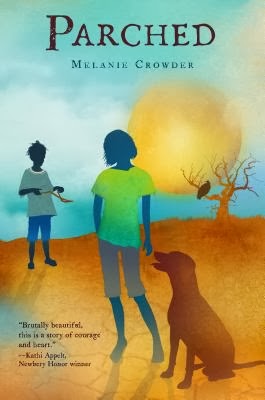
Parched

by Melanie Crowder
First line: “Sniff-sniff.”
Support your local independent bookstore: buy it there!
Content: There’s some harsh situations — a character was kidnapped and brutally treated, another character is shot and killed — but there’s no swearing at all. It’s not an action-packed book, so even though it’s on a 3-5th grade writing level, I’d be picky about which kid to give this to.

The world has turned to dust. Water is hard to find. And that makes anyone with water — or who can find water — valuable. Sarel’s family had water, until the gangs came through and killed Sarel’s parents and burned the compound to the ground. All that’s left is Sarel and the dog pack her father trained. It’s not a good thing; Sarel is running out of the little water she has left. Musa has a talent for dowsing, and has been kidnapped (or sold; I was never quite sure) to the gangs to find water. One night, Musa escapes, and finds his way to Sarel’s compound. It’s up to the two of them to work together to survive.

As you can tell, there isn’t much to this slim (seriously: it’s 152 pages.) novel. It’s highly introspective, more narrative than anything else. Even with the tension mounting to the end, it’s a quiet book about survival. I liked it, but I never really connected with it. Some of that was the quietness of it all. But it was also that I wanted more. I am not saying I needed a 300 page action-filled book, but I finished this one feeling like there was something missing. There wasn’t quite enough to it. I wanted more about how the world ended up parched. More about Sarel and her past. More about Musa and his talents. (Though I didn’t want more dog.) I wanted more connection between the characters. And the ending kind of came out of nowhere to me: I wanted answers as to how the book got to that point.

That said, the writing was gorgeous. And I have to give Crowder props for setting a dystopia book in an African-feeling setting. But it just wasn’t all I wanted it to be.

(Just for the record: because this is a Cybils nominee, I’ve been asked to make sure y’all know this is my opinion only, and not that of the panel.)

Hoot

by Carl Hiaasen
First sentence: “Roy would not have noticed the strange boy if it weren’t for Dana Matherson, because Roy ordinarily didn’t look out the window of the school bus.”
Support your local independent bookstore: buy it there!
Content: There were a few mild swear words (which A found amusing), and some instances of bullying and domestic violence. It feels like a genuine middle grade book, with real middle grade heroes (yay!) and happily sits in the middle grade (grades 3-5) section of the bookstore.

Ah, Florida. The air is hot and humid, it rains a ton, and Roy Eberhardt hates it. With a burning passion. He most recently lived in Montana, the land of the huge vistas and great snowboarding, but because of his dad’s job, he’s stuck in boring Florida. Until the day he notices a strange boy with dirty feet running away from the bus stop. His curiosity piqued, Roy follows the boy and discovers Something To Care About. See: Mother Paula’s Pancake House is building a new restaurant. On top of some burrowing owl dens, and the boy is bound and determined to stop the company. And Roy, for better or for worse, finds that he Cares enough to get involved.

I remember reading this ages ago — probably when it first came out — and liking it. Though, I seem to remember it being funnier than I found it this time. It was amusing, sure, especially when Bully Dana Matherson gets his come-uppance at the hands of Beatrice Leep, Tough Girl Extraordinaire. But, mostly, it’s a quiet book about Making A Difference. I like how Roy finds out that while vandalism is one way to get a corporation’s attention, there are other — possibly more effective — ways of handling it. It’s not only a fun book, it’s a lesson in civics and awareness. There are layers of complexity; Roy is bullied (a lot) and there’s some domestic issues with Beatrice. But Hiaasen did it without being preachy; this is NOT an issue book.

Which, honestly, is a mark of a talented writer. And for that reason alone more than worth the time it takes to read it.