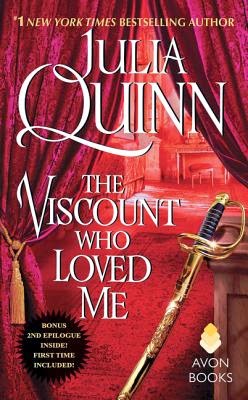
The Viscount Who Loved Me

by Julia Quinn
First sentence: “Anthony Bridgerton had always know he would die young.”
Support your local independent bookstore: buy it there!
Content: Um… yeah…. it’s definitely an Adult book. *blush*

I’ve always said that I prefer plot and character development with my sex (in books). So, I went into this one (a YAckers read, of course) with hopes that it would be, at the very least, entertaining.

And, thankfully, I was rewarded. (Yay!)

The basic plot is was this: Anthony Bridgerton is a rake of the worst sort. It’s 1814, in the height of the Jane Austen era, when chaperones were needed and etiquette was severely structured, and Lord Bridgerton is running around making love to all sorts of women. (Unsavory women, too!) So, of course Kate Sheffield was not going to let him any where near her sister Edwina (seriously: WHAT KIND OF NAME IS EDWINA?), even though she’s the catch of the season and Bridgerton has got it into his head to marry. And everyone knows he gets what he wants.

Except, what he wants turns out to be Kate. *wink wink* *nudge nudge*

And that’s about all the plot there is. There’s a lot (a LOT) of sassy banter between Kate and Anthony and a lot (a LOT) of innuendo and under-the-surface desire before he’s caught with his mouth on her breast, sucking the “venom” out of a bee sting (at which point I was howling with laughter), and they were forced to marry. And then the real fireworks started. Two whole chapters of a sex scene (why was there a chapter break in between?) in which Anthony desires his wife and she lets him have his way with her. (I am SURE there’s a feminist objection here, but honestly, I couldn’t see it for the blatant disregard for the time period.) It was bad. It was so horrible and awful and blush-worthy, I couldn’t stop reading. It was just so bad it turned the corner into good. (Or at least deliciously mock-worthy.) Everyone murmured.   Or had husky voices. It was just too, too delightful.

There were some honestly good bits along the way. I really enjoyed the Bridgerton dynamic as a family: there’s a croquet game that was honestly a lot of fun to read. And Quinn made them a close-knit, loving family which is not something you often see. And there was a bit of depth in both Kate and Anthony; Quinn did manage to give them some fears and insecurities, so they weren’t completely one-dimensional.

Not usually my type of book, but it ended up being a great diversion.

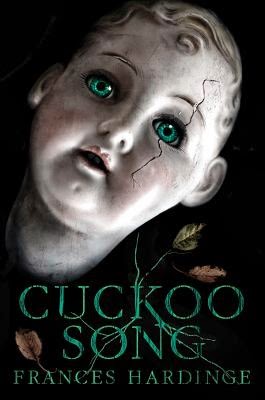
Cuckoo Song

by Frances Hardinge
First sentence: “Her head hurt.”
Support your local independent bookstore: buy it there!
Review copy left for me by the publisher rep.
Comtent: It’s more than a bit creepy, and it’s slow (like many Hardinge) books. I’ll probably put it in the YA section (grades 6-8), but I’d give it to a 10-year-old who showed interest and was willing to be patient with it.

I have not read everything Hardinge has read, but what I’ve read I’ve (almost) wholeheartedly loved. She is not an easy author to love; she makes you work for the story, often having a very slow start and building from there. Cuckoo Song was no different in that respect. It was a slow and somewhat confusing beginning, one that took me a bit to get into.

Triss has been ill for a good long while. She is Delicate, and often prone to Sickness. And so when she wakes after an accident during her family’s vacation no one seems to think that anything is the matter. Except she feels like something is … off. And her younger sister, Pen, (with whom she has always had a contentious relationship) is screaming awful things at her.  And so Triss does what any 12-year-old would do: she tries to figure out what’s wrong with her. And the deeper she goes into that mystery, the more she discovers that there are things Wrong with her family in some very dark (and somewhat magical) ways. And it’s probably up to her and Pen to fix things.

I don’t want to give away too much because much of what I loved about this was the slow realization of what was going on. There’s a reason the beginning is slow and confusing: Triss, herself, is slow and confused. The reader figures things out as Triss does, peeling one glorious, dark, delicious layer back after another. And no to worry: once the story really gets going, Hardinge’s writing is so lyrical it pulls you in, increasing the tension until the immensely satisfying ending.

It’s absolutely wonderful.

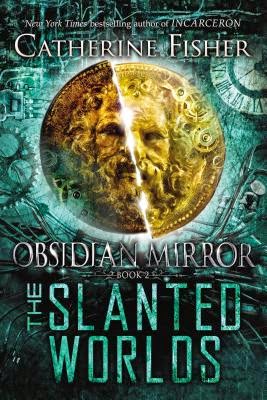
The Slanted Worlds

by Catherine Fisher
First sentence: “The Bomb fell in a split second of silence.”
Support your local independent bookstore: buy it there!
Others in the series: Obsidian Mirror
Content: There’s some violence and (much like the first one) this takes some effort to follow. Not for the reluctant of readers. It’s in the YA (Grades 6-8) section of the bookstore.

A few spoilers for the first one, obviously. You’ve been warned.

Both Jake and Venn have become increasingly desperate to use the mirror, to make it work right. Jake, in order to find his father. Venn, because he wants to turn back the clock to get his wife back. Neither of them know of the outside forces controlling the mirror — that’s a knowledge known intimately to Maskelyne, an old, old time traveler, who may have been the one who invented the mirror — but both are willing to do whatever it takes to keep the mirror safe, and bring back the ones they love. Including involving Summer, the leader of the Shee, the fae-like creatures.

I have realized while typing the above that I could recount the plot of the entire book and it probably wouldn’t make any sense to those who haven’t read it.

There are other factors, as well: Sarah’s still around, trying to destroy the mirror and rid the world of Janus, and she’s willing to involve the Shee as well.  In fact, the Shee is the wild card here: Summer is the chaotic evil here, working toward her own end, but we have no idea what that end it.

There’s a lot of wibbly wobbly timey wimey stuff in this book, time looping in and back and forward on itself in incredibly fascinating ways. Jake is the real focus of the book; its his quest to find his father that we follow most closely. It was a good thing to focus on one arm of the conflict, though I did miss having Sarah around.

But at the end, I was left wondering: how is this all going to come together in the next book? How are we going to resolve the tension between needing to rescue those trapped in time and the need to destroy the mirror to save the world?

I suppose I’m just going to have to read the third one and find out.

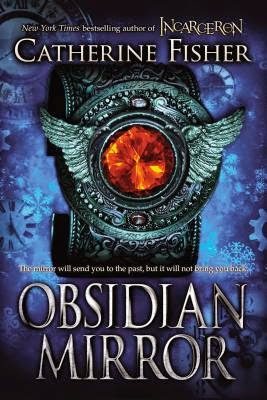
Obsidian Mirror

by Catherine Fisher
First sentence: “The boy put on the mask outside the door.”
Support your local independent bookstore: buy it there!
Content: Nothing objectionable, but it’s slow to start and is a  bit confusing. Not for the reader who gives up easily. It’s in the YA (grades 6-8) section of the bookstore.

This has been on my shelves for a long time. Seriously. I had the ARC, but gave that up, and finally, again, decided that I really needed to read this one. And I was in the mood this past weekend to indulge myself.

I shouldn’t have put it off. (Or maybe I should have: I’ve got the second one waiting to be picked up at the library. Shhhh. I know I said I wasn’t going to. But it’s CATHERINE FISHER.)

There’s three parts to this story. One is Oberon Venn, a very wealthy explorer who has spent the last two years in a depression because he was he cause of the accident that killed his wife, Leah. He will do anything to get her back. Including time travel. He and his trusty slave — there’s more to that than meets the eye — Piers are hidden out at Venn’s estate, trying to do just that: travel through time through the Obsidian Mirror.

The second player in this drama is Jacob, the son of Venn’s best fried. Who is missing and presumed dead. Or at least that’s what Jake thinks. So he’s headed, along with his unsuspecting teacher, Wharton,  to Wintercombe Abbey to force answers from Venn. Little does he know the web he will be tangled in.

The final player is the most complicated one: Sarah is possibly an escapee from an insane asylum. Or perhaps she’s a traveler from the future, a future where the mirror has destroyed the world, in order to destroy the mirror and prevent Venn from bringing his wife back.

There’s so much going on in this one, it’s hard to know where to begin. Yes, it’s slow and incredibly confusing to start with. I kept thinking “HUH?” But, I know Fisher’s work, so I stuck it out, and was richly rewarded. It’s time travel mashed with a mystery mashed with faery stories (yes, the Fey show up, and play a role), and if you give it time, it will begin to play out — it’s the first of a trilogy — in some incredible ways.

I can’t wait to read the next one.

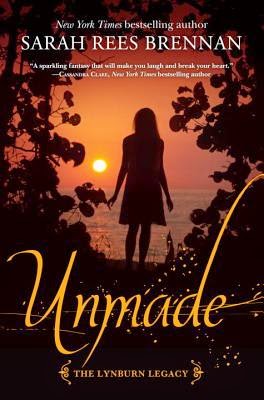
Unmade

by Sarah Rees Brennan
First sentence: “Kami Glass was standing to close to the fire.”
Support your local independent bookstore: buy it there!
Others in the series: Unspoken, Untold
Content: There’s a lot of violence, some of it brutal, plus some almost sexytimes. Not enough, however, to move it from the YA section (grades 6-8) of the bookstore.

Remember last time when I said the book was a bit of a middle book, and that the ending had me excited for the conclusion? (No? Well, neither did I?) Even so, I was able to fall back into Sorry-in-the-Vale with the Lynburns and Kami Glass with all her snarky confidence and contagious hope with ease.

Rob Lynburn has all the cards, all the power. And that has made Jared and Ash and Kami and their “side” quite desperate. Desperate enough to do desperate and dangerous things. This is an epic battle, a long, slow buildup to an intense climax. And interspersed in all that is heartache and love, loss and life, and a lot of heart.

This is a series, I think, that demands to be binge-read. And, thankfully, now you can. Sit down over a long weekend (like… Thanksgiving!) and immerse yourself in this deep, complex, wonderful world Brennan has created. Enjoy the characters, the good vs evil, the humor, the mystery, all at once without the wait.

I wish I could have. I enjoyed this book, but I think I would have enjoyed it SO much more had I read them all at once.

Audiobook: Keeping the Castle

by Patricia Kindl
Read by Biana Amato
Support your local independent bookstore: buy it there!
Content: There’s nothing objectionable, but my 8-year-old was quite confused while listening to it. So, it’s probably not for the younger set, just because of intricate plot lines and needing at least a working knowledge of Regency England. It’s in the YA section (grades 6-8) of the bookstore.

Althea Crawley has always known that she needed to marry well. Her father died shortly before her younger brother (and her father’s heir), Alexander, was born. The castle — in the north of England, on a cliff, and their home — her great-grandfather built is slowly falling apart (well, maybe not so slowly). And so when Lord Boring (yes, that really is his name) shows up in the neighborhood, Althea knows what she must do: get him to marry her. Unfortunately, his crass, merchant, cousin, Mr. Fredericks, keeps getting in the way.

The jacket compared this one to I Capture the Castle and Pride and Prejudice. The Capture the Castle part of it is silly: the only things those two books have in common is a young heroine and a castle. However, the book read like a spin on all of Austen’s books. There were elements of Emma and Sense and Sensibility as well as P&P. It’s a more practical Austen, however: Kindl gives us a more confident and curious and modern heroine than Austen ever did. And Kindl gives us more blatant class divisions than Austen did, as well. The love interest is a merchant, and falling in love with a merchant, even a  wealthy one, is something which a landed gentry in Austen’s world just wouldn’t do. In fact, there’s quite a few interesting elements that probably existed in Austen’s time but didn’t overtly make it into her books. As we were listening to it (Hubby quite liked it, too), it occurred to me that this is Jane Austen-lite: an Austenesque books for kids who are curious but can’t quite make it through Pride and Prejudice.

The back did have this right: it is frothy and light as a champagne cocktail. It’s not deep — we were discussing all the ways in which Kindl could have made it more complex and darker than it was — but it sure is fun.

Rose Under Fire

by Elizabeth Wein
First sentence: “I just got back from Celia Forester’s funeral.”
Support your local independent bookstore: buy it there!
Content: there were a lot of f-bombs (I didn’t count them) that came up once at the concentration camp (understandable) and other mild swearing throughout. Also a number of disturbing images and content (Nazi concentration camps don’t make for Light Reading). It is most definitely one I wouldn’t hand to a kid under the age of 13 or 14 (depending on their maturity handling Difficult Situation), whether or not they were on the reading level, so it’s shelved in my Teen section (grades 9-12) at the bookstore.

I don’t quite know where to start with this one. Once I discovered it was a Holocaust novel (as opposed to just a WWII novel), I put off reading it. I don’t like Holocaust novels, mostly because I don’t like being confronted with the evil things the Nazis did. But, because it was Elizabeth Wein, and because it’s a companion to Code Name Verity, I bravely gave it a shot.

And I found myself sucked into the world of women pilots, of strong, resilient women who know how to survive. It’s odd to say this about a Holocaust book, but I loved it.

Rose Justice is an American who has pulled strings to get enlisted as a transport pilot for the RAF. She’s doing her duty, blissfully unaware of the evils of the Nazis. Sure, they’re the Enemy, but the can’t be as horrible as they all say, right? Then, on a mission, she chases after a flying bomb (German pilotless planes loaded with bombs), gets lost over enemy territory, and ends up in Ravensbrück.

Even I, who actively avoids anything Holocaust, know about the horrors of Ravensbrück.

And yet, even though Wein captures the horrors, and the crimes, and the terribleness (I can’t seem to find a word strong enough) of Ravensbrück, it isn’t a hopeless, dark book. Even though Rose is changed permanently by her six months (only six measly months! How did people survive years there?), she retains her will to survive. And Wein has created a cohort of strong, amazing, wonderful (again, there is no word strong enough) women who do just that: survive. It’s amazing — and inspiring — to read.

I’m so glad I did.

Untold

by Sarah Rees Brennan
ages: 12+
First sentence: “Welcome to Sorry-in-the-Vale.”
Support your local independent bookstore: buy it there!
Others in the series: Unspoken
Review copy greedily stolen from the package the publisher sent to the bookstore, then hoarded on my shelves until I finally devoured it.

To catch up (spoilers for Unspoken, obviously.):
1. Kami’s imaginary friend, Jared, is real.
2. He’s part of an old sorcerer family.
3. Who used to rule Sorry-in-the-Vale
4. His uncle, Rob, is more than slightly batty, and is killing people because blood gives him power.
5. Kami wants to stop him.

In many ways, this is very much a second book in a trilogy. The first was a brilliant set up. This one, while still interesting and laugh-out-loud funny at times,  had the feel that everything is building toward some grand conclusion. Though we never quite get to it in this book.

That’s not to say that it’s a bad book. On the contrary, it’s actually quite good. Even though I felt like I was spinning my wheels — will Kami and Jared get together? Will Lillian ever stop being a Royal Snob?  Will Angela and Holly work out their differences? Will Ash ever grow a backbone? — it was done in a way that I didn’t mind the spinning. At all. It was also because I adore Kami. I hate to call her plucky, but she really is. She’s smart, and determined, and bossy, and willing to do ANYTHING for her family, friends, and town. I love her.

And the ending? Oh. My. Gosh.  If I wasn’t already convinced that endings can make or break a book, I would be now. The ending is brilliant. And painful. Because now I have to WAIT for the next book.

It was worth it, though.

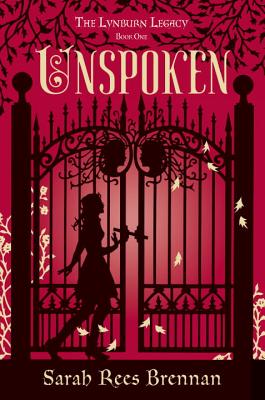
Unspoken

by Sarah Rees Brennan
ages: 12+
First sentence: “Every town in England has a story.”
Support your local independent bookstore: buy it there!

Kami has an imaginary friend.  She has had him in her head, talking to her, keeping her company for as long as she can remember. She’s learned not to talk about him, because people in her small English Village, Sorry-in-the-Vale, tend to think she’s a bit crazy, but he’s there and she’s learned to live with it.

Not for one moment did she ever think that 1) he was really real and 2) he’d show up in her village.

Kami is also an aspiring investigative reporter, something which won me over immediately. I loved her spunk and her gumption, and her Nancy Drew/Veronica Mars/His Girl Friday determination to get to the bottom of the story. Because in Sorry-in-the-Vale there are a LOT of secrets that no one is willing to tell.

To be honest, that kind of bugged me for a lot of the book: the fact that Brennan hinted at secrets, and hinted at secrets, and hinted at secrets, but the reader was as CLUELESS to understanding them as Kami was. I wanted more information, but it wasn’t enough of an annoyance to make me throw the book across the room. No, what kept me reading was the witty writing — the balance between humor, romance, and suspense — and the characters. I adored the girls: Kami, of course, but also her friends Holly and Angela. And the guys weren’t that bad either.

And when the secrets were finally revealed, I understood why Brennan approached it the way she did. She has a way of keeping me engaged, turning pages, until her satisfying-yet-frustratingly-open conclusion.

I can’t wait for the next one!

The Demon’s Surrender

by Sarah Rees Brennan

ages: 14+

First sentence: “Magic was like a special guest in Sin’s life.”

Support your local independent bookstore: buy it there!

There are many things I enjoy about this trilogy (the other two being The Demon’s Lexicon and The Demon’s Covenant): there’s action, there’s romance, there’s magic. It’s a grand package. But the think I think I most enjoy is that every book is written from a different point of view, something which ramps up the tension, and makes even the old information seem fresh.

Take the opening chapter of this book, for instance. It takes us back to a scene that happened in the first book (something which I was grateful for, actually, since my notorious bad memory and I have a hard time remembering details when it’s been a while since I’ve read this book). But it didn’t seem repetitive or even old because Brennan told the scene from the perspective of Goblin Market dancer, and supposed new leader, Sin.

This whole story, with its inevitable climax was told from Sin’s perspective, and that was the absolute right way to tell it. Though it’s not entirely her story, as evidenced by the cover: it’s also very much Alan’s story as well. I’ve come to realize over the course of the trilogy that it’s a complex, messy book: there’s no simple black and white story here. This is something which, at the beginning of every book, I struggle with: I want to trust characters, and there really isn’t anyone to trust. There is a greater good overarching everything, but getting there is in no way simple. I came to realize that, in the end, it’s lust for power, greed, and using people for personal gain (whether that’s just possession or killing) that is the real “bad guy.” Which means there’s a moral to the story, but it’s not one that’s heavy handed or even blatantly obvious. Both marks of excellent storytelling.

That said, there are some delicious characters to hate, some very intense moments, and Brennan knows how to write swoon-worthy romance (and yet not let it take over the book). All of which makes this trilogy worth reading.