The Thing About Jellyfish

by Ali Benjamin
First sentence: “During the first three weeks of seventh grade, I’d learned one thing above all else: A person can become invisible simply by staying quiet.”
Support your local independent bookstore: buy it there!
Review copy provided by the publisher.
Release date: September 22, 2015
Content: It’s longish, but there’s nothing questionable for younger kids. It is a bit on the depressing side, so maybe super-sensitive ones wouldn’t want to read. That said, the science is pretty cool. It’ll be in the middle grade (grades 3-5) section of the bookstore, though the 6-8th grader would like it as well.

Suzy Swanson knows why Franny Jackson died. Sure, everyone has been telling her that it was “just one of those things” when her former best friend drowned in the ocean, but Suzy is convinced that there Needs to be a Scientific Explanation. And she knows she’s figured out what it is: deadly jellyfish stings. So, Suzy sets out to research that, and even plans a trip to Australia in order to come to terms with her best friends’ death. And Suzy’s guilt about what happened between them before.

There’s a LOT going on in this book: dead friend, grief, friends growing apart, bullying, science, divorce…. it was almost too much for me. I ended up focusing on the science aspect of it, which was really pretty cool. I really liked all the jellyfish facts, and the research that Suzy ended up doing on them. I liked that she had a fantastic science teacher (my girls’ 7th grade science teacher was really pretty awesome too) who inspired kids to want to learn.

But other than that, it was just drama and more Drama. Middle school kids are mean, and Benjamin caught that perfectly. I felt copious amounts of pity for Suzy; such an awkward girl, and no one (hardly) had any compassion for her. No wonder she stopped talking.

That said, while the resolution was done well, I never really wholly enjoyed this book. Too much being made uncomfortable by Suzy’s awkwardness and the bullying of the kids around her.

But then, maybe that was the point?
The Little Paris Bookshop

by Nina George
First sentence: “How on earth could i have let them talk me into it?”
Support your local independent bookstore: buy it there!
Content: There’s a few sex scenes, mostly tasteful, though it gets somewhat crude once. There are also several instances of mild swearing. It’s in the adult section for thematic reasons.

Jean Perdu (which is French for lost) owns a small bookshop on a barge floating in the Seine in Paris. His specialty is figuring out what a person needs to read and then “prescribing” the Right Book for the malady. He calls his store the Literary Apothecary and has had some measure of success.

With everyone but himself.

His great love, Manon, left him 22 years ago, and Jean’s life has basically frozen since then. Sure, he’s lived — he’s in his 50s now — but he’s not Lived. And then he meets Catherine, and his life starts unthawing (but not in the way you think at first). He ends up on a boat trip (river trip?) down to the south of France to find Manon’s memory (she died soon after she left him) and to properly grieve.

This book is being billed as a bookish book, and it is in a way. It’s about the power of stories and narrative to help us through all times — both the good and the bad. But, it’s more about the healing power of grief. How, if you don’t let yourself grieve for what is lost then you can never move on, never really live again.

It’s very French, as well.  (A co-worker, who is very knowledgeable in All Things French, mentioned that this is a homage to Jean de Flourette and Manon of the Spring, both of which I saw when I was at BYU and probably should hunt down again.) There’s is a slight magical realism thread through it, in the way Jean could find the right book, to the power of food and company. It gets bogged down in the middle, during the river trip, and Manon’s travel journals, while providing some interesting insight to her and Jean’s relationship, interrupt the flow of the book.

That said, it was enjoyable, though it’s not my favorite bookish book about books.

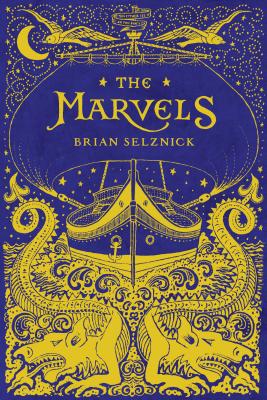
The Marvels

by Brian Selznick
First sentence (which comes about 400 pages in): “Joseph was lost.”
Support your local bookstore: buy it there!
Review copy provided by the publisher.
Release date: September 15, 2015
Content: It’s a huge book, which will be daunting. But 2/3 of it is pictures. And the text section may be a big confusing for younger readers. There is some smoking by adults, but other than that, there’s nothing that would stop me from giving this to a precocious 9- or 10-year-old. It will be in the Middle Grade (grades 3-5) section of the bookstore.

I don’t usually like to write about books months before they come out. But, since this is the first one I finished for the 48 hour book challenge, I figured it was okay.

I’m also going to be coy and not tell you too much about the book. I knew very little about it going in, and I think that’s the best way to experience it.

That said, I liked this one nearly as much as Hugo. It’s about the theater and family and truth in storytelling. Selznick’s art is gorgeous, as always, and even though the text section starts out a bit confusing, stick with it. It’s completely worth it at the end. Oh: and read the afterword. It makes everything that much better.

There’s really not much else to say, except: I can’t wait to share it with everyone else.

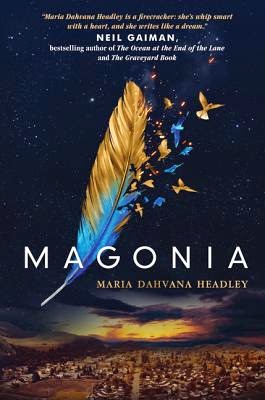
Magonia

by Maria Dahvana Headley
First sentence: “I breathe in.”
Support your local independent bookstore: buy it there!
Review copy provided by the publisher.
Content: There’s a bunch of swearing, including several f-bombs. It’s in the Teen section (grades 9+) but I wouldn’t be adverse to giving it to an 8th grader as long as they knew about the language going in.

Aza Ray has spent the nearly sixteen years of her life struggling to breathe. It’s a miracle she’s even lived this long, since she’s got a weird disease (named after her, unfortunately) that basically renders her allergic to air. She’s managed okay, with the help of her family, and her BFF, Jason. But, now, on the eve of her 16th birthday, things are getting weird. Jason maybe wants to be more than BFFs. It’s getting harder and harder to breathe. And weirdest of all? She’s seeing ships in the sky.

There are spoilers ahead. You’ve been warned. Because, for better or for worse, this is about to get REALLY trippy.

See: Aza Ray is seeing ships in the sky because there’s a country of bird people up there, called Magonia. And Aza is one of them. (Which is, duh, why she’s having trouble breathing regular earth air.) She was kidnapped as a baby and placed in a human home; whether it’s to punish her mother (according to her mother) or to save her (according to the bird-person who kidnapped her) remains to be seen. It’s really because Aza has this super-singing power that will either save Magonia or destroy the world. Or both. The problem is that she just can’t give up her human life (even though she DIED), and she just can’t quite kill off the humans.

I didn’t really know what to expect going into this, except that there’s a bit quote from Neil Gaiman on the cover and that everyone (at least on Edelweiss) is loving it. I completely — pun intended — missed the boat on this one. Seriously. I thought the premise was at best a drug-induced fantasy and at worst stupid. I thought the conversation was trying to hard to be John Green-esque and it sounded forced. I thought the plot was lame, even though it wrapped up nicely, and that the romance between Jason and Aza was forced. And even though I love fantasy, this just was NOT my thing.

But, as I said: it’s getting tons of love, so that may just be me not getting it.

Lost in the Sun

by Lisa Graff
First sentence: “When we were real little kids, Mom used to take Aaron and Doug and me to Sal’s Pizzeria for dinner almost every Tuesday, which is when they had their Family Night Special.”
Support your local independent bookstore: buy it there!
Review copy snagged from the ARC shelves at work.
Release date: May 26, 2015
Content: There’s some bullying, and some tough subjects and a couple of instances of mild swearing. It’ll be in the middle grade (grades 3-5) section of the bookstore, though I would hesitate giving it to the younger end of that spectrum.

Eight months ago, Trent was the cause of a fatal accident. He hit a hockey puck into the chest of one of his friends, who then died. Not really from the hockey puck: his friends had a heart condition that no one knew about, and that’s what caused the death. But Trent is convinced that it’s his fault. And he feels like everyone — well his father, his brothers, and his former friends — blames him for what happened.

Now, on the first day of sixth grade, Trent is completely depressed. Until the “weird” girl, Fallon, decides that they need to be friends. Fallon’s the one everyone shuns, mostly because she has a scar down her face. Everyone asks how it happened, but she keeps the true story close, choosing instead to make up ones. Over the fall, Fallon and Trent deal with his grief, guilt, and anger, as he tries to make life work.

A lot of books deal with grief from dead or sick parents, or dead or sick siblings. But the idea that a kid could be the catalyst for a friend’s death hits home and deep. I thought Graff captured those emotions perfectly, from Trent’s self-loathing to his feelings like everyone hated him. And because we saw the rest of the world through Trent’s eyes, I could tell which adults were reaching out (his homeroom teacher, eventually) and which adults just needed a good smack (his father). The longer Trent’s self loathing went on, the more I was afraid that Graff wouldn’t be able to give Trent a good resolution. But, in so many ways, she did. I was thoroughly satisfied with Trent’s arc, and with the way things weren’t neatly tied up in a bow.

Quite good.

The Trap

by Steven Arntson
First sentence: “The last day of summer break before the start of my seventh grade year was the first time I ever got punched in the face.”
Support your local independent bookstore: buy it there!
Review copy provided by the publisher.
Content: It’s some pretty dark subject matter — kidnapping and out-of-body experiences. Plus there’s romance, but nothing too mature. It’s in the middle grade (grades 3-5) section of the bookstore, though it’ll probably be of interest to the older end (and maybe into the 6th grade).

It’s the summer of 1963, right before seventh grade, and Henry Nilsson is pretty sure nothing exciting is going to happen. His dad is being laid off at the railroad and they’re having to tighten their belts at home (they even sold the TV!). Henry like-likes his twin sister’s best friend, Nikki, but has no idea what to tell him. And his best friend, Alan’s, brother bullying has increased.

Then, two things happen to change the trajectory of Henry’s summer: Alan’s brother goes missing. And they discover a book to teach them how to have an out-of-body experience, called “subtle” travel. Once they figure out how, they enter the subtle world, where things aren’t as nice as they seem. And where there’s some pretty scary things going on in them thar woods.

On the one hand, I enjoyed this one. I liked the historical detail, which was never the point of the book, but rather just background to give it some weight. I liked the friendship between Henry and the rest, including his sister. I liked that both Nikki and Alan were people of color — Nikki is Asian; Alan, Latino — but that it was never really an issue. (Well, it is, once.) I liked the mystery, the discovery of what was going on with Alan’s brother, and the realization that even though he’s often mean, he has some good in him.

What I didn’t like was the whole speculative fiction part of it. The subtle travel was weird (Seriously.) and I was never really able to suspend my disbelief enough to make it work for me. There was just too much left underdeveloped, that was just plain weird.

But, perhaps, those are adult concerns creeping into a middle grade book. It is a dark book, one that’s kind of creepy, and for those who like a slight creep factor to their book, it’s a good one. And perhaps, the positives outweigh the negatives.

The Swallow

by Charis Cotter
First sentence: “There’s no place for me,”
Support your local independent bookstore: buy it there!
Content: It’s kind of confusing and a little bit creepy, though the chapters are short and to the point. It would be in the middle grade (grades 3-5) section of the bookstore.

Polly is lost in a sea of siblings and foster siblings. Her father is a pastor and feels a need to rescue lost children, much to Polly’s dismay. Rose is lost as well, but for the opposite reason: she is the only child of very busy, distant parents who don’t spend much time with her at all. Its 1963 in Toronto, when these two meet, and because they both have an interest in ghosts — well, Rose can see them, so it’s not really an interest — they embark upon a mystery when finding a gravestone with Rose’s name in the graveyard behind their houses.

If that sounds convoluted and sort of strange, it’s because this book is, well, convoluted and sort of strange. I think Cotter was going for atmospheric, but for me it just came off as creepy and weird. And unnecessary. Perhaps it was just me; this was the last of the Cybils finalists that I read, and I was worn out on fantasy by this point. But, the characters seemed wooden, the parents unnecessarily strict or absent, the story too forced for my taste.

The twist that happens didn’t work for me, either.

Which is to say, this was my least favorite. Though, it’s probably just me, and there’s some kid out there who loves twisty ghost stories with shocking reveals.

The Bridge of San Luis Rey

by Thornton Wilder
First sentence: “On Friday noon, July the twentieth, 1714, the finest bridge in all Peru broke and precipitated five travelers into the gulf below.”
Support your local independent bookstore: buy it there!
Content: There’s really nothing, but because it’s a classic, it would be in the adult fiction section of the bookstore.

For my in-person last month, we wanted to read a classic. We looked at this huge long list of modern-day American classics some guy put up (I can’t remember right now who it was or why), and chose this one (mostly because it was the shortest). I know very little about Thornton Wilder; I’ve seen Our Town a couple of times (and never really “got” it) but that was the extent of my knowledge.

This story is a short one, a series of short vignettes about five people who died in a (fictional) bridge collapse in Lima, Peru in 1714. They were loosely interconnected, and the framework is about this monk who spent time researching their stories. I think it was supposed to be about the randomness of life and death, that both good and people can die at any moment and how it really doesn’t matter how you live your life.

Whatever.

Seriously. That’s how I ended up feeling at the end. I read the words, but none of them registered in my brain. I didn’t connect with any of the characters, the plot was nonexistent. I do have to admit that it may have been me (why else would it be on all the “you must read” lists?), because this isn’t the first book lately that I’ve gone “huh?” when I’ve finished. Slumps will do that to you.

Or maybe it’s the book. Either way, I finished it, but that’s about all I can say.

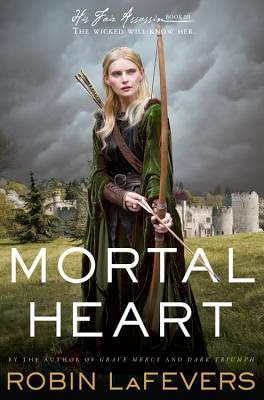
Mortal Heart

by Robin LaFevers
First sentence: “For most the bleak dark months when the black storms came howling out of the north is a time of grimness and sorrow as people await the arrival of winter, which brings death, hunger, and bitter cold in its wake.”
Support your local independent bookstore: buy it there!
Others in the series: Grave Mercy, Dark Triumph
Content: Like the other two, it has death (though no murders, I think), some sex (off screen) and more mature themes. It’s in the Teen section (grades 9+) of the bookstore.

Annith is the one who was always left behind. Quiet and dutiful, the Abbess always passed her over when it was time to go on missions. First Ismae left, and then Sybella. And Annith is the one to babysit the new novices. However, when the resident seer gets ill and Annith overhears the Abbess say that Annith would be perfect for the position, Annith panics. And takes off in the middle of the night: dang it if she isn’t going to get her adventure.

She ends up being overtaken by hellequins — servants of the God Mortain, like Annith herself — and their leader Bathazar, takes it upon himself to protect her from the, shall we say, less savory of the bunch. They ride around together — nominally to get Annith to some city I can’t remember the name of right now — for a couple of weeks, falling in love. And then Annith — and this is what I liked most about the book — decides that she really wants to be Independent and Have and Adventure, so she takes off. And she does. She never really becomes as Awesome as Ismae (who is still my favorite) or Sybella, but she holds her own.

Of course there are twisty twists and swoony swoons, and over it all is some very interesting (if only vaguely) historical setting. At some point, though, the twists made my eyes roll, and the swoons stopped being swoony, and I was predicting things right and left, which is never much fun for me.

It’s not my favorite in the trilogy, though it does wrap things up nicely. Even so, it’s a good series, and one worth reading.

I Kill the Mockingbird

by Paul Acampora
First sentence: “My mother’s wheelchair does not fit through the bathroom door, and I don’t know what to do about it.”
Support your local independent bookstore: buy it there!
Content: There’s nothing objectionable, but it feels a bit old for the section it’s in (middle grade, grades 3-5) but it’s not really quite old enough for the YA section (grades 6-8). It’s kind of one of those in-between books.

It’s the summer before high school, and Michael, Lucy, and Elena have a summer reading list they’re assigned. None of them really wants to do it, partially because they’re the sort of precocious readers who read Dickens in 8th grade, and partially because, well, no one like summer reading.

One of the novels on the list is To Kill a Mockingbird, and Lucy comes up with a brilliant (or so they think) idea to get people reading and talking about this classic: what if we made the novel scarce. Not steal it from libraries or bookstore, but just reshelve it so no one can find it. (As a bookseller: *grumble*) And then start a web campaign — iKILLtheMOCKINGBIRD.com — to feed it.

What they’re surprised at (and I don’t know why they would be), is how well it works. It goes viral (thanks to Wil Wheaton) and To Kill a Mockingbird starts disappearing from shelves all over the country.

It’s not just all about their viral marketing scheme (which I doubt would work. It’s plausible, if improbable), though. Lucy’s mother is in remission from her bout with cancer, which stresses Lucy out. And she and Michael might be going from friends to more-than-friends, which is awkward for both of them.

On the one hand, this was a sweet little book. There were some funny bits — the scene near the beginning where Lucy and Elena are doing a Nativity shoot for Lucy’s mom had me laughing — and some sweet bits. I liked that it was religious without being preachy (which will go over well in my heavily Catholic town). My problem is that I really didn’t feel it had a specific audience. It’s a bit old for my 5th grader, who won’t understand the whole viral bit or even the discussion about the novel. But it feels a bit… young… for an 8th grader, who would understand those things.

Even with that qualm, it was a good, quick read.