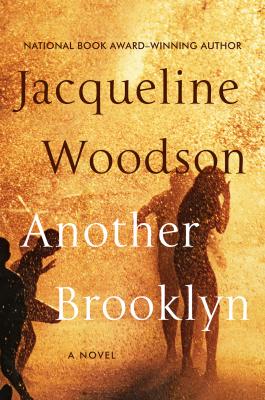
Another Brooklyn

anotherbrooklynby Jacqueline Woodson
First sentence: “For a long time, my mother wasn’t dead yet.”
Support your local independent bookstore: buy it there!
Review copy provided by the publisher.
Release date: August 9, 2016
Content: There’s some swearing, including a few f-bombs, and a lot of illusions to off-screen sex as well as drug use. It will be in the adult fiction section of the bookstore.

The death of August’s father, and her return to Brooklyn for the first time in many years, sets off a chain of memories from her childhood. When she, her brother and father left the farm down South, soon after her mother committed suicide. The friendships she had with girls her age, and the different paths their lives eventually took. The way her father and brother turned to Islam and the hope and guidance their religion gave them. It all comes crashing down on her, in a series of reflective snippets, as she tries to make sense of her childhood.

I’m not sure I fully unpacked all that this novel had to offer. In fact, I know I didn’t. It’s deceptively short and it goes quick, and I know I missed things. Not only Big Things (not that there was much of a plot; it really was a series of short, almost poetic vignettes), but the Meaning behind those Things. It’s a harsh place, Brooklyn of the 1970s, a sexist one as well as a dangerous one. And August, through Woodson, tries to unpack what it all Means. And even though I enjoyed the lyrical flow of the book, and related to the women in it, I’m not sure I understood what Woodson was trying to do.

That said, I think it’s an Important book, and one that will be great for book groups to sit and hash over. (I’d love someone to talk to about it.) And, I can’t deny the beauty of the writing; Woodson is supremely talented. I just wish I were a better reader.
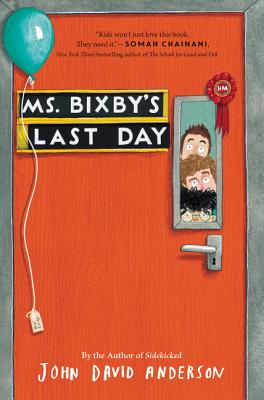
Ms. Bixby’s Last Day

msbixbyby John David Anderson
First sentence: “Rebecca Roundabush has cooties.”
Support your local independent bookstore: buy it there!
Review copy provided by the publisher.
Content: It’s about sixth graders, and it’s a little more mature in content for the younger set. That said, it’s in the Middle Grade section (grades 3-5) of the bookstore.

Everyone has one elementary teacher (I hope) that they remember fondly, that made school a fantastic experience. Mine was my 5th grade teacher, Ms. Westenskow, who cross-country skied to school one winter day, who  made the Revolutionary War interactive, for whom we would all do anything for. I don’t know what’s happened to her over the years (we moved after 5th grade and I started over), but I still remember fifth grade fondly.

Ms. Bixby is that teacher, the one who believes in the potential of each child, the one who reads cool books, the one who is cool, and who makes learning fun. And friends Topher, Steven, and Brand are among those three. So, when Ms. Bixby gets diagnosed with pancreatic cancer it devastates them (and the class, but these guys are our narrators) and after she leaves before the class-planned party, these three boys decide to take Ms. Bixby’s last day to her.

And thus begins our adventure. Skipping school on a Friday, the boys head out to get Ms. Bixby the things they think she needs: a good book, an excellent cheesecake, wine, and McDonald’s french fries. None of them are easy to get, but that’s part of the fun of this book.  It’s one part adventure, one part reminiscing as we get to know Topher, Steve, and Brand through the chapters they narrate, and it’s one part love story to the power of a great educator.

And, yes, I cried. But I felt that the book earned those tears, which is always a good thing.

Excellent.

When Friendship Followed Me Home

whenfriendshipby Paul Griffin
First sentence: “You’d have to be nuts to trust a magician.”
Support your local independent bookstore: buy it there!
Review copy provided by the publisher.
Content: It’s not a difficult read, and there’s nothing objectionable, but the subject matter is probably more serious than your average 8- or 9-year-old will want. That said, if they’re interested, I’d give it to them. It’s in the YA section (grades 6-8) of the bookstore.

Ben has had a rough life. He was dropped off at a group home when he was a baby, abandoned by his mother. He made friends, but one of them died after an accident. That lead to him meeting a social worker, an older woman whose partner had died, and him being adopted by her. Everything was looking up, especially after he found a stray dog (who ended up being the dog of a woman who had recently become homeless) and met a new friend, Halley, who is in remission from a rare cancer.

If you’ve read ANY middle grade/YA books, you know where this one is headed.

On some level, I wanted to be annoyed with this book. I felt like Griffin employed every single cliche out there: Manic Pixie Dream Girl, Dead Parents, Bad Parents, Cancer Book, it’s all in there. I wanted to be annoyed at it. I was a little frustrated when I realized the direction it was taken. But… I didn’t hate it. I didn’t.

Partially, it’s because it’s self-aware. There’s one quote, early on when Ben and Halley are talking about a story they’re writing, where Halley says, “Well, you have to get rid of [parents] somehow, and that is the most merciful yet expeditious way. Otherwise how do you turn her into an orphan? This is a middle grade story, for like ages ten to fourteen, and the rule is you need an orphan.”

I laughed, and as the book went on, I realized that Griffin knew what he was doing. He was Making Points, but subtly, and I didn’t hate him for his messages. I liked Ben and Halley and Flip the dog, among other characters, so I could get past the messages. And even though I wasn’t Moved by the book, I did enjoy reading the stories. And it was, in fact, written well.

So, I’m torn. I didn’t Love it like I wanted, but I didn’t loathe it either.

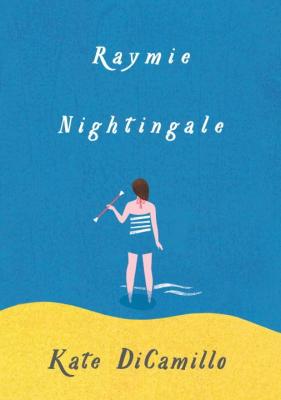
Raymie Nightingale

raymieby Kate DiCamillo
First sentence: “There were three of them, three girls.”
Support your local independent bookstore: buy it there!
Review copy provided by the publisher.
Release date: April 12, 2016
Content: The publisher suggests 10 and up, but I think a 4th-grader would be able to handle it. It will be in the middle grade (grades 3-5) section of the bookstore.

Raymie has a plan. She will take baton lessons — it’s the summer of 1975, after all — and enter the Little Miss Central Tire competition, and win. That way, her picture will get in the paper and her father — who recently ran off with a dental hygienist — will see it and want to come home.

The thing is: her plan (like most plans) doesn’t go as she thought it would. She meets two other girls: Louisiana, whose parents have died and who wants to win the competition as much as Raymie because that means she and her grandmother will have money for more than tunafish;  and Beverly, whose mother is insisting on the competition, but who secretly hates it all and would much rather sabotage the whole thing. Together, the three of them have a summer they will never forget.

In many ways, this is vintage DiCamillo: quiet and unassuming, and yet it reaches something deep inside you. I didn’t want to put it down, not because I was thoroughly invested in the plot or the characters, but because this longing to belong, to figure out what life Means, to find and have friends all spoke to me. It’s a common enough theme, but in DiCamillo’s deft hands it transcends the ordinary. (I don’t know if I can praise this highly enough.) And yet, I think it’s going to be one of those books that adults like but kids just don’t quite get. I think this one sits better with some life experience, and some perspective coming to it. But I may be wrong.

Who ever reads it will definitely be touched, I think.

Hour of the Bees

hourofbeesby Lindsey Eagar
First sentence: “Something flies too close to my ear.”
Support your local independent bookstore: buy it there!
Review copy provided by the publisher.
Content: It’s a tricky story, moving between “reality” and “magic” for much of it. Though there’s really nothing content-wise that would be inappropriate for younger readers, they might lose interest with the plotting. It’s in the YA section (grades 6-8) of the bookstore, though I’d give it to a 4th or 5th grader if they expressed interest.

All Carol wants to do the summer before 7th grade is hang out with her friends and have pool parties and sleepovers, but instead she’s stuck out at her grandfather’s ranch in southwest New Mexico, helping her family pack him up in order to send him to a nursing home. Not exactly her idea of fun. And it doesn’t help that her grandfather is suffering from dementia, either. It’s shaping up to be a long, hot, boring summer.

Except, once she gets there, Carol finds out that her grandfather is full of crazy, magical stories, ones that may or may not be true. And, over the course of the summer, Carol decides that maybe it’s not too bad.

Okay, that’s not exactly all there is to it. There’s a whole thread about a drought, and a tree, and bees taking away the rain that, honestly, I didn’t find all that interesting.

Maybe I should start with the good: I really like that there’s a book out there that deals with grandparents, dementia and death. It’s something that children do need to deal with, and it’s good that there’s a book that does take something like moving a grandparent out of the house and into a nursing home as well as tackling the mood and personality swings that come with dementia.

That said, this smack WAY too much of the Magical Mexican for me. Truthfully, it may just be me (though as I was relating it to E — who’s Mexican — she said, “Um. No.” But she may have been biased from my retelling); please let me know if you read it and you think I’m wrong here. But, I felt like the whole thing of “needing to get back to your roots” and the whole magical realism story thing just didn’t work. Yes, roots are important. But, so is change and growth. You don’t need to sacrifice one for the other (and I felt like Eagar was coming down firmly on Family and Roots are Very Important, especially since we’re Mexican).  It just felt… forced. Off. Not quite natural. And then there was Carol’s whole flipping from being a city girl to being a ranch hand at the end. I just didn’t get WHY. Was it her grandfather’s stories? Where did this deep connection to her roots come from? Why did it happen so suddenly, and so deeply that she would do drastic and rash things at the end? It didn’t make sense to me. (Again: it may just be me. I’ll admit I skimmed a lot.)

At any rate, it ended up not being one that I really loved.

I am Princess X

iamprincessxby Cherie Priest
First sentence: “Libby Deaton and May Harper invented Princess X in fifth grade, when Libby’s leg was in a cast, and May had a doctor’s note saying she couldn’t run around the track anymore because her asthma would totally kill her.”
Support your local independent bookstore: buy it there!
Content: It’s a bit intense at times and there is some mild swearing. It’s in the YA section (grades 6-8) of the bookstore.

Libby died three years ago in a car accident. May knows this. She’s moved on (sort of). But, when she’s back in Seattle the summer before she’s 17, she starts seeing stickers around town. Ones of a princess in a pink dress, red Chucks, and wielding a katana sword. The spitting image of the comic that Libby and May created in fifth grade. At first, it seems like a coincidence: maybe someone got a hold of all the pages Libby left when she died. Or, maybe — just maybe — Libby’s still alive.

After reading the webcomic, May is convinced of the latter. She’s convinced that Libby’s mom was murdered, that Libby was kidnapped, and that she’s the only one who can find Libby. She enlists the help of a recently-graduated computer geek (with a bit of a dark side), Patrick, and together they follow the clues May says are left. The thing is: what started out as an innocent investigation becomes increasingly more dangerous the further they get involved.

Ohmygosh! I don’t know why this took me too long to read this!

Seriously though, people: it’s a tight, interesting thriller, one that kept me guessing along as May and Patrick figure out and follow the clues. It gets intense at times and it definitely kept me turning pages.  THIS is what a good YA mystery is about. No extra lame love story. Cool characters. A fantastic mix of graphic and prose. So, so very good.

Can you tell I liked it?

Salt to the Sea

salttotheseaby Ruta Sepetys
First sentence: “Guilt is a hunter.”
Support your local independent bookstore: buy it there!
Review copy provided by the publisher.
Content: There are some disturbing elements — it is the horrors of WWII, after all — including violence and rape, though none of it is graphic. It’s in the Teen (grades 9+) section of the bookstore, but I’d give it to an interested 7th- or 8th-grader.

One of the things I really admire about Sepetys is her willingness to tell the untold story. The story that’s been buried or neglected because of the way history has been told. The story that’s difficult to face or bear. She looks at them unflinchingly, and compels us to bear this hard history with her. It’s a difficult thing, but she does it so eloquently we just can’t look away.

This time around she tackles the sinking of the Willhelm Gustloff, a Nazi ship that was carrying 10,000+ refugees that was sunk by the Soviets near the end of the war. We follow four young adults (they range in age from 15 to 21) — Emelia, a pregnant Polish refugee; Florian, a Prussian who’s on the run with a stolen secret; Joana, a Lithuanian nurse who’s been able to repatriate into Germany, and who’s searching for her mother; and Alfred a young Nazi recruit who is a bit… off — as they head toward the ship in the dead of winter. The chapters are short, almost poetic, and they intertwine in compelling ways. It propels you forward, in spite of the horrors (perhaps because of them?). The minor characters — the orphan boy Joana finds, as well as the shoemaker they travel with, among others — are just as fleshed out and real as the main characters. Sepetys didn’t cut corners, and I appreciated that.

It’s exactly what I’ve come to expect from her. And that’s the best thing.


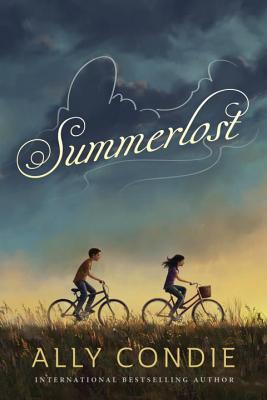
Summerlost

summerlostby Allie Condie
First sentence: “Our new house had a blue door.”
Support your local independent bookstore: buy it there!
Review copy provided by the publisher.
Content: There’s a lot of talk of death, but nothing too sad. It’ll be in the middle grade (grades 3-5) section of the bookstore.

Cedar Lee didn’t expect much from her summer visiting her grandparents in Iron Creek. Her dad and brother died in a freak accident the hear before, and the rest of the family has been just barely managing. Then Cedar’s mother finds a house in Iron Creek and purchases it as a summer home, not something they can afford, but perhaps something that will help with healing.

Cedar’s not happy about it; she misses her dad and her brother, and doesn’t really want to move on. But between the new house, a summer taking care of her other brother, Miles, and her new friend, Leo, maybe she can heal.

This is a really difficult book to summarize, mostly because not much happens. It’s an incredibly introspective story, driven by characters — most notably the friendship (and just that, nothing more) between Leo and Cedar — rather than by plot. But it’s a lovely look at friendship and healing and enjoying the simpler things of life. There’s also is a love of Shakespeare and acting that weaves through the story which helps tie the whole story together.

An interesting aside: this is a very Mormon book. Oh, Condie does a lot to disguise it, but it’s really the Shakespeare festival in Utah (to which I’ve never been). And it — at least to a Mormon — just feels Mormon. But, that said, it’s something I noticed because I was tuned into the clues. And it’s not something I minded at all.

In fact, I thoroughly enjoyed this one.

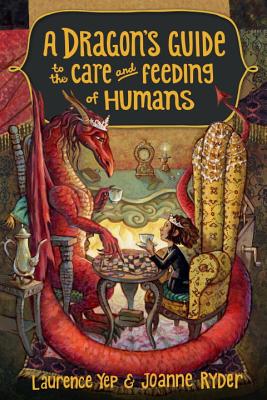
A Dragon’s Guide to the Care and Feeding of Humans

dragonsguideby Laurence Yep and Joanne Ryder
First sentence: ”
Support your local independent bookstore: buy it there!
Content: It’s short, there are lots of pictures, and the words aren’t terribly difficult. It’s a great bridge book between beginning chapter and middle reader, and good for ages 7 and up. It’s in the middle reader (grades 3-5) section of the bookstore.

Miss Drake, a dragon who has been around a long time, is happy with her lifestyle. Sure her “pet”, a human she calls Fluffy, recently died and she is grieving that. But when another human, the 10-year-old great-niece of Fluffy (aka Great-Aunt Amelia), comes into her life, she is not at all happy with it.

And thus begins the relationship between Miss Drake and Winnie. Sure, there’s a little adventure with a magical sketchbook and a rabid magic-eating monster, but mostly it’s about overcoming grief of the death of a loved one (Winnie’s father has recently passed away as well) and making friends.

My favorite thing is that it’s written from the dragon’s point of view. Beginning each chapter is a word of “advice” to magical creatures about how to deal with their “pets”, but the narrative is from the point of view of a very old, somewhat cranky dragon. It’s a clever take. That, and it’s blissfully short. Yep and Ryder know their audience, get to the point, and don’t bother putting in a whole lot of backstory. There are clues here and there about Miss Drake’s former pets and Winnie’s family (I’d like to read more about them in other books!), but there are no long-winded passages, no extra words. It’s refreshing.

My  only complaint is that while there is a child character, the protagonist (and the one who propels the action, in the end) is the dragon. And that felt a little off. But other than that, it’s an enjoyable story.

(Just for the record: because this is a Cybils nominee, I’ve been asked to make sure y’all know this is my opinion only, and not that of the panel.)

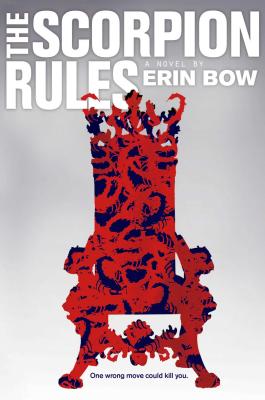
The Scorpion Rules

 scorpionrulesby Erin Bow
First sentence: “Once Upon a Time, at the End of the World.”
Support your local independent bookstore: buy it there!
Content: There are exactly two f-bombs, some mild swearing, and one illusion to sex. It’s in the Teen (grades 9+) section of the bookstore, but I’d give it to a 7th grader, if they had no objections to the content.

At this point in my life, I’m very much been-there, done-that when it comes to dystopian/post-apocalyptic books. I feel like I’ve read/seen them all, and there’s really nothing new to explore there.  So, my first thought was that this was just going to be more of the same-old, same-old, and I passed on the ARC. Then it came in, and on the back were quotes from authors I respect, so I thought (somewhat begrudgingly), that I would give this one a try.

(I know, I know: I’m not “supposed” to start these with “I’m not a fan of x”. But bear with me.)

It didn’t take me too long to realize that I was utterly wrong. First of all, the premise is something I haven’t encountered in a long while: humans have destroyed the world through climate change and war, and somewhere along the way, invented artificial intelligence. One of the AIs decided that enough was enough, and took over — by blowing up a number of huge cities — ruling the world. And the way Talis, the AI, decided to keep the peace? By keeping the children of the world’s rulers hostage. If they enter into war, their children would be killed.

Brilliant, no?

Greta is the Crown Princess of the PanPolar Confederacy, a major North American power formed out of what we know as Canada. She’s also a hostage of Talis, living in the prairies of Saskatchewan at the Precepture with her compatriots, fellow hostages. Then one day, war breaks out, one of her friends dies, and a new boy, Elian, shows up. He’s the grandson of the leader of a new alliance, and he’s not at all willing to take his role as a Dutiful and Humble hostage. He fights every step of the way. And somehow, this awakens Greta (and the rest, including her best friend La Da-Xia) to the horrible reality that is her life.

There is so much more to it than that, but I don’t want to give it all away. I adored the combination of high-tech (there are flying battleships and smart pads and cameras and, of course, the AI) and low-tech (the children at the Precepture are basically farmers, thinking about raising goats and bees and harvesting vegetables. There’s a monastery-like feel, as well: they call the AI in charge “Father”. But I also loved the diversity: Bow rightly depicted people from all over the world — African, Asian, Native American, Hispanic — but it felt natural and organic rather than some sort of forced diversity.

But what I really loved was the fluidity of the romance. There’s a love triangle of sorts, but not your typical one; Greta is bisexual and there’s no angst or heartache about this. She’s in love with both a male and a female, and it’s just the way she is. And even Talis, when he shows up, was more gender fluid in his depiction (as benefiting and AI, no?). It was all very different, and very, very refreshing.

It’s the start of a series, and I’ll definitely be picking up the next one to see where Bow takes Greta’s story.