The Magnificent Mya Tibbs: Spirit Week Showdown

spiritweekshowdownby Crystal Allen
First sentence: “I’m only wearing five braids to school today.”
Support your local independent bookstore: buy it there!
Review copy snagged from the ARC shelves at the bookstore.
Content: There’s a bit of mean girl-ness, and bullying, but the language is simple and the story pretty straight-forward. Give it to a strong second grade reader and up.

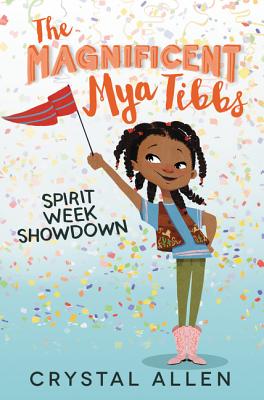
Fourth grader Mya Tibbs’s elementary school always has a Spirit Week competition right before the fall festival in their small Texas town. It’s always a tough competition, but this year the stakes are higher: VIP seats to the festival. Mya is sure that she and her best friend, Naomi, are going to win. Except they don’t get chosen as partners: Mya is paired with the school bully, Connie. And she won’t trade. Which makes Naomi more than mad, it means that she and Mya are no longer best friends. Period.

But as Spirit Week goes on, Mya realizes that she’s having fun with Connie, and that maybe things aren’t exactly what they seem.

This was such a charming school story.  The stakes weren’t high, but a fourth grader, they were high enough. Friendship is important, as is doing something fun and doing it well. And even though the whole pageantry of the Spirit Week felt really implausible (all the people were SO good at everything they did!), I rolled with it. I liked that Mya figured out what a real friend is like, and found out that she could stay true to her interests and herself on her own time line. It was wonderful that the main character was a person of color, as well. It’s a great early chapter book.

Three Books for African American History Month

I wrote this in my introduction to my newsletter:

I saw this video on Facebook a while back, and it got me thinking. Especially the part where they say that black history begins with slavery and ends with Martin Luther King, Jr. It helped that it came on the heels of the scandal surrounding A Birthday Cake for George Washington. I especially appreciated this post by author Mitali Perkins is definitely worth checking out. Both things together have made me more aware of the importance of diversity in children’s books, and made me more determined to search out more honest portrayals of black life.

I think that’s true, and as a result, I tried to find books that reflected the African American experience but didn’t have anything to do with slavery or civil rights. The three I came up with are these:

97808075301779780062342331 9781442459489

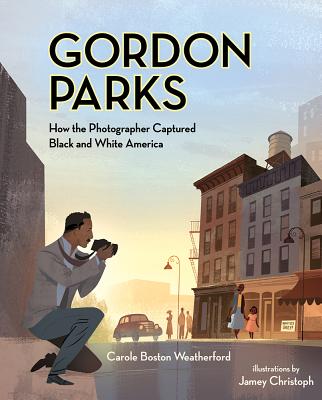
Gordon Parks: How the Photographer Captured Black and White America by Carolyn Boston Weatherford, illustrated by Jamey Cristoph

The Magnificent Mya Tibbs: Spirit Week Showdown by Crystal Allen

When I Was the Greatest by Jason Reynolds

A confession: I haven’t read any of these. But I think it’s definitely something I can rectify.

What would you have picked?

Peas and Carrots

peasandcarrotsby Tanita S. Davis
First sentence: “By the door,on the other side of the sheet that divides the room, Baby cries in his car seat.”
Support your local independent bookstore: buy it there!
Release date: February 9, 2016
Disclaimer: I’ve met the author, working with her for KidlitCon in Sacramento and I find her an absolutely delightful person.
Review copy snagged off the ARC shelves at my place of employment.
Content: There are several instances of mild swearing, plus some illusions to adult drug and alcohol use. Because there are no f-bombs, it’ll be in the YA section (grades 6-8, though it might be better for the older end of that spectrum) of the bookstore.

Dess is a 15-year-old girl stuck in the foster care system. Her deadbeat dad’s finally in jail, as is her mom. Dess’s grandmother gave up trying to care for her and her baby brother years ago. Dess is determined: she doesn’t need anyone. And so when she gets placed in a new home, one of an affluent family, she figures it’s not going to last.

Hope’s parents are stable and happy and take in foster kids, including Dess’s brother Austin, to give back to the community. Hope’s used to the revolving door of kids, but there’s never been one close to her age. Until now. And since Dess is doing pretty much everything to keep people at arm’s length, Hope knows that living with Dess is going to be a challenge. She just doesn’t know if she’ll be able to adjust.

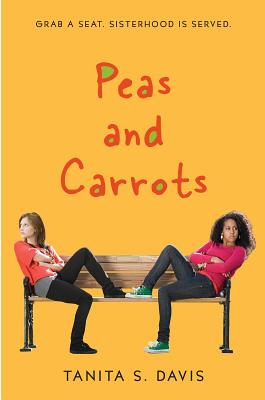
First test: which one of these girls is African American and which one is white? (Answer: Dess is white. Did you pass?) That’s actually one of the first things I liked about this: Davis takes your (my) assumptions about foster care, about the State of the Country, and turns it upside down. In this story, the white girl is the one who’s on the run from an abusive family and the black girl who has the stable life. And Davis doesn’t leave it there; there’s discussion about race and class and belonging, which I respect.

And, as an unofficial foster parent myself, I found myself nodding and agreeing and loving the entire book. Yes, the kids come with baggage and a backstory that usually isn’t pretty. Yes, their lives can be changed by living in a stable, more affluent (though we’re not nearly as well off as Hope’s parents) situation. But Davis also got the corollary to that: having a foster kid in your home is challenging, sometimes disruptive, but is also life-changing. And, if you let yourself — as Hope and Dess eventually find out — you will be better off for it.

Definitely worth reading.

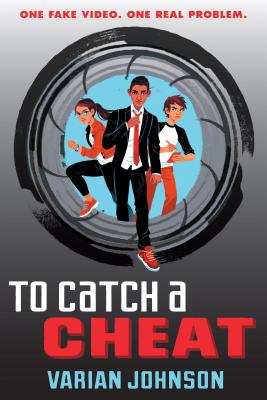
To Catch a Cheat

by Varian Johnson
First sentence: “Jackson Greene placed his pen on his desk, loosened his red tie, then flipped the page on his American History exam.”
Support your local independent bookstore: buy it there!
Review copy provided by publisher.
Release date: January 26, 2016
Others in the series: The Great Greene Heist
Content: There’s a slight romance. It’ll be in the middle grade (grades 3-5) section of the bookstore.

Jackson Greene’s in retirement. Again. For real this time. No more cons. No more heists. He’s focusing on getting Gaby de la Cruz to be his girlfriend and on passing American History. Then he gets called into the office: someone flooded the bathrooms and ruined the carpets over the weekend, and the principal is convinced it’s Jackson and his crew.

Except it’s not: every single member of the crew has an alibi for the time frame, albeit ones they’re reluctant to give. And then Jackson is texted a video — obviously faked — of him and his crew performing the prank. It’s blackmail: steal the answers to the huge American History test or the principal gets the video and Jackson gets suspended.

There’s more to the plot than that, of course, including a brilliant long con with lots of twists and turns. Sure, it’s implausible, but it’s a lot of fun as well. The diverse cast is back as well, which is also incredibly gratifying. It’s very nice to have a fun book with diverse characters and have it be (mostly) issue-free. (I’m not sure how well the Asian kids came out of this; the character development of the minor characters seemed a little weak, but maybe Johnson was relying on what he did in the first book?)

I thoroughly enjoyed it.

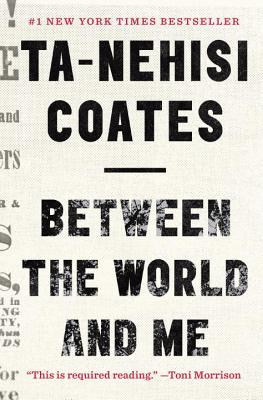
Between the World and Me

betweentheworldby Ta-Nehisi Coates
First sentence: “Son, Last Sunday the host of a popular news show asked me what it meant to lose my body.”
Support your local independent bookstore: buy it there!
Content: There is some swearing, including a couple f-bombs and the use of the n-word. It’s in the Sociology section (I think) of the bookstore.

By now, most of you will have either heard of this or read it, I think. There’s not much to say, summary-wise; it’s a letter from Coates to his son concerning what Coates thinks about being a black man in America. It’s sort of rambling, and kind of disjointed; it feels like a series of random thoughts jotted down on a piece of paper as Coates was musing about his place in this world. Which fits, I think.

What it is, really, is damning. Especially if you, as Coates put it, think you’re white. There’s a complacency that comes with being white, with being privileged (even if you’re “just” middle class), that isn’t afforded to those who are not. And Coates, rightly, forcefully, reminds us of that. Reminds us that to be black — particularly a black male, since he’s writing from his own experience — is to bear the burdens of all our complacency. That our “freedom” isn’t free, and that it’s not the military who are paying for it. That all these shootings that are making the news aren’t new, that they have been going on for hundreds of years, and those that think they are white just throw up their hands and turn a blind eye.

One passage that really struck me:

I am ashamed I made an error, knowing that our errors always cost us more. This is the import of history all around us, though very few people like to think about it. Had I informed this woman that when she pushed my son, she was acting according to a tradition that held black bodies as lesser, her response would likely have been “I am not a racist.” Or maybe not. But my experience in this world has been that the people who believe themselves to be white are obsessed with the politics of personal exoneration.

It’s a difficult read, because he condemns everyone and offers no answers. There’s no solutions, possibly because Coates doesn’t have any, and I found that a difficult thing to swallow. I want to know HOW I can change, what I can do to make a difference. Perhaps reading books like this is a start; it has made me aware that there are black men and women who think this way, who believe that they are lesser because we let police arrest and shoot them. Who are not given the same opportunities because they can’t afford to buy a house in the suburbs. Who are treated differently when they walk into stores just because of the color of their skin.

It does make me feel hopeless, in a way. But, on the other hand, I’ve read this and I’ve been made aware. Maybe that’s a start.

Zeroes

by Scott Westerfeld, Margo Lanagan, Deborah Biancotti
First sentence: “More coffee?”
Support your local independent bookstore: buy it there!
Review copy pilfered from the ARC piles at my place of employment.
Content: There’s some talk of drug use (none of it by teens), a smattering of mild swearing, and one (unnecessary, misplaced, and kind of glaring) f-bomb.

Who are the Zeroes?

They are six teenagers, all born in the year 2000, who have discovered, over the years that they have extra-ordinary powers. Bellwether can charm a crowd of people into believing whatever he wants them to. Crash is bothered by electronics, and she can make entire systems, well, crash. Flicker is blind, and yet she can see through every one else’s eyes. Anon isn’t invisible, but he is easily forgettable; his parents once forgot that he was deathly ill and left him (to die) in the hospital. Scam has this voice inside him that can talk anyone into anything he wants, which is what gets all the Zeroes into trouble.

With Mob, who can control a crowd’s mood, and her father, who is in deep with the Russian mob.

The question is: will the Zeroes be able to help them? Or are they just going to make things… worse?

It’s kind of hard to juggle multiple points of view in a book, and in this one they tackle six of them. Some of them — Anon, Flicker, Scam, and Mob come out with the best story arcs in the book — are really well developed. Others — Bellwether and Crash — aren’t so much. But, for the most part, the flipping between people helped push the story forward, and I found that I didn’t mind seeing the action from different perspectives.

And the story was pretty seamless, considering there were three authors writing. I was worried that it would be choppy, but whatever they did — editing, lots and lots of rewriting — worked.

It’s definitely a ton of fun.

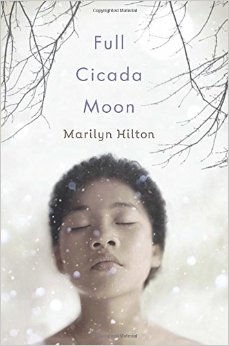
Full Cicada Moon

by Marilyn Hilton
First sentence: “I wish we had flown to Vermont instead of riding on a bus, train, train, bus all the way from Berkeley.”
Support your local independent bookstore: buy it there!
Review copy sent to me by the publisher rep.
Content: There isn’t anything objectionable, and it’s a novel in verse so it’d be appropriate for the younger readers. Good for conversation as well. It’ll be in the middle grade (grades 3-5) section of the bookstore.

Mimi Yoshiko Oliver is obsessed with space. It’s 1969, the height of the space race, and she wants to be an astronaut. The problem? She’s a girl. No one takes her desire seriously, especially in her school in Vermont. It also doesn’t help that she’s Afro-Asian, one of the only people of color in an all-white community.

As she goes through seventh grade and the beginning of eighth, Hilton gives us Mimi’s struggles and triumphs, from her attempts to get into shop class — there are some pretty strong gender norms in the late 1960s —
to her struggles to make friends. There are lots of stories about racism in the south in the 1960s. It was actually quite refreshing to be reminded that even northerners had issues with civil rights.

It’s a lovely novel in verse, as well. Hilton captured Mimi’s sense of wonder an awe at the world around her as well as her desire to go into space. It wasn’t overly detailed, something which might bother some readers but I found I didn’t mind. Perhaps it’s because I’m older, and I remember what it was like (sort-of). But, I also think it was a conscious choice on Hilton’s part to make it more accessible to those reading it. So, on the one hand, it’s historical fiction. But the other, it didn’t really feel all that much like it.

Even so, I thoroughly enjoyed spending time with Mimi and her family, as they adjust to a new home, broaden their horizons, and have a memorable year.

Everything Everything

by Nicola Yoon
First sentence: “
Support your local independent bookstore: buy it there!
Release date: September 1, 2015
Review copy picked up at CI3 and signed by the author.
Content: There is a few mild swear words, and one sort-of on-screen, sort-of-off-screen sex scene. The publisher has it listed for grades 7 and up, which puts it in the YA section, but I might move it to the Teen (grades 9+).

Madeline has spent her entire life inside. White furniture, white walls, filtered air, the whole deal. It’s because she has Severe Combined Immunodefiency (SCID), which basically means she’s allergic to the world. Any little disease, any little microorganism will kill her. So, she stays inside, reading, doing her online school.

And then Olly moves in next door.

Okay: yes, the plot is predictable. Boy moves in next door, they meet and have instalike, and suddenly the girl is questioning her Life Choices and Taking Risks.

But I ate this up. I don’t know if it was the short chapters, snippets of Madeline’s thoughts and observations, interspersed by some charming line drawings. Or the parallel worlds between her being trapped inside her house because she’s sick and Olly being trapped because of his abusive father. Or just the chemistry between Madeline and Olly, which was fantastic. Or the fact that Madeline was Afro-Asian, and yet it wasn’t really an issue. She just was. Her mother is suffenciently controlling (for good reason), and I adored Carla the Latina nurse, who was really more of a mother figure to Madeline.

And all of this added up to overcome the predictable plot and make me fall for this book. Another absolutely amazing debut.

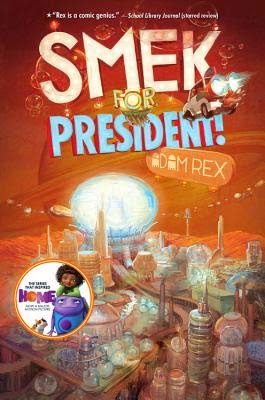
Audiobook: Smek for President

by Adam Rex
Read by Bahni Turpin
Support your local independent bookstore: buy it there!
Content: Nothing. Nada. Some fake swearing (“pardon my language”). The audio version is probably good for kids who have an attention span longer than 20 seconds; the book is in the middle grade (grades 3-5) section of the bookstore.

I loved the audiobook of The True Meaning of Smekday, so when I heard that Bahni Turpin was doing the sequel, I KNEW that was how I needed to experience this book. And I was right. Turpin is perfect for this. Seriously.

The story picks up a year and a half after Gratuity “Tip” Tucci and J. Lo save the world. The Boov have moved to New Boovworld, on one of Saturn’s moons. J. Lo and Tip are hanging on Earth, trying to get used to having Tip’s mom around. And, for J. Lo, trying to to fit in. They need a break, and so J. Lo soups up their car, Slushious, and they head off-world to check out the new Boov homeland. Since they saved the world, they’ll be welcomed as heroes, right?

Well, no.

Things don’t go quite like they planned. J. Lo is named Public Enemy Number One, and thrown into jail. Tip repeatedly avoids being captured, but only just barely. Which sends her on an adventure through New Boovworld. She meets and befriends a delightful flying billboard, whom she names Bill (of course), as well as several other Boov (and one human; Dan Landry’s son), in her attempts to free J. Lo and set everything right. There’s a lot of action, tons of humor, and a bit of time travel in the mix.

But what really made the book was Turpin. I adore her reading style, and it’s perfect for Adam Rex’s humor. I was chortling, guffawing on occasion, and I was thoroughly charmed by all the Boov voices (with their distinctive quirks). I was pleased to see that the Chief was back (if only in Tip’s imagination), as well as other favorite characters from the first book. I loved how Rex imagined New Boovworld. And it was satisfying (as a parent) to see that there were real consequences for Tip’s actions.

In short: I adored it.

Black Dove, White Raven

by Elizabeth Wein
First sentence: “Sinidu told me I should aim for the sun.”
Support your local independent bookstore: buy it there!
Content: There’s a smattering of violence, and some insinuations, but it’s not nearly as intense as Wein’s other books we have in the store. I’m torn between leaving it where it is (in Teen, grades 9+) and moving it to YA (grades 6-8), where it really fits better, subject and content-wise. Thoughts?

I know Wein has written other books about Ethiopia, but I didn’t know they existed, really, until this one came out and I started hearing the buzz. And so I really didn’t know what to expect with this one.

Many of the elements I have enjoyed about Wein are there: women pilots, in this case two: a white woman, Rhoda, and her black friend, Delia,  learned to fly in France and go around the States in the late 1920s/early 1930s with their barnstorming act. There is also World War II: after Delia’s accidental death, Rhoda takes their two children, her daughter Emelia and Delia’s son Teo (whom Rhoda has taken as her own) to live in Ethiopia, which was Delia’s dream.

The book is a long letter written to the emperor of Ethiopa by Emelia. It’s in the middle of World War II, and the Italians have invaded Ethiopia. Because of their precarious legal situation: Teo is not legally Rhoda’s son, they’re not really legally in the country, and because Teo’s father was Ethiopian, it means that their position in the country, especially with the Italians there, is a precarious one.

Emelia recounts history and how their little family ended up where they are. Teo contributes some, writing journal entries and flight logs — Rhoda eventually teaches both children to fly — and so you hear his voice as well as Emelia’s.

There’s a lot going on in this book, and yet, I felt like the conflict didn’t really pick up until the last third. It’s a quieter book than her previous two WWII books, one that felt more vignette-driven as well. (Though typing that, and thinking back to Code Name Verity and Rose Under Fire, I’m not sure that’s true.) The characters were definitely younger in this one, and perhaps that’s what I’m feeling. I did like how Wein rounded out most of the characters in the book, but especially the female ones (the male ones, aside from Teo, were basically set dressing, there to move the plot along). Wein also touched on a lot of cultural issues for the time: segregation in the US, slavery in Ethiopia, the war, the limitations of women at the time. Even though it didn’t feel like much, plot-wise, there was enough to hold my interest and carry the book.

I’m not sure I love it as much as I do the other books I’ve read by Wein, but I did thoroughly enjoy it.