Not if I See You First

by Eric Lindstrom
First sentence: “My alarm buzzes and I slap it off and tap the speech button at the same time.”
Support your local independent bookstore: buy it there!
Review copy provided by the publisher.
Release date: December 1, 2015
Content: There’s a lot of swearing — not overly so, but enough that I wouldn’t recommend it to sensitive souls. It’ll be in the Teen section (grades 9+) of the bookstore.

Parker Grant hasn’t had an easy life. She lost her sight at age 7 when her mother crashed the car (and was killed), but she and her dad have made do. Parker found a close cohort of friends that have stuck with her through the years. With the exception of Scott, who she thought was her friend until a betrayal in 8th grade. Now, just before the start her junior year, Parker’s life just got messy again: her father accidentally overdosed on prescription meds, and she’s alone again. (Well, not really: her aunt and uncle and their family have moved in with her. Which helps, but isn’t really something she is happy about.)

(Before I go much further, I know: dead parents. I understand getting them out of the way for the purposes of the story, but wow. Merciless.)

Now, Parker has to figure out what she’s going to do. She’s coping, but not well. And when Scott shows back up at her high school (they went their separate ways in 9th grade), she has to deal with those resurfacing emotions as well.

Lest that make it sound like a love story, it isn’t really. Yeah, there’s some kissing, and some talk about love and boyfriends and such, but the ending isn’t a perfect, happily-ever-after.

I did, however, fall in love with Parker. Seriously. From the opening pages where she goes for an early morning run, and the mechanics of that, I knew I was hanging out with someone worth getting to know. And the great thing is that she was a complicated person. She was angry, she was holding her emotions about her dad, about Scott, about everything in. She was a bad friend sometimes. But she also learned and grew and changed. And there were pretty great people (who were also normal) surrounding her.

I don’t know how accurate Lindstrom’s depiction of a blind girl was, or how well it’ll resonate with people who have experience with blindness. But, I liked that he didn’t limit Parker by her “disability”. She was capable, she was smart, and yes she needed help, but she was independent in so many ways. I also liked that no one was limited by color, size, sexuality (though that wasn’t really explored), or ability. There were POCs in the book, but it was only mentioned in passing. It wasn’t dwelt upon; these were just kids hanging out, making decisions, trying to get through each day.

Zeroes

by Scott Westerfeld, Margo Lanagan, Deborah Biancotti
First sentence: “More coffee?”
Support your local independent bookstore: buy it there!
Review copy pilfered from the ARC piles at my place of employment.
Content: There’s some talk of drug use (none of it by teens), a smattering of mild swearing, and one (unnecessary, misplaced, and kind of glaring) f-bomb.

Who are the Zeroes?

They are six teenagers, all born in the year 2000, who have discovered, over the years that they have extra-ordinary powers. Bellwether can charm a crowd of people into believing whatever he wants them to. Crash is bothered by electronics, and she can make entire systems, well, crash. Flicker is blind, and yet she can see through every one else’s eyes. Anon isn’t invisible, but he is easily forgettable; his parents once forgot that he was deathly ill and left him (to die) in the hospital. Scam has this voice inside him that can talk anyone into anything he wants, which is what gets all the Zeroes into trouble.

With Mob, who can control a crowd’s mood, and her father, who is in deep with the Russian mob.

The question is: will the Zeroes be able to help them? Or are they just going to make things… worse?

It’s kind of hard to juggle multiple points of view in a book, and in this one they tackle six of them. Some of them — Anon, Flicker, Scam, and Mob come out with the best story arcs in the book — are really well developed. Others — Bellwether and Crash — aren’t so much. But, for the most part, the flipping between people helped push the story forward, and I found that I didn’t mind seeing the action from different perspectives.

And the story was pretty seamless, considering there were three authors writing. I was worried that it would be choppy, but whatever they did — editing, lots and lots of rewriting — worked.

It’s definitely a ton of fun.

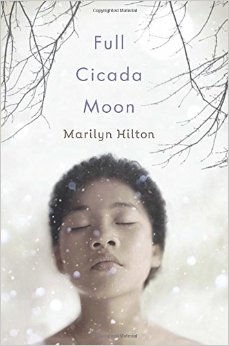
Full Cicada Moon

by Marilyn Hilton
First sentence: “I wish we had flown to Vermont instead of riding on a bus, train, train, bus all the way from Berkeley.”
Support your local independent bookstore: buy it there!
Review copy sent to me by the publisher rep.
Content: There isn’t anything objectionable, and it’s a novel in verse so it’d be appropriate for the younger readers. Good for conversation as well. It’ll be in the middle grade (grades 3-5) section of the bookstore.

Mimi Yoshiko Oliver is obsessed with space. It’s 1969, the height of the space race, and she wants to be an astronaut. The problem? She’s a girl. No one takes her desire seriously, especially in her school in Vermont. It also doesn’t help that she’s Afro-Asian, one of the only people of color in an all-white community.

As she goes through seventh grade and the beginning of eighth, Hilton gives us Mimi’s struggles and triumphs, from her attempts to get into shop class — there are some pretty strong gender norms in the late 1960s —
to her struggles to make friends. There are lots of stories about racism in the south in the 1960s. It was actually quite refreshing to be reminded that even northerners had issues with civil rights.

It’s a lovely novel in verse, as well. Hilton captured Mimi’s sense of wonder an awe at the world around her as well as her desire to go into space. It wasn’t overly detailed, something which might bother some readers but I found I didn’t mind. Perhaps it’s because I’m older, and I remember what it was like (sort-of). But, I also think it was a conscious choice on Hilton’s part to make it more accessible to those reading it. So, on the one hand, it’s historical fiction. But the other, it didn’t really feel all that much like it.

Even so, I thoroughly enjoyed spending time with Mimi and her family, as they adjust to a new home, broaden their horizons, and have a memorable year.

Everything Everything

by Nicola Yoon
First sentence: “
Support your local independent bookstore: buy it there!
Release date: September 1, 2015
Review copy picked up at CI3 and signed by the author.
Content: There is a few mild swear words, and one sort-of on-screen, sort-of-off-screen sex scene. The publisher has it listed for grades 7 and up, which puts it in the YA section, but I might move it to the Teen (grades 9+).

Madeline has spent her entire life inside. White furniture, white walls, filtered air, the whole deal. It’s because she has Severe Combined Immunodefiency (SCID), which basically means she’s allergic to the world. Any little disease, any little microorganism will kill her. So, she stays inside, reading, doing her online school.

And then Olly moves in next door.

Okay: yes, the plot is predictable. Boy moves in next door, they meet and have instalike, and suddenly the girl is questioning her Life Choices and Taking Risks.

But I ate this up. I don’t know if it was the short chapters, snippets of Madeline’s thoughts and observations, interspersed by some charming line drawings. Or the parallel worlds between her being trapped inside her house because she’s sick and Olly being trapped because of his abusive father. Or just the chemistry between Madeline and Olly, which was fantastic. Or the fact that Madeline was Afro-Asian, and yet it wasn’t really an issue. She just was. Her mother is suffenciently controlling (for good reason), and I adored Carla the Latina nurse, who was really more of a mother figure to Madeline.

And all of this added up to overcome the predictable plot and make me fall for this book. Another absolutely amazing debut.

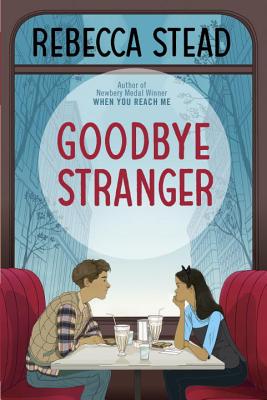
Goodbye Stranger

by Rebecca Stead
First sentence: “When she was eight years old, Bridget Barsamian woke up in a hospital, where a doctor told her she shouldn’t be alive.”
Support your local independent bookstore: buy it there!
Review copy picked up at Children’s Institute
Content: There’s one swear word. And several situations that are more middle school than elementary school. It’s in the YA section (grades 6-8) of the bookstore, but I’d give it to a fifth grader, especially as they’re approaching middle school.

I’ve been thinking about how to start this. It’s not an easy book to categorize: is it a book about friendship? Yes. About growing up? Also yes. About bullying and the shame girls feel about their developing bodies?Again: yes. About first love and that line between friendship and something more? Yep.

But it’s also more: it’s about doing the wrong thing and making it right. About figuring out who you are in the wake of change. And it’s all done with Rebecca Stead’s beautiful writing.

The story is nominally about three friends — Bridge, Em, and Tab — who have been friends since the third grade. They made a pact to always stick together and never to fight, which is easy until seventh grade. Then Em begins attracting the notice of older kids and boys, and, well, likes it. Tab becomes enamored of a feminist teacher and dives headfirst into the world of equality and civil disobedience. And Bridge is kind of stuck in between. She doesn’t really want to grow up (I can relate), and yet she’s kind of interested in it as well. She picks up a pair of cat ears on a headband and wears those through the fall and winter because they felt “right”. She’s not quite sure who she is, or where she fits.

There are plot points, and chapters written in second person by a “mystery” high school freshman narrator (I figured out who it was fairly quickly. Yay me!), but mostly the book is about every day little things as Bridge is trying to figure out where she fits in this weird middle school world.

I loved it, and I think I did for one reason: I saw both myself and my daughters in this book. I saw the awkward 7th grader I was, and realized that Bridge was okay in her journey, because I survived. I saw M and C in the friends, and the ups and downs of their middle school experiences. And I saw A, as she starts middle school next year, and was reminded (again) of all the changes that will come her way. And for that, I loved this. I loved the smallness of it (and the diverseness: Bridge is Armenian and Tab is Indian) and the hopefulness of it. And I loved that the friends did, in fact, make it work out.

I thought it was marvelous. I just hope it finds the kids who will think that too.

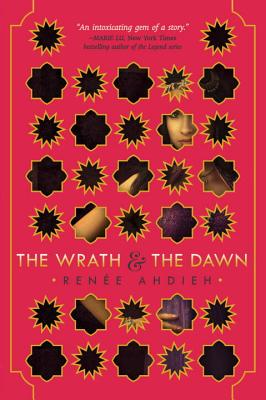
The Wrath and the Dawn

by Renee Ahdieh
First sentence: “It would not be a welcome dawn.”
Support your local independent bookstore: buy it there!
Review copy supplied by the publisher rep.
Content: There is some (implied) sex and there’s some violence, but it’s mostly appropriate for those who love grand, sweeping romances. I’d give it to an 8th grader and up, even though it’s in the Teen (grades 9+) section of the bookstore.

In this land, the king — 18-year-old Khalid — marries a new bride (chosen at random) every night, just to have her murdered the next dawn. It’s horrible for the people of the country who have come to look at him as a monster. But for Shahrzad, it’s personal: the most recent young woman sent to her death was Shazi’s best friend, Shiva. So (of course) Shahrzad volunteers for the job of bride.

And what follows is her attempt to stay alive.

If you know, even vaguely, the story of Arabian Nights, you pretty much know what’s going to happen. But, Ahdieh takes the story a step further: it’s not just the tales Shahrzad tells to keep alive. She gives motivation to Khalid (though in many ways it came too late for me to care very much) and she gives drive to Shahrzad. She’s there to exact revenge for her best friend, but discovers that there’s more to Khalid than murder.

Yeah, yeah, yeah.

I know people are loving this book. Seriously loving it. But, I just didn’t. I wanted to; I wanted to enjoy the sweeping Persian-inspired grandeur of the story, the fiestiness of Shahrzad, the illusions to the old tale. But, mostly what I wanted to do was smack Khalid and wonder why Shahrzad fell in love with him. (Too much telling, not enough showing?) It’s not that it didn’t make sense; it’s more that I just felt it was Decreed that they Fall in Love and So Mote It Be. I didn’t feel their love story. Then again, I didn’t feel Shahrzad’s rage. Or her first love’s betrayal. It was all Grand and Distant and I really didn’t care.

But since it’s getting pretty much universal raves from everyone else, it’s probably just me.

Enchanted Air

by Margarita Engle
First sentence: “When my parents met, it was love at first sight.”
Support your local independent bookstore: buy it there!
Content: It talks indirectly about drugs, sex, and teen pregnancy, as well as the violence of war, but it doesn’t dwell on that. It’ll be in the children’s biography section of the bookstore

I noticed that Abby had read this one and liked it, so I pulled it off my pile to give it a try. I mostly wanted something I could finish in one sitting, and this one — being a memoir in verse — fit the bill.

I didn’t expect to be thoroughly delighted by it.

Margarita is the daughter of a Cuban immigrant and the son of Ukranian holocaust survivors. Needless to say, she had an interesting story to start. Add to that the conflict in the 1950s with the Cuban revolution and the subsequent cold war, she definitely had  a story to tell. But: she chose to tell it through travel, through depictions of the island itself (which she described so lushly) as well as her family’s vacations to Mexico and Europe. She portrayed herself as an awkward child, caught between two countries and then unexpectedly cut off from half of her family. I can only imagine what her mother felt.

Elegantly told, beautifully imagined, it’s a love story to the power of words and images and home. (And I’m glad that her hope in her afterward for more normalized relations between the U.S. and Cuba may slowly be coming to fruition. I would love to visit there someday.)

The Truth Commission

by Susan Juby
First sentence: “First let me say that this will not be an easy tale to tell, so I’ll warm up with an author’s note.”
Support your local independent bookstore: buy it there!
Review copy pilfered off the ARC shelves at my place of employment.
Content: There’s some discussion of rape and bullying and a character doing drugs, but there’s no swearing, etc. It’s currently in the Teen section (grades 9-12), but I’d give it to a 7th or 8th grader.

This is going to be quick since I need to head to work. The basic story: Normandy Pale (she’s a girl) goes to an elite art school on an island off the coast of British Columbia. Her claim to fame? Her older sister immortalized a very awful version of their family in a cult popular graphic novel.

Normandy has never been happy with this, but when her sister shows back up into their lives (having suddenly left a prestigious art college in California), she’s really not happy. Add to that her friends Neil and Dusk (her name is really Dawn, but her personality is more Dusk-like) deciding that what they need to do is elicit Truth from people who aren’t fully honest with themselves, Normandy’s a bit of a mess.

Told as a work of “creative non-fiction” (complete with footnotes), this is really a delightful read. Juby’s exploring things like perception and truth, and whether or not it’s good to be honest with each other and with ourselves. It has a messy ending (being “true to life”), and some bumps along the way (the parents were particularly milquetoast) but in the end, I thoroughly enjoyed it.

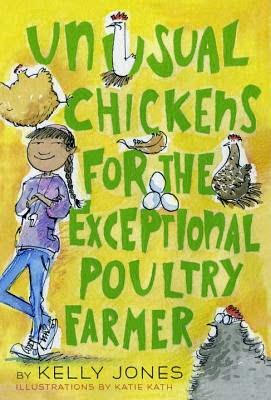
Unusual Chickens for the Exceptional Poultry Farmer

by Kelly Johnson
illustrated by Katie Kath
First sentence: “My great-uncle Jim had your flyer in his barn.”
Support your local independent bookstore: buy it there!
Review copy swiped off the ARC shelves at my place of employment.
Content: There’s some tricky words, and I’m not sure whether or not the epistolary format will turn off reluctant readers or encourage them. There’s a lot of fun illustrations and some good chicken facts, though. It’s in the middle grade (grades 3-5) section of the bookstore, but I’d probably give it to a confident 2nd grade reader.

Sophie Brown and her parents have just moved from the bustling city of Los Angeles to a farm in the middle of nowhere California. It was a move partially because of necessity — her dad lost his job and hasn’t been able to find a new one — and partially out of happenstance — Sophie’s dad’s uncle died and left him the farm. So, they’re trying to figure this whole thing out. And it’s not going terribly well. That is, until Sophie discovers a catalog for “exceptional” chickens. Turns out, that Uncle Jim was not only a farmer (he had a vegetable garden and some grape vines) but he raised, well, unusual chickens.

The chickens are not quite magical, and they’re based on real chickens, but they’re not quite normal either. (One lays glass eggs, for example.) Sophie is given instructions by the person who runs the catalog on how to catch and care for the chickens, but someone is trying to steal Sophie’s chickens. The question is: will she figure out how to keep the chickens (without divulging their magical properties)? And can she stop the thief from stealing her chickens?

The cleverest thing about this book is the format: Sophie’s story spills slowly over the course of the book through letters she writes to her dead abuela, dead great-uncle Jim, and the chicken place. (It’s kind of unusual her writing to dead people, but it works. She doesn’t really expect an answer back.) It’s a very one-sided story, and we only get snippets of things other than chickens: her mother’s free-lance writing, or her father’s failing search for a job. But, the tone is light, and there is a mystery to be solved with the chicken thief. But what really comes through is Sophie’s voice. She’s a determined child, someone who is willing to figure things out and solve problems. She’s spunky. And she’s half Latina. All of which makes for a charming book, a fun read, and a book worth checking out.

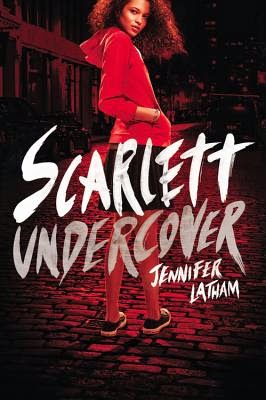
Scarlett Undercover

by Jennifer Latham
First sentence: “The kid was cute.”
Support your local independent bookstore: buy it there!
Content: There’s a bit of mild swearing (s**t) being the “worst” one, plus some kissing and references to (adult) smoking. It’s in the YA section (grades 6-8) of the bookstore, but I wouldn’t mind giving it to a savvy 5th grader.

I adored Nancy Drew as a kid. Seriously. I devoured them all. I loved the mystery, I loved Nancy Drew’s pluck. It was what I wanted.

This, however, is Nancy Drew for the Modern Age: she’s sassy, smart, and street-wise. And I loved it just as much (if not more).

Fifteen-year-old Scarlett is many things: an orphan (dad was murdered, mom died because of cancer); brilliant (she graduated from high school two years early); Muslim; and, perhaps most importantly, a detective. No, it’s not really official: she mostly does inside jobs for the Las Almas police department, and sometimes she hustles and gets a case locating something missing. Nothing that prepared her for when 9-year-old Gemma walks through her door.

Gemma’s worried about her older brother: something has happen to change him; he’s become distant, angry, and mean. But, more than that: Gemma’s convinced that her brother is responsible for the “suicide” of his (former) friend. And she needs Scarlett to find out what’s going on. Little does Scarlett realize the rabbit hole that she’s just opened up.

One of the things I loved most about this book was that Scarlett came from a religious family (she wasn’t non-religious; she just wasn’t as religious as her older sister), and there was a huge support in the surrounding community. But, it wasn’t an issue: it was just who Scarlett was. She greeted people in Arabic, she said her prayers, she observed Islamic customs and traditions. And she solved cases. It was so perfect in so many ways.

I also liked that she was sassy. She had an attitude, but one that suited her and the narrative, and it came through loud and clear. If I was my 11-year-old self, I would have adored Scarlett. (Which my mother may not have appreciated it.) I also loved that Scarlett, was capable: she got into some dangerous situations, and she had the know-how (and the tools) to get herself out. It’s really fantastic.

There is a vague hint of the supernatural — talk of djinn and portals and such — but it didn’t develop in a speculative fiction way, which actually made me very happy. I love speculative fiction, but it would have been out of place here.

I’m willing to talk this one up as much as possible; I do hope it finds a ton of readers.