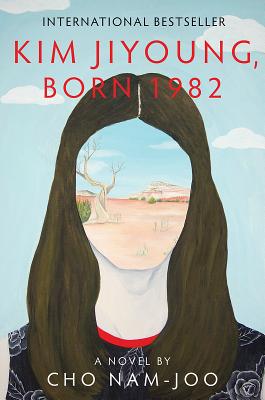
Kim Jiyoung, Born 1982

by Cho Nam-Ju, translated by Jamie Chang
First sentence: “Kim Jiyoung is thirty-three years old, thirty-four Korean age.”
Support your local independent bookstore: buy it there!
Review copy provided by the publisher.
Release date: April 14, 2020
Content: There’s some swearing, including a few f-bombs. It will be in the Adult Fiction section of the bookstore.

This is the story of one Korean woman, and how she get to the point, a year after giving birth, where she’s impersonating (but is she really?) other women. Something I didn’t know until the end: it’s told through the eyes of a psychologist/psychiatrist that Jiyoung goes to see, presumably because of her condition. She tells this psychiatrist about her life, from a childhood where she and her older sister were mostly neglected in favor of their younger brother, through school where she was often harassed by boys, to the workplace where she was often treated by men as a servant. She just decided it was her lot, and did the best she could, though there were women — including, eventually, her mother — who were telling her life could be different. Jiyoung gave up working when she had her baby, mostly because it was too hard to juggle daycare and a full-time job and her husband wasn’t terribly supportive.

This was just a portrait of one life, albeit one that had quite a few run-ins with the patriarchal system of Eastern Asia. It was a sad little book — sad that Jiyoung was never really encourage to do much of anything, sad that the lives of women still revolve around the men and boys. It’s odd too, it had footnotes (which makes more sense knowing it’s psychiatrist notes) and an odd cadence. It’s not a story I read to really connect with the characters, though much of that Jiyoung went through was relatable. But, even though we got the facts of her life, I felt like we never really got to know her. Although I appreciated the insight into contemporary Korean culture, I just felt disconnected through the book.

Oh, and the author got epidurals wrong, which is a small thing, but an annoyance all the same.

I do appreciate that this book exists, if only to highlight the sexism and misogyny in countries other than the United States. But, no, I didn’t find it enjoyable.
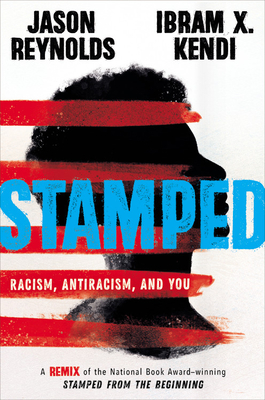
Audio book: Stamped: Racism, Anti-racism, and You

by Jason Reynolds and Ibram X. Kendi
Read by Jason Reynolds
Support your local independent bookstore: buy it there!
Or listen at Libro.fm
Content: There is frank talk of slavery and rape and they use the n-word a couple of times. It will be in the Middle Grade History section of the bookstore.

The publishers — and Reynolds himself — are calling this a “remix” of the National Book Award- winning Stamped, by Kendi, and a brilliant remix it is. Reynolds takes the ideas in Kendi’s book — which is a look at racism from the first recorded instance in the 14th century to the present day — and distills them down so that kids == it’s aimed at the 10 and up crowd — can easily grasp the ideas and the history.

And Reynolds makes it fun. It’s a “not history history book”, one where Reynolds talks about IDEAS and how they fit into the grander scope of history. It’s incredibly engaging to listen to (and read!) — Reynolds is a fabulous narrator — and it made me look at history in a new light. It’s an important book — I’ve checked the original out from the library because I’m interested in what Kendi’s research — especially in this day and age. It’s incredibly helpful as a white person to understand that racism is systemic and built into the framework of our society. And maybe by understanding that, we can all become a bit more aware.

Excellent and highly recommended.

Audio book: The Worst Best Man

by Mia Sosa
Read by: Rebecca Mozo and Wayne Mitchell
Support your local independent bookstore: buy it there!
Or listen at Libro.fm
Content: This is super sweary including a lot of f-bombs, and there’s on-screen sex several times. It’s in the romance section of the bookstore (yes, we have a romance section now!).

Lina Santos has worked hard to get where she is: the owner of a reputable wedding planning business. Sure, she was left at the altar by her fiance four years ago, but she hasn’t let that get in the way. Now, she’s got a shot at the job of a lifetime: wedding coordinator at a prestigious hotel chain. The catch? She has to work with her ex-fiance’s brother, Max, on the presentation. The double catch? They’re totally attracted to each other.

Oh this was so much stupid fun. It’s that sort of smart and sexy romance with a dash of Brazilian flavor (the author identifies as Brazilian-American) that is just fun to read. And this was definitely enhanced (*cough*) by the narrators. Mazo was delightful to listen to and if it’s possible to have a very sexy and sassy voice, Mitchell definitely has it. I think a good two-thirds of the fun of this one was in the delivery of the book. Not that the book itself wasn’t full of that great push and pull (*ahem*) of a well-written romance (and the sex scenes were definitely steamy!), but the narrators brought it to life and made it pop.

Not for everyone, obviously, but I thoroughly enjoyed my time with it.

Audio book: Becoming

by Michelle Obama
Read by the author.
Support your local independent bookstore: buy it there!
Or listen at Libro.fm
Content: There’s some mild swearing. It’s in the Biography section of the bookstore.

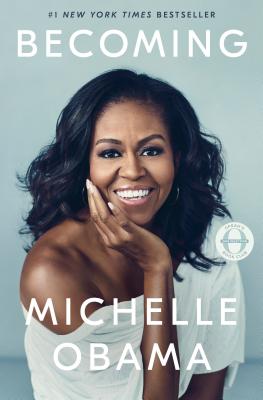
This is your basic memoir: the life of Michelle Robinson Obama, from growing up in the South Side of Chicago to going to college at Princeton and law school at Harvard, to how she met and married Barak Obama, her challenges and successes as a professional woman with two children, and then dealing with a husband who wanted to become (and then became!) president and all the challenges and success with being the first lady of the United States.

First off: yes, it does live up to the hype, especially on audio. Obama is a delightful narrator, and listening to her tell her insightful, funny, interesting story is a treat (whether or not you agree with her husband’s politics, I think). She is a delightful, smart, good human being and I’m glad she chose to tell her story. I do hope it does what I think she hopes it does, and inspires young girls and young women to get involved.

Mostly what it made me do, in the end, was desperately miss having someone in the White House (whether or not you agree with their politics) who took the idea of governing seriously, who did their best to be ethical and honest, and who actually was Presidential. You could argue that Barak Obama wasn’t a great president, but what you can’t say is that he didn’t take the role seriously. Same for Michelle: she took the idea of being First Lady seriously, harnessing her influence for something good, and I miss that terribly.

At any rate, this was an excellent book.

This Place: 150 Years Retold

by Various Authors
Support your local independent bookstore: buy it there!
Content: There is violence and racism as well as some mild swearing. It’s in the graphic novel section of the bookstore.

This is one of the reasons why I love the Cybils. I had never heard of this book, or would have ever picked it up, had I not been a judge for the graphic novels panel. And I’m so glad I did!

This is a series of short stories starting in the mid-1800s and going through to present day. Each story is told by an Indigenous people about people in their past or present who have somehow influenced or otherwise impressed them. Obviously, I hadn’t heard of any of them, but I found the stories not only to be interesting but to be important as well. I did feel like I connected with some of the stories more than others and that some of the art was better than others, but overall it’s a fascinating and important book. And one I’m glad I read.

They Called Us Enemy

by George Takei, Justin Eisinger, Steven Scott and illustrated by Harmony Becker
Support your local independent bookstore: buy it there!
Content: There is violence, some swearing, and many racist actions. It’s in the graphic novel section of the bookstore.

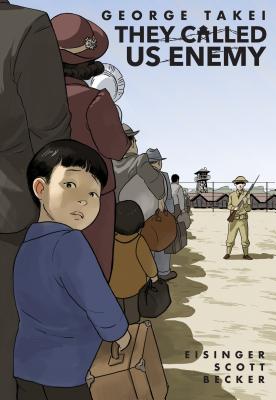
Everyone knows George Takei as Sulu on Star Trek (and as a side note, Hubby and K and I are working our way through the original series on Netflix — a consolation prize for not paying for CBS all access so we can watch Picard — and are enjoying it immensely). And if you’ve followed Takei on social media at all, you know about his childhood in the Japanese internment camps during World War II. But, since not everyone knows about this (shameful) part of our past, and because his story is relevant today with the ICE camps in California and Texas, he decided to tell it as a graphic novel.

It’s a tough story, but an important one; Takei was about 4 or 5 when his family was shipped off to live in one of the camps in Arkansas. He admits that he doesn’t remember much, and that he is grateful his father was willing to talk about their time in the camps (many of those who were sent felt shame and didn’t talk about it). It reminded me of John Lewis’s March, in that this is framed by a TED talk, by Takei looking back at this time. It’s a mirror to white people, at how harsh and how exclusive and judgmental we can be. And what the government will do — to citizens! — in the name of national security. (War is just awful.) While I’m not entirely sure the storytelling was smooth and the art was good but not brilliant, but the story is important enough to make this one worth reading.

Surviving the City

by Tasha Spillett and Natasha Donovan
Support your local independent bookstore: buy it there!
Content: There is tough content about indigenous women who have disappeared. It’s in the graphic novel section of the bookstore.

Miikwan and Dez are best friends. They’ve done everything together from their hanging out after school to their traditional and important Berry Fast. And ever since Miikwan’s mother disappeared, she has needed Dez in her life. But, Dez’s kokum is not doing well, heath-wise, and the state has threatened to put Dez into a group home. Which she doesn’t want, and so she leaves. Which sends Miikwan into a spiral: she can’t lose another woman in her life.

On the one hand, this is an important book: it’s picturing the lives of Native peoples in the city, not on the reservations, showing them balancing the traditional with the contemporary. It highlights the injustices by the government — why should Dez go into a group home because her grandmother’s health is failing? Would that happen if she were white? Or less poor? — and the grave harms done to indigenous women — the book is populated with ghosts of the women murdered and who have disappeared. It’s definitely an important story to tell.

Which is kind of why I wish it were actually told better. Maybe it’s because I am white, but I didn’t feel like the characters were fully developed — Miikwan’s main character trait was that she missed her mother and Dez’s was that she didn’t want to go into a group home. I wanted to know more about their Berry Fast: what was it, why is it important to them? I just wanted more from these characters to balance out the importance of the story they were telling. I also wanted to know more about the ghosts. Could MIikwan see them? Sometimes I felt like she could. I get why they were around, but what was their connection to our characters? And Dez — I just wanted more from her, other than the fact that she was worried about her kokum. What are her interests? She got in trouble in the beginning, was she the one who was always picked on by the teacher? Does she see the school counselor often (I got that impression, but wasn’t sure). There were just so many holes.

That said, I am glad this exists in the world.

Crush

by Svetlana Chmakova
Support your local independent bookstore: buy it there!
Others in the series: Awkward, Brave
Content: There’s some bullying and general middle-school romance. It’s in the Middle Grade Graphic Novels section of the bookstore.

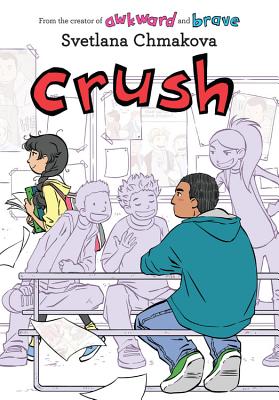
Jorge is the Big Kid at Berrybrook Middle School, the one that’s head and shoulders taller than everyone else. He doesn’t mind; he uses people’s assumptions of him (that he’s a Heavy) for good, making sure that bullies don’t pick on other kids. He’s got a group of friends he’s been friends with forever: Liv, the outgoing popular one, and Garrett, who just transferred to Berrybrook and is trying to fit in. Jorge is fine with the way things are.

But then Garrett decides to get in with the starting quarterback James’s group, and Jorge develops a crush on Liv’s friend Jazmine, and Drama breaks out in the middle school halls.

I really enjoyed this one. I think that Chmakova gets middle schoolers, and the everyday ups and downs of friendship, crushes, and belonging. I liked Jorge as a character, how he used his size to help others and how he wasn’t afraid to be an individual rather than going along with the crowd. This one was less about crushes, though, and more just about relationships, and what it takes to have a good one, whether it be friendships or romantic. Jorge wasn’t the character with the growth arc; rather, he was the rock that everything in the book revolved around, which was perfectly fine by me.

Really very, very good.

Black Brother, Black Brother

by Jewell Parker Rhodes
First sentence: “I wish I were invisible.”
Support your local independent bookstore: buy it there!
Release date: March 3, 2020
Review copy provided by the publisher.
Content: It’s pretty simply told, and easy enough (and appropriate) for younger readers to understand. It will be in the Middle Grade section (grades 3-5) of the bookstore.

Dante is the black brother in his family. His dad is white, his older brother Trey presents as white, but Donte and his mom present as black. Which wasn’t a problem until the family moved to a (mostly white) suburb of Boston and the boys started attending a (mostly white) prep school.

I’ll stop here and say this book is all about racism. Explicit racism from some of the students at the school — the story’s antagonist and school bully, Alan — but also the implicit racism in the system: Donte, because he is black, is the one who is always in trouble, who the teachers and the headmaster blame for things that go wrong. But it goes broader than that: Rhodes tackles the prison system — Donte is arrested for something he didn’t do at school, and the only reason he gets off is because he doesn’t present as stereo-typically black (and having a white father helped, too). And the overall racism inherent in sports.

It’s a simple book, but that makes sense, considering who its intended audience is. And Rhodes is a remarkable writer, able to simplify without dumbing down for her audience. It’s a good story, and one worth reading.

The Tea Dragon Festival

by Katie O’Neill
Support your local independent bookstore: buy it there!
Content: There’s really nothing objectionable. It’s a bit long for beginning readers. It’s in the Middle Grade Graphic Novel section of the bookstore.

From what I understand, this world is introduced in The Tea Dragon Society, so I kind of feel like I’m coming into this a little blind.

There is this world where dragons are shapeshifters (I think?) and they protect villages. There are also talking animals (I think?) and the tea dragons are kind of like little goats that you can harvest leaves from to make tea (I think?).

This book has to deal with a small village (in the mountains, so they only eat what they can forage) and a dragon that was supposed to be protecting it but had fallen asleep for 80 years. And with figuring out what you’re good at and doing that and not what People Expect you to do.

Or something like that

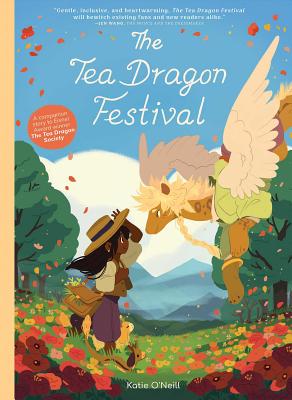
It’s just a weird little book. The art is gorgeous, though. I’d love to have some of O’Neill’s paintings; she does such lush landscapes. And I did admire that she has a deaf character that does sign language, though that was a bit challenging to depict in a graphic novel format. I do appreciate, too, that this is a tame little inclusive fantasy without any violence or conflict. Though that kind of means there’s not much meat to it either.

Good for those who want pretty pictures and a light story.