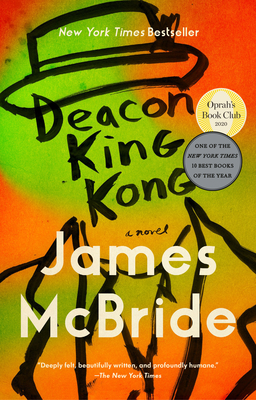
Deacon King Kong

by James McBride
First sentence: “Deacon Cuffy Lambkin of Five Ends Baptist Church became a walking dead man on a cloudy September afternoon in 1969.”
Support your local independent bookstore: buy it there!
Content: There is swearing, including many f-bombs, and the use of the n-word. It’s in the adult fiction section of the bookstore.

The plot of this one is almost incidental: Deacon Cuffy “Sportcoat” Lambkin (who also gets called Deacon King Kong for the amount of hooch he drinks) shot (but did not kill) a local drug dealer, who used to be a kid that played on a baseball team Sportcoat coached and umpired in the projects in Brooklyn. And, because of this, Things Happen. What the Things are doesn’t really matter: this is a novel that is propelled by the characters. And there’s a whole mess of characters. So many that when I tried to listen to this on audio, I got lost with who was who. But, reading it helped keep some of them straight. It’s a whole neighborhood full of characters, their wants and needs and desires and connections to each other. And McBride truly captured a moment in time, and a place, as the people of this Brooklyn neighborhood lived their lives and tried to keep things together as much as they could.

I didn’t absolutely love this book, but I didn’t dislike it either. It’s funny at times, and always interesting, if you like charioteer-driven novels.

Concrete Rose

by Angie Thomas
First sentence: “When it comes to the streets, there’s rules.”
Support your local independent bookstore: buy it there!
Review copy provided by the publisher.
Content: There swearing, including f-bombs, some tasteful sex, and talk of drug use. It’s in the teen section (grades 9+) of the bookstore.

Maverick Carter is just trying to live his life. He’s got a girlfriend he adores, and friends — including a cousin, Dre — that have his back. But then, his life is upended: a girl he had a one-night stand with (the condom broke) got him to take a DNA test to see if her baby was his. And sure enough, it was. Then she dumped the baby in Maverick’s lap and left (she was suffering from postpartum depression, so I get it). Which meant, all of a sudden, Maverick has to take stock of his life. Does he want to be involved in the King Lords and sell drugs, even though the money is good? How can he help his mom out (especially since dad’s been in prison since Maverick was eight). And then after a tragedy happens where Dre is killed, how can Maverick just go on?

In this prequel to The Hate U Give (you don’t have to have read that one first), Tbomas explores what it’s like to be a Black man in the inner-city in the late 1990s/early 2000s. When really all anyone expected of Maverick was for him to be a part of a gang, and to get a couple of girls pregnant. It’s all about Maverick finding it within himself to not be a stereotype, to not fall into the life his father lived, to be something — and someone — different. And, because Thomas is a gifted writer, she is able to bring life to this world and this character without making it seem preachy or trite. It really is an excellent story, and one that makes you feel for Maverick and his struggles and situations.

Thomas’s not just an important writer doing important work, though. She’s an excellent writer telling good stories. And that’s what really matters.

Felix Ever After

by Kacen Callender
First sentence: “We push open the apartment building’s glass door, out into the yellow sunshine that’s a little too cheerful and bright.”
Support your local independent bookstore: buy it there!
Content: There’s some teenage drinking and pot smoking, swearing — including multiple f-bombs — and some tasteful making out. It’s in the Teen section (grades 9+) of the bookstore.

Felix is a trans young man who is struggling. Not just with his father — who won’t say his name, just calling Felix “kid” — but fitting in at St. Catherine’s, an elite art prep school in New York City. Felix has one friend, Ezra, who is totally and completely accepting of who Felix is. However, not everyone on campus is. When one day during the summer term, an “installation” of Felix’s dead self complete with his deadname shows up, Felix is determined to find out who did that, and exact revenge. But things don’t go as planned.

I’ve not read a lot of trans fiction, especially for young adults, but I adored the way Callender handled this (one expects it would be handled beautifully, considering Callender identifies as non-binary). I adored Felix and felt his struggles to be accepted as his true self, even though he’s still kind of questioning his identity. I am glad Callender reminded readers that gender is a spectrum and perhaps labels aren’t always the best thing. But beyond that, I loved Felix and Ezra together, and the tension between Declan (who was a former boyfriend of Ezra’s) and Felix. I loved the emphasis on art, and how art can express inner feelings the way words sometimes can’t. And I still think Callender is a beautiful writer. They capture things on the page about being trans and black and queer and trying to fit into this world that doesn’t want them. It was powerful and challenging and wonderful all around.

I am definitely a fan of Callender’s now.

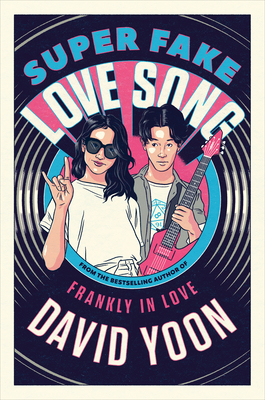
Super Fake Love Song

by David Yoon
First sentence: “Every superhero has an origin story.”
Support your local independent bookstore: buy it there!
Content: There’s some mild swearing and in the older brother has a drinking problem. It’s in the YA section (grade 6-8) of the bookstore.

Sunny Dae (yes, that is meant to be punny) is a Nerd. Not only self-declared, but declared by the student body of his super rich California high school. Which is fine with Sunny. He and his friends Jamal and Milo have their own thing: a DIY FX YouTube channel for people who want to make their own cosplay outfits. It’s a perfectly fine existence, and aside from the fact that Sunny’s older brother Gray won’t talk to him and his parents are always working, one that Sunny is happy with.

Then Sunny meets Cirrus Soh, who accidentally thinks that Gray’s old room — full of guitars and “cool” things — is Sunny’s. And Sunny leans into that lie: yes, he plays guitar. Yes, he fronts a band. Yes, he’s “cool”. And all of a sudden, he has to make good on his lie. He ropes his friends into it, and gets the girl. The problem is: he’s kind of liking the “new Sunny” but he’s letting his friends down. Can he find a way to balance everything?

This book was super fun! Okay, so the romance part of this book wasn’t the best; Sunny and Cirrus were a bit forced and their romance never really felt real to me. What I did love, though, was Sunny. I loved his grappling with being nerdy and realizing that not everything or everyone fits neatly into boxes. I loved his family and their relationship to each other. For me, that was where the most interesting drama took place. I adored Milo and Jamal, and thought the three friends were brilliant together. And loved passages like this:

“My two best friends wore what they normally wore, which was to say a combination of low-performance joggers and blank polos that were so normcore, they went though dadcore and into weekend dadcore beyond.”

And this:

“The cynic would say Sunset [Boulevard] was like any other street in the godforsaken post-apocalyptic wonderland. But it wasn’t. It was a twenty-some-odd-mile-long serpent behemoth whose head had no idea what its tail was doing.”

No, it’s not brilliant fiction. But it is a lot of fun! And right now, that’s what really matters.

Audio book: Sia Martinez and the Moonlit Beginning of Everything

by Raquel Vasquez Gillliland
narrated by Inés del Castillo
Support your local independent bookstore: buy it there!
Or listen at Libro.fm
Content: There’s swearing, including many f-bombs and description of sexual assault as well as almost-sex. It’s in the Teen section (grades 9+) of the bookstore.

It’s been three years since Sia’s mom disappeared in an ICE raid that sent her back to Mexico, a place where she had never been, having been brought to the US by her mother when she was young. Sia’s mom since disappeared, and was presumed to be dead. By everyone. So, for three years, Sia has been harboring grudge and aching for revenge on the sheriff who turned her mother in.

And… here’s where everything gets a little weird. I was enjoying this book about a girl who was dealing with her mother’s death, with the inherent racism in her town, with trying to keep her best friend together, with liking a new boy who just happens to turn out to be the estranged son of the sheriff. And then the book slants sideways and there are aliens? An Sia’s mom is not dead, but instead has spent the past three years being tested on in a secret government conspiracy? And it took half the book to get there?

I don’t know. I wanted to like this one more than I did. I adored the narrator; I think, in the end, she is what kept me listening (that, and I wanted to see just how far this alien thing would go) because I was annoyed. Annoyed that the jacket blurb gave away the aliens. Annoyed that they didn’t show up until halfway, and yet were so vital to the plot. Annoyed because it was a good book about a girl who was dealing with grief and loss and moving on, and all of a sudden: ALIENS AND YOUR MOM ISN’T DEAD.

I know there are people out there who liked this one. I’m just not one of them.

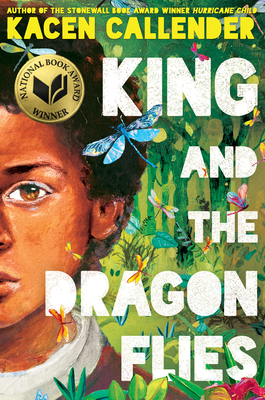
King and the Dragonflies

by Kacen Callender
First sentence: “The dragonflies live down by the bayou, but there’s no way to know which one’s my brother.”
Support your local independent bookstore: buy it there!
Content: There is some parental abuse, and kids run away. It’s in the middle grade section of the bookstore.

King’s brother Khalid recently died, and he and his parents are struggling to adjust to the new reality. It doesn’t help that King things his brother has come back as a dragonfly. And that his old good friend, Sandy, has come out as gay. In their small, conservative Louisiana town, and with Sandy’s abusive father as sheriff, that doesn’t bode well. Not for Sandy and not for anyone who wants to be his friend.

King spends the book coming to terms with both his brother’s death and with Sandy’s revelation (and the realization that he might be gay as well). It’s a quiet book, but it’s captivating. Callender is a phenomanal writer, and the feelings and emotions they invoke are incredible. They capture not only grief but friendship and parents struggling to do what they think is best. It’s a journey, one that is not readily summarized in a plot, but that is incredibly moving all the same.

Definitely deserving of the National Book Award it won, and highly recommended.

So You Want To Talk About Race?

by Ijeoma Oluo
First sentence: “As a black woman, race has always been a prominent part of my life.”
Support your local independent bookstore: buy it there!
Content: There is swearing, including multiple uses of the f-word, and the use of the n-word. It is in the Sociology section of the bookstore.

This has been on my radar for a while, at least since this summer when we had piles of it in the store. But, I didn’t pick it up until our discussion at one of my book groups led us to asking: “But HOW do we talk to other people about race?” We know, as white people, we need to be addressing racism. But how?

This book mostly answers this question. What it does more is go into depth about WHY it’s important to be talking about race, and what it is you’re talking about when you’re talking about race. But it does go into a bit of how. The answer? Just do it. You will do it wrong. But, if you listen to POC with an open heart and take their lead, then maybe we will make progress.

Because the thing Oluo stresses most is that we have to talk about race. We can’t just say “it doesn’t affect me so I don’t need to talk about it.” If you live in the world (not just the US), race and racism and White Supremacy affects you. Maybe not as much as it affects your Black or brown neighbor, but it does. I was grateful to hear her stories — I think that listening to the stories of Black and brown people is one of the things that moved me the most with all the reading I have done — and I am grateful for her advice for tackling talking about race.

Now to keep at it.

White Tears/Brown Scars

How White Feminism Betrays Women of Color
by Ruby Hamid
First sentence: “‘I am so uncomfortable having this conversation,’ said Fox News host Melissa Francis during a live broadcast of the network’s panel program Outnumbered on August 16, 2017.
Support your local independent bookstore: buy it there!
Content: There are some swear words, including a few f-bombs. It’s in the Sociology section of the bookstore.

I was scrolling through Instagram one day and one of the bookish accounts I follow (I wish I could remember which one) said that if you’ve read Hood Feminism, you really ought to read this one. So I stuck it on hold at the library.

And that account is right: as a white woman, and a feminist, this one is a must read.

Hamad — who identifies as an Arab-Australian — deconstructs what it means to be a Brown and Black woman in the world where the effects of colonialism and racism is still felt. Every day. There is some history here: understanding the history of how white men used white women’s bodies (and white women, knowing the power structure went along with it willingly) to control Indiginous and slave populations is important to understanding the power structure in today’s society. And there are contemporary examples, white women who have made gains in business politics, an society, but who use those gains to keep out their Black and brown sisters.

It made me think of the saying: “If we lift from the bottom, everyone rises”. Colonialism and, by extension, capitalism lifts from the top. (It’s not just America; it’s a product of all colonialism — any place a different population came in and displaced the Indigenous population, any population that enslaved another population are affected this way. So really, the entire world.) It benefits Whiteness and punishes everyone else. (Or at least that’s the way I see it.) And Hamad’s book was basically an invitation to explore how I, as a White woman, interact with Black and brown people, how I use my whiteness (to help? to hurt?), and how I can can do and be better.

So, yeah. A tough read. But a very, very important one.

Tristan Strong Destroys the Universe

by Kwame Mbalia
First sentence: “Nobody likes getting punched in the face.”
Support your local independent bookstore: buy it there!
Others in the series: Tristan Strong Punches a Hole in the Sky
Review copy provided by the publisher
Content: There is some violence and talk of trauma. It’s in the middle grade section (grades 3-5) of the bookstore.

Tristan Strong fixed the problems that he created in the first book in this series. And then he returned to our world while Alke rebuilds. Except: there is a new foe. The Shamble Man has is wreaking havoc on Alke and he has come into our world and kidnapped Tristan’s grandmother. Which leaves Tristan no choice but to return to Alke to get her back. And what he finds is a whole lot messier than he thought it would be when he left.

This is very much a second book in a series — being a bit more dark and dismal than the first. However, I enjoyed that Mbalia not only gave us a complete story. No cliffhangers here. I also appreciated along with the humor and adventure, Mbalia addressed the underlying trauma that happens when things — bad things, hard things — happen. It’s a clever and good way to introduce the concept to kids, and to allow for an opening to talk about them. It’s handled really well. But, even though Mbalia tackles tough subjects, it’s still a lot of fun to go with Tristan back into the world of Alke. I adore Gum Baby and her silly bravado, and I liked the way Tristan was able to work with people he initially found difficult to work with.

In short: it’s smart, it’s fun, and it’s definitely worth checking out.

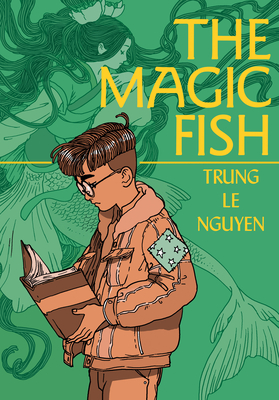
The Magic Fish

by Trun Le Nguyen
Support your local independent bookstore: buy it there!
Content: There some fairy tale-type violence. It’s in the middle grade graphic novel section of the bookstore.

 Tiến is a first-generation American, trying to live his best life. However, he has recently come out as gay to his friends, and wants to share that with his parents. However, he doesn’t know if they understand English well enough and he doesn’t know the words in Vietnamese. His mother feels like Tiến is growing apart as he grows up, but they do still share one thing: a love of reading fairy tales. And maybe through this connection,  Tiến will find a way to share about his life.

Honestly? It was a gorgeous book. The art was spectacular, and the fairy tale retellings (three re-tellings of Cinderella-type stories) were marvelous. I liked  Tiến  and his friends and the way he tries to navigate coming out and his feelings while his mother deals with being separated from her elderly, sick mother.

However, I’m not entirely sure who this graphic novel is for. I know adults will read it and love it, as will those who enjoy fairy tale re-tellings. But, is it for the middle grade age group? Maybe? Maybe there are some 4-8th graders who will read this and see themselves, or need to read this because they lack the confidence to come out to their family. But it lacks a real plot, which most middle grade books kind of need to have.

At any rate, it’s a gorgeous book, and Nguyen is a talented artist. I will be curious to see what he does next.