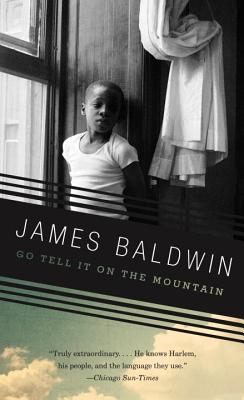
Go Tell it On the Mountain

by James Baldwin
First sentence: “Everyone had always said that John wold be a preacher when he grew up, just like his father.”
Support your local independent bookstore: buy it there!
Content: There is violence, some talk of sex, a liberal use of the n-word, and some swearing. It’s in the adult fiction section of the bookstore.

This one is difficult to describe plot-wise. It takes place over one night, as John, the son of a preacher in New York in 1935, goes to the church to clean and pray with his parents and other church-goers. Over the course of the prayers, we learn that John is not the biological son of his father, who resents his mother for not being more repentant for her sin of bearing John out of wedlock. We learn that John is conflicted about his stepfather, and the idea of church. We learn that John’s mother is just doing what she needs to do, and that his aunt — his stepfather’s sister — has held a lifelong grudge against her brother.

There isn’t much of a plot, it’s more of an exploration of the ways in which racism, enslavement, and patriarchy have affected the lives of these characters and the way they use religion to justify or explain or hide from the world. I’m not entirely sure it comes off as favorable to religious people; religion seems like a crutch to escape and a means of punishment rather than a means of worship and service. But that’s my white privilege talking; I have never been enslaved and I don’t know how religion works in that world. It was a fascinating read (possibly not one that I would recommend while on painkillers) and a complex one, even if it lacked plot.

Blackout

by Dhonielle Clayton, Tiffany D. Jackson, Nic Stone, Angie Thomas, Ashley Woodfolk, and Nicola Yoon
Support your local independent bookstore: buy it there!
Review copy provided by the publisher.
Content: There is mild swearing and three f-bombs. It’s in the YA section (grades 9+) of the bookstore.

The basic premise is this: it’s a hot summer day in New York City, and the power goes out at 5 p.m. The six different authors then set about telling six interconnected stories about what happens — romance-wise — once the lights go off. It takes place in Manhattan and Brooklyn, with both straight and gay couples, as the night goes on.

If there is goign to be short stories, I think, I prefer them when they are interconnected. Think of this as the Black, summer version of Let it Snow. It’s light, it’s fluffy, it’s fun, it’s swoony. People you don’t normally think of writing romance — Angie Thomas, Nic Stone — write solid stories that fit in beautifully in-between Jackson’s longer, multi-chapter anchor story. I loved the characters, I thoroughly enjoyed the stories, and thought it worked together really really well. In short: It’s a brilliant concept, brilliantly executed.

Definitely pick this one up.

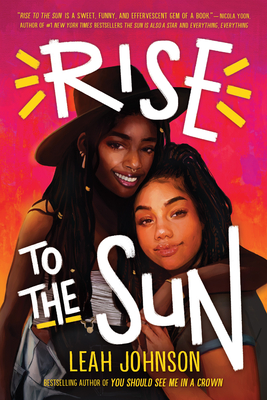
Rise to the Sun

by Leah Johnson
First sentence: “My best friend has always been the first person I run to when it’s time to blow up my life.”
Support your local independent bookstore: buy it there!
Review copy provided by the publisher.
Content: There is some swearing, including multiple f-bombs and some talk of sex. It’s in the Teen section (grades 9+) of the bookstore.

Olivia is a mess. She dates a lot, but her relationships never last. And her last one ended really, really badly. She just needs to get away, so she convinces her best friend, Imani, to drive to northern Georgia to a music festival where Imani’s favorite band is headlining. A best friend’s weekend is what they need.

Toni just graduated from high school, but ever since the sudden death of her father, she’s not sure if she wants to follow the stable path her mom has set, or follow in her father’s footsteps and pursue music. She’s at the festival to figure things out.

But when Olivia an Toni collide (almost literally), everything gets thrown up in the air as they try to figure out the sparks between them.

Much like Johnson’s first book, this one simultaneously is a joy of Black girl romance while having more difficult themes – like the death of a parent, or the expectations of parents – underneath. It’s a fun, delightful, breezy read, and one I’m definitely glad is out there Johnson writes some pretty spectacular YA books, that are much-needed in this market.

Unsettled

by Reem Faruqi
First sentence: “I grab Asna’s hand, palm to palm.”
Support your local independent bookstore: buy it there!
Review copy provided by the publisher.
Content: It’s a novel in verse, so even though it looks long, it goes quickly. There is some talk of bullying and dementia. It’s in the middle grade (grades 3-5) section of the bookstore.

Nurah is happy with her life in Pakistan: she has friends at school, she lives near her grandparents, and loves her home. But then, her father gets a job offer in Peachtree City, Georgia, and relocates the family there. Nurah finds it hard to adapt: she is out of place at school and her brother, whom she used to have a good relationship with, is increasingly distant. The one place Nurah feels at home is the rec center swim team; she’s not the best, but she feels at home in the water.

This was a very sweet and heartfelt story. I thought it worked really well as a novel in verse; it was simple without being simplistic. And Nurah’s challenges with fitting in at school, getting along with her increasingly distant brother, a grandmother with dementia, and just experiencing a new country are presented in a way to make them incredibly relatable.

It was a charming book, but one with a deeply felt heart.

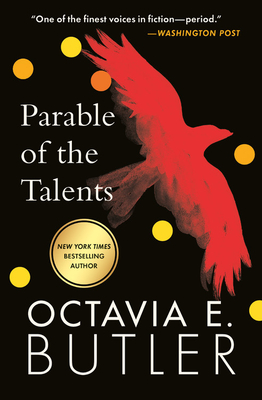
Parable of the Talents

by Octavia Butler
First sentence: “They’ll make a god of her.”
Support your local independent bookstore: buy it there!
Others in the series: Parable of the Sower
Content: It’s rough, violence-wise and emotionally. It’s in the Science Fiction/Fantasy section of the bookstore.

This book picks up five years after Parable of the Sower: Acorn is a settled community, not large but flourishing and prosperous. Earthseed is growing as a movement and Oamina and Bankole are expecting a baby. But, in the wider world, the United States has elected a Christian American minister and facist as a president — someone who believes that all vagrants, homeless, and heathens should be “reeducated” and their children taken away and raised by Good Christian families. Once he’s elected, he backs off, but there is a movement –Jarrett’s Crusaders — that takes it upon itself (without consequences) to follow Jarrett’s philosophies. They attack Acorn, take away the children (including Olamina’s 2 month old baby) and enslave the rest of the adults. It’s a pretty horrific section, reminiscent of the Nazi Concentration camps (and made me ashamed to identify as a Christian though I understand these people were Not Really Christian.) Eventually, Olamina escapes and then spends the rest of the book looking for her child and restarting her Earthseed movement.

The most interesting thing about this book was that Olamina’s daughter, Asha Vere (which was the name her – admittedly not great — Christian adoptive parents gave her), narrated it as well. Every chapter began with an Earthseed verse and then some narrative by Asha. At first, this bothered me — Asha blamed her mother for starting Earthseed, not finding her soon enough, and for decisions she made, none of which really sat well with me; her mother did the best she could given the circumstances — but eventually, I came to understand Asha’s resentment, and her bitterness toward her mother. Butler had to create conflict — because novels are not life — and she did that brilliantly by creating a division between mother and daughter (as well as between Olamina and her brother, who embraced Jarrett’s Christian American movement). Butler is an excellent writer and a consummate storyteller, and, much like Handmaid’s Tale, is quite prophetic. She pulled from history and put together a tale that is a warning as much as it is an engrossing story. I did find myself skimming toward the end, when things settle down and Earthseed becomes moderately successfull, eventually sending ships into outer space, but really: this duology deserves the accolades it has gotten.

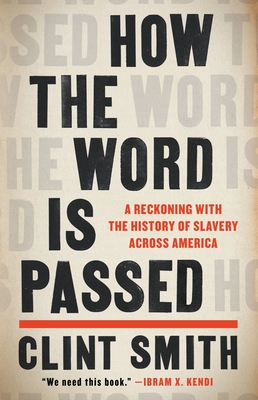
How the Word is Passed

by Clint Smith
First sentence: “The sky above the Mississippi River stretched out like a song.”
Support your local independent bookstore: buy it there!
Content: It talks about violence toward enslaved people, uses the n-word (in context) and some mild swearing. It is in the Biography section of the bookstore.

Clint Smith has written an absolutely beautiful book. It’s not an easy book to read, though the premise is simple: he visits several historical sites that are connected with the slavery in the United States, and recounts his experiences and analyzes the information presented at the sites. He talks to all sorts of people — visitors, tour guides, the people in charge of the sites — in order to get as wide a snapshot as possible.

He recounts his visits to seven sites: Monticello, Whitney Plantation, Angola Prison, Blandford Cemetery, Galveston Island, New York City, and Gorée Island. Some are delving into their history of enslaving people, others not so much. Smith works to understand and critique an inform the reader not just about the history around the sites, but how their interaction and presentation of the past is affecting and informing us today. In short: in order to reckon with the present, we need to reckon with teh past.

It sounds like a difficult read, and it is at times, but Smith’s writing is so beautiful, it doesn’t feel like a chore to read this. He is a poet, and it shows: his descriptions of the places and people, his journalistic interactions, his presentation all draw the reader in and made me, at least, want to read more.

Possibly one of the more important books I’ll read, but also one of the more beautiful ones.

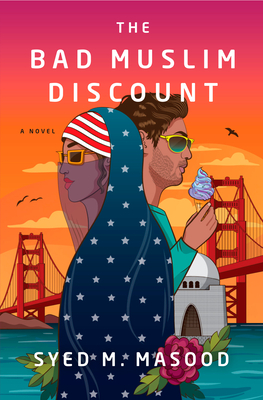
Audio book: The Bad Muslim Discount

by Syed M. Masood
Read by: Pej Vahdat & Hend Ayoub
Support your local independent bookstore: buy it there!
Or listen at Libro.fm
Content: There was some swearing and references to sex. It’s in the adult fiction section of the bookstore.

Anvar Faris was a child in Karachi, Pakistan, but when unrest started to affect his city, his parents decided to immigrate to the US. They landed in the San Francisco area, where Anvar met the love of his life (Zuha, at least I’m hoping I spelled that right), and realized that no matter how much his mother tried, he was not going to be the kind of Muslim that she wanted him to be.

Safwa grew up in war-torn Baghdad, with a conservative father who was taken and tortured by the US soldiers. She fled, leaving her ailing brother to die alone, something her father could not forgive. They ended up in Afghanistan, where they meet a opportunistic young man who gets Safwa and her father passports to Mexico, and from there they come to the US, ending up in San Francsico.

This book is less about the plot — though there is some tension between Safwa and her father and the young man (whose name I don’t think I could spell, having only heard the audio) and Anvar and Zuha help, in the end. It’s much more an exploration of how people live their religion (or don’t) and the reasons behind what they do and why the do it. Safwa’s father is strict and abusive, but how much of that is his beliefs and how much of that is the abuse he suffered at the hands of the US? The young man is angry and manipulative, and how much of that is his religion, or is it the circumstances of growing up in war-torn Afghanistan? Anvar is lax in his religion, but how much of that is laziness and how much of that is a serious questioning of religion His other brother is strictly faithful, but how much of that is because he believes and how much of that is putting on appearances? It’s an interesting exploration.

It’s also a good look at the variety that Islam has. I think too often, especially here in the US, we tend to paint Muslims as all one thing, when in reality (um, much like every other religion) there is a spectrum.

At any rate, the writing is good, and the narration was thoroughly enjoyable. I liked this one a lot.

On Juneteenth

by Annette Gordon-Reed
First sentence: “Texas, perhaps more than any other state in the Union, lives in the public imagination as a place of extremes.”
Support your local independent bookstore: buy it there!
Review copy provided by the publisher.
Content: It’s short, and there’s nothing objectionable. It does lean toward the history/memoir. It’s in the biography section of the bookstore.

This one ended up in my box at work (which meant someone there saw it and thought “Ah, Melissa will like this”) so I decided to give it a shot. But, before I could, Russell stole it off my TBR shelf because (I guess?) he knows Gordon-Reed’s work and was interested. His verdict? It’s a great little book of essays, though it’s really less about Juneteenth and more about how Texas is a microcosm for the US as a whole.

And he was right. In these five short essays, Gordon-Reed looks at growing up in Texas as segregation was ending, its history with slavery and the Confederacy, and, yes, what Juneteenth meant to her family growing up. It’s a quick read, but a fascinating one. It’s part memoir, part history, and interesting.

Definitely one to add to your piles.

Elatsoe

by Darcie Little Badger
First sentence: “
Support your local independent bookstore: buy it there!
Content: There are a couple instances of mild swearing. It’s in the YA section (grades 6-8) of the bookstore, but it’s appropriate for younger readers, if they’re not turned off by the length.

Ellie is an Apache living in an alternative Texas where there are monsters, fairy rings to travel in, and she can raise ghosts. It’s an old family gift, and they only use it to raise the ghosts of dead animals. More specifically, for Ellie, the ghost of her beloved dog, Kirby. When her cousin, Trevor, appears to her in a dream saying that he’s been murdered, Ellie takes it upon herself to go down to the town where Trevor is and try and figure out what happened. However, there are secrets in Willowbee. Ones that could put Ellie and everyone she holds dear in danger.

I really liked the premise of this one: ghosts and monsters and vampires and fairies all superimposed on the current United State, plus a murder mystery? Yes! However, this one lost me when it just couldn’t figure out who the audience is. Ellie is seventeen, but she acts like a 13 year old. It feels like a middle grade book: illustrations, short chapters, simpler language. The only reason Ellie is 17, I feel, is so she can drive. There’s no romance, the swearing is pretty mild… it’s not really the YA that YA readers have come to expect. But, it’s also not really a middle grade book, either.

I did finish it, and it was a good story with a decent ending. But, it’s not one of my favorites.

Parable of the Sower

by Octavia E. Butler
First sentence: “I had my recurring dream last night.”
Support your local independent bookstore: buy it there!
Content: There is a lot of violence, some frank talk about sex and rape, and some mild swearing (with one or two f-bombs). It’s in the Science Fiction/Fantasy section of the bookstore.

It’s 2024 and the world has gone to hell. Climate change, drugs gone rampant, violence due to poverty and desperation, the rich getting richer and the poor getting poorer. Fifteen-year-old Lauren Olamina lives with her father, step-mother and three-half brothers in a walled and gated community that isn’t rich, but is surviving pretty well. Lauren’s biggest obstacle is her hyperempathy — a condition that allows her to feel and experience another’s pain if she sees it — which makes her extremely vulnerable. And then, as the years and book goes one, things get worse. Lauren finds herself in the open, trying to survive the growing chaos, and finds, among other things, a birth a of a new faith.

I remember reading an Octavia Butler ages and ages ago, or at least trying it. I wasn’t successful. I’m not sure which one it was, but it just didn’t connect with it. But this one? Maybe it was the time — it begins basically in our present — and my awareness of our current political situation, but this felt not just like fiction, but, well, prophecy. It’s less about the characters, though I did care about them and what happened to them, and more about the way the characters interact with the world. It’s a survivalist tale, it’s a dystopian — though it’s in the early stages of being a dystopian — it’s a book about trusting each other and yet not making oneself vulnerable. It was disturbing, thought-provoking, harsh, brutal, and very very hard to put down. I went out and picked up the sequel because I need to now how this story ends.

I’m so very glad I read it.