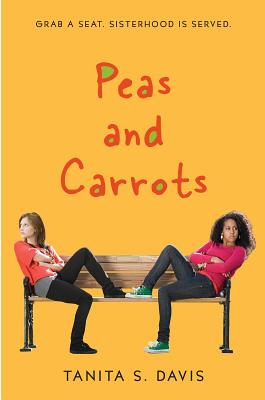
Peas and Carrots

peasandcarrotsby Tanita S. Davis
First sentence: “By the door,on the other side of the sheet that divides the room, Baby cries in his car seat.”
Support your local independent bookstore: buy it there!
Release date: February 9, 2016
Disclaimer: I’ve met the author, working with her for KidlitCon in Sacramento and I find her an absolutely delightful person.
Review copy snagged off the ARC shelves at my place of employment.
Content: There are several instances of mild swearing, plus some illusions to adult drug and alcohol use. Because there are no f-bombs, it’ll be in the YA section (grades 6-8, though it might be better for the older end of that spectrum) of the bookstore.

Dess is a 15-year-old girl stuck in the foster care system. Her deadbeat dad’s finally in jail, as is her mom. Dess’s grandmother gave up trying to care for her and her baby brother years ago. Dess is determined: she doesn’t need anyone. And so when she gets placed in a new home, one of an affluent family, she figures it’s not going to last.

Hope’s parents are stable and happy and take in foster kids, including Dess’s brother Austin, to give back to the community. Hope’s used to the revolving door of kids, but there’s never been one close to her age. Until now. And since Dess is doing pretty much everything to keep people at arm’s length, Hope knows that living with Dess is going to be a challenge. She just doesn’t know if she’ll be able to adjust.

First test: which one of these girls is African American and which one is white? (Answer: Dess is white. Did you pass?) That’s actually one of the first things I liked about this: Davis takes your (my) assumptions about foster care, about the State of the Country, and turns it upside down. In this story, the white girl is the one who’s on the run from an abusive family and the black girl who has the stable life. And Davis doesn’t leave it there; there’s discussion about race and class and belonging, which I respect.

And, as an unofficial foster parent myself, I found myself nodding and agreeing and loving the entire book. Yes, the kids come with baggage and a backstory that usually isn’t pretty. Yes, their lives can be changed by living in a stable, more affluent (though we’re not nearly as well off as Hope’s parents) situation. But Davis also got the corollary to that: having a foster kid in your home is challenging, sometimes disruptive, but is also life-changing. And, if you let yourself — as Hope and Dess eventually find out — you will be better off for it.

Definitely worth reading.

Upside Down Magic

upsidedownby Sarah Mynowski, Lauren Myracle, and Emily Jenkins
First sentence: “Nory Horace was trying to turn herself into a kitten.”
Support your local independent bookstore: buy it there!
Review copy pilfered off the ARC shelves at my place of employment.
Content: It’s simple enough for the younger set; probably good for advanced 2nd graders and up. It’s in the middle grade (grades 3-5) section of the bookstore.

Nory has a problem. She’s a witch, and she wants to get into the prestigious magic school that her super stuffy, absent father is head of. All she needs to do is turn into a kitten and hold that form for a few minutes. The problem is that she can’t do it. Well, she can turn into a kitten, but it never is just a kitten: it’s a beaver-kitten, or a dragon-kitten, or some other awful, terrible combination.

sOf course she doesn’t get into the school, and ends up going to a public magic school (the horror) and put in a class for those with “wonky” magic. There’s a kid who floats but can’t come down, another kid who turns into a rock, one who makes it rain inside and another one who is terrifying to animals. They are working to not only accept their magic as valid (in this society, those with wonky magic are Outcasts) and work together to make their magic do something incredible.

I think there’s a certain sort of kid who would love this kind of book. The kind of kid who likes magic stories, who likes an underdog story, and who doesn’t want to smack the adults in the book. I, unfortunately, am not that kid. I was annoyed at the predictable storyline and wanted to smack both the dad (the aunt who Nory ends up with is okay) and the mean girl at the new school. I understand I’m not the intended audience, so even though I didn’t care for it much, I realize that there are kids out there who will. And so I’m glad I read it for that reason.

(Just for the record: because this is a Cybils nominee, I’ve been asked to make sure y’all know this is my opinion only, and not that of the panel.)

Anna and the French Kiss

by Stephanie Perkins
ages: 14+
First sentence: “Here is everything I know about France: Madeline and Amélie and Moulin Rouge.”
Support your local independent bookstore: buy it there!
Copy given to me by the lovely Vasilly

So, this one has been getting a lot of hype, all of it saying how wonderful, how great, how supremely perfect this was.

M, when she finished it said, “Well, that was cheesetastic. Good cheese, but so cheesy.”

The basic story: Anna Oliphant is the daughter of a Nicholas Sparks-type author, who, not wanting to be outdone by all his Posh Hollywood Friends, ships Anna off to a Posh boarding school in Paris. (Oh noes.) She doesn’t know a lick of French, doesn’t want to leave her comfortable life in Atlanta, doesn’t want to leave her blossoming almost-relationship with Toph. But, to Paris she goes.

Where she bumps into — literally — Étienne St. Clair.

(cue dreamboat music)

What ensues is a lot of romantic push-and-pull. Anna obviously St. Clair, but she has a double problem to deal with: he’s got a girlfriend though she’s kind of out of the picture, and Anna’s friend Mer likes him as well. Then there’s the question of whether or not St. Clair likes her? Sure, they’re friends, and they hang out all the time. But does he like her?

(Because, you know, we ALL want to know that.)

That’s not to say this is a bad book: it’s predictable, sure. But I did enjoy the relationship between Anna and St. Clair, it’s heights and valleys, and it’s inevitable, swoon-worthy resolution. It’s not a simple book, and much like Maureen Johnson’s work, Perkins knows how to write a romance that deals with more even while putting the relationship front-and-center.

Update, 2018: I can see how I thought it was cheesy, but for whatever reason (time, place, etc.), I found it to have a lot more depth this time. There were themes about communication and assumptions that touched me, and a reminder that while my children are my responsibility, they are also their own people with their own dreams, and it’s not up to me to control their lives. Also: I missed the subtext that Americans really can be awful (en masse) the first time around. Still a very good book.

Not perfect, b I ut delightful.