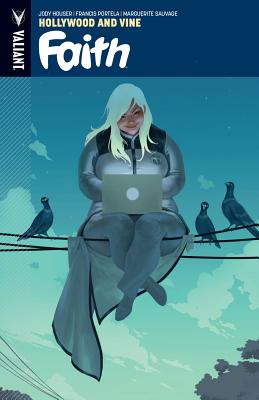
Faith: Hollywood and Vine

by Jody Houser, Francis Portela, and Marguerite Sauvage
Support your local independent bookstore: buy it there!
Content:  There is your usual superhero blow-em-up fare, plus some awkward moments. This would be in the graphic novel section of the bookstore if we had it.

So, in my graphic novel class this summer, we (well, me and a couple other students) ended up talking a lot about representation by women (and diversity, though not as much) in the comics/graphic novels world. One of the other students said that Valiant did an okay job with representation, but mentioned Faith as a good example of a plus-size superhero where weight didn’t really come into play. I was curious, so I picked it up.

After a traumatic experience and a bad breakup, Faith Herbert aka Zephyr (she’s a psiot who can fly and has some telekinetic ability)  has moved from New York to LA to try and do things on her own. Donning an alias, Summer Smith, she gets a job as a content writer for a culture blog/website. Even though she hasn’t made many friends and her ex has a reality TV show, Faith is doing pretty well. That is, until she discovers that psiots are disappearing and that there’s a tie-in to the new, hot sci-fi show on TV. So, of course it’s up to Faith (with some help from a few friends) to save the day.

On the one hand, yeah: it was refreshing to see an atypical superhero doing cool and amazing things and being comfortable in her own body (or at least not having her body be the center of the story line). But, and maybe this is me, I think much of what was “revolutionary” by that is diminished by the fact that everyone else in the book is skinny and/or super built. What’s the point of making the main character look more realistic if everyone else (from her crushes to the love interest to the bad guys to her co-workers) is “normal” and she’s the odd woman out? I kept noticing that she was always the fat one, and felt — even though it’s written/drawn by women — that somehow they were trying to draw attention to her size. So, even though the plot wasn’t about her weight, the book, ultimately, ended up being about her weight. Which made me sad. (To be fair, maybe it’s just me?)

That said, I liked the story. I liked Faith, and her fangirlness. I liked her daydreams and her awkwardness and her moral code. And I liked the resolution in the end.

It wasn’t a bad graphic novel and I am glad I read it.

Me and Marvin Gardens

by Amy Sarig King
First sentence: “There were mosquitoes.:
Support your local independent bookstore: buy it there!
Content: There’s some bullying, a kiss, and a lot of talk of scat. It’s in the middle grade (grades 3-5) section of the bookstore.

Obe (pronounced like Obi-Wan Kenobi) Devlin’s family has lived on their land for generations. But his great-grandfather was an alcoholic (never explicitly stated, but heavily implied) and mortgaged their land away to support his habit. Years later, the land is no longer being farmed but has been sold to developers, and it was then that Obe, now in 6th grade, began losing the life he’d always known.  And it isn’t just the change in landscape; with houses come new kids, who have different priorities and tend to tease (nay: bully) Obe. And with housing, comes pollution.

Obe’s really concerned about the environment (as is K; she’s the one I thought about most while reading this) and on one of his trips to clean up the creek by his house, he finds this creature. A creature that eats plastic. Maybe this is the solution to the Obe’s environmental concerns? It’s not that simple (it never is), but Obe’s finding of this creature, whom he names Marvin Gardens, changes his life.

It was a nice, quiet little book, this.  A bit about being conscious about how you treat the world. A bit about friends. A bit about toxic masculinity. A bit about science. A bit about history. And maybe, in the end, that was why I didn’t connect terribly well with it: it was trying to be too many things. New species (is it an alien? Where did it come from?), friendship, neglectful parents, history…. Decide already.

I can see some people — K, among them — really liking this one, though.


Last Day on Mars

by Kevin Emerson
First sentence: “Many hundreds of light-years from the solar system you call home, inside a spindly crystal structure floating at the edge of a great nebula shaped like an eye, a yellow light began to blink.”
Support your local independent bookstore: buy it there!
Content: There are some intense life-threatening situations and several deaths. It’s in the middle grade (grades 3-5) section of the bookstore.

Imagine this: in the distant future, the sun starts to expand, eventually getting so big that it makes living on earth impossible. Thankfully, humans have had a bit of time to prepare, so they decamp to Mars, where they find a planet in a distant solar system that should support life, and work to create a terraforming system. But, now, the sun’s expansion has sped up, and Red Line — the deadline to leaving — has arrived.

I’m going to interject here that I was a bit suspect about this one. It starts with aliens, and it leaves a lot explained at first, but trust me: stick with this one. I read it in one sitting, once I got into it, and it was an incredibly intense experience. I could NOT put this one down.

It nominally follows Liam  and Phoebe the kids (not siblings) of the last scientists left on Mars. They’re on the terraforming team, and want to get a couple last experiments in before Red Line. Except what starts out as boring gets really interesting really fast when things start going wrong. And after Liam and Phoebe discover proof of alien life.  It’s up to them — for some very intense but plausible reasons — to get off the planet and to join the spaceship headed for the new planet. But things don’t go as planned.

This is a first in a series, and I’m totally on board with Liam and Phoebe and their adventures. So very good.

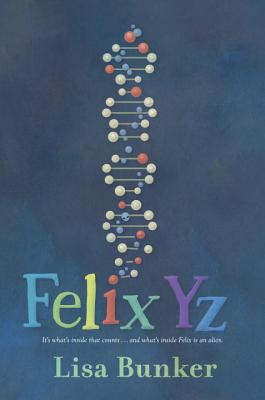
Felix Yz

by Lisa Bunker
First sentence: “I almost talked to Hector today.”
Support your local independent bookstore: buy it there!
Release date: June 6, 2017
Review copy provided by the publisher.
Content: It’s handling some more mature themes, so is probably not appropriate for the younger set (but you know your own kid). It will be in the middle grade (grades 3-5) section, but it might do better in the YA (grades 6-8).

When Feliz was three, his father was doing experiments and, well, accidentally fused Feliz to a fourth-dimensional alien. Unfortunately, his father died in the process, but Felix and his alien, whom he ended up calling *zyxilef, or Zyx for short were left to figure out an existence together.

Which they have for ten years. But, things are getting harder for Felix, and he will die if they stay fused. So, his family — Mom, Grandy (his gender fluid grandparent), and sister Beatrix — has talked to researchers who have decided that the only way is to de-fuse Felix and Zyx. The only problem: Felix might die.

The book is Felix’s “secret” blog: a history of how he was fused, what life with Zyx is like (alternately good and kind of tough), and his hopes and fears for the future.

On the one hand, this gets bonus points for progressiveness: a genderfluid and a bisexual supporting character, plus a gay main character. I loved the new invented pronouns to talk about Grandy (“vo, ven, veirs, veinself”). I enjoyed Felix’s voice, even though he was often petulant. But then again, what 13 year old isn’t? It was lacking in the action department, and I didn’t feel Felix’s anxiety for his life as much as I thought I could. But it wasn’t a bad book, and I did enjoy many aspects of it. Even if it’s not perfect.

One Trick Pony

onetrickponyby Nathan Hale
Support your local independent bookstore: buy it there!
Release date: March 14, 2017
Review copy provided by the publisher.
Content: There are some scary bits, but it’s pretty tame overall. It will be in the Middle Grade Graphic Novel section of the bookstore.

Aliens have invaded, and their primary goal is not to destroy the humans but to gather the technology. Everything and anything that can be considered tech — from forks and knives to guns to computers and robots — is gobbled up by the aliens, whom the humans have taken to calling Pipers.

On the outskirts of one of the “hot zones” (places where there is lots of piper activity) there’s a mobile community — the Caravan — of people whose main goal is to keep the tech — and thereby “civilization” — alive. Then one day, a few kids from the Caravan uncover a robot pony in the middle of the hot zone. Suddenly pipers are after them, and it ends in a confrontation that will either result in the loss of humanity or its salvation.

It’s an intriguing story, and I loved the way Hale told it. So very good.

The Ask and the Answer

askandanswerby Patrick Ness
First sentence: “‘Your noise reveals you, Todd Hewitt.'”
Support your local independent bookstore: buy it there!
Others in the series: The Knife of Never Letting Go
Content: There’s some violence, but nothing gory, and there’s a few mild swear words. It is, however, not for the faint of heart. It’s in the Teen section (grades 9+) of the bookstore.

Spoilers for the first one. You’ve been warned.

Todd and Viola thought they were going to find relief in Haven when they got there. What they found, though, was that Mayor Prentiss had beat them there, taken over the town in a bloodless coup, and is in power. Scary.

He separates Todd and Viola, taking him under his wing and threatening her life if he doesn’t comply. He sends Viola to live with the women in the healing houses. Where she meets the leader of the resistance, Mistress Coyle, and becomes involved with them. Neither one knows, for a good portion of the book, whether the other is alive. The only thing they do know is that they can’t trust anyone.

It’s a harrowing book: there are abuses towards women and towards the alien Spackle. And I can see what Ness is doing here: how many people do what their awful leaders tell them to do just because it’s the path of least resistance. And whether or not people fighting against a dictator can be consider terrorists. Like the first one, there’s a lot to think about. And even though it’s good, I found it hard to get through. Mayor Prentiss is a despicable character (maybe not as bad as Leck, but close) who does awful things and it made this book difficult to read, emotionally.

Which means, I think, that Ness did his job. And I’m wondering where the last book will go.

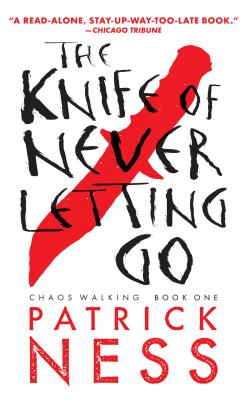
The Knife of Never Letting Go

knifeofneverby Patrick Ness
First sentence: “The first thing you find out when yer dog learns to talk is that dogs don’t got nothing much to say.”
Support your local independent bookstore: buy it there!
Content: There’s the anxiety factor plus a lot of violence plus the f-bomb a couple of times (though the main character says “eff” a lot). It’s in the Teen (grades 9+) section of the bookstore.

Todd is the last boy in Prentisstown in the New World. He’s waiting for his thirteenth birthday, which will come soon, and then he will become a man and join the other men in the town (and there’s only men). It’s an interesting place, this New World — there’s a virus that makes men’s thoughts (and only men, not women) audible, so not only is there no secrets, it’s chaotic hearing everyone else’s thoughts. But, as Todd is out gathering apples in the swamp, he encounters something he’s never experienced before: silence. Quiet. A gap in the Noise which turns out to be a girl.

Viola is part of a new wave of settlers to the New World, on the initial scouting ship. Her parents died in a crash, and when she finds Todd, she’s on the run from Aaron, who is Prentisstown’s fanatic religious leader. Then Todd is sent into exile and he and Viola are on the run, one step ahead of not only the insane Aaron, but the controlling mayor of Prentisstown and his army of fanatics.

There’s way too much to unpack in this novel in a blog post. Seriously. I’m glad I’m reading this as part of a book group, because I don’t think I could even begin to process it on my own. It’s a weird sort of mix between old-timey (the book is in a sort of dialect) Western and science fiction-y futuristic. It’s a survival story with a hint of dystopian. It’s weird and wild and gave me anxiety over and over again (!) and I practically read the whole 480 page book in two sittings. It’s engrossing and there’s so much to discuss. And even though it was written eight years ago, it’s still so very relevant.

My only complaint? The cliffhanger ending. ARGH. I’m just glad I can pick the next book up and read it right away, and I don’t have to wait for it to come out.

The Last Star

laststarby Rick Yancey
First sentence: “Many years ago, when he was ten, her father had ridden a big yellow bus to the planetarium.”
Support your local independent bookstore: buy it there!
Review copy sent to me by our publisher rep.
Others in the series: The Fifth Wave, The Infinite Sea
Content: It’s violent and intense; Yancey pulls no punches. There’s also a lot of (understandable) swearing, including f-bombs. It’s in the Teen section (grades 9+) of the bookstore.

If you can, read them all one right after the other; the impact of this one will be that much greater. Like the past two, I’m not going to go that much into plot; it’s really better if you just hit these as blind as possible.

I re-read my review for Infinite Sea, and my thoughts are mostly the same here. It’s intense. bordering on hopeless. Cassie and Zombie and Evan and Ringer and Sam are trying, against the odds, to prevent the end of the world. In many ways, it’s too late: the aliens have pitted us against ourselves:  if there’s no trust, there can be no civilization. But maybe, just maybe, they can prevent the world from completely imploding — Evan’s assured them that the aliens will start bombing the cities any day now — and keep millions more people from dying.

It was the hoping against hope that got me in this one. I read it slower; in small doses over several days this time because I couldn’t take the building hopelessness: will it work? There’s no glorious Independence Day or Men in Black climax here. Sure, it’s a small plucky (though increasingly small and increasingly desperate) team against incredible odds, but Yancey never shies away from the cost of those odds. I found that I appreciated it very much. It’s an incredibly intense series (I’m actually kind of sad the movie didn’t catch on the way Hunger Games did), and an powerfully written one.

I’m sad to see it end.

Nomad

nomadby William Alexander
First sentence: “Nadia Antonovna Kollontai, the ambassador of her world, was not on her world.”
Support your local independent bookstore: buy it there!
Review copy provided by the publisher.
Others in the series (though I’ve not read it): Ambassador
Content: There’s some intense moments, and maybe some difficult made-up words, but I’d give it to a 4th grader or higher. It would be in the middle grade (grades 3-5) sections of the bookstore.

I didn’t know what to expect heading into  William Alexander’s latest. From the cover, something in space, most likely. What I got was an epic adventure that involved aliens, space travel, time travel, and kids learning to put aside biases and learning to work together. There’s also a side story (which was never truly fleshed out to my satisfaction, but it didn’t deter from my overall enjoyment) about deporting illegal immigrants and how that affects people. In short: there’s a lot packed into this one.

From what I understand, Gabe and Nadia’s story begins in Ambassador, but since this is a Cybils book (I could have checked it out, but I honestly didn’t know until after I’d finished Nomad) I just dove right in. And aside from some initial getting used to the world that Alexander had created — a world in which aliens from all over space and time meet together in a dream space that you get to by, well, dreaming — I fell headfirst into the story and thoroughly enjoyed my time there.

I really enjoyed the problem-solving aspect of this as well. Nadia has been in space for 40 years (and hasn’t aged; isn’t speed-of-light travel fun?) and has to learn how to get along without her sight (she lost it in a failed experiment). She didn’t moan or whine about it; she just tackled the problem and looked for solutions. Gabe was the same way with being put into a new situation with being the Ambassador of Earth. He needed to learn the rules and guidelines and how to cooperate with people who are vastly different from him, and he did.

The only thing I didn’t think fit exactly was the subplot involving Gabe’s dad being deported. It did give Alexander an excuse to use a holding area near the border in Arizona, and to spotlight the awful conditions that immigrants (especially children) were being held in. But, other than that, it really didn’t serve much of a purpose to the overall story.

But even with that one little quibble, it was a delightful book, one I’m glad I read.

(Just for the record: because this is a Cybils nominee, I’ve been asked to make sure y’all know this is my opinion only, and not that of the panel.)

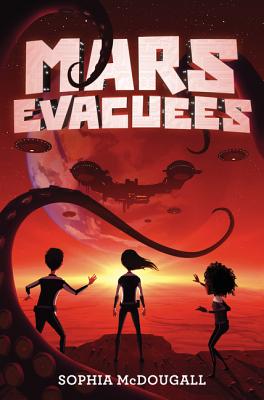
Mars Evacuees

marsevacueesby Sophia McDougall
First sentence: “When the polar ice advanced as far as Nottingham, my school was closed and I was evacuated to Mars.”
Support your local independent bookstore: buy it there!
Content: There’s several mild swear words and some violence (including bullying). It would be in the middle grade (grades 3-5) section of the bookstore.

It’s sometime in the future, and the Earth has shared its home with an alien species, the Morrors. The problem? The Morrors are changing the nature of the earth, freezing it over, and that’s got the humans mad. So, they started waging war against the Morrors, trying to kick them out. But it’s not working, mostly because they’re invisible to the human eye.

So, the humans are resorting to evacuating a select group of kids to Mars to train for combat. Alice Dare, whose mother is a star fighter pilot in this war, is one of those kids.

At first, it seems to be like any other boarding school: there are bullies, and Alice makes some friends — another English girl named Josephine and an annoying boy named Carl and his younger brother Noel — and everything seems to be going okay. Then, one day, all the adults disappear.

Most of the school goes haywire, but Josephine and Alice (along with Carl, Noel, and their robot teacher Goldfish) decide that what they really need to do is go find the adults. What they end up finding is a whole lot of trouble.

Oh. My. Gosh. I know the summary didn’t do this justice because it was the most awesome I’ve read in a long time. It’s smart, it’s funny, there’s fantastic characters, it’s packed with adventure, it’s diverse. It kept me hooked from page one through the conclusion. (And while there’s a sequel, this one stands on its own.) It was just so. much. fun.  Seriously.

(Just for the record: because this is a Cybils nominee, I’ve been asked to make sure y’all know this is my opinion only, and not that of the panel.)