September Jacket Flap-a-Thon

Ah.it’s been a bit of a challenge to get to the computer today. Mostly because I have everyone home — M’s sick, C has a matinee — and everyone’s monopolizing my computer time!! The joys of motherhood. 🙂

The Five Best:
5. Audrey, Wait! (razorbill): “Everybody’s singing ‘Audrey, Wait!’ Audrey Cuttler’s life hasn’t been teh same since that song, ‘Audrey, Wait!’ hit the airwaves. All she wants to do is go to concerts, hang out with her friends, and maybe score a date with the cute boy who works with her at the Scooper Dooper. But now, her ex-boyfriend’s song about their breakup is at the top of the charts and she’s suddenly famous! The paparazzi won’t leave her alone, the tabloids are trying to make her into some kind of rock goddess, and the Internet it documenting her every move! Will Audrey ever be able to have a normal life again? Get ready to find out, because it’s time for Audrey to tell her side of the story.”

This blurb was one of the reasons I started the book. It’s clever and catchy, like the cover. It’s not their fault I didn’t like it. 🙂

4. Grail Prince (Ballantine Books): “The wheel is turning and the world will change. . . . And a son of Lancelot, with a bloody sword and a righteous heart, shall renew the Light in Britain before the descent of savage dark. . . . So spoke the Lady of the Lake. Now her grim prophecy is coming true. King Arthur lies dead, struck down along with Mordred, his son and heir, and the greatest knights of Camelot. Of that peerless company, only Lancelot survives, a broken man who has turned his back on Britain and his forbidden love of Guinevere. Yet one knight, scarcely more than a boy, fights amid the ruins to keep Arthur’s dream alive: Galahad, the son of Lancelot. Before his death, Arthur swore the young knight to undertake a quest: a search for the scattered treasures of an ancient king. On the recovery of these powerful relics–a grail, a spear, and a sword–hinges the future of Britain. But it is the past that torments Galahad. He cannot forget or forgive his father’s betrayal of his king. Nor can he banish thoughts of the intoxicating Dandrane, sister of his friend Percival, from his mind. Yet only a man pure in heart can fulfill the prophecy of the Lady of the Lake. Not since The Mists of Avalon has an author so brilliantly reimagined and brought to life the enduring Arthurian legends. Weaving back and forth through time, from Arthur’s mighty reign and commanding influence to Galahad’s ultimate quest to preserve the destiny of a nation, The Grail Prince is an unforgettable epic of adventure and romance, of clashing swords and hearts set in a magical world as deadly as it is beautiful.”

One of those instances where the blurb is so good that it sets up unreasonable expectations for the book, which isn’t nearly as good. Still. Makes you curious, doesn’t it?

3. Balzac and the Little Chinese Seamstress (Alfred A. Knopf):
“An enchanting literary debut — already an international best-seller. A the height of Mao’s infamous Cultural Revolution, two boys are among hundreds of thousands exiled to the countryside for “re-education.” The narrator and his best friend, Luo, guilty of being the sons of doctors, find themselves in a remote village where, among the peasants of Phoenix mountain, they are made to cart buckets of excrement up and down precipitous winding paths. Their meager distractions include a violin — as well as, before long, the beautiful daughter of the local tailor. But it is when the two discover a hidden stash of Western classics in Chinese translation that their re-education takes its most surprising turn. While ingeniously concealing their forbidden treasure, the boys find transit to worlds they had thought lost forever. And after listening to their dangerously seductive retellings of Balzac, even the Little Seamstress will be forever transformed. From within the hopelessness and terror of one of the darkest passages in human history, Dai Sijie has fashioned a beguiling and unexpected story about the resilience of the human spirit, the wonder of romantic awakening and the magical power of storytelling.”

Good. Not brilliant, but short, and accurate. Which counts for a lot when it’s an adult book.

2. Crown Duel (The Crown and Court Duet) (Firebird): “Battle on and off the field, with sword and fan, with might and manners… It begins in a cold and shabby tower room, where young Countess Meliara swears to her dying father that she and her brother will defend their people from the growing greed of the king. That promise leads them into a war for which they are ill-prepared, a war that threatens the homes and lives of the very people they are trying to protect. But war is simple compared to what follows, when the bloody fighting is done and a fragile peace is at hand. Although she wants to turn her back on politics and the crown, Meliara is summoned to the royal palace. There, she soon discovers, friends and enemies look alike, and intrigue fills the dance halls and the drawing rooms. If she is to survive, Meliara must learn a whole new way of fighting — with wit and words and secret alliances. In war, at least, she knew whom she could trust. Now she can trust no one….”

Clever way to intrigue, and write about two different books that have been combined into one.

1. Dracula (HarperCollins Publishers): “The punctured throat, the coffin lid slowly opening, the unholy shriek as the stake pierces the heart — these are just a few of the chilling images Bram Stoker unleashed upon the world with his 1897 masterpiece, Dracula. Inspired by the folk legend of Nosferatu, the undead, Stoker created a timeless tale of gothic horror and romance that has enthralled and terrified readers ever since. This illustrated edition does full justice to the dark splendor of Stoker’s novel of the count who feeds off the blood of the living. Stark and powerful relief engraving from renowned illustrator Barry Moser brings to life the story’s most unforgettable moments and characters: the ship of death that brings Dracula to English shores as it pitches upon the sea; the final terrible siege at his Transylvanian lair; and the faces of clever, loving Mina Harker, mad, ravenous Renfield, wise Professor Van Helsing, and of course, Count Dracula himself. Told in letters, diary entries, and news clippings, Dracula maintains an uncanny power over the reader, not only in the chilling charisma of its of-imitated character, but in the pace and fury of its storytelling. Stoker’s novel has inspired countless movies and like its hero, has the power to live forever.”

As good as the book…. makes me want to read it again!

The One Worst:
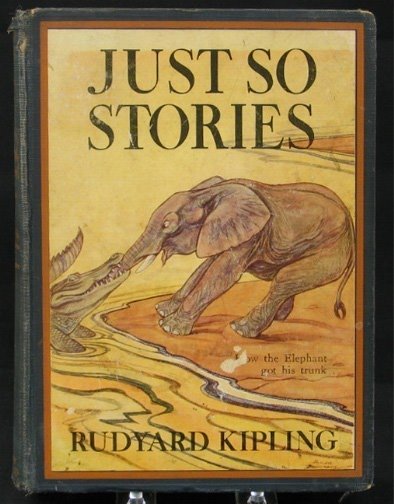
Just So Stories (Magnum): “‘In the days when everybody started fair, Best Beloved, the Leopard lived in a place called the High Veldt. ‘Member it wasn’t the Low Veldt, or the Bush Veldt, or the Sour Veldt, but the ‘sclusively bare, hot, shiny High Veldt, where there was sand and…’ More? Find in this book ‘How the Leopard Got His Spots,’ and you will be carried along (but always toward the astonishing answer) on a soaring wave of sounds and pictures meant by Rudyard Kipling to be read aloud — and ‘sclusively for children of all ages. And then frolic through other pages to see How the Whale Got His Throat, How The Rhinoceros Got His Skin and even (but don’t really believe it) How the Alphabet Was Made… Kipling wrote the delightfully imaginative Just So Stories in 1902, for his own Best Beloved, his daughter Josephine. But millon have since felt no less loved through his gift to them of his playful wit and the sheer music of his language. The Just So Stories are set, literally, in India, the scene of many Kipling’s books, but they come, in a sense, from a country of magic.”

Ack. Really. It’s bad. But then, the copy was written in 1968. We’ve gotten much, much better since then.

The Other One Worst:
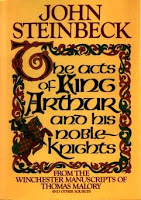
The Acts of King Arthur and his Noble Knights (Farrar, Straus and Giroux):

I’m not even going to bother writing it out. They just took the introduction and used it as flap copy. Lazy, lazy, lazy. Bad copy writers.
The Acts of King Arthur and his Noble Knights

I really liked the idea of this book. I was searching for a copy of Malory’s Morte d’Arthur and came across this one, “written” by John Steinbeck. I thought it was interesting: who knew that Steinbeck had done anything with King Arthur? I got it from the library, and perused the introduction. It turns out that Steinbeck hated reading until an aunt gave him a copy of Mallory, and it was because of that book that Steinbeck became who he did. He wanted so much to “translate” it into common vernacular, so he took it upon himself to go to England, study the manuscripts and create a version of the work of his own.

However, he never finished it. This was published after his death, in 1976, with a series of letters from Steinbeck to his agent and editor about the process. I found both the introduction and the letters fascinating.

But. (You knew there would be one, didn’t you?)

When it came to the actual reading of the tales, I was bored out of my skull. I won’t say that it was Steinbeck’s — or even Mallory’s — fault, because there was a part of me that was intrested to see the origins of all the novels I’ve enjoyed. I just realized about 100 pages in that I like the novelizations. I like to have my mythical characters have motivations, and conversations, and to be more fleshed out than they were in this telling. (For the same reason, I don’t really like Greek myths, although Hubby and M tell me I’m missing out.) And since my time is better spent reading something I really like, I abandoned it.

If you’re interested in Arthurian legends on an intellectual level (or you handle myths in pure form better than I do), this really is an interesting way to read it, especially if you can’t get your hands on a good version of Le Morte d’Arthur. It’s just not for me.

Just So Stories

The Just So Stories, by Rudyard Kipling, are, I think, some of the most retold stories in English language. I know I’ve heard most of them (though not all) in some form or other before I ever picked up this collection of the original tales to read. Not all the stories are equal: the most famous ones — about how the elephant got his nose, or how the camel got his hump — are justifiably so, being timeless, funny, and enjoyable to read. Some of the others are clever, but kind of silly (like how the alphabet was made… Cute, but… kind of dumb). Some — like the first story about the whale — were just weird. Even so, it was an enjoyable experience.

Although I enjoyed reading the stories, and I could tell the affection Kipling had for his daughter (whom the stories were written for), I really think these stories are better enjoyed told, or with a lot of illustrations, then read straight through. Kipling has an almost Seussian grasp of the language, inventing words to suit his needs. I often resorted to reading out loud just so I could hear what Kipling was trying to do with a certain passage.

It was definitely worth the time, though.

Banned Books Week Meme

Found at The Book Nest (thanks, Corinne!):

Look through this list of most banned books. If you have read the whole book, bold it. If you have read part of the book, italicize it. If you own it but haven’t gotten around to reading it yet, *** it.

1. The Bible
2. Huckleberry Finn by Mark Twain
3. Don Quixote by Miguel de Cervantes
4. The Koran
5. Arabian Nights
6. Tom Sawyer by Mark Twain
7. Gulliver’s Travels by Jonathan Swift
8. Canterbury Tales by Geoffrey Chaucer
9. The Scarlet Letter by Nathaniel Hawthorne
10. Leaves of Grass by Walt Whitman
11. The Prince by Niccolò Machiavelli ***
12. Uncle Tom’s Cabin by Harriet Beecher Stowe
13. Diary of a Young Girl by Anne Frank
14. Madame Bovary by Gustave Flaubert
15. Oliver Twist by Charles Dickens
16. Les Misérables by Victor Hugo
17. Dracula by Bram Stoker

18. Autobiography by Benjamin Franklin
19. Tom Jones by Henry Fielding
20. Essays by Michel de Montaigne
21. The Grapes of Wrath by John Steinbeck
22. History of the Decline and Fall of the Roman Empire by Edward Gibbon
23. Tess of the D’Urbervilles by Thomas Hardy
24. Origin of Species by Charles Darwin
25. Ulysses by James Joyce
26. Decameron by Giovanni Boccaccio
27. Animal Farm by George Orwell
28. Nineteen Eighty-Four by George Orwell

29. Candide by Voltaire
30. To Kill a Mockingbird by Harper Lee
31. Analects by Confucius
32. Dubliners by James Joyce
33. Of Mice and Men by John Steinbeck
34. Farewell to Arms by Ernest Hemingway
35. Red and the Black by Stendhal
36. Das Capital by Karl Marx
37. Flowers of Evil by Charles Baudelaire
38. Adventures of Sherlock Holmes by Sir Arthur Conan Doyle
39. Lady Chatterley’s Lover by D. H. Lawrence
40. Brave New World by Aldous Huxley ***
41. Sister Carrie by Theodore Dreiser
42. Gone with the Wind by Margaret Mitchell
43. The Jungle by Upton Sinclair
44. All Quiet on the Western Front by Erich Maria Remarque
45. Communist Manifesto by Karl Marx ***
46. Lord of the Flies by William Golding
47. Diary by Samuel Pepys
48. The Sun Also Rises by Ernest Hemingway
49. Jude the Obscure by Thomas Hardy
50. Fahrenheit 451 by Ray Bradbury
51. Doctor Zhivago by Boris Pasternak
52. Critique of Pure Reason by Immanuel Kant ***
53. One Flew Over the Cuckoo’s Nest by Ken Kesey
54. Praise of Folly by Desiderius Erasmus ***
55. Catch-22 by Joseph Heller
56. Autobiography of Malcolm X by Malcolm X
57. The Color Purple by Alice Walker
58. Catcher in the Rye by J. D. Salinger
59. Essay Concerning Human Understanding by John Locke ***
60. Bluest Eye by Toni Morrison
61. Moll Flanders by Daniel Defoe
62. One Day in the Life of Ivan Denisovich by Aleksandr Solzhenitsyn
63. East of Eden by John Steinbeck ***
64. Invisible Man by Ralph Ellison
65. I Know Why the Caged Bird Sings by Maya Angelou
66. Confessions by Jean Jacques Rousseau ***
67. Gargantua and Pantagruel by François Rabelais
68. Leviathan by Thomas Hobbes ***
69. The Talmud
70. Social Contract by Jean Jacques Rousseau ***
71. Bridge to Terabithia by Katherine Paterson
72. Women in Love by D. H. Lawrence
73. American Tragedy by Theodore Dreiser
74. Mein Kampf by Adolf Hitler
75. A Separate Peace by John Knowles
76. The Bell Jar by Sylvia Plath
77. Red Pony by John Steinbeck
78. Popol Vuh
79. Affluent Society by John Kenneth Galbraith
80. Satyricon by Petronius
81. James and the Giant Peach by Roald Dahl
82. Lolita by Vladimir Nabokov
83. Black Boy by Richard Wright
84. Spirit of the Laws by Charles de Secondat Baron de Montesquieu
85. Slaughterhouse Five by Kurt Vonnegut
86. Julie of the Wolves by Jean Craighead George

87. Metaphysics by Aristotle ***
88. Little House on the Prairie by Laura Ingalls Wilder
89. Institutes of the Christian Religion by Jean Calvin
90. Steppenwolf by Hermann Hesse
91. Power and the Glory by Graham Greene
92. Sanctuary by William Faulkner
93. As I Lay Dying by William Faulkner
94. Black Like Me by John Howard Griffin
95. Sylvester and the Magic Pebble by William Steig
96. Sorrows of Young Werther by Johann Wolfgang von Goethe
97. General Introduction to Psychoanalysis by Sigmund Freud
98. Handmaid’s Tale by Margaret Atwood
99. Bury My Heart at Wounded Knee by Dee Alexander Brown
100. A Clockwork Orange by Anthony Burgess
101. Autobiography of Miss Jane Pittman by Ernest J. Gaines
102. Émile Jean by Jacques Rousseau
103. Nana by Émile Zola
104. Chocolate War by Robert Cormier
105. Go Tell It on the Mountain by James Baldwin
106. Gulag Archipelago by Aleksandr Solzhenitsyn
107. Stranger in a Strange Land by Robert A. Heinlein
108. Day No Pigs Would Die by Robert Peck
109. Ox-Bow Incident by Walter Van Tilburg Clark
110. Flowers for Algernon by Daniel Keyes
111. Are You There God, It’s Me, Margaret by Judy Blume
112. The Harry Potter series by J.K. Rowling
113. The Merchant of Venice by William Shakespeare
114. A Wrinkle in Time by Madeline L’Engle
115. The Witches of Worm by Zilpha Keatly Snyder

A disclaimer on the ***: most of them are my husband’s philosophy books. We own them, but that doesn’t mean I’ll ever get around to reading them… 🙂

Audrey, Wait!

I read a lot (a LOT) of books for kids, and I have come to realize that they fall into, essentially, three categories. There’s the ones that I enjoy simply because they are good, enjoyable, fun, thought-provoking, interesting stories that are mostly well-told. Then there’s the ones that I go into mom-mode, deconstructing and analyzing the book as if these characters were my own children. Then… there’s the ones that are perfectly ordinary teenagers doing perfectly (well, mostly) ordinary teenagery things. I have come to believe that I’m just too old and uncool to even remotely relate.

Audrey is famous. Not because she wants to be. She’s just an ordinary 16-year-old junior who just broke up with her boyfriend, Evan. It’s just that Evan’s in a band, and he wrote a song about their breakup called “Audrey, Wait!” and an agent heard it and radio stations played it, and suddenly it’s the hippest song around and she’s famous. This book is her story.

I really can’t give you much more of a summary of that… because I didn’t finish it. It’s not because it’s a bad book. It’s got a sassy tone, and it’s fast-paced and incredibly hip. I liked the idea, looking at meta-fame of today’s overly connected society, and how one person would deal with all that. But… it was just too hip for me. I found myself feeling old and out of touch when reading it. Granted, I wasn’t even nearly as cool as Audrey when I was a teenager (“band” means that thing with trumpets and flutes that plays on a football field); and I didn’t go see anyone remotely cool until I was a senior and went to see Rush with a friend). So I didn’t even have any past to draw upon here. So, about a third of the way in, I flipped to the end to see if it all ends up happily ever after (it does), and abandoned it.

This one is just for people much, much cooler than me. And I’m okay with that.

My Geeky Best of 2008

I like this week’s Weekly Geek… though I don’t usually start compiling lists until further down the road. Anyway… the instructions this week are:

1. Compile your list of favorites. Please be sure that books you choose actually were published in 2008, or at the very earliest in the winter holiday season of 2007. Sometimes books that come out then are left out. (Please limit your list to 10 books, though, if you read a lot of new books.)

2. Come back and sign Mr Linky with the url to your top books of 2008 post.

On a side note for the WGers out there… this fits in swimmingly with the Cybils! (Conversely, all you non WGers, Dewey would love to see your lists, too!!) Nominations open on Wednesday (that’s October 1st)… the only rules are one nomination per person per category (follow the link for the category listings), and they have to be published between Jan 1 and October 15 of this year.

So… for my list:

Best YA:
Suite Scarlett, Marueen Johnson
The Patron Saint of Butterflies, by Cecilia Galante
A Curse Dark as Gold, Elizabeth Bunce
The Adoration of Jenna Fox, Mary E. Pearson

Best Adult:
The Host, Stephenie Meyer

No, I didn’t like it all that much, but I looked at my list, and it’s the only one published in 2008. Obviously, I’m not as up on current adult fiction trends as I am on YA and middle grade…

Best Non-fiction:
um… I have the same problem as with adult fiction… I read three and hated two, so that leaves:

First Kiss (then tell), various YA authors

Best Middle Grade:
The Penderwicks on Gardam Street, Jeanne Birdsall
Out of the Wild, Sarah Beth Durst
Battle of the Labrynth, Rick Riordan

Best Graphic Novels:
Rapunzel’s Revenge, Shannon/Dean/Nathan Hale

Nobody’s Princess

It’s not a common problem of mine, but there have been instances in the past where I’ve enjoyed the afteword to the book much more than the book itself. This one, as much as I wanted to really like it, was along those lines. It was kind of just blah until I got to the afterword, which was full of information, humor, and held my interest in a way that the novel didn’t.

The idea behind this book was to explore how Helen of Sparta became to be Helen of Troy. We don’t get that far in this book (there is a sequel, Nobody’s Prize), though. Helen is the oldest daughter of the King of Sparta, thereby making her the heir. But she’s also a free spirit, only wanting to do what she would like with her life, hang the expectations that society (even a women’s lib-ish one like Sparta) puts on her. She finds a way to learn to fight. She talks her parents into letting her go with her brothers and twin sister when said sister is sent to Mykenae to get married. She tricks said Mykenaen king out of arranging a marriage for her. She accompanies her brothers along to hunt a wild boar at her mother’s childhood land of Calydon, where she befriends huntress Atalanta and learns to ride a horse. She tags along with her brothers when they go to Delphi and finds a way not only to befriend the oracle, but finds a way for her and her friend/freed slave Milo to go on the same adventure.

I liked Helen well enough; I liked her spunk and determination. I liked how she was willing to do anything to become more “educated” and how she wasn’t willing to let society’s expectations stop her. But that wasn’t enough for me. I wanted some grand conflict and resolution, something to thrill me and keep me gripped to the edge of my seat (granted, having just finished Dracula had something to do with this feeling) and all I got was a series of vingnettes where Helen learned something or did something. I never really became involved in the plot, partially because by the time it got interesting, Helen up and moved on, and we had to start all over again building relationships, creating conflict. I wanted some overarching story, something to tie it all together and to the story of Helen I know.

I do have some hope, though, that this could all be a grand set up and the pay off very well could be in the next novel. At the very least, though, the afterword is fascinating. As for the rest… I’m crossing my fingers that the sequel is better.

Dracula

In my quest (though not a very diligent one) to read all things vampire, I figured that I should probably start at the beginning, and read Bram Stoker’s vampire classic. Thankfully, I had the encouragement of the RIP III challenge (and everyone telling me to be excited) to get me off my lazy butt and actually read it. And… well… WOW.

I’m sure everyone’s heard of Dracula — he’s a part of our culture in a way that I don’t think Stoker expected him to become. And vampires, too, especially these days; between Buffy and Twilight they’ve become hip. But, I didn’t know — and I’m not sure how many people who haven’t read the book do — the whole story, the whole mythos. And I found all that fascinating, from the various devices to keep the vampires at bay, to the methods Dracula took not only to access his victims, but to just get around. It was interesting stuff. Even the plot of the book, while a bit simplistic for my taste, still managed to keep things moving enough to hold my interest. I wasn’t expecting that, either.

But what really made the book fabulous (well, as fabulous as a gothic horror tale can be) for me was the mood. Stoker is amazing at setting mood. He has a way with words that just captivated me. The tension and suspense were palpable. I got about 150 pages from the end, at 10 p.m., and realized I’d either have to stop or push through to the end; I was that freaked out by what was going on. There were many occasions, right from the first, when I had to put down the book and walk away because the mood was so intense. Actually, while reading this, I was reminded of why I went on an Edgar Allen Poe kick in 8th grade. We had read The Tell-tale Heart in English class, and I was blown away. Not by the plot, or even by the characters (the ones in Dracula didn’t really do anything for me, either), but because of the mood. While I don’t like to be grossed out (hence my shying away from Stephen King), I don’t mind the occasional fright. And Dracula hit that right on the spot.

Terrific. Creepy, terrifying, and absolutely terrific.

I’ve Been Hearted

Trish at Library Queue (and Nooky friend extraordinaire), gave me this award. Sigh. I appreciate getting the award — who doesn’t want to know they’re loved — but the problem then becomes the passing on of it. See, I only read and comment (only occasionally, I know) on blogs that I love. Really. Especially recently, when I decided that I really needed to pare back my blogging time, mostly because A and K are demanding more of my attention, and I’ve been feeling guilty that my online world is seeming, to them, to be more important than they are. What I really wish I could do was put up my bloglines and say if you’re on it, I love your blog, and thanks so much for making my world a better place. (And giving me tons and tons of awesome book recommendations and other sanity-saving moments.) (Also it seems I can’t do one of these awards without much guilt and explanations, mostly so no one who reads this will feel too bad that they aren’t in the link list below.)

All that said, here are the rules:
1) Add the logo of the award to your blog 2) Add a link to the person who awarded it to you 3) Nominate at least 7 other blogs 4) Add links to those blogs on your blog 5) Leave a message for your nominees on their blogs!

And my bloglove goes to (trying not to double up):
bookshelves of doom
fizzy thoughts
Em’s Bookshelf
Bookwyrm Chrysalis
Bluestalking Reader
Shelf Elf
Tripping Toward Lucidity