Founding Mothers

I have mixed feelings about this one. A collection of stories and letters about the women behind (beside?) the men that were instrumental in founding the United States, it’s a work that could be seen as enlightening and entertaining. In fact, there were many times when I was enlightened and entertained. I did learn about some women that I hadn’t heard of before — my favorite was Eliza Pickney, a South Carolina woman who basically managed things on her own for most of her life. She was also a bit of an entrepreneur, coming up with the idea and the means to make indigo a cash crop. There were also the usual players: Abigail Adams, Martha Washington, Dolley Madison, and it was interesting to see the way that Cokie Roberts portrayed each of those women.

However, it was a hard book to get through. I think that the book had simultaneously a too broad and too narrow of focus. Too broad, because of all the people she tried to squeeze into 277 pages. Roberts organized her book chronologically, which was probably inevitable considering that it was the time period that drove all the people, but it also made it hard to keep everyone straight. She started Abigail Adams’s story in one chapter, dropped it after a few pages and didn’t pick it up again for another couple of chapters. There were also so many women — I couldn’t keep the Kittys straight to save my life — that Roberts focused on, however briefly, that I felt like I needed a flow chart to figure out who was who (and who was related to whom!).

It was too narrow because I felt that Roberts slighted the men. Sure, it’s a book on the women during the late 1700s, and yes, we want to give them the credit the history books have denied them all these years, but I felt that Roberts did it at the expense of the men. She poked fun at John Adams (I was not happy with that… especially after reading David McCullough’s biography!); portrayed George Washington as a competent leader, but an incompetent in his personal life… (I agreed with her assessment of Alexander Hamilton and Ben Franklin, though…) Perhaps it’s just personal biases getting in the way here, but I felt like she could have portrayed these women as working in partnership with their partners, rather than at odds with them.

And then there was Cokie Roberts herself. She peppered the book with asides, snide remarks, opinionated comments. Which is all fine and good; she’s the author, she can interpret the letters however she wants. But it drove me nuts. After a while, the extreme annoyance (I shouted at the book a couple of times!) I had at the beginning boiled down to a mild irritation, but it never left. There was a (very large) part of me that wished she’d just shut up and leave the letters and stories to speak for themselves.

That said, the letters and stories are fascinating to read. And I do appreciate that Roberts took the time to focus on these amazing women. Even with its faults, its a book worth reading.
Princess Ben

This is another one of those my-gosh-I-can’t-believe-my-library-FINALLY-has-it-in books. I know I’ve seen reviews of this one popping up around; though for the life of me, besides Sarah Miller, Em, and Abby, I can’t think of where I found them…. at any rate, I heard about it, I wanted it, and I was super happy to get it.

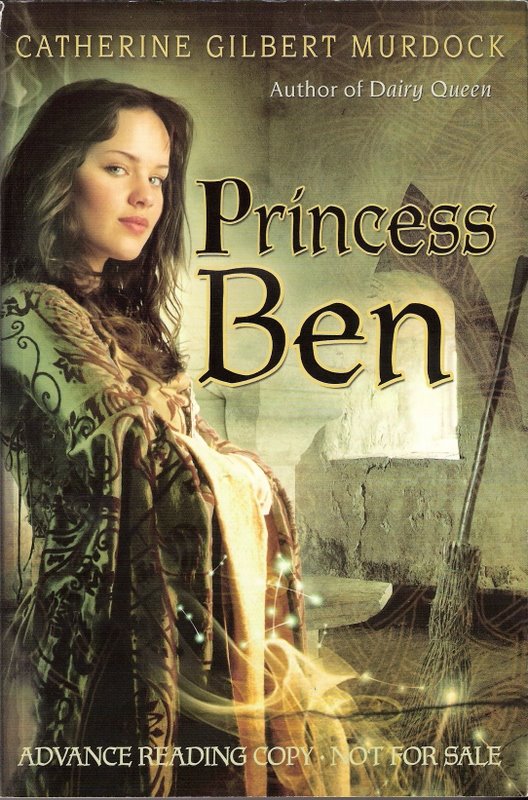
It’s a great princess book. I loved Catherine Gilbert Murdock’s other books (Dairy Queen and Off Season), but this one is nothing like her other books. It’s deliciously different. Benevolence (that’s Ben for short, thank you very much), is a princess who doesn’t want to be one. She’s raised by a loving mother and a prince father, but they mostly let her do what she wants. Until one day, Ben’s left an orphan. She’s taken in by Queen Sophia, who tries, mostly against Ben’s will, to change Ben into a princess. It’s not pretty. Accidentally, Ben discovers a wizard room, with a book of spells, and sets to learning them. And, because she finds it unbearable, she ends up escaping the castle and Sophia’s regiment. Unfortunately, that only gets Ben into more trouble. Then again, that may not have been an unfortunate thing.

I really liked this book, as princess tales go. I liked that Ben’s not your typical princess, not just being a fiesty, head-strong (though spoiled) girl, but in other ways. She’s not thin. She has issues with food and comfort. She’s not perfect; her imperfections aren’t even remotely endearing. She has to endure (grumpily) trials in order to learn. In short, she’s a heck of a lot like me. I liked that. M said that she didn’t like that Murdock made a big deal about Ben being fat, but I think it was a necessary element to the story… it was something that Ben had to learn to deal with and accept, and it didn’t define who she was.

I also liked the world building, and use of magic. I liked that I felt the world supported the characters, rather than overwhelming them, as it can do in fantasy novels. I liked Queen Sophia; sure she was supposed to be mean and evil, but I felt more that she was overwhelmed and inexperienced (at being a parent, mostly), and I empathized with her, even while I was rooting for the grumpy and stubborn Ben.

However, I do think that Murdock slighted her other ones, Prince Florian and his father especially. Actually, the romance in the book was a bit uneven… it putters along at a 3 and then rockets to a 10 in the last chapter. (I liked the rocketing; I just wish there was more build-up.) I wanted to know more about Prince Florian than his glower. (Granted, it’s written from Ben’s point of view, so that may not have been possible…)

Most of all, though, I liked that what I liked outweighed what I didn’t like. It’s always nice when that happens.

2008 Challenge #8: The Arthurian Challenge

For this challenge, I mostly deviated from my original list. I did read Mary Stewart’s triology — The Crystal Cave, The Hollow Hills and The Last Enchantment — and have to admit, that I still like them best. They really are classics.

As for the other three:
Sword of the Rightful King, by Jane Yolen
Grail Prince, by Nancy McKenzie
The Dragon’s Son, by Susan L. Thomson

I attempted The Acts of King Arthur and his Noble Knights, by John Steinbeck, and found that I’d rather read a novelization of the myth instead.

Thanks Becky for hosting this one!

The Dragon’s Son

I picked this one up to round out Becky’s King Arthur Challenge, mostly because I felt bad that I didn’t finish the John Steinbeck book. I found it through a random search of the library’s catalog; I knew I wanted a young adult or middle grade book, but that was all. After a bit of looking, this one popped out at me. Sarah Thomson takes a new and interesting approach to the legend: not only does she go back to the earliest Welsh stories of Arthur, she tells the story from the point of view of the lesser-represented characters (Nimue, Morgan, Luned and Medraud/Mordred) rather than from the usual perspectives.

Essentially a collection of four short stories (everyone gets a few chapters to tell their tale), I was impressed not only with the stories themselves, but with the way they were used to propel the entire myth forward. Thomson manages to tell the entire Arthur story — from conception to death — in 181 pages, and while it wasn’t as in-depth as it could have been, I don’t feel like I missed anything.

The book begins with Nimue, and tells her story from her meeting Myrddin through their relationship to his death. It covers a huge amount of time, but her primary role is to tell about the conception and birth of Arthur. Morgan comes next, but her fundamental character has been changed: she’s not a witch or even a Lady of Avalon. Instead, she’s a bitter, slighted sister of Arthur. She saw her father’s murder by Uther, and she was never able to forgive Myrddin for that. So, when she married Arthur (interesting twist, I thought) and he took her to the castle, she left him because he wasn’t willing to get rid of Myrddin. The story then switches to Luned, who is the handmaid to Elen, Morgan’s sister. This one I found the most fascinating. It involves Lancelot, called Owain here, and how he came to marry Elen/Elaine. Thomson made Elen terrified of men, mostly because she was married off at 12 to a brute of a man. Luned is Elen’s voice, her strength, her solace. It’s only after Luned brokers a marriage to Owain for Elen’s saftey (after her former husband’s death), that Elen learns to love. Unfortunately, Owain’s heart belongs to another, and Elen pines away in a monestary. It moves the story forward, though, because Elen is given Gwydre, who is Arthur’s heir (another interesting twist; Morgan had twins) to raise. The last story is Medraud/Mordred. His is the most tragic, the most bitter. Growing up as the son of Morgan, he is not only influcenced by her mother’s wanton ridding of sons (she gives up Gwydre to Arthur without any complaints), but by Arthur’s neglect. He resolves to kill Arthur, not just because his mother is bitter and wants revenge, but also because Arthur is unwilling to recognize Medraud as his rightful heir. He wages a war of words, rumors against his own brother, and eventually after a confrontation with Arthur, leaves and comes back with an army. And we all know how that turns out.

I liked the changes to the traditional story that Thomson made– the basics were the same, but details were different. I found that interesting and, yes, refreshing. It was nice not to read the same story hashed out. Seeing the story from the minor characters point of view also made it more intersting. A lot of the other elements we usually associate with Arthur were done away with, too: magic, aside from Myrddin’s few prophecies, was essentially non-existant. As were most elements of Druid worship (there were some references to “old ways” but that was it).

I always feel good when I manage to find a book on my own that I like. So, I’m feeling pretty good today, because I liked this one. A lot.

2008 Challenge #6 and #7: Herding Cats, RIP III

Killed two birds wtih one Frankenstein, finishing up Renay’s Herding Cats challenge, as well as Carl’s RIP III . I like it when I can do that.

For Herding Cats, I read:
1. American Born Chinese, from Dewey’s list
2. The Thief, from Mem’s list
3. Frankenstein, from Becky’s list

I think I liked The Thief best out of those three, but all three were worth reading and quite enjoyable.

For RIP III, I read:

1. Dracula, Braham Stoker
2. Frankenstein, Mary Shelley
3. Coraline, Neil Gaiman

Hands down, I liked Dracula best. I’m so glad I had an incentive to read it.

Thanks Carl and Renay for awesome challenges!

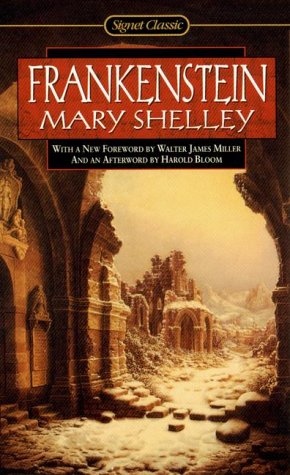
Frankenstein

I think the thing that struck me most about Mary Shelley’s Frankenstein was how un-horror-inducing it was. I didn’t find it to be a horror novel; sure Victor Frankenstein did a horrific thing (more on that later), but the novel itself wasn’t much of a horror book. In the edition I read, Walter James Miller pointed out that it’s actually more a work of science fiction than gothic or horror, and I’d have to agree. It’s a treatise on many things, the primary one being what happens when a scientist tries to become God.

Other observations:

Frankenstein, the scientist, is not a very sympathetic character. He creates this monster, mostly because he can, figuring the creation will bless his name. Instead, when the creature is made alive, Frankenstein freaks out, and bolts, leaving the creature to fend for himself. From this moment, I realized that the narrative was tainted; how could I respect or like or believe Frankenstein when he so casually creates life and then abandons it. Perhaps that’s the mother in me talking.

Along the same lines, I actually liked the monster better, or perhaps I should say that I felt more pity for the monster than for Frankenstein. I’m not sure whom Shelley wanted us to sympathize with, but I was entirely on the monster’s side. Frankenstein behaved abominably, and all the monster wanted was a companion. How could Frankenstein, having gone so far, deny the monster that thing?

There is an interesting discussion of nature versus nurture in the novel. The monster, by his own account, is actually a sensible, feeling, kind being. It’s the fact that he’s universally abhorred that makes him turn to violence and revenge against Frankenstein. It’s all in the nurture of the monster, or lack thereof, that calamity is brought upon Frankenstein and his friends. I’m not sure I agree, entirely, with that reasoning, but it made sense in the framework of the story.

The story itself was long-winded and plodding. I have to admit I skimmed sections, reading only enough to get the gist of the story. In the intro (which I liked, can you tell?), Miller blames Percy Shelley for that — he “edited” Mary’s language to make it more “literary”. I probably would have preferred something more straightforward.

This book has made me think, though. I’d love the opportunity to hash it out in a classroom or good book group setting; there are a lot of topics and thoughts for discussion in the 198 pages that Shelley wrote out. And for that, it’s well worth reading.

Coraline

I think I did this one wrong. I could see, as I was reading it, what captivated many people. I could see, how if I had read it the right way, I could have been, if not scared, then delightfully weirded out.

However, I read the graphic novel first.

My bad.

(Ooh. I can’t believe I just wrote that.)

See, I knew the plot — I knew what Coraline was going to experience on the other side of the door and how she was going to get out of it. I knew all the weirdness and the suspense, and so I think on some level I missed out on the experience that should have been Coraline the novel.

I have to admit that the graphic novel did an excellent job of adapting Gaiman’s work. It caught the spirit of the book, and surprisingly, didn’t leave any detail out. I knew what was going to happen — there were really no surprises — because I had seen it all before. On the other hand, the novel was wonderfuly descriptive (hence the really good graphic novel adaptation), and had an interesting feeling of foreboding and adventure all rolled up into one.

Still. I think I might have expected too much from the book; I know if I had read this one first, I would have enjoyed it that much more.

Lesson learned. If there’s a graphic novel adaptation of a novel, read the book first.

Sense and Sensiblity

I read this once, about 6 years ago. It was the very last of an Austen kick, where I read all of her works back-to-back over the course of a month. Needless to say, by the time I got to Sense and Sensibility, all the books were sounding alike, and the 561 pages of this book were just daunting. I decided I liked Emma Thompson’s adaptation better, and haven’t bothered re-reading this one since.

That said, I thoroughly enjoyed reading it this time around. While the story of Elinor and Marianne and their suitors lacks the chemistry of Darcy and Lizzy and the humor of Emma, it more than makes up for in drama. I think this just might be the most intense of her stories… between the libertine and cad Willoughby and the tension and heartache that Elinor goes through with Edward, I’m not sure if there’s a more soap-opera-ish Austen. I also think that this one explores class and money in a more explicit way than in the other novels. Sure, it plays a part in Mansfield Park and P&P, but it’s more in the background. Fanny and Lizzy shouldn’t be getting the men they do because they’re out of their class. But, if it wasn’t for money, Marianne’s heart wouldn’t have been broken, Edward wouldn’t have been cast out. There are a lot of money-conscious characters in this one (right from the start with John and his wife!) and it factors heavily in the plot. I think Austen could rightly be pegged as showing what money *can* (but doesn’t necessarily) do to people, and how Elinor and Marianne deal with it.

I think I still like the movie version of this more than the book, though. There’s a lot of excess — characters, descriptions, plot points (what? Willoughby came back? I didn’t remember that!) — that Thompson streamlined while still maintaining the heart of the story. It’s one of my favorite adaptations, and I think I’m going to indulge myself tonight.

Glad I read the book first, though.

There’s Fall (Or Estella) in the Air!

The October Estella’s Revenge is up!

It’s another good issue (if I do say so myself; I got asked to pinch-hit since Andi’s swamped, and I played Book Review Editor for this issue…). I’ve got several book reviews: What if…?; Two Parties, One Tux (and a very long subtitle); and a couple of Twilight Zone graphic novels. In addition though, there’s a lot of really good reviews, an interesting piece on choosing to read a chunkster, and a piece on banned books (happy banned books week!). And it wouldn’t be October without an interview with the popular paranormal romance writer (and Ann Arborite!!) Colleen Gleason.

Enjoy!

Cybils Nomations Open Today!

Shamelessly stolen borrowed from Jen Robinson’s Book Page:

CybilslogosmallNominations for the third annual Children’s and Young Adult Bloggers’ Literary Awards (the Cybils) will be open Wednesday, October 1st through Wednesday, October 15th. The goal of the Cybils team (some 100 bloggers) is to highlight books that are high in both literary quality and kid appeal. The Cybils were founded by Anne Boles Levy and Kelly Herold.

This year, awards will be given in nine categories (Easy Readers, Fantasy & Science Fiction, Fiction Picture Books, Graphic Novels, Middle Grade Novels, Non-Fiction Middle Grade/Young Adult Books, Non-Fiction Picture Books, Poetry, Young Adult Novels). Anyone can nominate books in these categories (one nomination per person per category). Nominated titles must be published between January 1st and October 15th of this year, and the books must be in English (or bilingual, where one of the languages is English). To nominate titles, visit the Cybils blog between October 1st and 15th. A separate post will be available for each category – simply nominate by commenting on those individual posts. If you are not sure which category to choose for a particular book, a questions thread will also be available.

Between October 16th and January 1st, Cybils panelists (children’s and young adult bloggers) will winnow the nominations down to a 5-7 book short list for each category. A second set of panelists will then select the winning titles for the different categories. The winners will be announced on February 14th, 2009.

The Cybils lists, from long lists to short lists to the lists of winners, offer a wonderful resource to anyone looking for high-quality, kid-friendly books. The Cybils team has worked hard to balance democracy (anyone can nominate titles) with quality control (two rounds of panel judging by people who focus on children’s books every day). We do this work because we consider it vital to get great books into the hands of children and young adults.

How Can You Participate?

We think that the Cybils nominations will be of interest to parents, teachers, librarians, writers, and teens. If you have a blog or an email list or belong to a newsgroup that serves one of these populations, and you feel that your readers would be interested, please consider distributing this announcement (you are welcome to copy it). The Cybils team would very much appreciate your help in spreading the word. And if you, or the children that you know, have any titles to suggest, we would love to see your nominations at the Cybils blog, starting on Wednesday.