Advent Tour: O Tannenbaum

I haven’t thought to talk about our Christmas tree before, because usually we wait to put it up after A’s birthday. Which means, if I generally choose the first Sunday in December (and I do), then I don’t think about my tree as a viable advent calendar topic.

But this year, because my husband is off to Hong Kong, we put the tree up early. And I realized, that there’s a story I could tell.

This is our tree:

I don’t know if it shows, but my tree is not what you’d call elegant. Or put together. It’s a hand-me over, 9 feet tall, and leans slightly to the left; in fact, we’ve warned the kids that if they do too much bouncing around, the tree will fall over (we know this from experience). It’s not color coordinated, and I’m sure Martha Stewart would not approve. However, what my tree has going for it is that each ornament (or at least most) have a story behind them. I can tell you where we got each and every ornament and why it’s hanging on the tree. Okay, sure, I’m getting older, and some of the stories are a bit fuzzy. But it’s one of the things I like most about our tree: it’s got stories.

Let me tell you a few.

This one was the first one Hubby and I purchased, on our honeymoon to San Francisco. We saw it sitting in the gift shop of the San Francisco Botanical Gardens, and knew we had to get it.

This one is another early one: I cross-stitched it because of Hubby’s love of cows. I think there should be more cows at Christmas, personally.

While we’re talking old ornaments, this is one of the oldest on the tree. It’s a shrinky dink, made in 1973, when I was one. I’m constantly amazed that it’s still in one piece (though the words “Merry Christmas 1973” on it are are fading). I do still love seeing it on the tree, though.

Another homemade one… if I had a chance and the money to collect anything, I would probably collect Santas/Father Christmases. I’m quite enamored with the whole mythology of Santa, and how he’s represented in different cultures. (There are a lot of Santas on our tree, in various forms, as a result.)

One of the other things we’ve done is get each one of the girls their own ornament for each year. We’re doing it so they have something to take with them when they move out, but, like everything else on the tree, they have their own stories, too.

This one of M’s we bought when we stopped over in Salt Lake City the Christmas of 2000. I was so excited by the stopover that I took her to see Ballet West’s Nutcracker, which happens to be my favorite. They had a gift shop, and so we had to pick out an ornament. She got the Sugar Plum Fairy. (We also have a Nutcracker ornament from the same place, but he was bought much earlier, and is a bit worse for the wear these days.)

This one of C’s was one that I painted (not well, but there it is) the Christmas she adored The Snowman. She was 20 months old, and it was her favorite movie and favorite book. We wanted to remember that.

This one of A’s was a pair of baby shoes that her grandma sent her the year she was born. (She’s our December baby, if you haven’t figured that out yet.) They were much, much too nice to wear, so we tied the laces together and threw them on the tree. Perfect.

K, being the youngest, only has a few ornaments (she wanted to know why she didn’t have very many). This one we picked up at a craft fair in Coeur d’Alene a couple years back. It’s sculpted out of candle wax. I’m not sure she picked this design out; it may have been picked out for her. Still, the detail is amazing.

And being parents of school-aged children, there’s a handful of odd little school ornaments. Things they make in class, and then bring home to throw on the tree. The girls love seeing them as they come out of the box, and so I don’t have the heart to throw them away.

And finally, our tree wouldn’t be our tree without our fireman. He was sent to us by Hubby’s older sister, many years ago. I have no idea why she sent him, but we immediately fell in love: what tree shouldn’t have a guardian fireman? We stick him near the top so he can keep an eye on all the other ornaments, and protect the tree from any danger.

Merry Christmas!

Be sure to check out the other stops on today’s tour:

Veronica @ The First Draft

Betti on the High Wire

by Lisa Railsback
ages: 10+
First sentence: “A bright light shines on the beautiful girl.”
Support your local independent bookstore: buy it there!

Babo is a leftover child. In her unnamed war-torn country — unnamed on purpose, to give her a sense of universality, which I found both interesting and disconcerting; I wanted something more concrete as a reader — she lives with other orphaned children in an abandoned circus camp. It’s not an easy life; there’s not much food, and there’s always the danger of soldiers and bombs. And yet, she’s happy. She tells stories to the other children, she pretends that her parents will come back and get her.

And then, one day, an American couple come to the camp and want to adopt Babo. Although she tries desperately to get them to change their mind, the next thing she knows her name is Betti and she is on a plane (with her friend and fellow leftover child, George) to America. The book is mostly about her struggles to, and against, adjusting to her new life.

It’s a heartbreaking story; Babo/Betti is a fighter and a survivor, and she feels guilty about having comforts when her friends are still stuck with a lousy life. She’s been struggling her whole life, and she’s afraid about what it might do to her. In a couple of very telling scenes — it’s one of the best books I’ve read lately that shows rather than tells — you get the sense of Babo/Betti’s desperation and fear. Her adoptive parents are complex as well; on the one hand, they’re overly generous and kind of clueless Americans, but there’s a real love for lost souls, and a genuine concern for Babo/Betti’s well-being. Railsback doesn’t paint everything in black and white, though Babo/Betti tries to make things that way, and as a result, the book is a complex, and yet accessible, look at war, refugees and adoption.

(Just for the record: because this is a Cybils nominee, I’ve been asked to make sure y’all know this is my opinion only, and not that of the panel.)

2010 Challenge #3: The Flashback Challenge

It has come to my attention (aka: I realized today) that I’m not going to read anything more for the Flashback Challenge this year. I’ve got too much on my plate with the Cybils and other reading (I WILL read Fried Green Tomatoes. I promise!) to actually reread any more.

That said, I still accomplished my goal of rereading six books, though half weren’t on my original list.

1. The Wrinkle in Time series, Madeline L’Engle (childhood)
A Wrinkle in Time
Wind in the Door
A Swiftly Tilting Planet
2. The Dark is Rising series, Susan Cooper (adult)
Over Sea, Under Stone
The Dark is Rising
Greenwitch
The Grey King
Silver on the Tree
3. Howards End, E. M. Forester
4. The Girl in Hyacinth Blue, by Susan Vreeland
5. Under the Tuscan Sun, by Frances Mayes
6. Nine Parts of Desire, by Geraldine Brooks
7. The Graveyard Book, by Neil Gaiman

It was fun to reread books I haven’t in years. I’ll have to do this more often.

Tortilla Sun

by Jennifer Cervantes
ages: 10+
First sentence: “I stared at the glossy image.”
Support your local independent bookstore: buy it there!

Izzy has just moved, again, and is looking forward to a summer getting to know people in her neighborhood so she’s not the new kid at school. Again. But then her mom drops a bombshell: she’s off to Costa Rica to finish research for her dissertation, which means Izzy has to spend the summer with her Nana in a small village outside of Albuquerque. This is not what Izzy wants. At all.

And yet, once she’s there she discovers that learning her heritage is much more interesting than she gave it credit for. Her nana is interesting, fun, full of life. Her neighbor, Mateo, is intriguing. But more than that, she slowly learns the story of her father who died before she was born, something which her mother hasn’t been willing to share. And that may be the greatest gift of all.

It’s a sweet story, one that’s full of vibrant color and life. Even though it was a parent dying book — in fact, there was quite a bit of death and trauma in this book — much like Milo, it focused on healing and understanding and celebrating the life of the one who’s dead, rather than mourning. It felt natural and celebratory rather than depressing. There was a bit of magical realism, but only a touch and that added to the healing tone of the book. Yes, there was conflict, and Izzy needed to learn lessons and grow a bit (and there was a few tense moments near the end), but it was a happy book, one that celebrates life and family and traditions.

A great first novel; I’ll be quite interested to see what Cervantes comes up with next.

The Importance of Being Earnest

by Oscar Wilde
ages: adult
First sentence: “Did you hear what I was playing, Lane?”
I’d tell you to go buy it, but you can get this one online for free.

I really don’t have much idea what to say here. I’ve been a fan of the play for ages: my mom had a copy of a BBC production while I was growing up, and I remember watching and finding it hilarious. And I own the Colin Firth/Rupert Everett version which still makes me laugh. Judi Dench is so fabulous as Lady Bracknell.

So, I don’t really know what I expected to get out of reading the play, if I expected anything. I guess I was kind of curious to see how the movie version held up to the actual play, and I also figured since I loved it so much I should actually read the play. That, and I have decided that I really like Wilde’s writing. So, I wanted to read more of him.

And, the long and short of it: I like it better performed. That shouldn’t have come as a surprise; I have a terrible track record reading Shakespeare, and I don’t see why any play should be different. The lines weren’t as funny, the silliness of it all came off as banal rather than hilarious. I’m terrible at reading inflection and timing; I need narration. And while I enjoyed it, I didn’t love it like I love the movie. I did find out (and it’s to be expected) that the movie does take some liberties with the play, giving Lady Bracknell a past, and switching the ages of Jack and Algy around as examples, it’s really quite faithful to the original.

The play itself is a delightful spoof on Victorian England, on class restrictions, and on love in general. No matter how you get it, whether reading or watching, it’s quite worth your time.

Crunch

by Leslie Connor
ages: 10+
First sentence: “I saw it like this: a single worker at some faraway oil refinery with his head tilted down, peering into a pipe, waiting for one more drop that never came.”
Support your local independent bookstore: buy it there!

The unthinkable has happened: we’ve run out of oil. It’s not because of anything really drastic: no catastrophic natural events or wars. There is simply no more oil. Which means no more gasoline.

This means that 14-year-old Dewey Marriss and his four siblings are home alone — their parents are stranded in Maine on vacation — for who knows how long. In addition, the little bike shop they own and run is suddenly no longer little. Bikes are the new transportation, and everyone needs theirs fixed. Now. It all starts out okay, but the longer the crunch goes one, the more stressed the siblings become. It doesn’t help that Dewey thinks parts are slowly going missing; can he figure out who the thief is before everything completely collapses.

It’s a vaguely dystopian premise, though an interesting one to explore: what would happen to society and the infrastructure if the oil — for whatever reason — ran out? The book doesn’t go as far as a dystopian does: it really is a story of how Dewey and his siblings deal with the crisis. And it’s fascinating how that happens. It helps a lot that Connor’s writing is incredibly engaging; she keeps it simple yet doesn’t talk down to her readers. The mystery element comes on slowly, and it’s not really a central aspect to the book, but it’s still interesting.

Most of all, though, it’s an immensely entertaining book, one that kept me turning pages.

(Just for the record: because this is a Cybils nominee, I’ve been asked to make sure y’all know this is my opinion only, and not that of the panel.)

November Jacket Flap-a-thon

Ah, nearly the end of the year; sometimes I’m amazed at how fast time flies. I’m treating you to a non-Cybils rendition of the Jacket Flap-a-thon, out of the five non-Cybils books I read this month, here are the best three:

I Shall Wear Midnight (HarperCollins): “It starts with whispers. Then someone picks up a stone. Finally, the fires begin. When people turn on witches, the innocents suffer. . . . Tiffany Aching has spent years studying with senior witches, and now she is on her own. As the witch of the Chalk, she performs the bits of witchcraft that aren’t sparkly, aren’t fun, don’t involve any kind of wand, and that people seldom ever hear about: She does the unglamorous work of caring for the needy. But someone—or something—is igniting fear, inculcating dark thoughts and angry murmurs against witches. Aided by her tiny blue allies, the Wee Free Men, Tiffany must find the source of this unrest and defeat the evil at its root—before it takes her life. Because if Tiffany falls, the whole Chalk falls with her. Chilling drama combines with laugh out-loud humor and searing insight as beloved and bestselling author Terry Pratchett tells the high-stakes story of a young witch who stands in the gap between good and evil.”
Maybe I’m biased because I love these books, but I love that the flap copy gives you a brief overview of the series and a hint of this book without giving much away at all.

Squirrel Seeks Chipmunk (Little, Brown and Company):
“If animals were more like us,
if mice kept pets and toads could cuss,
if dogs had wives and chipmunks dated,
sheep sat still and meditated,
then in the forest, field, and dairy
you might find this bestiary,
read by storks, by rats and kitties,
skimmed by cows with milk-stained titties.
“I found the book to be most droll,”
might quip the bear, the owl, the mole.
Others, though, would be more coarse.

“Bull,” could say the pig and horse.
As to the scribe, they’d quote the hen,
“Trust me, he’s no La Fontaine.”

Absolutely pointless as flap copy. Seriously. But it’s SO much fun, and horribly clever, which makes it perfect for this book.

Starcrossed (Arthur A. Levine Books): “In a glamorous castle full of Llyvraneth’s elite, Celyn Contrare serves as a lady-in-waiting to shy young Merista Nemair. Her days are spent dressing in velvet, attending Lady Merista, navigating court gossip, and charming noblemen over lavish feasts. And at night, she picks locks, steals jewels, forges documents, and collects secrets. Because Celyn isn’t really a lady-in-waiting; she’s not even really Celyn Contrare. She’s Digger, a sneak-thief on the run from the king’s Inquisition, desperate to escape its cruel instruments and hatred of magic. If she’s discovered, it will mean her certain death. But life as a lady-in-waiting isn’t safe either. The devious Lord Daul knows her secret, and he’s blackmailing her to serve as his personal spy in the castle. What she discovers-about Daul, about the Nemair, even about her own Lady Merista — could signal civil war in Llyvraneth. And for a thief trained never to get involved, taking sides could be the most dangerous job yet.”

It doesn’t give the plot twists and turns away, and yet manages to be intriguing. What is going on in this book? I want to know.

Other books read this month:
Clementine, Friend of the Week
The Kneebone Boy
Linger
Darius Bell and the Glitter Pool
Bamboo People
Zora and Me
What Happened on Fox Street
The Lost Hero
How I, Nicky Flynn Got a Life and a Dog
Milo: Sticky Notes and Brain Freeze
Shooting Kabul
Out of My Mind
Belly Up
The Reinvention of Moxie Roosevelt

Running total: 163 books
Adult fiction: 24
YA: 58
MG: 56
Non-fiction: 15
Graphic Novel: 10
Didn’t Finish: 7

The Reinvention of Moxie Roosevelt

by Elizabeth Cody Kimmel
ages: 11+
First sentence: “What goes through people’s heads when they come up with names for their kids?”
Support your local independent bookstore: buy it there!

Moxie Roosevelt Kipper has spent the first 13 years of her life regretting her name. It’s such a big name to live up to, and she’s not been exactly anything more than ordinary in her small town. Now, going in to eighth grade (her small town school doesn’t go past seventh), she’s been accepted into a boarding school on a music scholarship, and she has a chance to become different.

To reinvent herself.

She goes about this by deciding, in some hilarious turns, to put on different personalities depending on the situation she’s in or person she’s with. This, predictably, causes problems: can you be a Detached, Unique, Coolly Knowing Individual (code name: DUCKI) with your uber-hip roommate, and a Mother Earth Goddess (code name: MEG) with the Buddhist ashram-raised girl across the hall and make it all work? Well, of course not. And things get sticky for Moxie before she figures out what she really wants to be.

It’s a cute book, if a bit precious with the whole boarding school setting. It taps into the insecurities of every tween/pre-teen/teen girl: how can I get people to like me? And what is my personality, really? And is it okay if I’m not just like everyone else? It’s a bit over-the-top with the lying and experimenting, but mostly with humorous results.

And in the end, it gets its point across: being yourself is just fine.

(Just for the record: because this is a Cybils nominee, I’ve been asked to make sure y’all know this is my opinion only, and not that of the panel.)

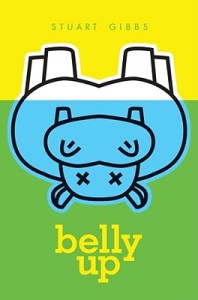
Belly Up

by Stuart Gibbs
ages: 10+
First sentence: “I’d just been busted for giving the chimpanzees water balloons when I first heard something was wrong at Hippo River.”
Support your local independent bookstore: buy it there!

Teddy Fitzroy has had a charmed life. The son of a gorilla researcher and a nature photographer, he’s spent most of his life surrounded by animals in the Congo.

Now, at age 12, he’s found himself smack in the middle of the Texas Hill Country, at FunJungle, the worlds biggest, best, and newest zoo. It’s supposed to be state-of-the art, best researchers, finest environments for the animals, a whole safari experience without having to go to Africa. Except, Henry the Hippo — the mascot, and a huge, ornery, animal — has turned up (literally) dead. It looks like natural causes at first, but upon a closer look, it turns out that Henry was murdered. And it seems it’s up to Teddy (and his new friend, Summer, who is also the daughter of the park owner) to figure out who did it and why.

There’s adventure as Teddy and Summer try to unravel the mystery before them, with some close scrapes. It’s not so hard of a mystery that the reader can’t at least try to figure it out, but not so easy as to be predictable. It’s entertaining, and yet with all the animals, it kind of feels (I’m hoping it is at least) a little educational. If anything, it has a fabulous balance to it: well-written and engaging plus entertaining and kid-friendly.

Quite enjoyable, in other words.

(Just for the record: because this is a Cybils nominee, I’ve been asked to make sure y’all know this is my opinion only, and not that of the panel.)

Starcrossed

by Elizabeth C. Bunce
ages: 13+
First sentence: “I couldn’t think.”
Support your local independent bookstore: buy it there!

I adored Elizabeth Bunce’s first novel, A Curse Dark as Gold, so when I found out that she had another (thanks, Leila), I knew I would read it. And I kind of had an inkling I would love it. Which, of course, I did.

Without giving too much away, sixteen-year-old Digger is a thief in the city of Gerse. She’s made a living, ever since she ran away from the convent at age 11, stealing things for people. It’s been a good way to survive, especially in the increasingly intolerant and restrictive atmosphere of the capital city. Except, this time, the job went horribly wrong. The authorities were waiting, and Digger just barely escaped with her life. Twenty-four hours later, disguised, she falls in with a bunch of nobles and ends up in a mountain retreat with them. Where she finds that nothing is quite as it seems, especially since she’s being blackmailed to find out all the secrets.

It’s a complex world Bunce has created, fascinating in its religion and politics. I would have been captivated if it had only been that. She reveals things slowly, peeling back layer by layer, to keep you guessing and wondering and hoping. But it’s more than that: the characters, especially Digger, are fascinating. (Okay, it helps that I’m half in love with one of the men, yet again.) Like the religion and politics of the world, they are fairly complex; you can sense that even the stereotypical ones are hiding some sort of secret. Maybe it won’t be revealed in this book, but it’s there, lurking under the surface.

It’s the first in a series (I hope; there’s a sequel due out next year), something which I can’t wait to sink my teeth into.