When I decided to resurrect my 10 Question For series, I was in the middle of the 2012 Cybils round one, and, more specifically, I had just finished Geeks, Girls, and Secret Identities. I was so enamored with the book and with Mike Jung, I knew he had to be next. Thankfully (I never tire of being surprised that authors are willing to “talk” to me!), he said he’d love to do an interview.
MF: So, Geeks, Girls, and Secret Identities (or GGSI, as we ended up calling it on my Cybils panel), is your first book. Congrats! Can you tell us a bit about the process of how it came to be published?MJ: Thanks! I started writing GGSI in 2006, and after a close call with an agent I started seriously querying other agents in 2009. I ended up signing with the Erin Murphy Literary Agency’s Ammi-Joan Paquette in 2010, but before that happened I somehow managed to blunder my way into a friendship with Arthur Levine – we first connected with each other on Facebook, and in mid-2010 (right after I signed with Joan) I got to meet Arthur at the SCBWI Summer Conference. We really hit it off, and fortunately the manuscript that would become GEEKS, GIRLS, AND SECRET IDENTITIES was ready to go. Arthur read it after the conference, acquired it, and ka-blam, dream come true for yours truly.
MF: Where did you get the idea to write a middle grade book about superheroes?
MJ: I knew from the start that I wanted to write middle grade, although it did take some time to keep my writerly voice from zigzagging between MG and YA – I kept inserting a very YA-centric note of cynicism into the manuscript, and I had to exert quite a bit of discipline to get a handle on that. My middle-grade years were powerfully formative for me, and they were the time when books truly embedded themselves in the foundation of my worldview. I read to escape loneliness, lose myself in new worlds, and contemplate the startling fact that people could actually conjure these amazing stories out of thin air. Regarding superheroes, well, I think the next question answers that.
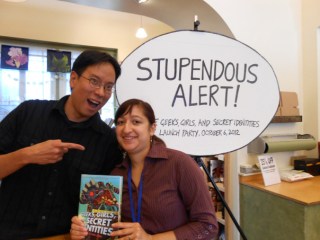 |
| Mike with another author (and Cybils guru) Sarah Stevenson |
MF: Fess up: are you a superhero geek? (It seems, from the book, that you may be. Either that, or you did your research well, because you got the fanboy/girl thing down.)MJ: I am a MASSIVE superhero geek, and though it’s been a long time since I’ve read comics with any great frequency, I’ll always be an old-school Marvel and DC devotee. Yes, BOTH Marvel and DC – I’m very bipartisan that way. I owe a great debt of thanks to my older brother, whose comic book collection was vast and lost a whole lot of collectible value because of my tendency to read everything in it, no matter how carefully bagged and boxed up it might have been.
When it comes to Spider-Man girlfriends, I’ll always be “thumbs up!” on Gwen Stacy and “meh” on Mary Jane Watson. John Byrne’s work on the X-Men was superb, but he started going slowly but surely downhill when Alpha Flight got their own series. There is only one true Silver Surfer, and it was created by Jack Kirby: hallelujah, all hail King Kirby, now and forever. The Sub-Mariner would kick Aquaman’s butt in a fight. I spent six months trying to draw a perfect rendition of Danny Rand’s hand smoldering with the power of Iron Fist. I retain my fondness for the Metal Men. I think Plastic Man’s full potential was squandered. Among DC’s female heroes I’ve always preferred Black Canary to Wonder Woman. I could do this all day…
MF: Being married to a superhero geek, I completely understand! I find humor so subjective. Was it difficult writing a funny book? How did you get the humor to work?
MJ: I totally agree that humor is really, really subjective, and in a way, that took some of the humor-related difficulty out of the equation, because I wasn’t really trying to tailor my writing to anyone’s sense of humor but my own. I’m told that humor is one of my strengths, and I did throw a whole bunch of stuff into GGSI just because I think it’s funny. That’s really all there is to it. I know what I like, I know what I think is funny, and I’ve spent enough time developing my writing skills to know how to make that happen on the page. Sometimes I wish I had a stronger grasp on the defined mechanics of humor, such as they are – the comedy rule of three, and so on – but my understanding of what’s funny about my writing is based solely on having done a whole lot of writing practice and having read a whole lot of books.
I’m also very aware and accepting of the subjective nature of humor. It’s really not possible to write something that’s universally funny – no matter what your sense of humor is like, you’ll always be able to find someone who doesn’t share it. It’s actually a very liberating thought, because it utterly releases us from the need to try and please anyone but ourselves.
MF: I know this is unfair, but do you have a favorite scene or character in GGSI?
MJ: I don’t want to be too spoilery about it, but my favorite part of the book is probably the very end of chapter 26. I never wanted to write a book that was just slaphappy and humorous, or fast-paced and action-packed – my goal from the start was to create a story with a strong, authentic emotional core. I wanted my characters to have emotional experiences with genuine impact, whether it be through the dynamics of peer interactions, the love of parents for their children, or the uncertainty of a friendship that may be lost. The end of chapter 26 is where I was most successful in making that happen, and I think I was able to do it through dialogue, action, and description. I’m quite proud of that section of the book.
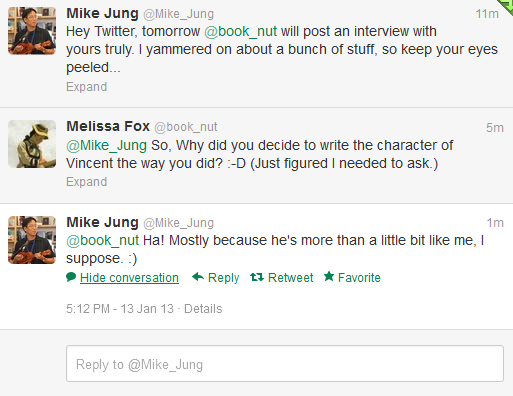
MF: I agree: it wasn’t just a superhero book, and it wasn’t just a comedy; it has a good emotional core. Truthfully: I loved Polly, and the role – atypical for a lot of girl characters – she played in the book. Why did you decide to write her that way?MJ: The snide part of me wants to say “Why wouldn’t I?” It’s not the first time I’ve been asked this question, it’s a question that I see asked of a lot of writers, and it’s worth noting that I’ve yet to be asked why I chose to write Vincent the way I did. [Touche: Shannon Hale makes a similar point here. *hangs head in shame*]
Questions like this imply that the unthinking, non-deliberate, default choice would be to create a girl character that isn’t strong, proactive, and dynamic. That certainly has been a default choice in the past, and maybe for some writers it’s still a default choice, but I like to think that we’ve matured enough as a society that it’s no longer perceived as an automatic choice for EVERY writer.
I’m not a Pollyanna about this: I know that as a global community we have far too much room for growth in that respect. But I have spent my share of time thinking about issues of gender bias and societally imposed roles, and as the father of a young girl I believe I bear both an obligation and a responsibility to continue thinking about those things. It’s not hard to do, because my adult life has been filled with strong, intelligent, articulate females, not the least of which are my wife and daughter. Polly is a strong character with an absolutely pivotal role in the book. She’s neither weak nor submissive, and has no trouble speaking her mind and taking action as she sees fit. She may be atypical in terms of girl characters in literature, but she’s not at all atypical in terms of reality. The world is packed to the rafters with strong women and girls.
And, because I couldn’t resist, I sent this tweet out:
MF: You’ve also written a chapter in Dear Teen Me. What were the differences between writing for a middle grade and a teen audience?MJ: The main difference was that I didn’t really think very hard about how to write in a voice that matched the age and experience of my characters, because my DTM letter isn’t fiction. I think writing a YA novel would be entirely different, because I’d need to inhabit the minds of my characters in order to make the novel truly come alive. My DTM letter was written entirely from my own perspective, however, and the things I wrote about (coping with suicidal thoughts, mostly) were things I experienced as a teenager, so I knew the subject matter would be relevant for teens coping with the same difficulties.
MF: How did you come up with the ukulele song? (Which is also hilarious.)
MJ: Before writing my book my main creative outlet was music – I played the local coffeehouse circuit, performing original songs on guitar and ukulele. I stopped doing that when my daughter was born, but I picked up the uke again last year at the Erin Murphy Literary Agency’s annual retreat. My dear friend Carrie Gordon Watson (who’s also a musician) and I joked around about forming a band to play at the retreat, and somehow we ended up actually doing so. It turned into an incredibly fun and meaningful experience, and got me back into making music. Later that summer I had a conversation with my editor about how hard it is for authors to just come right out and ask people to buy their books, and I had another semi-joking conversation on Facebook about writing a theme song for my book launch party. I let my brain marinate in those two conversations for a couple of months, and then the song pretty much wrote itself.
MF: That’s cool! (Can I say that I hope you write one for your next book?) What’s the best book you’ve read most recently? And why did you love it?
MJ: I actually read it in manuscript before it was under contract, but I bought a shiny new copy of Ellen Oh’s PROPHECY, the first book in a YA fantasy trilogy set in ancient Korea. If you like strong female protagonists, rip-roaring action, vividly imagined settings, and extremely creative mayhem, you’ll love PROPHECY – it’s one of the best things out there right now. My favorite book of 2012 just might have been Kate Milford’s THE BROKEN LANDS – when I finished the last page my first feeling was sadness that I’d never be able to read it for the first time again. I also loved Anne Nesbet’s THE CABINET OF EARTHS, Martha Brockenbrough’s DEVINE INTERVENTION, J. Anderson Coat’s THE WICKED AND THE JUST, Raina Telgemaier’s DRAMA, Courtney Summers’s THIS IS NOT A TEST…uh, yeah. It’s hard to pick just one.
Thanks so much for your time, Mike!
You can check out Mike’s doings on his blog, and on his Twitter feed.







 The Book Nut