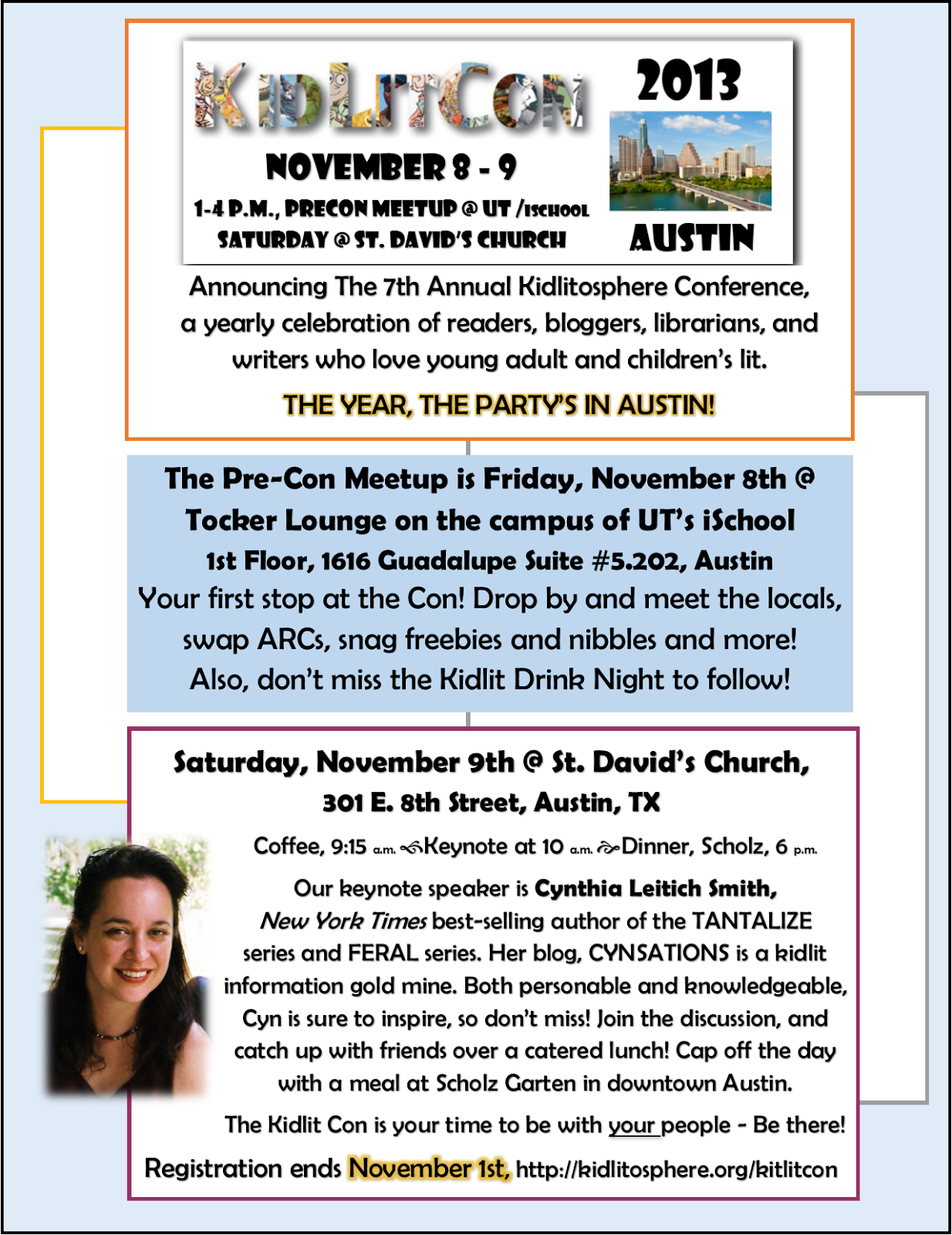
I don’t know why I’ve been mum about writing on KidlitCon this year. I’m going. And I’m quite excited. Call it laziness, business, or just blogging burnout (hey, there’s a panel for that this year!), but I haven’t quite gotten around to putting it out there that 1) it’s happening (November 8-9, Austin, TX, only $65!) and that 2) you should come. Seriously. (Reigstration’s open until Nov 1.) It’s a great place to hang out with like-minded people, chat, stay up late, get away from the family (well, maybe that’s only a reason I have…), and become excited about kidlt and blogging again. It’s worth your time and money. Promise.
I’m not saying that because I’ve thrown my metaphorical hat in with Charlotte and Katy on a panel/round table discussion on blogging about middle grade books. Our Grand Plan for this is to lead a discussion on middle grade books, reading them, blogging about them, enjoying them, and so on… Charlotte’s got a discussion list going on her post (follow the link above), so if you’d please go check it out and add whatever you think we should be talking about to the post, we’d appreciate it. Oh, and we’re all planning on bringing our piles of middle grade ARCs to hand out, so there’s that, too.
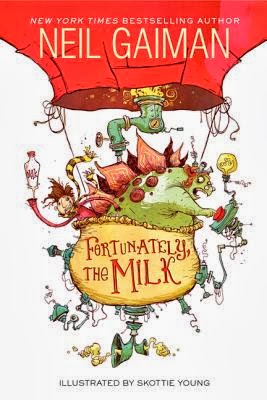
by Neil Gaiman, illustrated by Skottie Young First sentence: “There was only orange juice in the fridge.” Support your local independent bookstore: buy it there!
Two things up front: First, this is a tall tale. Second, because it’s a tall tale (and because it’s meant for beginning(ish) readers), there’s not much substance to it.
That doesn’t mean it’s not enjoyable; it is. I enjoy Gaiman’s stuff normally, but I really do think I prefer his whimsical works for younger kids. This one is basically the tale of a dad who went out to get milk for the morning cereal, and had a wild adventure getting back home. There are hot air balloons (or rather “Professor Steg’s Floaty-Ball-Person-Carrier”), pirates, piranhas, aliens, time travel, and even sparkly ponies. Of course, the kids don’t believe the dad, because he’s obviously telling a story. Or is he?
As I said, this is delightful. The illustrations are brilliantly funny, and I laughed aloud at many parts. My only problem with the book is that I would have liked it better if it had been a true middle grade novel, and one of the kids had had the adventure, rather than their father doing all the cool, fun stuff.
But that’s such a minor quibble. I’m going to hand this one to K to see what she thinks. I have an inkling that she’ll like it.
(Just for the record: because this is a Cybils nominee, I’ve been asked to make sure y’all know this is my opinion only, and not that of the panel.)
by Wendy Mass ages: 9+ First sentence: “Okay, first off, the quotes that start each chapter are from real people who know a lot of really cool things.” Support your local independent bookstore, buy it there!
Joss is the seventh son of the Supreme Overlord of the Universe. He lives in the realms, and even though he’s a billion years old by our count, he’s really only just entering teenage-hood by theirs. His six older brothers are established in their jobs in the Realms: managing afterlife, creating planets, observing said planets. Joss, well, he delivers pies. (They’re really good pies, though.)
He doesn’t think much about his existence, going about his daily life with his friend Kal, until one day when someone from some planet (it turns out to be Earth) spies the Realms through their telescope. This is, to put it mildly, a Big Taboo. Usually, the planet in question gets destroyed. But, since this is Earth and Kal’s parents were there as Onworld observers, Earth isn’t destroyed, it’s just taken out of time. And, for some reason unknown to Joss, it’s his job to put it back to rights.
To complicate matters, an Earth girl named Annika has showed up in Kal’s place (I forgot to mention that he summarily disappears along with his parents, who were on Earth), and is tasked with the job of helping Joss recreate the Earth. From scratch.
Like many of Wendy Mass’s other books, this one was thoroughly enjoyable. I especially liked — and I’m not sure it was intentional or not — the blending of science and “religion”. As Joss worked through the scientific application of the Earth’s creation — and I don’t doubt that Mass’s science is spot on; she’s known for her research — from the big bang through evolution, it occurred to me (granted this is an adult, and a religious, perspective) that you could see God in what Joss was doing. Sure, Mass called it the Supreme Overlord of the Universe and cloaked it in the mask of kids speculative fiction. But, why couldn’t God have used science to create the world?
Sorry. I got off track.
At any rate, I really enjoyed Joss’s learning of evolutionary science. And physics and chemistry as well. And I thought Mass was clever to frame it as a fantastical adventure. It made the science less… boring. There was a sweet ending as well.
In short: a very fun book.
(Just for the record: because this is a Cybils nominee, I’ve been asked to make sure y’all know this is my opinion only, and not that of the panel.)
Heroes of Olympus, book 4 by Rick Riordan ages: 12+ First sentence: “During the third attack, Hazel almost ate a boulder.” Support your local independent bookstore: buy it there! Others in the series: The Lost Hero, The Son of Neptune, Mark of Athena
First off: I liked this one SO much better than Mark of Athena. I am glad for that.
The plot picks up right after MoA left off (actually, one of my favorite things about the book is the dedication. I love how Rick knows his fans.), with Percy and Annabeth in Tartarus and the rest of the seven (Leo, Hazel, Frank, Jason, Piper) plus Nico are on the Argo II. Both sets have one goal: make it to the House of Hades and shut the Doors of Death before Gaea raises the giant army.
From the start, you know that the heroes have to fail. If they succeeded, there wouldn’t be a need for a fifth book. And yet, I like how Rick (we’re on a first-name basis now, you know) plots this one. They do fail, but not completely. And, along the way, they learn some valuable lessons about themselves and each other.
To be fair, this was an incredibly crowded book. While I’ve enjoyed this series, I do have to admit that, in many ways, making it so huge with so many view points and so many main characters is a drawback rather than a plus. I enjoyed the book as a whole, sure, but I also felt like there were things missing. There is so much going on — not just Percy and Annabeth sludging through the monster hell, but also the impending battle back at Camp Half Blood, or the rest of the heroes’ adventures — that bits are bound to be left out. And part of me wants those stories, as well. Granted, those aren’t the stories that Rick chooses to tell, but I still feel like there’s something missing.
Even with the crowded feeling, I did enjoy the book. Rick has a gift with creating characters you just love (Bob! Nico! Frank! Leo! Hazel! Even Piper had a chance to be awesome!) and — I know I’ve said this before — he still has a gift for making you want to turn pages, to find out what’s next. And just when you start to think it’s slogging (at least this time), he switches the action somewhere else. (On the other hand, that’s probably a contributing factor to the busy-ness of the book.)
No, this isn’t my favorite series Rick has written (give me the original Percy Jackson and the Olympians!), but it’s a good one. And I’m more than happy to go on a journey one more time with Percy and crew. And I do think I’ll be sad when it’s over next year. Which means, in spite of my quibbling, it really was a good book.
(Just for the record: because this is a Cybils nominee, I’ve been asked to make sure y’all know this is my opinion only, and not that of the panel.)
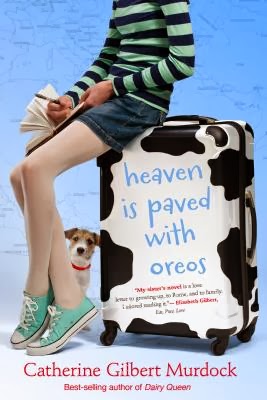
by Catherine Gilbert Murdock ages: 11+ First sentence: “Darling Sarah!” Support your local independent bookstore: buy it there!
When I heard that Catherine Murdock wrote a new book in D. J. Schwenk’s world, the first thing I did was put in on hold at the library. It’s been years since I’ve read Dairy Queen and it’s companion books, but I have fond memories of them. And while I didn’t love this one as much as the originals, it didn’t disappoint.
Fourteen-year-old Sarah Zorn is best friends with Curtis Schwenk. And since that’s not really acceptable in middle school (as C finds out more often than not), they’ve come up with their “Brilliant Outflanking Strategy”: let everyone think that they’re dating, even if they’re not. Except, that doesn’t really work: right before Sarah goes to Rome with her grandma, Z (yes, that’s what everyone calls her), Curtis “breaks up” with her.
But, as things go, Lessons Are Learned in Rome (Italy is a good place for Lessons), and Sarah comes home a Wiser and More Mature person, one who is more willing to face the unknown. A lot of that is due to her grandmother’s story, which we learn over the course of the book.
Told in journal-style (is there a name for that?), we see the world, both Wisconsin and Rome, through Sarah’s eyes. She’s a lovely person to have as a companion through this journey. And even though Z’s story is a non-traditional one, I found it hard to judge her for it. She was who she was, and even Sarah’s questioning of that didn’t stop me from enjoying Z. (Maybe it’s because I’m a hippie at heart.) My favorite part was the Rome section. Murdock only had Sarah and Z spend a week there; I wished it could have gone on much longer, and in more detail. But, I did like how the act of going changed Sarah, and the results that came out of that.
So, no, it’s not as strong a novel as Murdock’s original series; in many ways it feels tacked-on after the fact, an unnecessary cousin tagging along. But that didn’t stop me from really liking it.
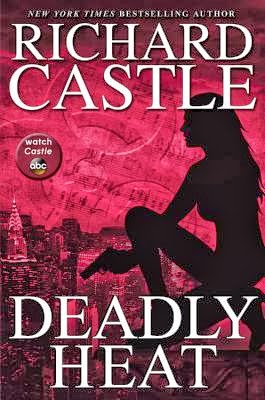
by Richard Castle ages: adult First sentence: “NYPD Homicide detective Nikki Heat double-parked her gray Crown Victoria behind the coroner van and strode toward the pizza joint where a body waited.” Support your local independent bookstore: buy it there! Others in the series: Heat Wave, Naked Heat, Heat Rises, Frozen Heat
I’ve always kind of thought that you couldn’t pick up these books without having first watched the show. But, after finishing this one, I realized that really the only frame of reference you need is Frozen Heat. It picks up almost directly where that one leaves off, and ties most directly into it, giving us some nice loose ends all wrapped up.
Nikki knows who actually killed her mother. What she doesn’t know, is who called the shots. And that’s something she’s determined to do, even though the Department of Homeland Security Agents Bell (who happens to be Jameson Rook’s ex) and Callahan keep getting in her way. In addition, she’s faced with a serial killer, nicknamed Rainbow, who is playing games with her. And yes, she’s next on his list.
She’s also getting flack from her incompetent commander for juggling two cases, something which Nikki resents. But, determined as she is, she (and Rook, of course) doggedly persevere, and manage to solve the crimes in the end.
Much like season 5, this was a bit lighter, but also like Frozen Heat, it’s really it’s own beast now. I recognized a few plotlines from the season, but mostly, that’s not what I was reading this for. No, now I’m invested in Nikki Heat the character (not Nikki Heat as a reflection of the way Stana Katic plays Kate Beckett… man, that’s confusing!), and her own personal journey. And this one, I think it’s safe to say, is a pretty decent mystery. I suspected the end, though the clues were there, and if I had been paying attention I would have figured it out. I also liked the way the two storylines intersected in the end, and how they helped each other resolve. I liked that both Nikki and Rook had a chance to shine.
I’m sold on this as a series now, which means I’ll be sad if the show ever ends and these disappear. Unless, of course, the ghostwriter decides to keep it up. In that case, I’ll keep reading them.
by Ellen Booraem ages: 10+ First sentence: “Death stalked the spider, pre-algebra book in hand.” Support your local independent bookstore: buy it there!
Conor O’Neill has fears. Spiders, safety, his father pressuring him into taking the entrance exams to one of the elite high schools in Boston. Even with his fears, Conor’s managing. Until his worst fear comes true: a banshee shows up in his window, waiting to keen for a death of one of Conor’s family.
At first, Conor tries to keep the banshee — whose name is Ashling — a secret, but (of course) that doesn’t work. She’s bored waiting for the death to happen and it’s her first time out of the Underworld since her death 1600 years ago. She wants knowledge, and (of course) middle school is a good place to get it. Except for the whole “if people see you keening when something dies, they die too” thing.
It’s more complicated than that, obviously. There’s a side story about one of Conor’s former lives in which he had a relationship with Ashling. And there’s a trip to the Underworld so that Conor can cheat death (not his own; and he doesn’t, really, in the end. Spoilers, I know.).
While I liked Booream’s treatment of Celtic mythology (and other; there’s some Greek and African mythologies in there as well) and her modernizing of banshees (and the Underworld, for that matter), in the long run, this just didn’t work for me. I think my main problem with it was Conor. He was so insecure, so unsure of himself, that I felt that, for most of the book, he was just spinning his wheels. I wanted him to be proactive and DO something instead of just being reactive to everything around him. And by the time that happened, I felt like it was too little, too late. (And his younger 10-year-old sister Glennie was just annoying.) I did like Ashling, however; I thought Booream caught the idea of a supernatural being — especially one who wouldn’t have encountered the modern world — enthused with the mortal world. I liked Ashling’s discovery of cell phones, computers, buses, even sidewalks. That charmed and amused me.
I’m just disappointed it wasn’t all like that.
(Just for the record: because this is a Cybils nominee, I’ve been asked to make sure y’all know this is my opinion only, and not that of the panel.)
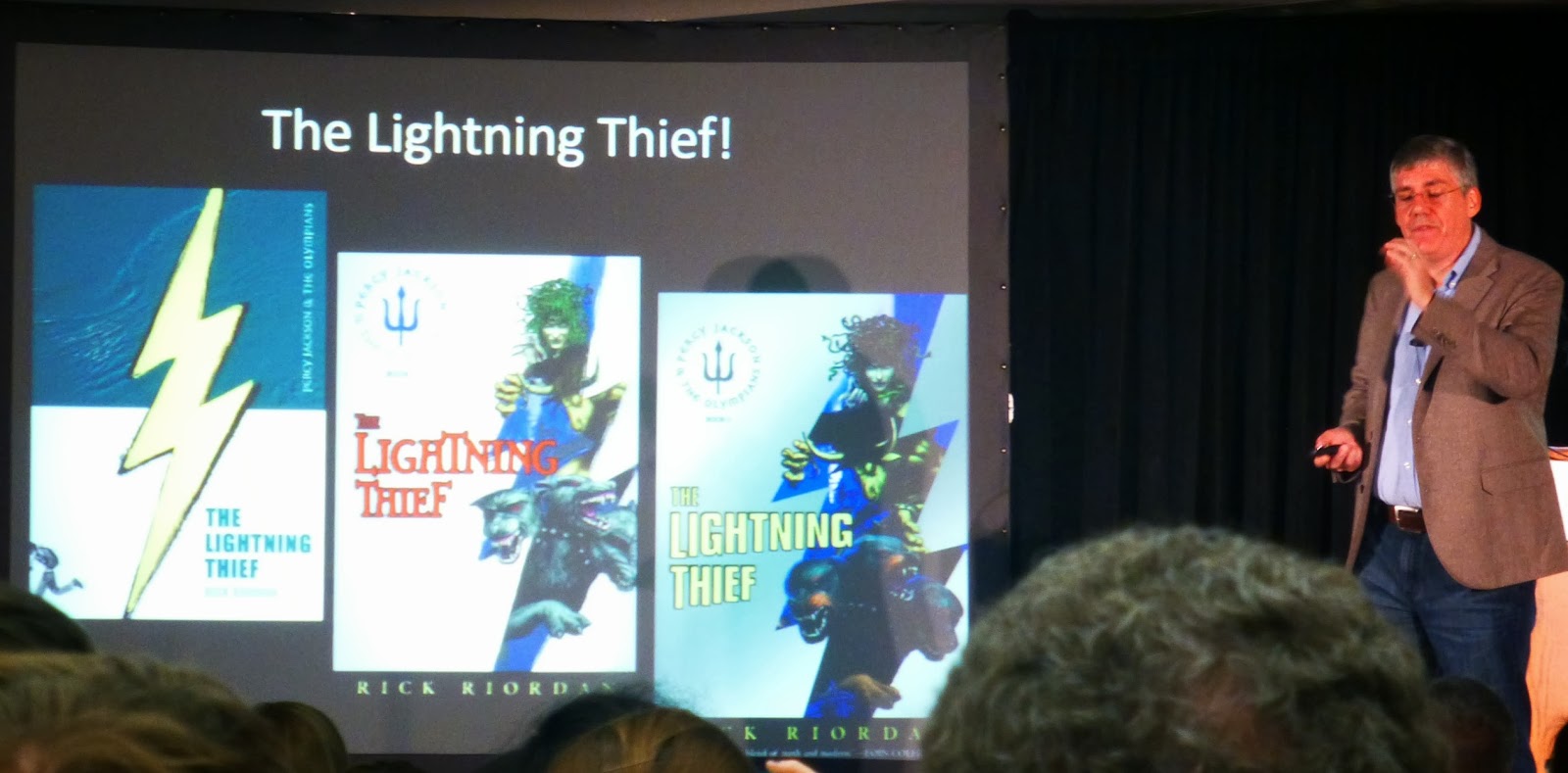
First, some background. I discovered The Lightning Thief on a shelf in my library in Macomb, Illinois. The cover was Awful…
(Even Rick thought it was awful.)
but I gave it a chance, and fell in love. I passed it to M, who adored it, as well. Over the next eight years, I would have another daughter, bringing the total up to 4, and we continued to buy (and love) Rick’s books. All of us. (Yes, we even got Hubby on the bandwagon.) And Rick became more and more popular.
Then, we finally got old enough to start thinking about going to author events. And #1 on the list of authors we would ALL love to see was J. K. Rowling. But we knew we’d never see her, so the real #1 was Rick. We know we should have seen him 7 years ago before he got HUGE, but that wasn’t in the cards. So we waited for him to come relatively close. We did think about going down to see him in Austin last year, but the timing wasn’t right, so we didn’t make it.
But THIS year, he came to St. Louis (only 7 hours instead of 9) and it happened to be on a weekend night, on a week when the girls had a small fall break. THIS WAS IT. And I bought the tickets, made the arrangements, and we were off.
(Hubby didn’t come; he went to Texas for a conference instead.)
The day of the event, we spent a good 5 hours at the St. Louis Zoo in the morning and then went swimming at the hotel in the afternoon. This is important because A, who is the BIGGEST fan of them all, ended up with a huge headache from dehydration, but still insisted on going to the event. (When I asked her the next day if it was worth it, even with the headache, she said, “HECK YEAH.”)
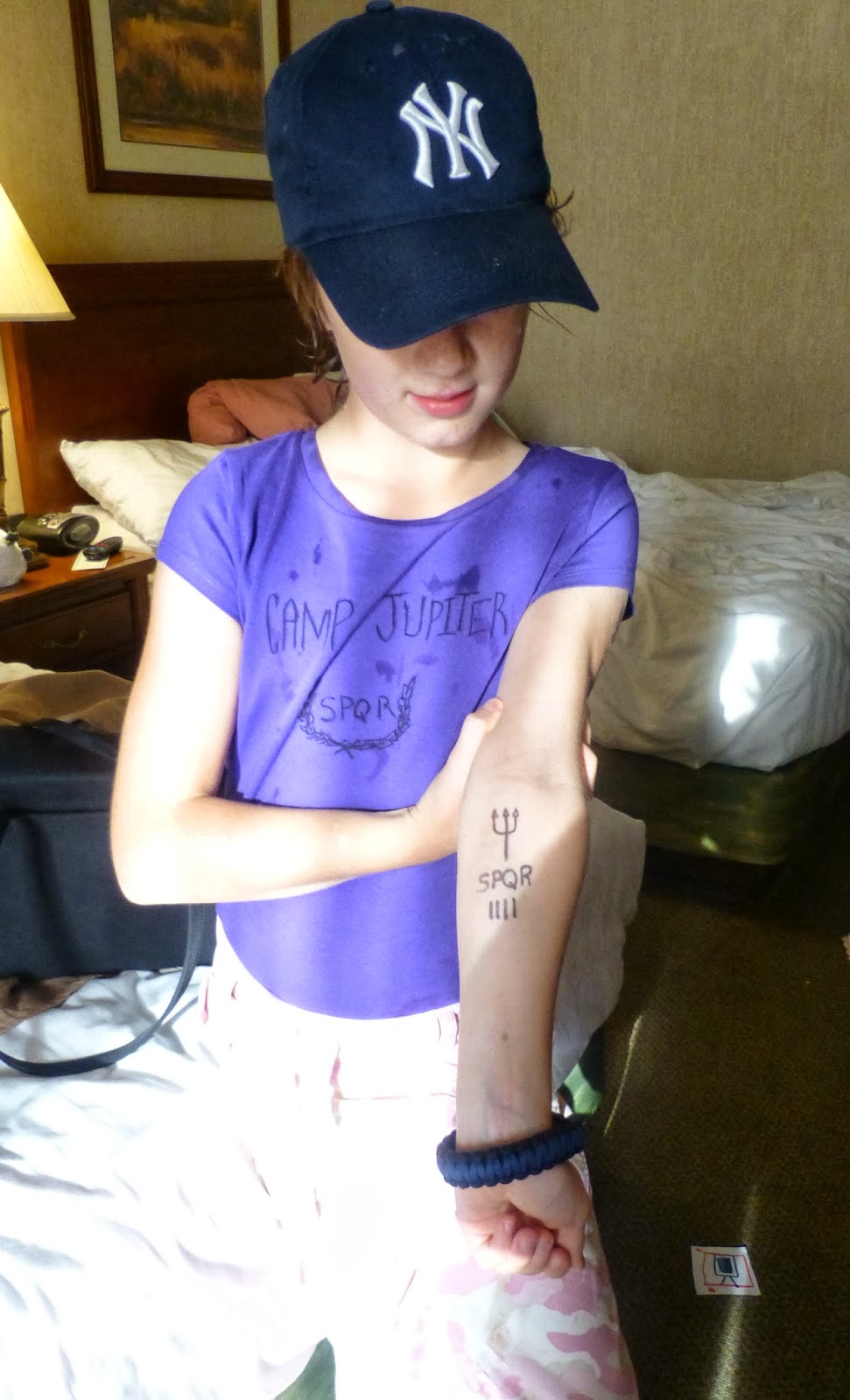
A remembered her Annabeth hat, but forgot her Camp Half Blood shirt, so we made a quick trip to Target and found a purple shirt to make Camp Jupiter.
It was at the St. Louis County Library, and we got there a half hour before the doors opened. The line was already halfway around the building. So we waited.
Wrong fandom, but we thought it was awesome anyway.
Finally!
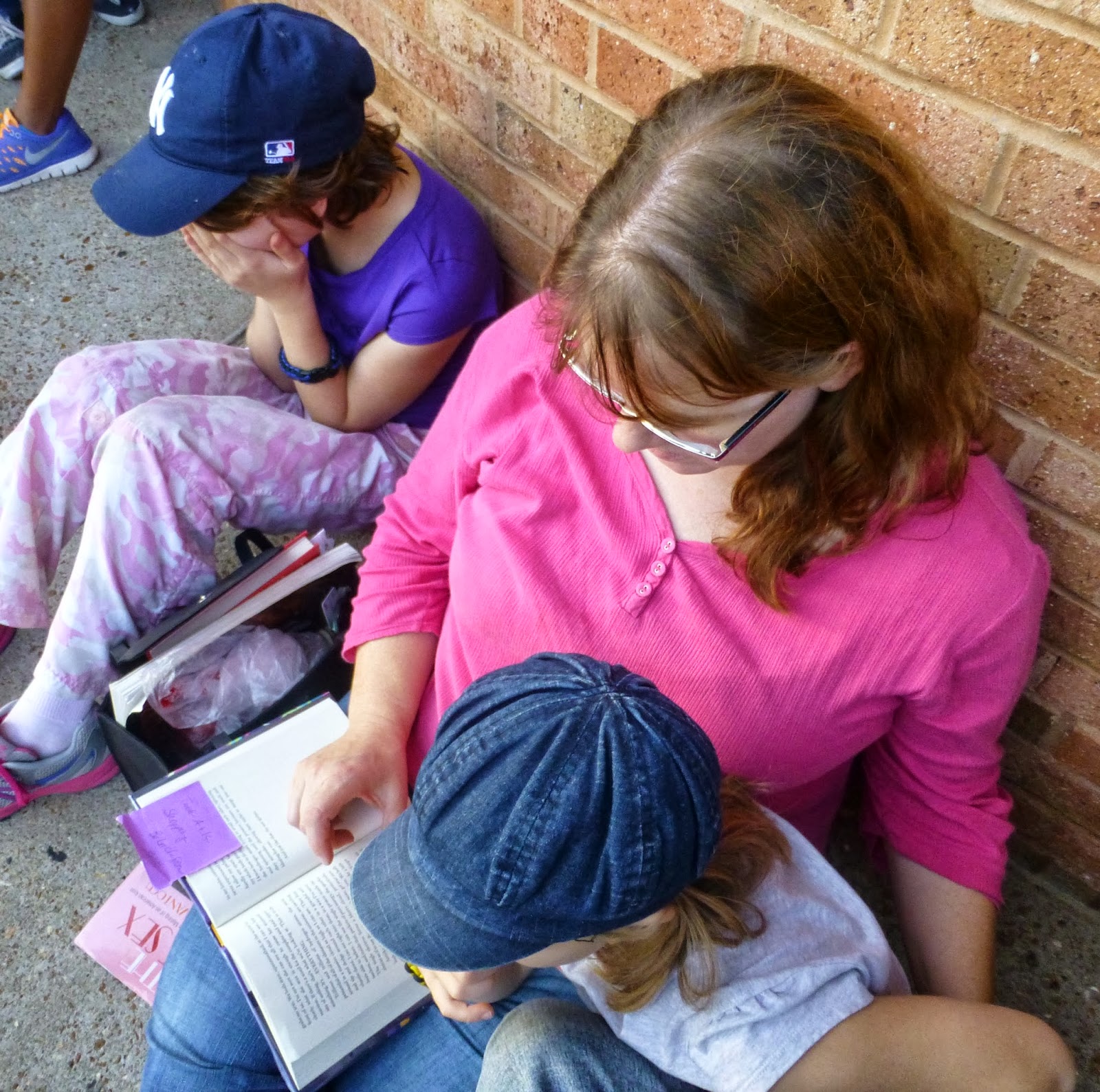
Once we got in, there was more waiting, but we had two copies of the books. They were snagged by A and C.
Look! A signed book!
We weren’t the only ones reading.
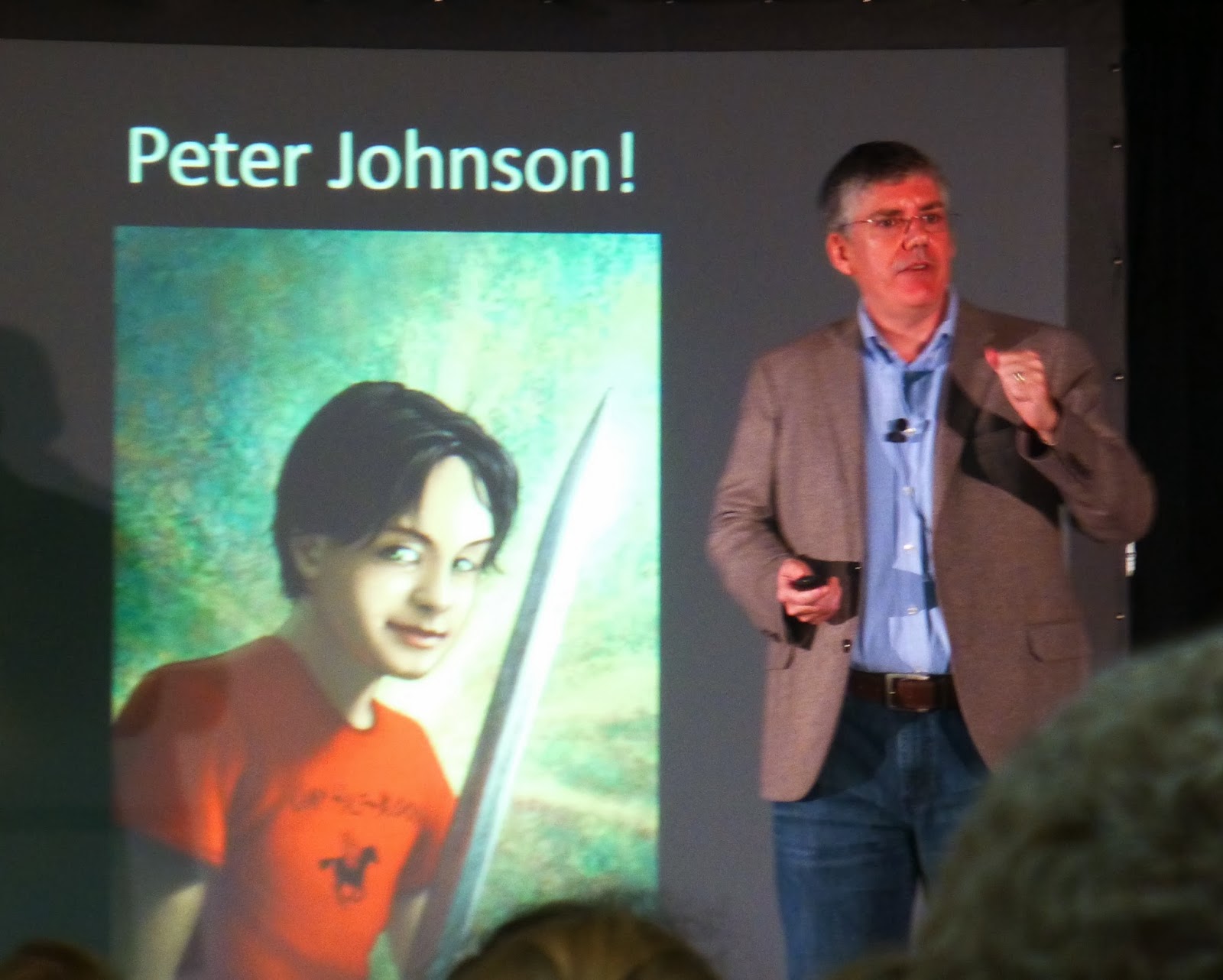
Eventually, the waiting ended, and the program began! Rick Riordan was a TON of fun. His teaching background comes out in presentations; he knows his fans and exactly what to say. From references to Twitter and Tumblr, shipping and “Everyone’s favorite character…. Octavian! Oh, wait. LEO!” He basically told his path to becoming Rick Riordan Successful Author, and even though I knew most of it already, it was still highly entertaining.
The best picture I took.
Rick took this one. We’re about a third of the way back, all the way on the left. No, you can’t see us.
Then, at the very end, he did a really brief Q&A. I was smart enough to know that this part was truly unique, and turned on the camera to record. I missed the first question which was, “Rick, why are you so sassy?”
And then it was over. Too soon, I might add. I think we all thought we could have stayed there all night, but the hour was fabulous.
K won a Camp Jupiter shirt, which I didn’t take a picture of, and we made it back to our hotel, exhausted, but thoroughly happy. There are very few people (I’m not related to, anyway) I’ll travel any distance to, but I’m definitely glad I managed to get the girls to this one.
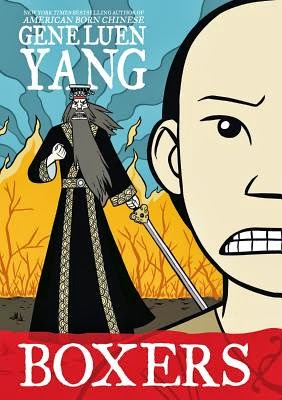
by Gene Luen Yang ages: 13+ Support your local independent bookstore: buy it there!
I didn’t quite know what to expect going into reading Gene Luen Yang’s newest graphic novels. I did know that they were a pair, and I read them back-to-back. But what I got…. wow. I think, after I turned the last page, the best comparison would be a Zhang Yimou movie. Both sweeping and intimate, these graphic novels pack a powerful punch.
They center around the Boxer rebellion in China which culminated in the summer of 1900. In Boxers, we follow the story of Little Bao, a third son of a village peasant. He’s not respected, and his older brothers push him around a bit. He loves opera, and he spends all his free time watching it, which doesn’t help his situation at home any. He does long for respect, and gets his chance when a young man by the name of Red Lantern shows up. Red Lantern teaches the village men kung fu, and ends up taking Little Bao under his wing. This becomes crucial when Red Lantern is killed by the imperial army, and Little Bao takes over his duties as leader of the rebellion. Their mission? To enact justice in behalf of those who are being bullied.
However, what starts out as justice soon becomes a crusade to rid the land of foreigners, mostly Christians, and those Chinese who have converted. Little Bao becomes increasingly more ensconced in this crusade, and increasingly more uncomfortable with it. Along the way, he meets Vibiana, a Christian convert.
In Saints, we see Vibiana’s side of the story. We discover that her conversion to Christianity is more an act of desperation rather than true devotion. A fourth daughter of a deceased father, she is often neglected and beaten at home. She finds refuge in the home of Dr. Won, the village acupuncturist, who introduces her to Christianity. Soon afterward, she sees visions of Joan of Arc, which she doesn’t understand but finds comfort in. After one particularly brutal beating, Vibiana leaves her family and goes to work in a Christian orphanage, which is where she meets Little Bao.
I shouldn’t have to say this, but these stories are both tragedies. And yet, possibly because of this, there is much to think about. I love the tagline on the backs of these: “Every war has two faces.” Yang does a superb job not only showing the horrors of war, or the decisions of a leader, but also that there are many different sides to a story, and that every truth is a valid one. The ending is tender and horrible, and left me wondering about the nature of faith, devotion, and fanaticism.
by Kate DiCamillo, illustrated by K. G. Campbell ages: 8-12 First sentence: “In the Tickham kitchen late on a summer afternoon…” Support your local independent bookstore: buy it there! Review copy pilfered from the ARC shelves at my place of employment.
Flora is a cynic. Her mother is a romance writer and Flora is positive that she loves the shepherdess lamp more than her own child. Her father is awkward, his opening line being, “George Buckman. How do you do?”
Then one day, a squirrel gets vacuumed up by Flora’s neighbors ultra-spiffy vacuum, and (after they determine that it’s not dead) gains superpowers. Well, he can communicate with Flora, type out poetry, and fly. Flora is convinced that means the squirrel — which she named Ulysses after the vacuum — is meant to save the world.
I wanted to love Kate DiCamillo’s latest with my whole heart. I didn’t. I liked it well enough; Flora is clever, and Ulysses is cute. But, I never felt like I connected with the characters. I felt that while it was clever and sweet, it lacked heart and depth. (Yeah, I know: it’s for younger readers. That doesn’t mean it can’t have depth.) I did like the illustrations, quite a bit, and I liked what DiCamillo was trying to get across here.
So, chalk it up to me and my slight reading slump. It may be a lot better than what I ended up thinking it was.
(Just for the record: because this is a Cybils nominee, I’ve been asked to make sure y’all know this is my opinion only, and not that of the panel.)









 The Book Nut
