How to Catch a Bogle

by Catherine Jinks
First line: “The front door was painted black, with a shiny brass knocker that made a satisfying noise when Alfred used it.”
Support your local independent bookstore: buy it there!
Review copy off the ARC shelves at my place of employment.
Content: There’s a few mild swear words and some very intense moments. I’d put it in the middle grade (3-5th grade) section of the bookstore, but I’d be wary about giving it to a sensitive younger kid.

Imagine a Dickensian London, complete with orphans, pickpockets, unsavory doctors, toshers, and blackmailing landladies. And then add… bogles.

What are bogles, you might ask?

Well, it’s what our fair heroine, Birdie, and her master, Arthur, call the paranormal creatures that they get rid of for the people of  London town. Not everyone believes in them, but Arthur and Birdie know one thing: if there’s children disappearing, it’s most likely a bogle.

(I’ll let you read the book to find out how to catch them, though.)

There isn’t much plot to this one in terms of plot; Birdie and Arthur catch bogles until they meet a woman of Society who decides that bogle catching is an unsuitable occupation for a girl. (Birdie objects.) They catch more bogles until things become Sufficiently Dangerous (that’s when the unsavory doctor comes in). There’s a bit of excitement, a kidnapping, and some hauntings before it’s all over. No, this one’s mostly about atmosphere. It’s a dark book — bogles are not nice creatures — and very  much the dirty London of Dickens’ time.

I loved it.

I know: I don’t usually like atmospheric books, or Dickens for that matter. But the combination of a clever take on the paranormal and the plucky character of Birdie was enough of a combination for me to fall head over heels for this one. It’s a perfect stand alone story (though it — like many this Cybils season — says it’s a “Book one”), one that is perfect for those who love historical fiction as well as the paranormal.

(Just for the record: because this is a Cybils nominee, I’ve been asked to make sure y’all know this is my opinion only, and not that of the panel.)
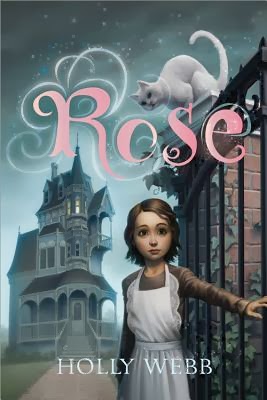
Rose

by Holly Webb
First sentence: “Rose peered out the corner of the window at the street below, watching interestedly as two little girls walked past with their nursemaid.”
Support your local independent bookstore: buy it there!
Review copy sent to me by the publisher for the Cybils.
Content: Aside from the creepy person kidnapping orphans (but it’s really not that scary), there isn’t anything untoward in this book. It would happily sit in the middle grade (3-5th grade) section of the bookstore.

Rose lives in St. Bridget’s Home for Abandoned Girls in London, with no idea, really, where she came from or who she is. (She’s named after the rose bush that was blooming the day she was found in a fish basket in the churchyard.) She really doesn’t have much hope of ever being adopted, so she trudges on, one day after another. Then one day, a housekeeper for a wealthy alchemist/magician arrives, and Rose ends up as a maid in the house. And she discovers that she has a talent for magic. It turns out, too, that orphan children are disappearing from the London streets. No one is really concerned — they’re orphans, after all — but when a friend of hers from St. Bridget’s goes missing, Rose knows she has to do something. And with the help of the magician’s apprentice, maybe she can.

This is, in many ways, a book that’s already been written. Orphan? Check. Plucky lower class girl outsmarting the gentry? Apprentice story? Check. Check. Evil magician stealing children? Check. It should have been by-the-numbers boring.

And yet, it wasn’t. Partially because of the writing — Webb does know how to keep the pages turning — but mostly because Rose is such an endearing character. She’s neither snarky nor plucky. She just does what Needs To Be Done. She’s hardworking, but doesn’t have any desire to be Great. She’s not terribly smart — she has no idea how she’s doing what she’s doing — but she is willing to learn. And she is, above all, loyal to those she calls her friends.

She is, for all purposes, a Hufflepuff.

And that is why I loved her. The story is good, as well. I think this is a first in a series, but it doesn’t need to be. I can see a lot of kids loving it — boys too, if they can get past the title and cover — because it’s quite accessible.

A true winner. (Go Hufflepuff!)

(Just for the record: because this is a Cybils nominee, I’ve been asked to make sure y’all know this is my opinion only, and not that of the panel.)

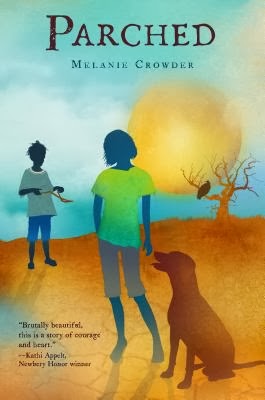
Parched

by Melanie Crowder
First line: “Sniff-sniff.”
Support your local independent bookstore: buy it there!
Content: There’s some harsh situations — a character was kidnapped and brutally treated, another character is shot and killed — but there’s no swearing at all. It’s not an action-packed book, so even though it’s on a 3-5th grade writing level, I’d be picky about which kid to give this to.

The world has turned to dust. Water is hard to find. And that makes anyone with water — or who can find water — valuable. Sarel’s family had water, until the gangs came through and killed Sarel’s parents and burned the compound to the ground. All that’s left is Sarel and the dog pack her father trained. It’s not a good thing; Sarel is running out of the little water she has left. Musa has a talent for dowsing, and has been kidnapped (or sold; I was never quite sure) to the gangs to find water. One night, Musa escapes, and finds his way to Sarel’s compound. It’s up to the two of them to work together to survive.

As you can tell, there isn’t much to this slim (seriously: it’s 152 pages.) novel. It’s highly introspective, more narrative than anything else. Even with the tension mounting to the end, it’s a quiet book about survival. I liked it, but I never really connected with it. Some of that was the quietness of it all. But it was also that I wanted more. I am not saying I needed a 300 page action-filled book, but I finished this one feeling like there was something missing. There wasn’t quite enough to it. I wanted more about how the world ended up parched. More about Sarel and her past. More about Musa and his talents. (Though I didn’t want more dog.) I wanted more connection between the characters. And the ending kind of came out of nowhere to me: I wanted answers as to how the book got to that point.

That said, the writing was gorgeous. And I have to give Crowder props for setting a dystopia book in an African-feeling setting. But it just wasn’t all I wanted it to be.

(Just for the record: because this is a Cybils nominee, I’ve been asked to make sure y’all know this is my opinion only, and not that of the panel.)

SideKicked

by John David Anderson
First line: “Captain Marvelous sighed.”
Support your local independent bookstore: buy it there!
Content: There’s some violence, and a bit of a body count. And there’s a budding love triangle (with a couple of kisses), though it’s all pretty innocent. It feels older than elementary school, though, so I’d put it in my YA (6-8th grade) section. However, I wouldn’t be opposed to handing it to a 10- or 11-year-old.

A long time ago (when M and C were little), we had a They Might Be Giant’s CD enttitled NO! On there was this particular song:

I didn’t think much of it at the time (it wasn’t my favorite on the CD by far), but when I started this book, that song kept playing through my head. See: Andrew Bean — Drew to his friends — was born with a “condition” that makes all of his senses amplified. He thought, growing up, that he was just Weird, but then he discovered the H.E.R.O program (that’s Highview Environmental Revitalization Organization. Their motto? We keep the trash off the streets.), which is, in reality a sidekick training program. For superheroes.

Which kept reminding me of another favorite of M and C’s when they were younger: Sky High. (My favorite line from that movie? “Holy (blank), (blank) Man!”) It’s essentially the same plot: Drew (and his sidekick friends) must Save the City from an Evil Genius (though in this case, there was a twist — that I saw, but didn’t mind  — that made it interesting) because the Superheroes aren’t able to. (Except, in this case, one is Reformed and Comes to the sidekick’s aid.)

I guess that makes it sound like I didn’t like this. Which isn’t true: I did. I don’t think it was wholly original (the superhero thing was done most excellently last year with Geeks, Girls, and Secret Identities), but it was fun. There was action (it starts out with a rescue scene), some romance, some angst, and some laughter. And Drew’s voice was spot-on for a sidekick with pretty useless superpowers. It may not be the best book out there this year, but it is an enjoyable read.

(Just for the record: because this is a Cybils nominee, I’ve been asked to make sure y’all know this is my opinion only, and not that of the panel.)
2013 Advent Tour: 10 Terrific Christmas Books

I was thinking, when I saw this button for this year’s Virtual Advent Tour, that I’d been a part of this since the very, very beginning. So, I went back and looked, and discovered that, yes, I have been. One of the benefits of being an Old Fogey in Blog Years.

One of the downsides is that it’s difficult coming up with new ideas every year…

But, going through past posts, I’ve talked about stories, yes, and I’ve talked about books, but I think what was needed is a list of all my favorite Christmas stories. (I am also doing this in the hope that I can get some good suggestions for next year’s book.)

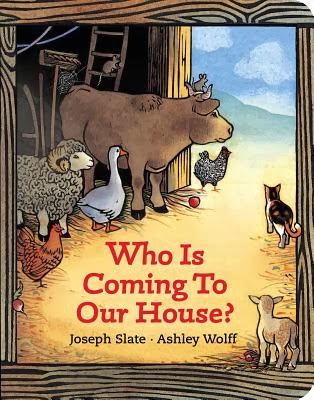
1. Who is Coming to Our House? by Joseph Slate and Ashley Wolff: I don’t have many Nativity books, mostly because the ones I find are either too didactic or too saccharine. But this one, available only in board book, is charming and sweet and perfect.

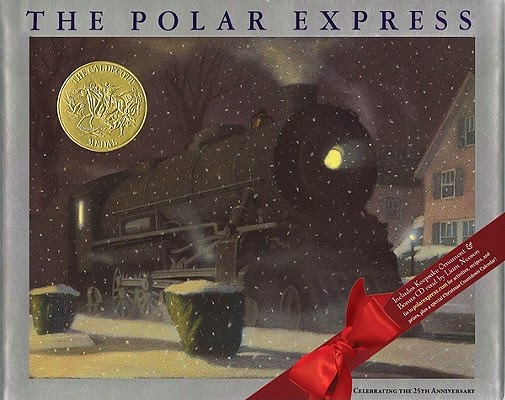
2. The Polar Express, by Chris Van Allsburg: Do I need to write about this one? I still cry at the end, no matter how many times I read it.

3. Yes, Virginia, There is a Santa Claus, by Frances Pharcellus Church: A lovely Victorian-inspired illustrated version of the original letter.

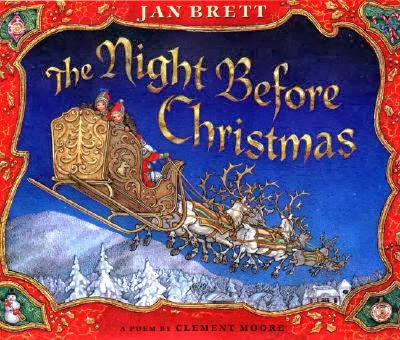
4. The Night Before Christmas, by Clement C. Moore, illustrated by Jan Brett. There are many versions of this one, but even after years and years, I love Jan Brett’s version of this. (Though Holly Hobbie‘s new one is quite lovely as well.) I’m not a big fan of Brett, overall, but her style suits this story.

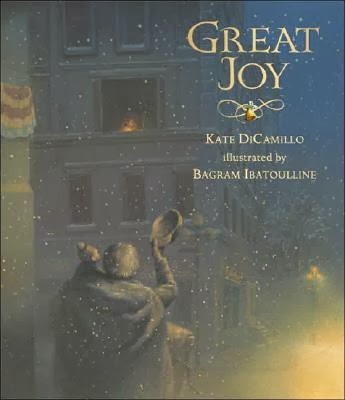
5. Great Joy, by Kate DiCamillo, illustrated by Bagram Ibatoulline: Simple story of a homeless man and a young girl in a church nativity play. It’s not often so few words pack so powerful a punch. Gorgeous illustrations as well (which is a must!).

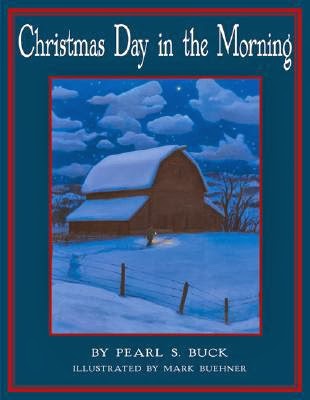
6. Christmas Day in the Morning, by Pearl S. Buck, illustrated by Mark Buehner: I don’t often read this one because it’s long, but it’s worth the read. And Buehner’s dark, lush art only adds to this touching story.

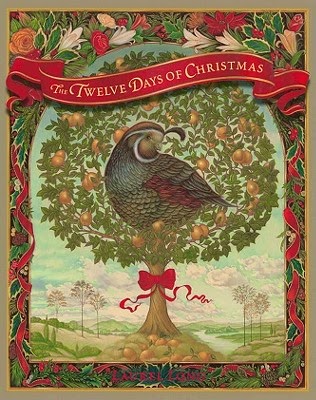
7. The Twelve Days of Christmas, illustrated by Laurel Long: it’s just the Christmas song, but in this case, the art is Everything. I am also fond of Emma’s Christmas by Irene Trivas for a retelling of this. Unfortunately, I think it’s out of print.

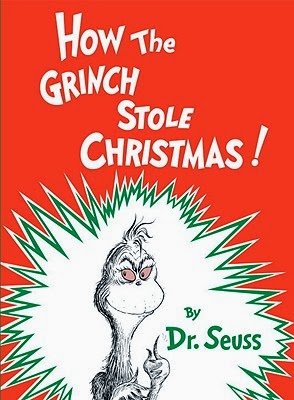
8. How the Grinch Stole Christmas, by Dr Seuss: I keep wondering if I’ll ever get tired of this because we read it constantly during the month of December every single year. I don’t think so, though.

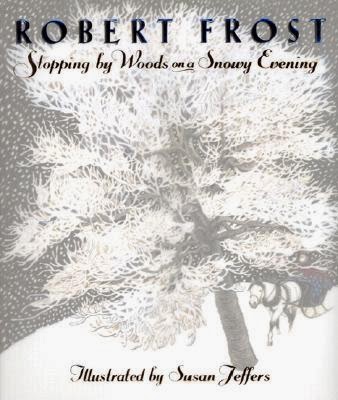
9. Stopping by Woods on a Snowy Evening, by Robert Frost, illustrated by Susan Jeffers. Not a Christmas book, but a winter one. And gorgeously quiet.

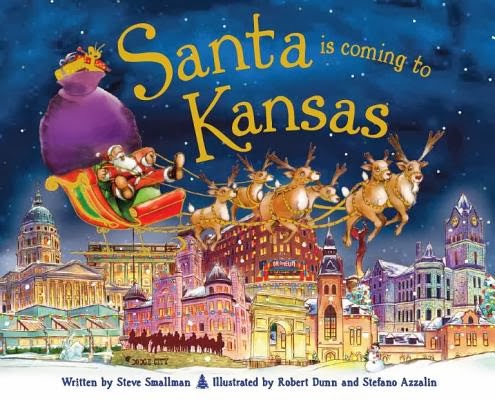
I had a couple that could go here, but I think, in the end, I’m going to put the one that I picked up this year. It’s not the best book, per se, (it’s cheesy and I think it’s one of those mass-produced ones that change depending on where you live) but it’s fun, and the kids like it.

10. Santa is Coming to Kansas, by Steve Smallman, illustrated by Robert Dunn and Stefano Azzalin

There are mine. What are your favorite Christmas books?

Oh! And if you’re curious, here are my past posts:
2012: Advent Calendar
2011: American Girl Dolls
2010: Christmas Tree
2009: Christmas Top 10
2008: Merry Christmas Interview
2007: Story Night

Audiobook: Longbourn

by Jo Baker
read by Emma Fielding
Support your local independent bookstore: buy it there!
Content: There is some talk of sex, but it’s vague and not at all explicit. And some mild swear words. It’s in the general fiction section at the bookstore, mostly because that’s the way it’s marketed. If a 15 year old were interested, I’d give it to them.

This is, to be frank, Pride and Prejudice fanfiction. All the familiar settings — Longbourn, Pemberly, London — are there, as are the familiar characters — Lizzie, Jane, Mr. and Mrs. Bennett, Bingley and Wickham (Darcy not so much).The difference is that it’s really only the bare bones of the P&P and the story is told from the points of view of three servants: Mrs. Hill, the housekeeper; Sarah, a maid; and James, a footman.

It basically follows the plot arc of P&P, though the concerns are not the concerns of Lizzie and Jane. And, honestly, I was expecting to love visiting that story from the perspective of the downstairs help. However, I was in for a surprise: unlike Austen’s witty observations on human character, Longbourn is a very pedantic book: every day is get up, do the work, collapse in bed. It’s also a dirty book — literally, there’s dirt, blood, pig slop, mud, you name it; Baker doesn’t whitewash the 19th-century.

There’s a slight love triangle between Sarah, James and Mr. Bingley’s footman, and while it goes somewhere, it feels kind of superfluous. I never really connected with the help; Baker didn’t make me care about all the work they were doing, or how annoying Mrs. Bennett was, or what a creeper Wickham was. And so, when at the beginning of volume 4 (I think; listening to it kind of throws off those things), I got backstory on Mrs. Hill and James, I was more than annoyed. First, at the timing — why wait until most of the way through the book? — but secondly because Mrs. Hill and James were not who I cared about or was interested in.

And then it just kind of petered out at the end. Baker kept the story going past the end of P&P, through the marriage of Lizzie and Darcy and even later until everyone is Old. I didn’t care. I wanted to care, but I was just Tired of the story.

I finished it. But I’m thinking that I shouldn’t have. Which is too bad.

(A note on the reader: she was fine. She was interesting. But it wasn’t enough to make me really like the book.)

The Wells Bequest

by Polly Shulman
First sentence: “The Wednesday when the whole time-travel adventure began, I was fiddling with my game controller, trying to make the shoot button more sensitive.”
Support your local independent bookstore: buy it there!
Content: The main character is a bit obsessed with the girl (too much for my taste in a time-traveling, science fiction adventure book) and there’s a terrorist threatening to destroy NYC. It’s in the middle grade (3-5 grade) section of the bookstore, though I personally would hesitate before giving it to just any third grader, though I’m not sure I could pinpoint why.

Leo is the son of Russian immigrants who really only expect two things from him: excellence and to be scientifically minded. Leo — for better or for worse — is neither of those. At least not in the traditional sense. Leo is a Tinkerer. He loves taking things apart and putting them back together. He loves building new and better things. Which makes him perfect for the page program of the New York Circulating Material Repository. He gets there in a weird, round-about way, though: a time-traveling version of himself and an unknown girl (Jaya Rao, who was in the first book of this series The Grimm Legacy. Thankfully this one stands on its own, however.) stops in his room to tell him to read H. G. Wells’ The Time Machine.

I’d like to say that an adventure starts there, and there is a bit of an adventure that involves NikolaTesla, Mark Twain, and a crazed British page that has a raging crush on Jaya. I while I did enjoy reading this book, mostly I felt like it was a set-piece for Shulman to show off all the Really Cool Things that could come from reading science fiction books. There are many references to classic science fiction (which I got, but I wonder how an elementary school student would handle) and the inventions that come out of them are really neat. But I felt like that was the entire point of the plot. And I kind of wanted more action and less cool inventions.

(There’s also the side issue of Leo being Obsessed — though not in a crazy way — with kissing Jaya. I know he’s a hormonal pre-teen boy, but get on with it already. It’s a science fiction time travel book. I felt like it was a distraction.)

Even with my qualms, it was a fun story. And I’m curious about the first one as well.

(Just for the record: because this is a Cybils nominee, I’ve been asked to make sure y’all know this is my opinion only, and not that of the panel.)
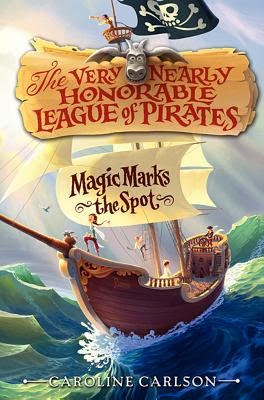
Magic Marks the Spot

The Very Nearly Honorable League of Pirates, Book 1

by Caroline Carlson
First sentence: “Ever since the letter had arrived from Miss Pimm’s, Hilary had spent more and more time talking to the gargoyle.”
Support your local independent bookstore: buy it there!
Review copy provided by the publisher for the Cybils
Content: There’s a couple of swordfights where no one gets injured. For a pirate book, it’s really quite tame. It’s shelved in the middle grade (3-5th grade) section of the bookstore.
Hilary Westfield has one dream: to become a pirate. Unfortunately the league of pirates in Augusta has one rule: no girls. Girls are sent to Miss Pimm’s finishing school, because that’s Where Girls Go. Thankfully, Hilary has Pluck and Determination and doesn’t let the Rules stop her. (This book insists you talk about Things in Capital Letters.) As soon as she gets a chance, she runs away from Miss Pimm’s and finds a pirate — Jasper, the Terror of the South Seas — who doesn’t care that she’s a girl. 
There’s more to this book — magic and treasure and an Enchantress and a Wicked Parent — but really, what I loved most about this book was that Hilary set out to be a pirate and succeeded ON HER OWN TERMS. No dressing up like a boy. No bowing to Tradition. No Resigning Oneself to her Fate and Making the Best of It. Nope. Not for Hilary. She (and her talking gargoyle, whom I really loved) decided that they wanted to be pirates, and Dang It, they became pirates. 
I liked this one an awful lot, mostly because of the above reason. But — aside from the unnecessary letters that were written in cursive, which is a real turn-off for kids These Days; the book got much better after I started skipping them — I really enjoyed all of it. There was humor (Miss Greyson, the governess/chaperone, was hilarious), sword fighting, a wee bit of romance (but not overstated; it was between the adults), and most of all Hilary being Awesome.
Yeah, it was a bit slow at the start, and I really don’t like that it’s yet another one in a series, but I thought the story wrapped up well enough, and I’d be willing to see where Hilary’s piratical adventures take her. 

(Just for the record: because this is a Cybils nominee, I’ve been asked to make sure y’all know this is my opinion only, and not that of the panel.)

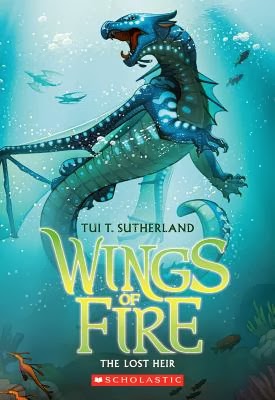
The Lost Heir

Wings of Fire 2
by Tui T. Sutherland
First sentence: “Underwater, Webs couldn’t hear the screams of dying dragons.:
Support your local independent bookstore: buy it there!
Others in the series: The Dragonet Prophecy
Content: There’s some dragon violence — a few battles, some one-on-one fighting, and a baby dragon egg is smashed — but other than that, it’s pretty low-key. It resides in the middle grade (3-5th grade) section of the bookstore.

Spoilers for the first book, obviously.

When we last left our dragonets — the five dragons that were taken when they were eggs and raised by the Talons of Peace to stop the war that’s been going on for too long — they had escaped their captors/guardians and were setting off to find the clans. They’d interacted with the Mud Wings, to some dissatisfying results, and been captured by the Sky Wings (and their bat-crazy queen), but got out of there. Now they’re headed to the Sea Wing palace, presumably because Tsunami, one of the dragonets, is the queen’s daughter. They figure they can find refuge and protection there.

Except — probably predictably — things aren’t what they seem. Sure, Tsunami’s mother, Queen Coral, is happy to see Tsunami. But she’s not very happy to see Tsunami’s friends, and shoves them off to a cave. It’s slowly revealed that Queen Coral’s not a little crazy. And that there are traitors in the midst. And that Tsunami doesn’t fit in as well as she thought she would.

I’ve decided — partially because books three and four are already out, but also because it just makes sense — that the purpose of each of these books is not only to tell an overall story, but to highlight a specific tribe of dragons. And in that latter purpose, Sutherland does a fantastic job of creating an individual world. The Sea Wing palace and world are fascinating — they have their own language that involves flashing stripes, which is pretty cool — and even though Tsunami starts out as a complete brat, she develops into a fairly confident leader by the end. What I found myself growing impatient with was the overarching plot of the war and the prophecy. The menacing posturing by Coral’s friend Queen Blister, the suspicion and automatic mistrust of the Talons of Peace.

I’ve not disliked this series, and it’s perfect for those who enjoyed Warriors or Guardians of Ga’hoole. But I’m probably not going to keep reading. I just don’t have much interest in the overarching storyline.

(Just for the record: because this is a Cybils nominee, I’ve been asked to make sure y’all know this is my opinion only, and not that of the panel.)
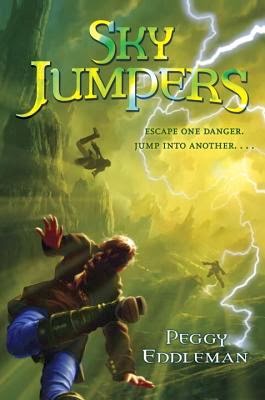
Sky Jumpers

by Peggy Eddleman
First sentence: “You would think I’d never jumped off a cliff before, based on how long I stood there.”
Support your local independent bookstore: buy it there!
Review copy snagged from the ARC shelves at my place of employment.
Content: There are some intense moments, but other than that, it’s pretty tame. It’s shelved in the middle grade (3-5th grade) section of the bookstore.

It’s a future after World War III, which devastated the world. The scientists thought they were doing good in creating “green” bombs, but (because, you know, BOMBS) it still wiped out many cities and destroyed most of the population. In addition, they changed the properties of metal and magnets, and while they made some ground more fertile, it made other places toxic. And — perhaps worst of all — it created the Bomb’s Breath: pockets of air that if you breathe, it’ll kill you.

This is the world that Hope has grown up in.

Living with her adoptive parents in White Rock, a town in a fertile valley, she has discovered that the thing that is most highly prized is Inventing. Since the war destroyed all our technology, it’s up to everyone, really, to invent gadgets and come up with ideas to make life less, well, primitive. Except Hop is terrible at it. What she’s good at is being daring: she’s figured out that if you hold your breath in the Bomb’s Breath you won’t die and that the thicker air has a slowing quality to it. She has taking to jumping off cliffs (sans parachute) through the Bomb’s Breath for fun. (No, she didn’t ask permission.)

Then, one day in winter, some bandits infiltrate their previously safe town and take hostages, demanding access to the town’s one true commodity: the antibiotic they’ve developed. The only hope for the town — since their guard and the weapons are guarding the next town over — is to go fetch the guard back. And the only way to do this is to go over the mountain and through the Bomb’s Breath. And the only one who can do this is Hope.

I’m a bit torn on this one.

On the one hand: I love Eddleman’s take on the dystopian genre. It’s so overdone that it really needs something unique to grab my interest. And Eddleman did just that. I also liked how Hope was a fierce girl, taking the initiative in spite of her misgivings, and using her strengths to not only get the guard but also help outwit the bandits.

On the other hand: I’m not sure. It’s not something I can pinpoint, but I felt disconnected from the book the entire time. Like I was on the outside, looking in, rather than being grabbed and immersed into the world. Perhaps I was turned off  by the BOOK ONE on the back of my ARC. I don’t know if it’s truly going to be a series — this one wrapped up just fine — but the idea of that just set me on edge. I really am so tired of series books.

I shouldn’t let that prejudice interfere with my reading of this one, though. It was a good book. One that I think will appeal to both genders. And there’s a lack of “magic” that was refreshing as well; Hope got by on her wits and her ingenuity and her reliance on her friends. I can get behind that.

(Just for the record: because this is a Cybils nominee, I’ve been asked to make sure y’all know this is my opinion only, and not that of the panel.)