The Swallow

by Charis Cotter
First sentence: “There’s no place for me,”
Support your local independent bookstore: buy it there!
Content: It’s kind of confusing and a little bit creepy, though the chapters are short and to the point. It would be in the middle grade (grades 3-5) section of the bookstore.

Polly is lost in a sea of siblings and foster siblings. Her father is a pastor and feels a need to rescue lost children, much to Polly’s dismay. Rose is lost as well, but for the opposite reason: she is the only child of very busy, distant parents who don’t spend much time with her at all. Its 1963 in Toronto, when these two meet, and because they both have an interest in ghosts — well, Rose can see them, so it’s not really an interest — they embark upon a mystery when finding a gravestone with Rose’s name in the graveyard behind their houses.

If that sounds convoluted and sort of strange, it’s because this book is, well, convoluted and sort of strange. I think Cotter was going for atmospheric, but for me it just came off as creepy and weird. And unnecessary. Perhaps it was just me; this was the last of the Cybils finalists that I read, and I was worn out on fantasy by this point. But, the characters seemed wooden, the parents unnecessarily strict or absent, the story too forced for my taste.

The twist that happens didn’t work for me, either.

Which is to say, this was my least favorite. Though, it’s probably just me, and there’s some kid out there who loves twisty ghost stories with shocking reveals.

The Castle Behind Thorns

by Merrie Haskell
First sentence: “Sand woke, curled in the ashes of a great fireplace.”
Support your local independent bookstore: buy it there!
Content: There’s death and betrayal and politics, and lots of funny French names, so maybe it’s not for the most reluctant of readers. It’s in the midde grade (grades 3-5) section of the bookstore.

Sand, short for Alexandre, is the son of the local smithy in a small French duchy. (Well, it’s in one of those offshoots just when France was becoming, well, France.) The duchy castle has been in disrepair for longer than Sand’s 13 years, and surrounded by thorns. No one has gone to see what could be seen  inside.

Then Sand, who has been arguing with his father about attending university (he doesn’t want to), throws a token in Saint Melor’s wishing well, and ends up inside the castle. With no clue how he got there or how he will get out.

A brief aside here: we discover things right along with Sand, and while that generally annoys me, in this book it works to great effect. Sand is disoriented and alone, and Haskell captures that perfectly, transferring Sand’s anxiety and his slow realization that he’s stuck there and no one is coming to get him to the reader. All of which is followed up by his determination to survive and make things work.

During his explorations, Sand finds a body of a dead girl, and straightens her up. And because this place is magical (something which comes on very slowly, and quietly), she wakes up. Suddenly, Sand is not alone, and he and Perrotte — who happens to be the daughter of the long-dead Count — have to work together to find their way out of the castle.

I know it sounds boring, but it’s not. Haskell is a gifted writer, and she captures so many inner emotions and struggles and makes them not only real but captivating. I loved the friendship that developed between Sand and Perrotte (and that it wasn’t a romance!). I loved how they worked together to figure out how to get out of the castle. I loved that Sand’s strengths and Perrotte’s strengths were different and they found a way to compliment each other.

Yeah, all of this is really introspective for a middle grade fantasy novel, but in Haskell’s talented hands, it works well.

More than just well: it works wonderfully.

The Jupiter Pirates: Hunt for the Hydra

by Jason Fry
First sentence: “Tycho Hashoone was doing his math homework when the alarms started shrieking.”
Support your local independent bookstore: buy it there!
Content: There’s some intense moments, and a lot of off-screen deaths. And the names are pretty challenging to sound out. But, it’s a short book that reads quickly, and would be in the middle grade (grades 3-5) section of the bookstore, though I think 6-8th graders would enjoy it as well.

Tycho is part of one of the great pirating families of the Jupiter alliance. They’ve been capturing ships for booty for generations, flying the same starship, the Comet, making their name and their living. The captainship is handed down from parent to child, and the current captain, Diocletia, is Tycho’s mom. Which means that Tycho, his twin sister Yana, and their older brother, Carlo, are all in competition to be the next captain.

Lest you think that’s the focus of the book, it’s not. Even though their competition is a huge part. No, the real story is the disappearance of Jovian privateers (as the pirates are now called). When the Hashoones capture a freighter that happens to have an Earth diplomat on it (Jupiter and Earth have been at war for decades), that sets off a chain of events that will involve the Hashoones figuring out the dirty politics behind the disappearances.

On the one hand, this is freaking cool. Pirates! In Space! (or as A pointed out, a book version of Treasure Planet.) And, I like the world building that Fry did. He’s come up with some creative ideas for the future, and I liked the way the privateers/pirates balanced politics with business, just on the legal side of outlaw.

But.

The writing was pedestrian, the competition side of the story took up too much time and what I came to consider the “real” story took too long to develop  and was wrapped up too quickly. (Though that last scene was pretty dang awesome.) While I really enjoyed that this was a family business, Fry was juggling too many characters so I felt like I never really got to know any of them. And maybe this is all quibbling — I mean, will kids really care? — but it made the book a less-than-stellar read for me.

Nuts To You

by Lynne Rae Perkins
First sentence: “One mild day in early November, I took my lunch down to the waterwheel park.”
Support your local independent bookstore: buy it there!
Content: There are short chapters, lots of illustrations, and it’s pretty basic vocabulary-wise. Which means it’s perfect for the younger readers as well as those who struggle. It’s in the middle grade (grades 3-5) section of the bookstore.

The book starts out inauspicious enough: the author having lunch on a picnic bench. But then, a squirrel comes up and, after a bit, begins talking to her. He tells her a fantastic story of adventure, of friendship, and of bravery.

Jed the squirrel was minding his own business, really, when he was picked up by a hawk. He manages to escape with some quick thinking (and the ancient squirrel martial art of Hai Tchree), he manages to escape, falling into an unknown part of the forest. Meanwhile his two best friends, TsTs and Chai, have seen Jed’s daring escape, and they head out into the forest to find him.

It sounds horribly corny, doesn’t it? I’ve been putting this book off for months just because 1) talking squirrels?? 2) really??? But trust me: it’s adorable. The squirrels talk to each other, true, but the only reason they talked to the “author” was because they’ve learned English over the years. No magic. Promise. Even so, the way Perkins has imagined the forest is charming, believably true to the animals she portrays, and just delightful.

There are a couple of reasons why. First, it’s the friendship between Jed, Chai (who’s a delightful character in his own right), and TsTs is a wonderful one. They will do just about anything for each other, and they work better together as a team. Second, the footnotes and asides had me cracking up. The voice Perkins chooses to tell this story is part of what makes it so perfect. Third, the illustrations help give the text just the right boost from weird and corny to adorable and fun.

Sure, there are some downsides: the environmental message at the end is a bit tacked on and heavy-handed. And the jokes and asides will probably drive those who dislike intrusive narrators bonkers. But I was completely won over and just wanted to hug the book in the end.

The Luck Uglies

by Paul Durham
First sentence: “
Support your local independent bookstore: buy it there!
Content: There’s a lot of death — most of it off screen — and some pretty intense moments. Throw in a lot of difficult names of places and people, and this is not for the younger set, unless they’re pretty strong readers. Even so, it’d be in the middle grade (grades 3-5) section of the bookstore.

Rye O’Chanter has spent her life roaming the streets of Village Drowning, from her home in Mud Puddle Lane to her mother’s store to her the in her friend owns across the village. It’s not been a tough childhood, even though her father has been gone for years, but life in Village Drowning under the protection of the strict, and somewhat cruel, Earl Longchance hasn’t been a walk in the park, either.

The one day, the village is threatened by a beastie that everyone thought was extinct: the Bog Noblin. It had passed into lore: beasties that will eat you if you go outside after dark. The thing is, though: they really do. And when this one brings a heap of trouble on the village (partially because of the stupid Earl), it’s up to Rye — sort of — to stop it.

But she can’t do it on her own. Thankfully, a helpful stranger she calls Harmless shows up at just the right moment.

I’ll say this to start: I ended up liking this book more than I did in the beginning. I had a lot of unanswered questions at the beginning; almost too many for my taste. It was frustrating that I didn’t know the why, or who, or what. Then again, neither did Rye (because of information her mother held back). But, once I started getting answers — almost halfway through — the book picked up for me, and I actually enjoyed the adventure. There was a moment when I was afraid that Rye wouldn’t be allowed to be the hero of her own book (and that the guy was going to Save the Day), but Durham pulled through and allowed Rye to do what needed to be done.

The other thing is that even though there’s going to be a second book, this really is a stand-alone story, and that’s refreshing. I enjoyed Rye and the relationships she had with those around her (her younger sister, Lottie, is adorable). I loved how Durham showed a happy family with caring relationships, and yet Rye was a clever and capable and brave and tough girl. That was definitely something I liked.

So, in the end, this was a really solid fantasy.

Boys of Blur

by N. D. Wilson

First sentence: “When the sugarcane’s burning and the rabbits are running, look for the boys who are quicker than flame.”
Support your local independent bookstore: buy it there!
Content: There are some intense moments, some violence, and some reference to abuse. It’s pretty intense, so while it’s in the middle grade (grades 3-5) section of the bookstore, I’d hesitate giving it to the younger part of that age range.
There’s so much going on in this slim book, that it’s difficult for me to know where to start. 
There’s Charlie Reynolds, who had an abusive father, but whose mother was strong enough to leave and who found Mack, a former professional football player from a small town in Florida, to help keep her and Charlie safe. They got married and had an adorable little girl, Molly.
There’s Cotton Mack, the homeschooled son of one of Mack’s cousins, whom Charlie meets when he’s in Florida to attend the funeral of Mack’s former football coach.
It’s after that funeral that things start getting weird for Charlie and Cotton. Like ancient mythical men on mounds wielding swords weird. Like panthers that are tame and the zombie-like Stank (aka Gren) who feed off of envy and greed. And somehow it falls to Charlie and Cotton (well, mostly Charlie) to stop the Gren from rising and destroying their town.
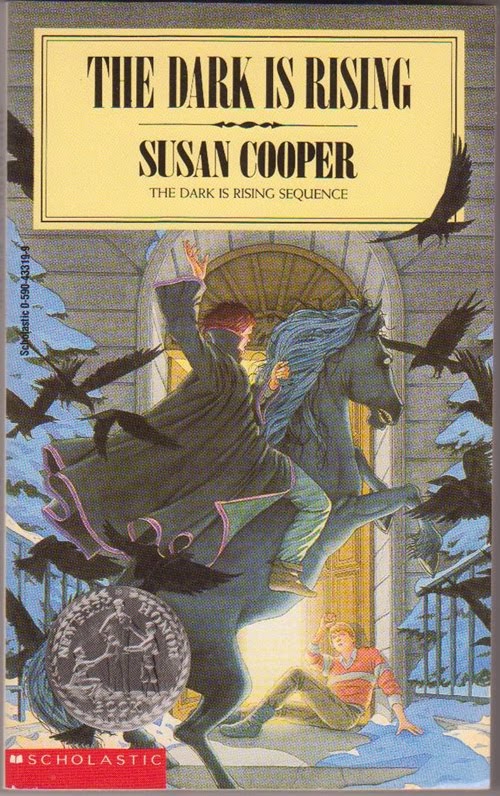
In many ways, this one is reminiscent of The Dark is Rising: an ancient force pitted against a boy, who didn’t know he had it in him to face that ancient force. The difference is that this one is very southern, and is liberally scattered with African Americans. Which brings me to my one problem: why did the white kid have to be the one to save the world, in the end? Why did Cotton have to be taken out of commission? Although I really liked the book, with its mix of football and mythology and family, I was disappointed by this.
I don’t know how much that affected my enjoyment in the end, because Wilson does know how to pace a book, and he’s incredibly tight in his timing, and he knows how engage a reader. So, overall, I’d consider this one a win. 

The 2014 Cybils Winners are Here!

I’ve had a fantastic Cybils year. I eschewed my usual round 1 reading — which is why there’s not been nearly as many reviews as usual around here — to be the Cybils blog editor, something which I really enjoyed. I liked reading all the reviews, visiting blogs I usually don’t.

I was, however, chosen to be a second round judge for the Elementary/Middle Grade Speculative Fiction category. And today, we announce that (and the others!) winner! (An inside tip: read all the way through to the YA Speculative Fiction blurb. It’s GREAT.)

I’m always a little sad at the end of Cybils season, because it’s such a great community effort.

Though, to extend the season a bit more, over the next two weeks, I’ll post reviews of the finalists.

Here’s to another fantastic Cybils!

The Slanted Worlds

by Catherine Fisher
First sentence: “The Bomb fell in a split second of silence.”
Support your local independent bookstore: buy it there!
Others in the series: Obsidian Mirror
Content: There’s some violence and (much like the first one) this takes some effort to follow. Not for the reluctant of readers. It’s in the YA (Grades 6-8) section of the bookstore.

A few spoilers for the first one, obviously. You’ve been warned.

Both Jake and Venn have become increasingly desperate to use the mirror, to make it work right. Jake, in order to find his father. Venn, because he wants to turn back the clock to get his wife back. Neither of them know of the outside forces controlling the mirror — that’s a knowledge known intimately to Maskelyne, an old, old time traveler, who may have been the one who invented the mirror — but both are willing to do whatever it takes to keep the mirror safe, and bring back the ones they love. Including involving Summer, the leader of the Shee, the fae-like creatures.

I have realized while typing the above that I could recount the plot of the entire book and it probably wouldn’t make any sense to those who haven’t read it.

There are other factors, as well: Sarah’s still around, trying to destroy the mirror and rid the world of Janus, and she’s willing to involve the Shee as well.  In fact, the Shee is the wild card here: Summer is the chaotic evil here, working toward her own end, but we have no idea what that end it.

There’s a lot of wibbly wobbly timey wimey stuff in this book, time looping in and back and forward on itself in incredibly fascinating ways. Jake is the real focus of the book; its his quest to find his father that we follow most closely. It was a good thing to focus on one arm of the conflict, though I did miss having Sarah around.

But at the end, I was left wondering: how is this all going to come together in the next book? How are we going to resolve the tension between needing to rescue those trapped in time and the need to destroy the mirror to save the world?

I suppose I’m just going to have to read the third one and find out.

The Forgotten Sisters

by Shannon Hale
First sentence: “Miri woke to the rustle of a feather-stuffed quilt.”
Support your local independent bookstore: buy it there!
Others in the series: Princess Academy, Palace of Stone
Release Date: February 24, 2015
Review copy snagged from the ARC shelves of my place of employment.
Content: There’s some violence, but nothing graphic. And some kissing, which may be ew-inducing in the younger set. Still, I think it belongs in the middle grade (grades 3-5) section of the bookstore, though it might do better with the 5-7th graders.

Miri finished her year at the Palace and was looking forward to going back home to Mount Eskel, seeing her family, enjoying getting back to the life she once had before the Princess Academy changed her path. But, her winding road isn’t finished yet: the neighboring country, Stora, is threatening invasion, and in order to pacify them King Bjorn has offered up some distant cousins as a bride to the aging Storan king. And Miri is sent, unwilling and unprepared, to the swamp of Lesser Alvan to find these cousins and whip them into shape for a royal wedding.

What Miri finds when she gets to the swamp are three motherless girls — Astrid, Felissa, and Sus — who have been resourceful enough to find a way to survive without the help of the castle. They were supposed to be getting an allowance, which has been stolen by the local village overlord. They were supposed to have servants and a family, and they’ve been robbed of that, too. However, they made to, and once Miri figured out how to connect with them, things went well.

In fact, Astrid and Sus were my favorite characters. Felissa was nice enough — her main characteristic, as Hale often reminded us, was smiling — but Astrid was tough, no-nonsense, responsible, and just plain amazing. Sus soaked up the knowledge, and there’s a scene at the end (I won’t spoil it) where she talks coolly and rationally and logically and in the end makes everyone listen to her. Miri,too, was a bastion of resourcefulness: she adapted to the swamp life and fought back against the bandits and robber barons. She fought for justice and did so in a way that wasn’t violent.

The thing that kept running through my mind while reading this was that it was a girl power book, but not in the way we usually think of it. Usually, we want our girls to be like guys: kicking butt, fighting. But, Hale has given us girls and women who Do Things and stand up to people without violence, without force. In fact, you can look at this book as the myriad of ways women survive what men in power do to them. From making decisions to making war to actual physical violence, men can be (are often?) cruel and unthinking. But, women can survive and flourish.

It never got didactic or heavy-handed, though I did think some of the twists and turns of plot were a bit much. It came together in the end, though, in a very satisfying way. Because above all, Hale is a consummate storyteller. And this is definitely a good story.

I Was Here

by Gayle Forman
First sentence: “The day after Meg died, I received this letter:”
Support your local independent bookstore: buy it there!
Review copy pilfered from the Penguin rep pile.
Content: There is drinking, illusions to pot smoking, language, and some tasteful sex. It’s also a post-high school graduation book. For these reasons, it’s in the Teen section (grades 9+) of the bookstore.

Cody and Meg have been best friends for as long as Cody can remember. Since her mother was gone pretty much all the time, Cody practically grew up at Meg’s house. Meg’s family became her family, Meg’s dreams her dreams. Until they graduated, and Meg got a full-ride scholarship away from their small Eastern Washington town and to a fancy liberal arts school in Tacoma. Suddenly, Cody was the one left behind.

A year later, though, Meg committed suicide. Leaving Cody behind again.

An aside here, in case this sounds crass: this book isn’t about Meg’s suicide. Not really. It’s about Cody, and her reactions to Meg’s suicide. Dealing with grief, dealing with loss, dealing with the reasons why. Meg isn’t a character in this book, even though you kind of get to know her. She’s a reason. A cause.

Cody heads to Tacoma to clean out Meg’s apartment and discovers an encrypted file. Suddenly what seemed like a simple suicide looks more suspicious. And with the help of one of Meg’s roommates (stereotypical Korean computer whiz) and an ex-boyfriend (tortured rock soul whom Cody ends up “saving”) Cody tries to make sense of the senseless.

In the end, it was less of a mystery than I hoped for and more of a romance. And while the romance was okay, I kind of thought it took away from the whole grief thing. Cody is hurt, and maybe one needs a Man to heal, but it kind of felt out of place here. Forman is a good writer, though, and she got across Cody’s raw grief and her questions that didn’t have answers and her need for closure.

A good read, if not an exceptional one.