Spell Bound

by Rachel Hawkins
age: 12+
First sentence: “There are times when magic really sucks.”
Support your local independent bookstore: buy it there!
Others in the  series: Hex Hall, Demonglass

I suppose it’s typical, but honestly: Sophie Mercer just can’t catch a break. Then again, when you’re 17, a demon (though not currently in possession of her powers), and facing down some of the most evil people on earth (the problem is that they always think they’re right), then there’s not many breaks to be had.

Then — after she discovers that her mother isn’t really who she thought she was (sounds creepy, but it’s not) — she mysteriously gets transported back to Hex Hall (thankfully, with BFF, boyfriend, fiance, and ghost-friend) to face down the evil demons once and for all.

There really isn’t much to be said about this one that I already haven’t said about the other two.

Swoon-worthing kissing? Check.
Snark? Check.
Awesome magic fighting? Check.
Cool vampire BFFs? Check.
Creepy ghosts? Check.
Kick-butt heroine? Check.

And a great way to end the series, as well. Hawkins wrapped everything up nicely, put a bow on it, managed the love-triangle thing without getting all weird on us, and gave us some fun, magical nonsense in the process.

What more can you ask for? Nothing.

Demonglass

by Rachel Hawkins
ages: 12+
First sentence: “At a normal high school, having class outside on a gorgeous May day is usually pretty awesome.”
Support your local independent bookstore: buy it there!
Others in the series: Hex Hall


When we last left Sophie, she had figured out who was killing off the witches, but not in time to save Elodie, one of those popular girls/dark witches. (She wasn’t exactly the nicest person around, but she didn’t really deserve to die…) Oh, and she discovered that Archer Cross, love of her life, was actually a member of L’Occhio di Dio (aka, The Eye, an organization that’s out to eradicate the world of Prodigium), and they can never see each other again. In other words: life sucks.

So, how about summer vacation in England? (That makes everything better, right?)

She finally gets to meet her demon/warlock/powerful dude dad, who comes to Hex Hall to take Sophie away from the frying pan and into the fire. Sure, they place they’re staying (Thorne Abbey) is huge and gorgeous and English, but there’s trouble brewing. There are two demons staying at the abbey, which means someone is “breeding” them. Then, there’s an attempt on Sophie’s life. And, to make matters worse, Archer saunters back into her life. Just when she thought she was getting over him, and learning to like the guy she’s betrothed to (don’t ask), Cal.

This book is just as full of smart, magical nonsense as Hex Hall was. And I’ll have to add Hawkins to my list of people who know how to write a kiss, because there were some seriously swoon-worthy parts of this one. They are snarky fun, books that are meant to be read in one sitting, engrossing and hilarious, with pretty wicked twists and turns.

Awesome.

Blood Red Road

by Moira Young
ages: 15+
First sentence: “Lugh got born first.”
Support your local independent bookstore: buy it there!

This one took a while for me to get into. In fact, I read the first quarter, then put it down for a good week before picking it up again (and then, only because I didn’t want to return it to the library unread — since I had already started it — and I couldn’t renew it). But, once I got halfway through, I was in, hook, line and sinker.

It’s the future, and because of some undetermined event, the world as we know it has dissolved into chaos. Saba and her family, twin brother Lugh and little sister Emmi along with their father, live out in the middle of nowhere, going nowhere, basically existing. That is, until four men come and forcibly take Lugh away. Well, that doesn’t sit well with Saba, so after her father dies (which is pretty much right away), she takes Emmi and heads off to get Lugh back. Actually, she tries on several occasions to ditch Emmi, but the little girl is tough and won’t be left behind.

The world they discover is not a happy place. They spend a month in Hopetown where Saba is a cage fighter (which is as grim as it sounds), before they manage to escape. From there they have to make it to the hidden valley in the mountains where the king (who is certifiably insane) has Lugh hostage, preparing to kill him as a human sacrifice on midsummer day. Which, by this point, is right around the corner.

It’s a tough book to get into — there are no quotations marks, and it’s written in dialect, which always throws me for a loop — but I have to admit that Young knows how to write action (there are many intense moments) as well as romance (seriously). She’s given us a strong reluctant heroine, someone who leads without knowing it, inspiring greatness in both herself and those around her.

All of which makes me curious to see where Young is going to go in the next book.

Hex Hall

by Rachel Hawkins
ages: 12+
First sentence: “Felicia Miller was crying in the bathroom.”
Support your local independent bookstore: buy it there!

Back in the fall, I was invited by the lovely Laura at A Jane of All Reads to participate in a book group. We read YA books, snark quite a bit, and then post about it on our blogs (so you all can be jealous?).

This month was mine to be Keeper of the Book, and the one out of my nominations that was chosen was the “smart magical nonsense” of Hex Hall.

So: the basic plot for those of you with your heads under rocks…. Sophie Mercer is a witch. She’s been raised for the past 16 years by her human mom, but after a prom night gone bad (don’t ask), she’s shipped off to juvie for Prodigium (that is: fairies, witches and shapeshifters): boarding school Hex Hall. There, she makes a best friend in Jenna, her pink-loving vampire roommate; develops a wild crush on the hottest warlock on campus, Archer Cross; makes enemies of the only other dark witches (read: the popular girls); and eventually crosses paths with a demon. Part boarding school story, part teen crush, part mystery, and all sorts of awesomeness, Hex Hall is quite the fun read.

This is what the three of us who read it (and Demonglass and Spell Bound) had to say about it (spoilers, obviously, ahead):

Me: So… I’ve finished both Hex Hall and Demon Glass, and I’m trying to figure out a way to get Spell Bound without having to buy it (if I can find one of the two copies we’re supposed to have it at work, I’m going to check it out there). So, if y’all want to start discussing any (or all?) of the trilogy, be my guests. 🙂

Sya: I have it on my kindle and plan on reading it before the hex hall discussion.

Donna: I’m almost done with mine. I’m ambivalent. I’m entertained but I’m not blown away by it or anything…. Just finished and read the teaser for the next book. If there’s more Cal, I may read on. He’s awesome. Overall the whole book reminded me a bit of Mari Mancusi’s titles in tone and voice but not as satirical. Entertaining but still not blown away. Did like the ending though.

Sya: I think that that’s kind of the point – it’s solidly entertaining without being even remotely challenging. And yes, there’s quite a lot more Cal in book two and he’s particularly swoonsome on a regular basis.

Me: I agree with Sya: it’s good, fluffy, magical chick-lit. I don’t think it’s supposed to blow you away. And I agree, too, Donna: the ending was quite good. Did you see any of it coming? Also: what think ye about the love triangle nonsense (it develops more in book 2)?

Sya: I think the love triangle is a bit of a non starter… It’s not been played up as that much of a plot point as far as I can see (I’ve just started the third book) so far.

Melissa: Oh, good. Actually, I was worried about that (in the third book); I didn’t want it to become your typical YA-we-can’t-just-have-one-love-interest thing.

Sya: I really am right at the beginning of the third one so out could come into play. Will keep you posted.

Me: Thanks! (I really do need to get my hands on that one…) I have higher hopes than mediocre YA tropes for it.

Donna: I saw the big baddie ending up being someone close to Sophie. I just didn’t have it pinned down as who. As for Alice, she didn’t sit right although I didn’t see the entire thing coming. It’s not too often I see something coming full force. When I do then it’s really bad! I didn’t even realize there was a love triangle, unless you count Elodie-Sophie-Archer. And I found it slightly hypocritical of Archer to rank on Sophie’s name for the ‘ie’ when he’s dating the Cliff Notes version of Melodie.

Sya: I kind of figured that Alice didn’t have the best of intentions but I was still taken aback by the ending and liked the way it set things up for book two. On the love triangle front, it’s a bit more prevalent in the third book but still in a sort of background way and doesn’t detract from the rather exciting and sinister story.

Me: Donna: “And I found it slightly hypocritical of Archer to rank on Sophie’s name for the ‘ie’ when he’s dating the Cliff Notes version of Melodie.” HA! I totally agree. Sya: Rather exciting and sinister??? I need to find that one.

Sya: I just finished it. I thought it was completely awesome – such a lot of fun and actually even a wee bit moving in places. Great way to end the series.

We kind of got off-topic there. Back to Hex Hall…

Sya: I’m not quite sure what thread I should be posting my Hex Hall thoughts so I’m jumping in here. I thought the book was great. I read it for the second time for this discussion and followed it up with the second and third in the series. And I really enjoyed the whole lot. Sophie is a fun and believable protagonist, pleasingly flawed and endlessly entertaining. The mean girls are particularly fun to read and Archer is a bonafide hottie – played by Ethan Peck in my head (also, Sophie’s dad? Totally Richard Armitage. Obvs). Cal is also rather scrummy and I actually really liked his character arc as the trilogy continued. In fact, I was pleased that in a trilogy that is essentially light reading the characters really did display some depth. The plot itself kept me reading and while I could see that Alice wasn’t all she seemed, I didn’t really see the whole demon-family thing coming. The writing was fluid and pleasingly visual – I had a really good sense of what Hex Hall looked like – and all in all I’d recommend these books. Will be interested to see what Rachel Hawkins comes up with next.

Me: I agree about the depth of the characters. In my mind, these are a lot like Ally Carter’s books: a lot of fun, but smart, engaging fun. Entertaining, without making you feel guilty. And proof that brain-candy doesn’t have to be written badly, or just hit the same note over and over and over again. I also like that it’s basically clean, geared toward the age group, without pandering and talking down.

Donna: I grew a little tired of Carter’s Gallagher girls books but that quirk kind of wore off. I’d have to keep reading the HEX HALL series to see if I’d feel the same way but since I’m more amenable to this Mancusi-ish quirk it might have more staying power for me. The GG series kind if got away from me and went a little too quirky.

Me: Mancusi-ish quirk”??? And I wasn’t thinking so much Gallagher girls as Heist Society, which I like better, anyway. (*sigh* Hale. *swoon*)

Donna: Mancusi is really over the top but in a way it’s really palatable for me. It’s probably totally personal as she and I share a Lost Boys love and she satirizes current camps to no end so the joke ran longer for me. Haven’t read Heist Society and I think I got to book 2 in GG before I didn’t feel much of a need to keep reading. I may have read three.

And that ends our discussion… we get a little scatterbrained when talking, no? Have you read Hex Hall (or any of the sequels — my reviews coming next week)? What did you think?

(Participants in this discussion: Sya @ The Mountains of Instead and Donna @ Bites)

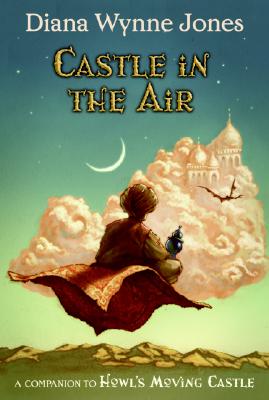
Audiobook: Castle in the Air

by Diana Wynne Jones
Read by Jenny Sterlin
ages: 12+

Support your local independent bookstore: buy it there!
Others in the series: Howl’s Moving Castle

Abdullah is a mediocre carpet merchant in Zanzib, living a terribly boring life. Sure, his daydreams are exciting, full of princesses and beautiful gardens, but his life? It’s just selling carpets and dealing with his father’s first wife’s relations. That is, until a stranger comes by and sells Abdullah a magic carpet.

The first night he has it, he goes to sleep on it and wakes up in the garden of Flower-in-the-Night, a smart, yet naive (and very sequestered) princess. Abdullah, of course, falls instantly in love. Everything was supposed to be happily ever after, but a powerful djinn kidnaps Flower-in-the-Night, and Abdullah’s life suddenly gets more complicated. There’s a cranky genie, a trip to Ingary, falling in with a bitter Strangian soldier, and finally, a castle in the air where Abdullah has to save 30 princesses from their fate of being brides of an evil djinn.

It’s the perfect kind of fairy tale (which is, of course, what DWJ is known for): romance, adventure, humor, magic; sweeping grand panoramas that captivate you fully. No, Howl and Sophie aren’t in this one (well, hardly at all), but that’s really just fine: Abdullah, the pompous flatterer and coward that he is, made up for that. I was constantly rolling my eyes at him — the way that Sterlin made him sound was quite grating at first — but that didn’t mean I didn’t like him. On the contrary, he was quite enjoyable to go on an adventure with, even if he was lovesick and heartily silly.

Sterlin (aside from the grating-at-first Abdullah) was a stellar reader, doing voices for all the different characters and keeping me entertained throughout the story. I’m glad I picked this one as an audiobook; it was definitely an enjoyable way to spend a commute.

The Floating Islands

by Rachel Neumeier
ages: 12+
First sentence: “Trei was fourteen the first time he saw the Floating Islands.”
Support your local independent bookstore: buy it there!

The world: a large country, Tolounn, whose only art is war. A small country, The Floating Islands, which are technically part of the Tolounn empire, but have been nominally independent for 200 years. There’s magic —  mages and dragons and flying men (called kajuraihi) — and the books goes for an ancient feel, with boats and horses, though it has steam-powered engines.

The characters: There’s Trei, half Tolunnese and half Islander, which makes him an outcast, at least in Tolounn. He relocates to the Islands after his family’s death, mostly because his father’s family won’t take him and his mother’s will. There he meets his cousin Araene, who is a brilliant chef and chafes against the really strict rules for girls: she wants to be able to follow her passions. (Who wouldn’t?) It turns out that she has an affinity for magic, and the mage school pulls her in; however, since she’s a girl it means she needs to go out as a boy. While she follows her passion, Trei follows his: to be a kajuraihi. Both of them will have roles to play in the conflict between the Islands and ; both will help determine not only their fates, but the fate of their country.

There are other minor characters, boys from the mage school and boys from the kajuraihi school, including Prince Ceirfei, a nephew to the Island king.

While it wasn’t a bad story, or even poorly written (it’s pretty good on both accounts), I really wanted this book to be more than it was. I had a hard time keeping all the characters and places and terms (*sigh* Why is it when some fantasy writers create a whole new world, they feel a need to create a new language along with it?) straight, and eventually stopped trying for pronunciations. I also expected it to be more about Trei and Araene, and their determination to make their way against all odds. Instead, it turned out to be more about the conflict between the two countries, and everything else was swept aside. So, by the end — when there were still 60 more pages to the book — it felt really anti-climatic. I wanted everything to be stronger, more forceful, more gripping. It was nice, but that’s about it. (I feel bad for saying this because it really was a nice read. Not terrific, but nice.)

So, maybe this one was just a victim of my expectations. That does happen sometimes.

Grave Mercy

by Robin LaFevers
ages: 15+
First sentence: “I bear a deep red stain that runs from my left shoulder down to my right hip, a trail left by the herbwitch’s poison that my mother used to try to expel me from her womb.”
Support your local independent bookstore: buy it there!
Review copy provided by my place of employment.

I feel like I’m the last on the bandwagon with this; everyone seems to have read it already, and everyone seems to have loved it (including M who, 17 pages in, came to me and said, “This book is awesome.”). Thankfully, it was one that quite lived up to the hype.

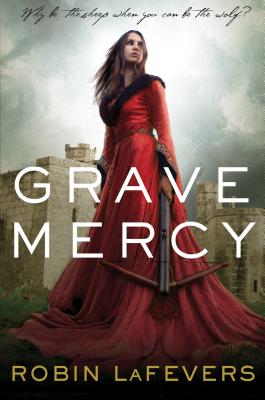
It doesn’t hurt that it has a pretty cover (or a catchy tagline), either.

It’s Brittany, 1485, and Ismae, our fair heroine, has been married off (at the paltry age of 14!) by her abusive father to a hulking brute of a man. Consigned to her fate, she is surprised when a series of herbwitches and priests save her, sneaking her off in the night. She ends up at the convent of St. Mortain, one of the old gods, where they worship Death.

And train the girls who are brought to them to be assassins.

Three years pass, and Ismae is ready to be sent off on assignments. She performs well, and so is thrown into something more grand and complex: court politics. She is sent off to keep an eye on Gavriel Duval, adviser to Anne, duchess of Brittany. Ismae is supposed to pose as his “cousin” (*coughcough*), and keep an eye on him; if he turns out to be a traitor, as the abbess and Count Crunard, a patron of the convent, suspect, then she is to kill him.

However, once there, Ismae discovers that court politics — as well as her heart — are much more complex than that.

I realized about 30 pages in that if Marion Zimmer Bradley’s Mists of Avalon and any Phillipa Gregory book had a love child, this one would be it. There is court intrigue, romance, fights, horse chases, desperate situations, historical trappings, sweeping European settings, all covered in a sheen of mysticism that makes everything sparkly.

In other words, quite awesome.

Stupid Fast

by Geoff Herbach
ages: 14+
First sentence: “This could be a dark tale!”
Support your local independent bookstore: buy it there!

I will say this up front: in spite of what you might think judging from the title and the cover, this is not a football book. Sure, the main character, Felton Reinstein, gets drafted to play football (which he hasn’t the first clue about), football actually plays a real minor role.

It is, however, a guy book. In fact, that’s the best thing about this book. Herbach knows guys, and gets the voice down: his sweatyness, awkwardness, quirks, confusion, lusts, and cluelessness scream 15-year-old Guy. Additionally, it works because Felton is so dang likeable. Even in his guyness, you want to know this kid.

It’s the summer before Felton’s junior year. He’s about to turn 16, and his growth spurt (starting around Thanksgiving) has finally hit him: he can’t keep up with his body. That said, he’s, well, stupid fast. Which means he can actually do things in the sports arena, something which he never could do before. He almost beat the track star before nerves got to him. And so, he gets recruited to play for the football team. He has no idea what he’s doing, but it feels good to get out and work his body out. Especially since his home life has been falling apart at the seems.

See, his dad killed himself when Felton was five (Felton had the unfortunate experience of finding him), and his mother, Jerri, has been holding it together. Until this summer: now she’s slowly falling apart. Well, maybe not so slowly. She went from loving mom to calling Felton a jerk and a f-bomb-er, and spending her days in a dark room watching TV and sleeping. Felton has a way out, but his younger brother Andrew is suffering.

It sounds dark, but trust the first sentence: while it’s tackling some tough issues, it never becomes an issue book. It’s really just about Felton and his ability (or lack thereof) to deal with all the changes in his life. The ending does wrap things up a bit nicely, but instead of being happy, it’s more hopeful: that maybe Felton, in spite of all the crap around him — because, after all, he’s a nice guy — will will make everything work out for the best.

Goliath

by Scott Westerfeld
ages: 12+
First sentence: “‘Siberia,’ Alek said.”
Support your local independent bookstore: buy it there!
Others in the series: Levithan, Behemoth

When we last left our fair heroes, Deryn and Alek, they had helped the revolution against the Ottoman Empire succeed, and prevented them from entering the Great War. Now the crew of the Leviathan is headed for Siberia, to pick up some unusual cargo — inventor Nikola Tesla, who claims that his invention, Goliath, can bring the Great War to an end, once and for all.

Of course, there’s still the problem of Deryn being a girl and Alek thinking she’s a boy, and plus she’s in love with him and he’s a prince and she’s a commoner. So, of course, there will be stickiness when he finds out.

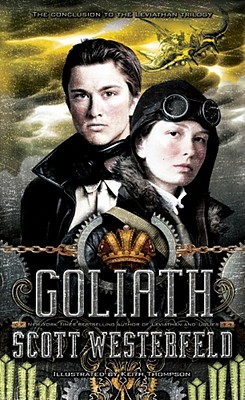
Like the previous two books, Goliath is many things all at once: action-packed, filled with battle scenes and daring escapes and cool contraptions; gorgeous, with Keith Thompson’s art elegantly complimenting Westerfeld’s words. I have to admit flipping through the book to look at the pictures, just so I can see them before reading the words so I can figure out what the heck is going on. It’s a bit of a love story this time around as well, and even though Westerfeld doesn’t have the swoon-worthy prose of, say, Maureen Johnson, he does fairly well keeping a balance between Deryn and Alek’s friendship and their budding love. (Though I have to admit here that one of my favorite characters was Alek’s perspicacious loris, Bovril. He was awesome.)

It has a wider scope than the previous two books, as the Leviathan basically circumscribes the world, going from Siberia to Japan to California through Mexico to New York. It’s almost as if Westerfeld felt like he couldn’t leave any part of his new steampunk world untouched. It kind of felt forced, though I do get the historical implications; he was, after all, just following the path that the actual World War I took.

Even with that criticism, it was wonderful to follow Deryn — who is really one of those awesome, cool, capable heroines you just have to cheer for! — and Alek’s — who has really grown on me over the trilogy — story come to a good end.

And you can’t ask for more than that.

Liar’s Moon

by Elizabeth C. Bunce
ages: 14+
First sentence: “I’d have gotten away if that little guard hadn’t cracked me in the eye.”
Support your local independent bookstore: buy it there!

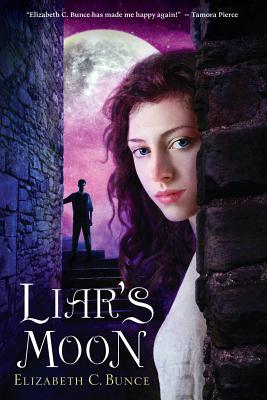
When we last left our fair Digger/Celyn (if you really don’t want spoilers for Starcrossed, you ought to read that one first and then come back), she had survived the winter snowed in at a remote mountain castle, and helped rescue a prince and incite a rebellion against the ever-increasing militant state of her country and town. Now she’s back in Gerse, doing what she does best: thieving. She never expected to get caught, let alone thrown in jail with Lord Durrell, who’s in there as the main suspect in his wife’s murder. Digger gets enlisted to do the other thing she does best — digging — in order to prove Durrell’s innocence. Along the way, she finds herself in possession of more than one secret she wishes she didn’t have. Ones that people may do everything in their power to keep hidden.

Much like the first book in this series, it’s easy to get lost in Digger’s world. For starters, she’s a fascinating, complex character, full of both flaws and virtues. She’s smart, clever, and strong, as well as loyal enough to go out on a limb for her friends. It’s amazing to sit back and watch her do her stuff.

In addition, this one reads like a historical fantasy mystery novel: if Durrell is innocent (and is he really?), who did kill his wife? And what about all the mysterious goings on with both Durrell’s family as well as his wife’s family? Not to mention the rebellion… The book has a different feel than Starcrossed — grittier is the first word I can think of — and yet is just as rich and engaging and thrilling (and full of swoon-worthy heroes, though I missed Prince Wierolf) as the first book. (Though you do need to read Starcrossed before you read this one. Then again, why wouldn’t you?)

And then there’s the twist at the end: some you saw coming, but the very end… completely out of left field in a most delicious way. I can’t wait to see what Bunce does next with Digger and this world.