Throne of Glass

by Sarah J. Maas
ages: 14+
First sentence: “After a year of slavery in the Salt Mines of Endovier, Celaena Sardothien was accustomed to being escorted everywhere in shackles and at sword-point.”
Review copy provided by my place of employment
Release date: August 7, 2012

At first glance, this should be a great fantasy novel. A strong, but not exactly noble, heroine (is there an assassin theme this year?) is put up against twenty three other people (Hunger Games!) in competition for the spot to be the king’s Champion (i.e., heavy) and win her freedom.

Of course she’s Beautiful, Desirable, Awesome, Cool, Flawed, Intelligent, Perfect, and both the prince and the Captain of the Guard is in love with her. (Or so I assume; I never actually got to that point.)

It has Everything a Woman Fanasty Reader wants, right?

Well, there is one problem: the writing is crap.

Sorry. I suppose I should beat around the bush, and I do have to admit that it may be me, not the book, but honestly I had no patience for this (all from the ARC, so maybe the editing will get it together in the next month…):

“She curtsied, looking up at him beneath lowered lashes.” (*eye roll* I understand she’s playing a part, here, but this is just lame.)

“She actually did trip on her dress, and her shoes cut into her heels quite terribly, but he would hear none of her objections as he dragged her into the hall.” (Blah blah blah. There were a lot of instances like this, where I just wanted to say: Really, we don’t need to know how many buttons are on her dress, or whether or not her heels hurt terribly. Get. On. With. It.)

“‘Save it for the competition,’ he said softly, but not weakly.” (SERIOUSLY??? Why does “softly” imply “weakly”? Why do I care?)

“Ahead, Cain turned a corner, heading north — back toward the castle. [repetitive] Like a flock of birds, they followed him. [What have they been doing up to this point?] One step after another, never slowing down. [I didn’t think, giving the previous two sentences, that they had been slowing down.] Let them all watch Cain, let them plot against him. [Okay then: she switched Point of View here, didn’t she?] She didn’t need to win the race to prove she was better — she was better without any kind of validation that the king could give her! [You keep telling yourself that, dearie.] She missed a breath, and her knees wobbled, but she kept upright. The run would be over. Soon. [Not soon enough.]”

There were more, but that pretty much gives you an overview of my irritation. I know that by reading so many middle grade and young adult fiction books, my patience with plotting and wordiness has become limited. But, this was egregious even for a crossover novel (was it supposed to be teen? Adult? I never did figure that out).

So, I bailed. The romance(s) were moving too slowly for me (too much simpering, not enough smouldering), the author kept telling me rather than showing me stuff, and the whole plot was taking way. too. long.

One other note: this author has a huge fan base [don’t shoot me!], and has written several on-line prequels leading up to this novel. I don’t think reading on-line fiction should be a prerequisite to enjoying a novel, and yet I felt that I was missing something when reading this one. Yet another reason I bailed.

But I’m sure some people will luuuuuvvvv it.  Just not me.
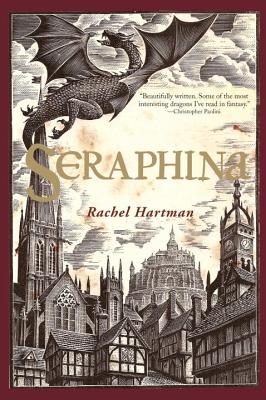
Seraphina

by Rachel Hartman
ages: 13+
First sentence: “I remember being born.”
Support your local independent bookstore: buy it there!
Release date: July 10, 2012
Review copy provided by my place of employment.

I should get the gushing out of the way first: I have read books about dragons, some of which were really clever, but I have never seen dragons like this.

And that blew. me. away.

I have struggled with how to sum this novel up, but am completely at a loss. There is so much going on, much of which is best left to be discovered as you go, that a summary is almost impossible. This is what I can tell you: the main character is Seraphina, a sixteen-year-old assistant chief musician in the castle. Except she has a secret, one that will cost her her life if revealed. The country is Goredd, which has been at peace with the dragons for forty years. It’s a tentative peace, one which is hanging by the slimmest of threads. There is prejudice against the dragons rampant in the populace of Goredd, a fire that is barely constrained. And so when Prince Rufus is found beheaded, it’s everyone’s — from the military down to the common people — assumption that the dragons did it, and there are people calling for blood.

And then there are the dragons. They walk among the humans, as humans: learning, teaching, advising, observing. Granted, they stand out to the humans; dragons are more rational, less emotional, mathematically minded, and not at all spontaneous. But, even though they are differences, it’s their ability to mimic humans that is the root of all the prejudice and terror in Goredd.

Really, that’s all you need to know to start. Know this as well: this is an excellent first novel. It’s a rich, rich world that Hartman has created, full of religion, politics, romance, music, and action. And while it works as the start of a trilogy, it also stands on it’s own, bringing the story arc to a satisfying conclusion, while leaving threads open to pursue in later books.

But really, read this one for the dragons. You’ll never see them like this again.

Crossed

by Ally Condie
ages: 12+
First sentence: “I’m standing in a river.” 
Support your local independent bookstore: buy it there!
Others in the series: Matched

I’m not quite sure how to do this without giving too much of Matched away, so if you’re one of the people in the world who haven’t read it, you might want to skip this.

Cassia and her True Love, Ky, have been separated, but Cassia’s not going to let that stop her. She gets herself reassigned to the Outer Provinces, in hopes of tracking him down; he was sent there as a result of a sort she had done earlier. In the meantime, Ky is doing his best to survive, and when he finally lands in the village he was from, he sees his chance, and with a couple others, takes it.

Eventually, Cassia and Ky meet up (was there any question that they would, really?), and find their way — with their hangers on — through the caverns of the Carving to something resembling safety: the Rising, or rebellion.

In some ways, this was less pedantic than Matched: instead of treading the same old dystopian line, Condie is expanding her world, showing bits and scraps of the Society, its founding and what it’s capable of. It’s also interesting to get things from Ky’s perspective; in many, many ways he’s a more interesting and complex character than Cassia is. I appreciated knowing his history and motivations, things we weren’t given in Matched.

But there’s still so many unanswered questions, so many loose threads at the end of the book. It makes you curious, but at the same time impatient for answers. And even with all the loose ends, this one is less gripping than Matched.  Too many moments of Ky and Cassie either pining for one another, or staring into each others’ eyes once they do meet back up. Gag. There has to be more to a plot than Romance, right?

So. I don’t know if I’ll scramble for the next one, waiting for it to come out with baited breath. But it wasn’t a complete waste of my time. 

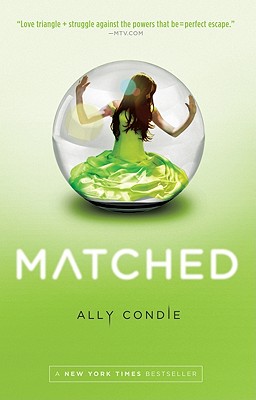
Matched

by Ally Condie
ages: 12+
First sentence: “Now that I’ve found the way to fly, which direction should I go into the night?”
Support your local independent bookstore: buy it there!

I’m probably the last person on earth to read this, which is part of the reason why I’ve avoided it for so long. (You know me and my hesitance to read popular books…) I figure something that popular couldn’t be that good. Right?

Well, in some ways yes: perhaps it’s because I’m immensely tired of dystopian books, but it seems as if this one doesn’t really cover anything new. A perfect society, headed by a controlling government? Check. A person who, after years, realizes that the society and perfection isn’t all it’s cracked up to be? Check. A love triangle? Check. Lots and lots of set-up for the next in the series (because none of these can be stand alones)?  Check. It was all very run-of-the mill.

And yet, I enjoyed the world that Condie had built: while she never explained the demise of the society, she did manage to convey the loss of history, of tradition that is so important in a diverse culture. I liked Cassia and Ky and even Xander as characters, and liked that Condie didn’t make anyone out to be truly malicious. In a sense, everyone in the book was just a cog in the system, which in itself is unique.

It’s enough to make me curious about the second book, and I’ve got it sitting in my pile for the weekend. That said, I don’t think it’s the best, or even most original, dystopian tale out there.

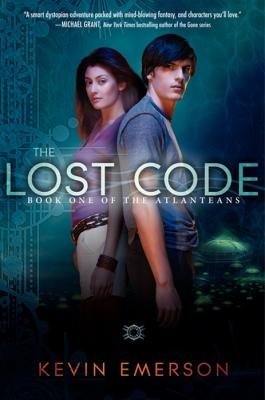
The Lost Code

by Kevin Emerson
ages: 12+
First sentence: “The morning after I arrived at Camp Eden, I drowned for the first time.”
Support your local independent bookstore: buy it there!
Review copy provided by the author, whom I met at KidLitCon 2011

Owen is not what you’d call the outdoorsy type. Growing up in the Hub — the caves where people live in the outer reaches of the society — he never really had a chance to go outside, to get much exercise, to enjoy nature. Sure, much of this has to do with the radiation levels from the depleted ozone. But, it’s also because that’s not exactly the person Owen is. So, when he gets a chance to go to Camp Eden — a nature preserve inside a dome that protects the world from the radiation — he takes it. Even if it seems like something he wouldn’t do.

Once there, weird things start happening: he drowns, but doesn’t die. He grows gils, he discovers a secret society. And the people who are supposed to be protecting him and the other campers turn out to be something more… sinister.

The thing that this book really has going for it is that it’s a unique combination of dystopian and fantasy: the world that Emerson builds is clearly dystopian: there’s talk of radiation leaks, and technology that has enabled people to be frozen and reawakened later. But, it’s also fantasy: the evolution of gils, and the set-up of a quest that involves Owen and some friends he makes at camp are clearly not in the realm of the possible. In addition, it’s got that summer-camp feel to it: there are typical power dynamics and interactions (including a romance) that could fit in any YA novel. It truly is a unique hybrid of styles.

Unfortunately, though, it’s all set-up, and it does take a long time to get to where the action really begins. There are a lot of questions, and while many of them are answered by the end, it almost takes too long to get there.

Still, it’s an intriguing enough beginning to make me curious as to where the series will go.

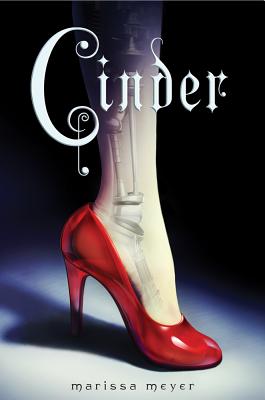
Audiobook: Cinder

by Marissa Meyer
Read by: Rebecca Soler
ages: 12+
Support your local independent bookstore: buy it there!

Cinder is a cyborg — part human, part machine — which puts her at the fringe of the New Beijing society. She’s just a mechanic, even if she is a good one, and just barely tolerated by her stepmother and stepsisters. (Well, one of her stepsisters, Peony, is her friend. The other, not so much.)

Then, once day the crown prince Kaito shows up at her booth, dragging an android that needs to be fixed. And Cinder’s world — for better and for worse — is changed forever.

I should get this out of the way for all of you who haven’t read it: yes, this is a first in the series. I somehow missed this fact, and so by the end of the book, when it was clear that it wasn’t going to be wrapped up in one story, I was pretty frustrated. I think, if I had known this would go on longer, I would have been less impatient with the story.

Because, really: it took too long to tell. I know it didn’t help that I figured out the twist a little ways into Book 2, but really: this story could have been told sufficiently in one book; making it a series just felt forced to me.

That said, there were elements I did like: I liked Cinder’s android friend, Iko, and Cinder’s relationship with her. I liked Cinder, and the way her cyborg elements helped, enhancing her as a character. I liked the doctor (I don’t remember his name; since I listened to it.), and his role in the story. I liked the world that Meyer built: part dystopian, part fairy tale. I did like the way she was morphing the Cinderella story into something else: the basic elements were still there, but melded quite well with the world that Meyer created. I loved the reader: she was brilliant, and her reading made the story pop.

I guess, in the end, the positives of the book outweigh my frustration at the story taking too long to tell.

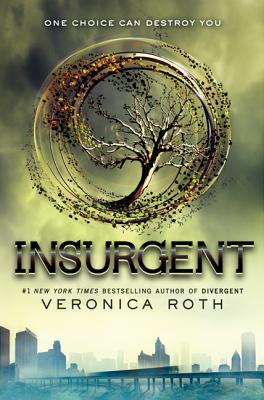
Insurgent

by Veronica Roth
ages: 14+
First sentence: “I wake with his name in my mouth.”
Support your local independent bookstore: buy it there!
Others in the series: Divergent

(Warning: if you haven’t read Divergent, go do that now. There will, obviously, be spoilers for Divergent in this review.)

Tris, Tobias and their friends are on the run. After successfully — sort of — stopping the Eurdite faction and their plan to exterminate the Abnegation faction, and the city government, they’re hiding out, regrouping. Their faction, Dauntless, has all but dissolved: half have defected to Eurdite, basically becoming their thugs, the other half is hiding out in the Candor faction. Then there’s the “factionless”: those without a place to belong. In this fight which pits Knowledge and Brawn against Truth and Selflessness, it seems those whom everyone has been ignoring are suddenly quite important.  But the important thing is this: Tris and Tobias (and their friends) make their way through most of the factions, assessing and trying desperately to figure out what Jeanine (the leader of Eurdiate) wants so badly with the Divergent, so badly that she will kill for.

The action picks up immediately where Divergent leaves off which is both a strength and a weakness. A strength because for this story, there isn’t a need for months in between plot lines. The action is too intense, too immediate for that. And Roth finds a way to build on the ideas of Divergent, taking the plot lines in intriguing directions. The weakness comes if you, like me, haven’t read Divergent immediately proceeding. Roth wastes no time on exposition, no time on explanations: if you don’t know what’s going on, tough luck.

That said, she does weave bits of information into the chapters, enough so that I was able to remember the basic story of Divergent by the time I was half way through. (It’s just getting to that point!) But, eventually, this story kicked in, and I no longer needed past information — admittedly, I did get tired of Tris and Tobias’s clandestine smooching, which lacked both intensity and passion — to carry my interest. The story is very much a middle-of-a-trilogy: things need to happen, pieces need to move, revelations need to come out (though, honestly: I felt the Big Reveal was a bit forced), in order for the story to move forward. There’s a lot of running around from faction to faction (on the plus side: you get to see the insides of all the factions), recruiting people, trying to understand what the Ultimate Purpose is here. Much like Katniss, Tris spends the book trying to recover from Bad Deeds She Did, though she’s a much more pro-active character than Katniss is. However, everything seems too cut-and-dried, too much like jumping through hoops. I wanted there to be more surprises. (There were a few; Roth, I think, revels in making characters who will do both “good” and “bad” things, within the space of a few chapters.)

I’m not sure it’s as good as Divergent was, but since it left us on a bit of a cliff-hanger (Roth does know how to write an ending!), I’ll have to leave my ultimate judgement until the next book comes out.

The Girl of Fire and Thorns

by Rae Carson
ages: 13+
First sentence: “Prayer candles flicker in my bedroom.”
Support your local independent bookstore: buy it there!

Elisa is the younger sister in the royal family of a smallish country. The only thing that marks her as different is that she’s the bearer (the first in a century) of the Godstone, a jewel in her navel. She has no idea what her “service” is supposed to be, but she does know that it will require something of her.

So, when she’s married off to a king of an adjoining country on her sixteenth birthday, she figures it’s the first step in her destiny.

Little did she know what that would mean.

There really is so much to like about this book. It does start slowly; Elisa with her eating issues and insecurities are quite hard to like. But, as the book goes on, she warms on you: it’s truly a book about growth, about Elisa figuring out how to come into her own. And it’s a pretty amazing journey. I enjoyed that the book was religious in its own right. Elisa sees herself as a servant of God, and there’s some interesting implications and conflicts that arise from that belief. It’s a richly detailed world, Spanish-influenced, but one in which the world doesn’t overpower the characterization, a remarkable feat in itself.

I also have to admit (slight spoiler here) that I’m happy that while there is a bit of romance (she does get married in the opening chapter, after all), Elisa manages to find a way to be strong and self-assured without having to be on the arm (or in the arms) of some boy. Sure, she’d like to be desired, but in the end, a boy is not necessary. Good message, that.

All of which means I’m quite interested to see what Carson comes up with next.

Reread: The Hunger Games

by Suzanne Collins
ages: 12+
First line: “When I wake up, the other side of the bed is cold.”
Support your local independent bookstore: buy it there!
Others in the series: Catching Fire, Mockingjay

I caught the Hunger Games hype early (not as early as some, but earlier than others), reading it a few months after it came out. And because I did, I mostly just linked to others’ reviews, and gave you my thoughts. I haven’t picked the book up since then (though I did read the other two), though I did go see the movie the weekend it came out with C and M.

Then, it was our choice for our mother-daughter book group, and we decided to go with this one. I couldn’t pass up the chance to read it again.

First off: it lives up to a second reading. (I was actually worried about this.)

So, if you have been living under a rock, the basic plot is this: it’s sometime in the distant future, and the US has dissolved into a country with a capitol and 13 districts. Then, at some point, the districts rebelled against the domineering capitol. Except that they were defeated — the 13th obliterated — and the other 12 were made to give one girl and one boy as “tributes” to the Hunger Games: a contest of survival, where the winner is the last one left alive.

Katniss lives in the poorest of the districts, 12, and she’s making it by. Her father was killed in a mine accident, and she’s been single-handedly keeping her family — her mother, and her younger sister, Primrose — alive. So, when at the Reaping (when they choose the tributes), Primrose’s name is called, Katniss does the only thing she can do: volunteer to go in Primrose’s place. She’s off to the 74th annual Hunger Games.

I’ve heard Katniss called a strong heroine, and after this reading, I’m not sure I agree. Don’t mistake me: she’s a survivor. She will do anything to make sure she keeps herself, and those she loves, alive. It’s her sole purpose in life. But I’m not sure she’s a strong character, someone who takes charge, who’s proactive about herself and her future. No, she’s more a reactive type, someone who deals with situations thrown at her. Which isn’t bad, but that doesn’t mean she’s strong, in the typical sense.

The second thing I thought of is that all the hype about Team Peeta and Team Gale is really quite misguided. Sure, there’s romance, but really: Katniss is too busy surviving to really pay much attention to the boy, and while we think Peeta likes her, we’re getting everything warped from Katniss’s point of view. I like those who say they’re Team Katniss, because honestly: there’s just too much going on in her world for her to spend time on a luxury as romance.

But, overall: worth the reread. It’s still a book I’d recommend to people, as a commentary on reality television, on the hoplessness of war. It’s tight, action-packed, and still unputdownable. And you can’t beat that.

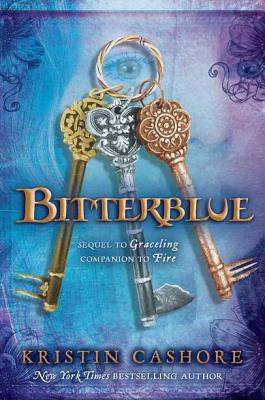
Bitterblue

by Kristin Cashore
ages: 13+
First sentence: “When he grabs Mama’s wrist and yanks her toward the wall-hanging like that, it must hurt.”
Support your local independent bookstore: buy it there!
Others in the series: Graceling, Fire

First: If you haven’t read Cashore’s previous two books, you should. Seriously. Like, right now.

I’ve been waiting three years for this book. Three years of following Kristin Cashore on her blog, waiting patiently, hoping that Bitterblue will be as wonderful as Graceling and Fire are. So, obviously, my expectations were high.

It’s eight years after the death of Bitterblue’s (completely insane, cruel, wicked, evil, horrible, terrible, there-isn’t-a-word-strong-enough-to-describe-his-atrocities) father’s (justifiable) murder. She’s been queen since she was 10, surrounded by advisers that her uncle (the king of Lienid and Po’s father) picked. She’s been moving paperwork, treading water. And now, she’s beginning to wake up, for lack of a better word. She wonders what goes on outside of her castle, and starts sneaking out at nights. There she learns that she’s not the only one who is having trouble putting Leck’s atrocities behind her. It’s all over the kingdom: her people are not well people, and those who are searching for truth are being harassed and murdered. However, realizing this is not the end of the story: it’s only the beginning. This book is very much one of healing, of getting past a tyrant (a mild way to put it) and his terrible past, and finding a new path of Truth and Justice, while acknowledging that the abusers were in so many ways victims, too.

When I logged that I read this one on Goodreads, I started scrolling through the reactions of people there, and I discovered two things. One: you’ll either love or hate this book. Two: It seems to me that the complaints boil down to just a couple things.

First: there isn’t enough Katsa and Po, and they’re different. True, Katsa and Po aren’t the main characters of this book, but they do play a role. (Also: of COURSE they’ve changed. It’s been eight years people!) In fact, sometimes I felt that Po was too much of a fallback for Bitterblue, and I was actually glad the times in which he wasn’t around, and Bitterblue was forced to do things on her own. That said, there are really two storylines going on here, and our heroes from Graceling do play a major part in the second one. Also: Bitterblue’s romance isn’t full of chemistry, but is rather a slow one, in which they are friends first. However, it’s also not one that can go anywhere. That said, my favorite character was Giddon. I don’t remember him well from Graceling, but I adored him in this book. He was such a rock, such a kind, good-hearted individual, that I couldn’t help like him.

Which brings me to point number two: Cashore is so heavy on women that she doesn’t cut men a break. (Though one person said they didn’t like the way Cashore treated women, and to that I have no answer… REALLY?) I don’t understand this. There are strong women in this book, strong men and weak men and traitorous women. It’s all there. One of the things I think Cashore does best is portray the spectrum of human possibility: it’s possible for people to lie for good reasons. It’s possible for people to be in love and fight. It’s possible to trust people and then be betrayed. It’s possible for healing. It’s possible to find good women and men to surround oneself with.

Complaint three: it’s long, boring, complex, confusing. Well, yes. I think that’s done on purpose: Bitterblue is confused — warped by her father’s actions, which still have a hold on her, her advisers, and the country — trying slowly to work things out, and we see events through her eyes and memory. It’s not an easy process, and therefore to have a straightforward book would not do Bitterblue and her story justice. It’s very much like Chime in this: Bitterblue is not always the most reliable narrator, because she doesn’t have all the pieces, but to tell the story any other way would lessen the impact of the revelations at the end.

I’ve blathered on too long. The short version of all this: Bitterblue is excellent. One can only hope that Cashore doesn’t take three years writing the next book. I need her stories.