by Jessica Day George
Speculative Fiction
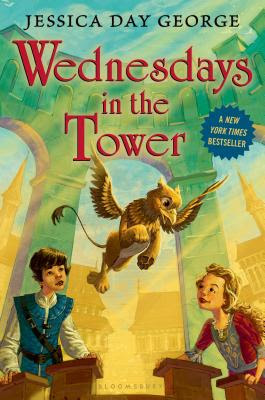
Tuesdays at the Castle
by Jessica Day George
ages: 9+
First sentence: “Whenever Castle Glower became bored, it would grow a new room or two.”
Support your local independent bookstore: buy it there!
Eleven-year-old Princess Cecilia — Celie to her family and friends — loves living in Castle Glower. She’s made it her job to know all the nooks and crannies and shortcuts, from the long-established ones, to the ones that crop up periodically. See, Castle Glower is definitely magical, and may be alive: it has opinions about the residents there (the state of your rooms is a definite indicator of its opinion of you), and chooses the person who would be best to rule the castle. Everything is grand at Castle Glower.
That is, until the King and Queen leave to pick up their oldest son from the Wizard College, leaving Celie and her two older siblings — heir apparent Rolf, and sister Leliah — in the care of the castle. Unfortunately, the royals were attacked, and presumed dead. Suddenly, the council and neighboring countries are all over the Castle, supposedly “helping” Rolf take the throne. But the castle hasn’t changed the rooms; perhaps their parents aren’t dead after all? It’s a lot to take in, and that’s not even mentioning the creepy Vhervhish prince that is overstepping his boundaries. It’s up to Celie — and the castle — to stop what may have been a tragedy from becoming a calamity.
It’s a cute and clever little book; I think the premise is the strongest part of the book, though I really liked Celie as a character. Sure, the plot was a bit rushed, and I thought that maybe things wrapped up too tidily, especially since this is being hailed as a “start of a series.” But then, I’m not the target audience, and I’m sure that younger readers and fantasy lovers will really enjoy this one. (I’m planning on reading it to A as soon as we get done with our current reading.)
Audiobook: The Wee Free Men
by Terry Pratchett
read by Stephen Briggs
ages: 9+
Support your local independent bookstore: buy it there!
I first read The Wee Free Men two years ago, and thoroughly enjoyed every bit of the time I spent with the book. It’s hilarious, adventuresome, cool, and Tiffany Aching, even when she’s just 11 years old, is a force to be reckoned with. There’s a power in her, a determination. I love that in this world, all it takes to be a witch is powers of observation and the knowledge that you’re the only one who can do anything about the situation.
There’s magic, of course, but it’s not flashy magic. It’s quite, subtle, and still there, even after you know how it’s done.
That said, I loved hearing this book read aloud. Even more so than when I read it. It’s fine reading it and all, but nothing — nothing! — is funnier than someone doing a spot-on Scottish accent for the Nac Mac Feegle. And the voice for Toad? So deadpan, so hilarious. I laughed. So hard. Often. And I actually got the section near the end when Tiffany goes up against the Queen; something which I remember eluding me when I read it. Perhaps because listening to it means I go through things more carefully than when I read them? Whatever it is, listening to the audiobook made this books so much more loveable and enjoyable than it already was.
Which means, of course, that I’m going to have to listen to the rest of the Tiffany Aching books.
Daughter of the Forest
by Juliet Marillier
ages: adult
First sentence: “Three children lay on the rocks at the water’s edge.”
Support your local independent bookstore: buy it there!
Sorcha is the seventh child and only daughter of Lord Colum of Sevenwaters. She’s led an idyllic childhood, for the most part (aside from her mother’s death with Sorcha’s birth, and her father’s unwillingness to show any affection towards her after that), in ancient Erin, playing and exploring with her brothers in the forest behind their home. Then, as she hits the cusp of adulthood, her father remarries an enchantress who, for various reasons, becomes jealous of Sorcha and her brothers. When, in a moment of spite she turns the brothers into swans, Sorcha is devastated. And, even more so when she finds out the only way to break the curse is to sew shirts of a thistle plant without speaking until she’s done. It’s not an easy task, and only the love she has for her brothers can see it through.
A grand, sweeping retelling of the Brother’s Grimm tale, The Six Swans, it has a little bit of everything: magic, faeries, and, of course, romance. It’s set in ancient Britain/Ireland, which allows Marillier to explore the tension between the old ways and the newer religion. A grand book.
When Kelly suggested this as a buddy read, I jumped at the chance. She has the first part of our conversation at her blog; come back and read the rest when you’re done!
—————
Melissa: I agree: when it’s done well, it’s a joy to read. And I thought Mariller balanced the fantasy and the history quite well. Have you read anything else by her?
Kelly: I have read Wildwood Dancing, which is a young adult novel that is also a fairy tale retelling. I quite liked it, so I am happy to have finally read something else by her. All of her books look really good, actually, and I even ‘collected’ her for a while because I just figured I was going to like her. I don’t have everything by her, obviously, because I have only actually read one book by her until this one. I think she is going to continue to be an author I enjoy. What do you think?
Melissa: I also read Wildwood Dancing, but I loathed it. Seriously. Which, I suppose, was part of my subconscious hesitation to read this one. But, I‘m glad I gave her a second chance; I liked this one a lot better. (And it’s unusual for me to like an adult book better than a YA one!) What did you think about the brothers, and the love triangle (of sorts)? Did it work for you?
Kelly: Really? I really like fairy tale re-tellings… They are one of my favourite parts of fantasy, so it is hard for me to find one I don’t like. I actually read a couple in the last few years that share the same fairy tale with Wildwood Dancing. Anyway, I really liked Connor. There was something compelling about him, but there were times near the end of the book where I was a bit shaken in that liking. Then, there was one conversation that he had with Sorcha and it made him appear better in my eyes again. I think that all of the brothers added something to the story and to their family. Do you mean Sorcha and her brothers as the triangle or Sorcha and the other two brothers?
Melissa: I generally like fairy tale re-tellings; I just had issues with Wildwood Dancing in particular. I liked Conor as well, though I’m not sure he was my favorite brother. I agree: there was a time near the end of the book when I wondered what he was doing. He was very out of character, and I’m not sure I quite bought the reasoning for it. I liked Sorcha’s relationship with Finbar at the beginning, and I found it interesting how the enchantment affected him. I liked Liam, as well; I felt he was a good eldest brother, fair and firm and yet loving. And I meant the love triangle with the British brothers. Did it work for you?
Kelly: I am not sure which brother was my favourite… Finbar was for a while in the beginning, but then he changed and I was never entirely sure what to make of him. He was a very brooding character. There were times where I felt really bad for him. As to the love triangle, I am not really sure. When it all played out, it seemed to make sense… And, I liked Red more than Simon. I think if the triangle wasn’t there it would have been a very different book and then I am not sure exactly how it would work out. I suppose it made sense for me and really, it was more the Fair Folk than the people themselves for a while there. Speaking of the Fair Folk, do you think the step-mother and the woman that constantly appeared to Sorcha really were the same people?
Melissa: Wow, I never even thought about that. Two sides of the same coin? I didn’t get that vibe, though I did feel like the step-mother was a part of the Fair Folk. I really liked Simon, for what it’s worth, though I can see the appeal of Red. I agree about it being a different book, though, without the love triangle. In this case, it made the book a better one. Anything else?
Kelly: I think the Fair Folk and her step-mother will be explained more in the second book. Then we will know if our thoughts are correct. See, I liked Red better. I knew that Simon would be upset, but Red was a more interesting character. Simon might have been, too, if the circumstances were different and we got to know him a bit better, but it is hard to say. I think that is most of the story covered without giving too much away. It was fun, though. I am glad we read this book together because otherwise I may never have got through it!
Melissa: Me, too; it’s always good to have extra motivation.
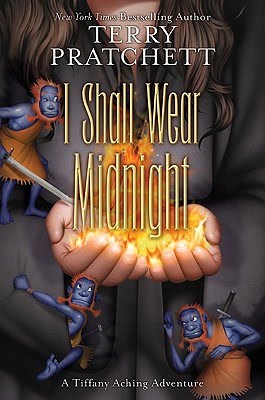
I Shall Wear Midnight
by Terry Pratchett
ages: 13+
First sentence: “Why was it, Tiffany Aching wondered, that people liked noise so much?”
Support your local independent bookstore: buy it there!
Tiffany Aching has discovered that she was a witch, gone through training, accidentally joined a dance she shouldn’t have and had to kiss the winter as a result. Now, she’s back at the Chalk, a sixteen-year-old girl, trying to manage her stead as a witch. It’s not going too horribly: she’s managing to get the things done that need doing. Until one day, things start to unravel. It began with a beating of a young girl by her father, and the rough music started. Then it morphed into something grander: Roland’s engagement to Letitia, daughter of an uppity Duchess, the Baron’s death, and a growing resentment and fear of witches. It turned out that Tiffany had accidentally let out something quite evil, something which, if left to roam, will result in the demise of all the witches. And it’s up to her to make things right again.
I know it sounds dark, and there are some dark moments, but this book is so wonderfully affirming, so incredibly hopeful, that it isn’t the dark bits that stand out. While it’s not as hilarious as some of the other books in the series, it’s still quite amusing. And Tiffany really, truly grows into her own. She has to give up some things, and learn some things, and make some difficult decisions, but she does it all. And she makes some new friends, looking past prejudice and bad first impressions to see that everyone is wonderfully more complicated and interesting that we give them credit for at first.
A perfect ending for an excellent series.
Mockingjay
by Suzanne Collins
ages: 14+
First sentence: “I stare down at my shoes, watching as a fine layer of ash settles on the worn leather.”
Support your local independent bookstore: buy it there! (Though you probably already have.)
NO SPOILERS. Promise.
Like Hunger Games and Catching Fire, this book is very unputdownable. Thankfully, I set aside the day to sit and read, otherwise I’d have been biting my nails and obsessing over the book. Better to get it all over with in one sitting.
And, for the most part, I really really liked the book. I liked what Collins did with Katniss, and the rebellion, and Gale, and especially Peeta. I liked the direction Collins was taking the books, the whole Katniss-as-Mockingjay thing. There were touching moments, some kick-butt moments, she kept me guessing as to where the plot was going, and she generally laid foundation work for something absolutely incredible to happen. There’s a lot of good anti-war stuff in there, how rebellions don’t always work right, how killing ourselves isn’t always the answer.
There are some things I wished she would have done: I missed Cinna, I wished Haymitch had more to do, I wished she had done something more with the District 13 government. Those were minor quibbles, though.
Because, the book fell apart for me. Completely and totally by the last 45 pages. There’s a moment near the end — and if you’ve read the book, you know where it is — where I was on the edge of my seat, disbelieving. However, in the pages that followed, Collins made choices — with characters, with the plot, with narrative — that completely derailed the rest of the book. It would have been so much better if… but it wasn’t. The whole ending was anticlimactic, and took the book in a direction that felt forced. I ended up feeling dissatisfied with the whole book, in the end. I’m not sure what I wanted, really, but it wasn’t the ending that Collins gave me.
Which, unfortunately, left me with a less-than-stellar reaction to the book overall. (And am I the only one?) And that’s too bad. Because it’s a great series: thought provoking and intense. I just wanted something better to end with.
Leviathan
by Scott Westerfield
ages: 12+
First sentence: “The Austrian horses glinted in the moonlight, their riders standing tall in the saddle, swords raised.”
Support your local independent bookstore, buy it there!
First, a disclaimer: I have never, ever heard of steam punk before this book, let alone read it. I had no idea what it entails, what makes a good steam punk book, or what even to expect.
But if this is even remotely typical of the genre, I’m hooked. It was an awesome, wild and weird ride, a fabulous adventure — no one writes nail-biting action like Westerfield — and a grand beginning to a story that has the potential to be absolutely amazing.
It’s 1914, on the eve of the Great War. Alek is a prince of the Austro-Hungarian empire and it’s the murder of his parents that sets off the war, as well as sends Alek on the run for his life. All he has with him is a few loyal men, and a Stormwalker in order to fend off the Germans. Deryn is a commoner, a girl, who desperately wants to fly in the British Air Service. Mind you, they’re not flying planes, but rather Darwinist living creatures — huge ecosystems of creatures that work together to get off the ground. Deryn disguises herself as a boy, and by a fluke or two of nature (ha!), ends up as part of the crew of Britain’s newest airship, the Leviathan.
Told in alternating chapters, the book details not Alek’s escape from his palace and Deryn’s entry into the air service, but their eventual meeting and the results of that meeting. As I mentioned before, there’s tons of nail-biting action from Alek’s initial escape to a couple of attacks by the Germans. But what I found most fascinating (and wild and weird) was the combination of historical fiction and futuristic elements, as well as a re-imagining of science. I loved the Clankers versus Darwinist feud, as well as each individual science. The clanker machines were awesome, powerful, and captivating to read about. But the Darwinist inventions — the wild cross-breeds, the machinations to keep them up in the air, the things (like flechette bats, for instance) that Westerfield created — were the things that kept me turning pages and shaking my head in amazement. What kind of imagination dreams this stuff up? (Well, Westerfield’s, of course.)
The book ends somewhat abruptly, but I’m totally sold: I want to know what happens next. I want to know what adventure Deryn and Alek are going to go on, and I want to know about the small mystery that’s part of the larger story.
The problem — like all books with sequels — is being patient until the next one comes out.
Wintersmith
by Terry Pratchett
ages: 12+
First sentence (not including the Nac Mac Feegle glossary): “When the storm came, it hit the hills like a hammer.”
I got this email from Laura from Life after Jane yesterday that I haven’t been able to stop thinking about. She says,
You never get just a story with Pratchett. You get life lessons and a unique way of looking at things. I’ve heard him called the Douglas Adams of fantasy fiction but I have to disagree. If you ever read any of the Hitchhiker’s Guide series you’ll notice that fabulous and witty as it is, Adams clearly didn’t like people. With Pratchett I’m always amazed how he can poke fun at the silly, pettiness of people while at the same time expressing a very real and warm love of them. I always finish his books feeling that he has a very profound point and that he really just adores everything and everyone.
I haven’t been able to stop thinking about it because she’s absolutely right. It’s the reason why his books are so delightful — even if they’re not quite as soaring as the other books in the series — why you find yourself laughing out loud or nodding in agreement: because Pratchett cares, and it comes across in the writing.
Like the other two books in the Tiffany Aching adventures, the plot really isn’t what matters. It’s the characters — in this one we have the Wintersmith and Roland, who are both infatuated with Tiffany, even if she’s not really that interested, and Nanny Ogg whom you just want to hug, as well as ones from the other books — and the little nuggets of wisdom or humor that are littered throughout. My mom said that she thought these were good “girl” books, but I’ll take it a step further: these are just good books.
And Pratchett is definitely a good writer.
Buy it at: Amazon, Powell’s or your local independent bookstore.
The Wee Free Men
by Terry Pratchett
ages: 12+
First sentence: “Some things start before other things.”
The Declaration
I found the premise of this book, by Gemma Malley, fascinating. It’s the not-too-distant future, 2140, and a drug — Longevity — has been developed that will extend life forever. It started out innocently enough; curing cancer, AIDS, other diseases… but eventually, someone discovered that cells could be regenerated, sickness cured, and no one would ever die.
The implications of that discovery, though, were profound. If no one ever died, and yet people kept having children, then… well, the Earth’s resources would be overwhelmed. Hence the Declaration. By taking Longevity, you forfeit the opportunity to have kids. Period. No discussions. Yet, some people still end up having kids, for one reason or another, and those children are called Surpluses. They’re illegal, they’re a burden on society. So, when they’re caught, they are stashed away in Surplus Halls, where they’re taught to become “Valuable Assets” to the rest of the Legal society.
That brings us to our main character, Anna. She’s a Surplus, living in Grange Hall since she was 3. She “enjoys” it; as much as she can “enjoy” anything. She’s a Prefect, in charge of a group of other Surpluses, she’s nearly 16, and working toward being a Valuable Asset. She’s determined to pay for her parents’ Sin of having her. That is, until Peter comes into her life.
Peter isn’t like the other Surpluses; for one, he’s lived on the Outside for 15 years, having only recently been caught. He doesn’t fit in. He doesn’t want to. He really only has one purpose: to rescue Anna from a life of being a Surplus.
Initially, I liked the set up — Surpluses as slaves, brainwashed into believing the things that the Head Mistress beats into them. The book is full of the ethical questions and the interesting implications of the choice for Humanity to live forever.
She remembered a time, when she was young, when energy was still plentiful and people thought that recycling was enough. Before islands started to be submerged by the sea, before the Gulf Stream changed Europe into the cold, grey place it was now, with short summers and long, freezing winters. Before politicians were driven to action because infinite life meant that they, not some future generation, would suffer if the world’s climate wasn’t protected.
Peter’s efforts to convince Anna to escape were interesting, too. How do you convince someone who had been so indoctrinated in something that the thing was wrong? How do you get someone like that to risk everything to escape into the Unknown? For three-fourths of the book, I enjoyed it, relished the ride. It was haunting, so close to what could be in real life. The Head Mistress, Mrs. Pincent, was brilliantly and chillingly cruel, at the beginning:
“Hit her,” ordered Mrs. Pincent, who was now walking towards her. “Make her know her Sins. Help her to learn from her mistakes and to understand what being a Surplus means. Make her see that she is unwanted, a burden; that every step she takes along these corridors are steps that she has stolen. Make her see that she is worthless, that if she dies no one will care, that in fact the world will be better off with her not trespassing on it. Make her understand all that, Anna.”
But on page 274, the book made, for me, a serious mistake: Mrs. Pincent got a backstory. One that was possibly supposed to make me feel for her, make me understand the gravitas of the decisions that needed to be made. Unfortunately, it just made me annoyed. It was so predictable. I thought the book saved itself a couple of pages later, but by the end, I was rolling my eyes. All the tension, all the chilliness, all the ethical implications were gone. Kaput. In short: the ending just didn’t live up to my expectations. It could have been so much better.
Which is too bad, since the rest of the book was quite good.