EMGSF Smallish Books

The Lonely Lake Monster
by Suzanne Selfors
First sentence: “Pearl smacked the alarm clock until the loud beeping stopped.”
Content: Nothing objectionable or difficult at all. My only problem is deciding whether or not it’s happiest in the middle grade (3-5) section or the beginning chapter book (grade 1-2) section. It could go either way.
Others in the series: The Sasquatch Escape

I really liked the first one of the series; and this was more of the same. It wasn’t bad; Pearly got to shine as her own heroine, saving her friend Ben from a lonely lake monster. She came up with and executed a solution on her own, which I was very proud of and grateful for. It just lacked substance, which is just me as an adult talking. It’s perfect for the target age group.

The Ghost Prison
by Joseph Delaney/Illustrated by Scott M. Fisher
First sentence: “For pity’s sake, get up, lad.”
Content: Lots of ghosts. Would sit in the middle grade (3-5) section of the bookstore.

This is a ghost story. For kids. It’s got (duh) ghosts, and kid-eating monsters, and atmosphere coming out the wazoo. Except, it wasn’t scary. At all. Even the twist at the end wasn’t a surprise. Perhaps it was because I am an adult, and it’d be terrifying to a 7-year-old. But, honestly? You want something scary? Read Coraline.

Mickey Price: Journey to Oblivion
by John P. Stanley
First sentence: “Every great adventure starts with a moment.”
Review copy sent to me for the Cybils.
Content: Seventh-graders being put in dangerous situations. But other than that, nothing. Would reside in the middle grade (3-5) section of the bookstore.

Mickey Price — confusingly telling this story to his kids when he’s older — is a seventh grader who gets chosen to be a part of a super-secret astronaut program in 1977. They get sent to the moon and Save The World. There’s science and math because, you know, they’re Useful. And I spent the entire book alternately wondering WHY this was in the Speculative Fiction category — was it because it’s unrealistic to send seventh graders into space — and wishing Stanley had gotten a better editor. Good idea, lousy execution.

(Just for the record: because this is a Cybils nominee, I’ve been asked to make sure y’all know this is my opinion only, and not that of the panel.)

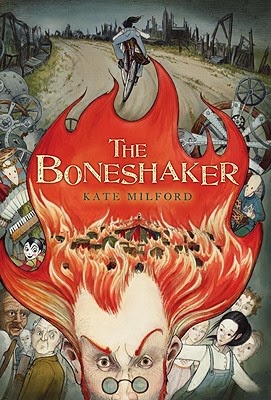
Audiobook: The Boneshaker

by Kate Milford
Read by: Erin Moon
Content: some intense moments (the Devil’s pretty scary), some violence, some disturbing images (if it were a movie). Language is probably suitable for someone reading on a 5th grade level. Has the feel of an older Middle Grade book, so I’d probably put it in the YA section (grades 6-8) at the bookstore.
Support your local independent bookstore: buy it there!

It’s 1914, and 13-year-old Natalie Minks has a pretty good life. Her father is the local mechanic — bicycle, mostly, but he’ll tinker with cars — and her mother tells the most amazing stories about their town, Arcane. Natalie herself has a predisposition for both: she loves tinkering with her father as well as listening to her mother’s stories.

Then one day Dr. Jake Limberleg’s Nostrum Fair and Technological Medicine Show comes to town. It was a fluke — their front wheel came off at the crossroads, and they decided to set up shop while they waited for Mr. Minks to fix their wagon. And that’s when the Trouble starts. Natalie, for better or for worse, is tuned into it and with her frienemy Miranda (I think that’s what her name was; I can’t look it up in the book!) and her trusty Chesterlane Eidolon bicycle (a bone shaker of an old thing that would be the fastest in the world, if Natalie could ever ride it), she decides to take on Limberleg and solve the mystery, saving her town. If she can.

I don’t know how I can write about the way this captured my attention. Sure, I was on a long drive to Austin, and it had my full attention anyway, but I didn’t want to stop listening. Milford has taken the idea of a Faustian Bargain — you know: those stories where a character meets the Devil and then outsmarts Old Scratch? — and elevated it. Not only is there two elements to this bargain, but we get historical elements thrown in as well. The traveling medicine show (I loved the Paragons of Science, even though they were Evil), the bicycles, the references to the “war” (which took me a minute to realize they meant the Civil War): it all added Atmosphere, which made the fantasy element, the bargains with the Devil at the Crossroads, that much creepier.

(It also helped that I kept thinking about this song:)

In short: a winner of a book.

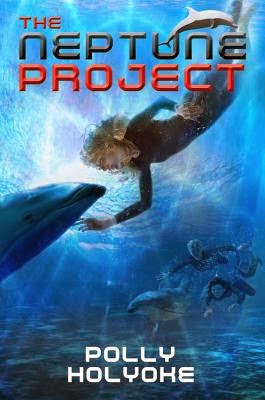
The Neptune Project

by Polly Holyoke
ages: 10+
First sentence: “I wake to an urgent tap at my window.”
Support your local independent bookstore: buy it there!

Nere Hanson (a terrible name, that, as A pointed out) has never understood why she felt more at home in the sea, with the dolphins. Her parents are scientists who study the ocean, but that’s not the whole picture. Nere has problems breathing on land, and it’s just getting worse. Then the government of the Western Collective (roughly some futuristic dictatorship that came out of the US; this is set along the Pacific coast) demands that everyone who lives by the ocean move inland, to help with “food production.” So, Nere’s mom pushes forward her plans, breaking the news  to Nere and her friends Robry and Lena that the reason why they struggle to live on land is that they’re genetically altered to survive — like breathe seawater and everything — under the ocean.

I’m going to stop here for a minute. I’ve read books about exploring the ocean as an option for when global warming takes over and turns this planet into one gigantic mass of water, and I’ve read books that deal with genetic mutation of people (and I think I’ve read one that combines the two in some search for Atlantis, now that I think about it), but this one struck me as unique. Holyoke has done her research and this one felt, well, authentic. I appreciated that. I also enjoyed her use of dolphins; they weren’t props, but rather their own characters, which added another interesting layer to the story.

After they make the change, and get away from the Marine Guard (read government thugs), Nere, Robry, and Lena have to figure out how to survive in their new environment. They meet up with another group of kids who have had this change done to them — Nere is resentful for a good part of the book because her mother did this to her, without her consent, and didn’t give her the time to adjust to this. I love Bad Mom Decisions in Middle Grade books — and set out for the rendezvous point. From there, they head north to Vancouver to the colony that Nere’s father is setting up.

Even though it’s a first in a series — I really would love a stand-alone speculative middle grade fiction book sometime — and it’s just an elaborate set-up, Holyoke does a fantastic job creating her world. And I liked the dynamics she created in the group. It wasn’t as middle school-ish as the jacket flap led me to believe, but a genuine portrayal of kids thrown in a new situation and forced to survive. And Holyoke isn’t afraid to kill characters off or have characters betray one another. It was complex, and I enjoyed that.

I only wish I had more of a sense of closure with this one; I’m not sure I’m all excited to read further adventures of Neve and the Neptune Project. But this one was definitely enjoyable.

(Just for the record: because this is a Cybils nominee, I’ve been asked to make sure y’all know this is my opinion only, and not that of the panel.)

The Blue Sword

by Robin McKinley

ages: 12+
First sentence: “She scowled at her glass of orange juice.”
Support your local independent bookstore: buy it there!

I first read The Blue Sword ages and eons ago. No, not when I was a kid, though I could have. It was soon after I first read Beauty by Robin McKinley (the book a friend gave me that I credit with my current love of YA). While I liked Beauty well enough, it was Harry Crewe and the country of Damar that I fell hard for.

Since I read this pre-blog, when I started it up, I wrote a couple sentences about my favorites. This one went like this: “The Blue Sword is full of adventure, magic, romance, swordplay… it would probably make a pretty good movie if anyone ever thought of it. It was an engaging book, well-written and the heroes were believable and interesting (there’s a lot of believable tension and chemistry between the two lead characters, which makes it fun).”

That doesn’t even begin to sum up the awesomeness that is The Blue Sword.

Harry Crewe is an orphan who has been shunted out to Damar, which lies on the outer reaches of the empire. She’s a ward of the regional head there, and is not happy about that. At all. Partially, it’s because she misses her parents, but mostly it’s because she’s unsettled. Unsatisfied. She never was the type of girl to sit still; she preferred riding and climbing to sitting and sewing. But, she’s supposed to be “proper” now, which means she looks wistfully out at the mountains, and wishes she could just do something.

Then Corlath, the king of the Hillfolk, shows up at the settlement. Nominally to try and make some sort of agreement with what they call the Outlanders, but that fails. Instead, he sees Harry, and his kelar — which is a kind of magic — demands that she come with him. So, he kidnaps her. Yes, it’s unsettling at first, but eventually she learns that the Hillfolk is where she belongs. She has the kelar, too, as strong as Corlath’s. And it becomes her Fate to be Harimand-sol, the lady Hero, and the first one since Lady Aerin to wield the Blue Sword in battle.

That’s the basic gist of it, but not the whole thing. McKinley, when she’s at her best, knows how to weave a good story. She pulls in amazing characters — my favorites are Jack Dedham, the career military guy with a soft spot for Hillfolk; and Narknon, the hunting cat that adopts Harry — and creates a vivid and detailed world but without all the exposition. She’s such a tight writer, such a gifted writer, that she’s able to do all this with a minimum of words, or without making it seem inaccessible or difficult.

In short: it’s brilliant. (And it’s more than 30 years old, without being dated in any way. That counts for a lot.)

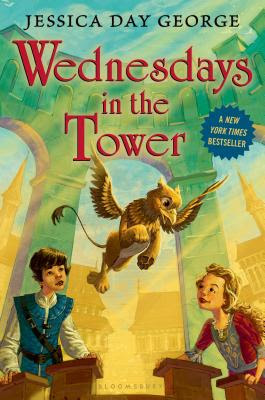
Wednesdays in the Tower

by Jessica Day George

ages: 9+
First sentence: “There are a lot of things that can hatch out of an egg.”
Support your local independent bookstore: buy it there!
Others in the series: Tuesdays at the Castle
Our fair heroine Celie has adjusted back to regular life after the events of the last summer, when she was forced to defend her castle against evil forces. She’s almost finished her almanac of the castle, which is something that makes her feel extremely proud. And she thinks she’s pretty much figured out all the castle secrets. Then, one Wednesday — a day when the Castle isn’t supposed to change — the Castle deposits a huge egg in a tower off of Celie’s room. And in the egg? A baby griffin.
That starts a chain of events that leads Celie (and her family) into a discovery of the true nature of the Castle. 
This is one of the most delightful follow ups to one of the most delightful books. I still adore Celie and her family (it’s not often you get a good family in a kids’ book). And I love how George managed to work both with the good family and around it. I thoroughly enjoy Celie as a heroine, as well, mostly because she’s not out kicking butt or saving the world, but rather just solving problems and defending the things that mean the most to her. 
And the griffin is pretty dang cute, too. 
It does end on a wee bit of a cliff hanger, which makes me wonder two things: 1) where the story will go next, and 2) if the title will be Thursdays in/at something….
I’m looking forward to it. 

Tuesdays at the Castle

by Jessica Day George
ages: 9+
First sentence: “Whenever Castle Glower became bored, it would grow a new room or two.”
Support your local independent bookstore: buy it there!

Eleven-year-old Princess Cecilia — Celie to her family and friends — loves living in Castle Glower. She’s made it her job to know all the nooks and crannies and shortcuts, from the long-established ones, to the ones that crop up periodically. See, Castle Glower is definitely magical, and may be alive: it has opinions about the residents there (the state of your rooms is a definite indicator of its opinion of you), and chooses the person who would be best to rule the castle. Everything is grand at Castle Glower.

That is, until the King and Queen leave to pick up their oldest son from the Wizard College, leaving Celie and her two older siblings —  heir apparent Rolf, and sister Leliah — in the care of the castle. Unfortunately, the royals were attacked, and presumed dead. Suddenly, the council and neighboring countries are all over the Castle, supposedly “helping” Rolf take the throne. But the castle hasn’t changed the rooms; perhaps their parents aren’t dead after all? It’s a lot to take in, and that’s not even mentioning the creepy Vhervhish prince that is overstepping his boundaries. It’s up to Celie — and the castle — to stop what may have been a tragedy from becoming a calamity.

It’s a cute and clever little book; I think the premise is the strongest part of the book, though I really liked Celie as a character. Sure, the plot was a bit rushed, and I thought that maybe things wrapped up too tidily, especially since this is being hailed as a “start of a series.” But then, I’m not the target audience, and I’m sure that younger readers and fantasy lovers will really enjoy this one. (I’m planning on reading it to A as soon as we get done with our current reading.)

Audiobook: The Wee Free Men

by Terry Pratchett
read by Stephen Briggs
ages: 9+
Support your local independent bookstore: buy it there!

I first read The Wee Free Men two years ago, and thoroughly enjoyed every bit of the time I spent with the book. It’s hilarious, adventuresome, cool, and Tiffany Aching, even when she’s just 11 years old, is a force to be reckoned with. There’s a power in her, a determination. I love that in this world, all it takes to be a witch is powers of observation and the knowledge that you’re the only one who can do anything about the situation.

There’s magic, of course, but it’s not flashy magic. It’s quite, subtle, and still there, even after you know how it’s done.

That said, I loved hearing this book read aloud. Even more so than when I read it. It’s fine reading it and all, but nothing — nothing! — is funnier than someone doing a spot-on Scottish accent for the Nac Mac Feegle. And the voice for Toad? So deadpan, so hilarious. I laughed. So hard. Often. And I actually got the section near the end when Tiffany goes up against the Queen; something which I remember eluding me when I read it. Perhaps because listening to it means I go through things more carefully than when I read them? Whatever it is, listening to the audiobook made this books so much more loveable and enjoyable than it already was.

Which means, of course, that I’m going to have to listen to the rest of the Tiffany Aching books.

Daughter of the Forest

by Juliet Marillier
ages: adult
First sentence: “Three children lay on the rocks at the water’s edge.”
Support your local independent bookstore: buy it there!

Sorcha is the seventh child and only daughter of Lord Colum of Sevenwaters. She’s led an idyllic childhood, for the most part (aside from her mother’s death with Sorcha’s birth, and her father’s unwillingness to show any affection towards her after that), in ancient Erin, playing and exploring with her brothers in the forest behind their home. Then, as she hits the cusp of adulthood, her father remarries an enchantress who, for various reasons, becomes jealous of Sorcha and her brothers. When, in a moment of spite she turns the brothers into swans, Sorcha is devastated. And, even more so when she finds out the only way to break the curse is to sew shirts of a thistle plant without speaking until she’s done. It’s not an easy task, and only the love she has for her brothers can see it through.

A grand, sweeping retelling of the Brother’s Grimm tale, The Six Swans, it has a little bit of everything: magic, faeries, and, of course, romance. It’s set in ancient Britain/Ireland, which allows Marillier to explore the tension between the old ways and the newer religion. A grand book.

When Kelly suggested this as a buddy read, I jumped at the chance. She has the first part of our conversation at her blog; come back and read the rest when you’re done!

—————

Melissa: I agree: when it’s done well, it’s a joy to read. And I thought Mariller balanced the fantasy and the history quite well. Have you read anything else by her?

Kelly: I have read Wildwood Dancing, which is a young adult novel that is also a fairy tale retelling. I quite liked it, so I am happy to have finally read something else by her. All of her books look really good, actually, and I even ‘collected’ her for a while because I just figured I was going to like her. I don’t have everything by her, obviously, because I have only actually read one book by her until this one. I think she is going to continue to be an author I enjoy. What do you think?

Melissa: I also read Wildwood Dancing, but I loathed it. Seriously. Which, I suppose, was part of my subconscious hesitation to read this one. But, I‘m glad I gave her a second chance; I liked this one a lot better. (And it’s unusual for me to like an adult book better than a YA one!) What did you think about the brothers, and the love triangle (of sorts)? Did it work for you?

Kelly: Really? I really like fairy tale re-tellings… They are one of my favourite parts of fantasy, so it is hard for me to find one I don’t like. I actually read a couple in the last few years that share the same fairy tale with Wildwood Dancing. Anyway, I really liked Connor. There was something compelling about him, but there were times near the end of the book where I was a bit shaken in that liking. Then, there was one conversation that he had with Sorcha and it made him appear better in my eyes again. I think that all of the brothers added something to the story and to their family. Do you mean Sorcha and her brothers as the triangle or Sorcha and the other two brothers?

Melissa: I generally like fairy tale re-tellings; I just had issues with Wildwood Dancing in particular. I liked Conor as well, though I’m not sure he was my favorite brother. I agree: there was a time near the end of the book when I wondered what he was doing. He was very out of character, and I’m not sure I quite bought the reasoning for it. I liked Sorcha’s relationship with Finbar at the beginning, and I found it interesting how the enchantment affected him. I liked Liam, as well; I felt he was a good eldest brother, fair and firm and yet loving. And I meant the love triangle with the British brothers. Did it work for you?

Kelly: I am not sure which brother was my favourite… Finbar was for a while in the beginning, but then he changed and I was never entirely sure what to make of him. He was a very brooding character. There were times where I felt really bad for him. As to the love triangle, I am not really sure. When it all played out, it seemed to make sense… And, I liked Red more than Simon. I think if the triangle wasn’t there it would have been a very different book and then I am not sure exactly how it would work out. I suppose it made sense for me and really, it was more the Fair Folk than the people themselves for a while there. Speaking of the Fair Folk, do you think the step-mother and the woman that constantly appeared to Sorcha really were the same people?

Melissa: Wow, I never even thought about that. Two sides of the same coin? I didn’t get that vibe, though I did feel like the step-mother was a part of the Fair Folk. I really liked Simon, for what it’s worth, though I can see the appeal of Red. I agree about it being a different book, though, without the love triangle. In this case, it made the book a better one. Anything else?

Kelly: I think the Fair Folk and her step-mother will be explained more in the second book. Then we will know if our thoughts are correct. See, I liked Red better. I knew that Simon would be upset, but Red was a more interesting character. Simon might have been, too, if the circumstances were different and we got to know him a bit better, but it is hard to say. I think that is most of the story covered without giving too much away. It was fun, though. I am glad we read this book together because otherwise I may never have got through it!

Melissa: Me, too; it’s always good to have extra motivation.

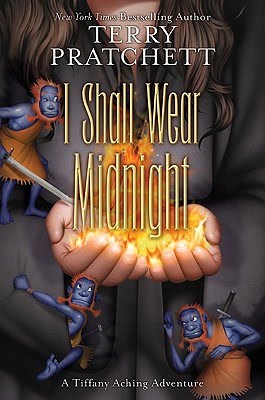
I Shall Wear Midnight

by Terry Pratchett
ages: 13+
First sentence: “Why was it, Tiffany Aching wondered, that people liked noise so much?”
Support your local independent bookstore: buy it there!

Tiffany Aching has discovered that she was a witch, gone through training, accidentally joined a dance she shouldn’t have and had to kiss the winter as a result. Now, she’s back at the Chalk, a sixteen-year-old girl, trying to manage her stead as a witch. It’s not going too horribly: she’s managing to get the things done that need doing. Until one day, things start to unravel. It began with a beating of a young girl by her father, and the rough music started. Then it morphed into something grander: Roland’s engagement to Letitia, daughter of an uppity Duchess, the Baron’s death, and a growing resentment and fear of witches. It turned out that Tiffany had accidentally let out something quite evil, something which, if left to roam, will result in the demise of all the witches. And it’s up to her to make things right again.

I know it sounds dark, and there are some dark moments, but this book is so wonderfully affirming, so incredibly hopeful, that it isn’t the dark bits that stand out. While it’s not as hilarious as some of the other books in the series, it’s still quite amusing. And Tiffany really, truly grows into her own. She has to give up some things, and learn some things, and make some difficult decisions, but she does it all. And she makes some new friends, looking past prejudice and bad first impressions to see that everyone is wonderfully more complicated and interesting that we give them credit for at first.

A perfect ending for an excellent series.

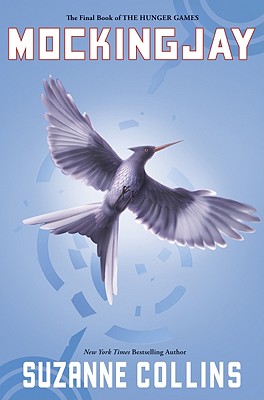
Mockingjay

by Suzanne Collins
ages: 14+
First sentence: “I stare down at my shoes, watching as a fine layer of ash settles on the worn leather.”
Support your local independent bookstore: buy it there! (Though you probably already have.)

NO SPOILERS. Promise.

Like Hunger Games and Catching Fire, this book is very unputdownable. Thankfully, I set aside the day to sit and read, otherwise I’d have been biting my nails and obsessing over the book. Better to get it all over with in one sitting.

And, for the most part, I really really liked the book. I liked what Collins did with Katniss, and the rebellion, and Gale, and especially Peeta. I liked the direction Collins was taking the books, the whole Katniss-as-Mockingjay thing. There were touching moments, some kick-butt moments, she kept me guessing as to where the plot was going, and she generally laid foundation work for something absolutely incredible to happen. There’s a lot of good anti-war stuff in there, how rebellions don’t always work right, how killing ourselves isn’t always the answer.

There are some things I wished she would have done: I missed Cinna, I wished Haymitch had more to do, I wished she had done something more with the District 13 government. Those were minor quibbles, though.

Because, the book fell apart for me. Completely and totally by the last 45 pages. There’s a moment near the end — and if you’ve read the book, you know where it is — where I was on the edge of my seat, disbelieving. However, in the pages that followed, Collins made choices — with characters, with the plot, with narrative — that completely derailed the rest of the book. It would have been so much better if… but it wasn’t. The whole ending was anticlimactic, and took the book in a direction that felt forced. I ended up feeling dissatisfied with the whole book, in the end. I’m not sure what I wanted, really, but it wasn’t the ending that Collins gave me.

Which, unfortunately, left me with a less-than-stellar reaction to the book overall. (And am I the only one?) And that’s too bad. Because it’s a great series: thought provoking and intense. I just wanted something better to end with.