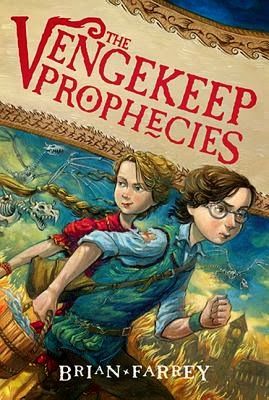
The Vengekeep Prophecies

by Brian Farrey
First line: “Even weeks later, I heard rumors that I had ruined the Festival of the Twins.”
Support your local independent bookstore: buy it there!
Content: Aside from the fact that Jax and his family are thieves — and  I suppose adults might have a problem with their kids reading that (though I don’t know why…), and maybe some scary monsters (depending on how sensitive your kids are; they’re not that scary) there’s absolutely nothing untoward in this book. Resides quite happily in the middle grade (3-5th grade) section of the bookstore.

Jax Grimjinx is a thief. He comes from a long line of thieves. It’s the family business, and has been for centuries. There’s only one problem: Jax is a bookish nerd, a klutz, and actually is quite a terrible thief. (Yes, it is his fault — this time — that the Grimjinx family ended up in jail.) Then a suspiciously convenient prophecy turns up, putting his family at the center as the Heroes. It predicts all sorts of Dire Perils for the town of Vengekeep, which start coming true. (It wasn’t supposed to: there really is no such thing as Lava Men.) There’s seemingly no stop to it. Until Jax with his bookishness figures out there might be a Way to break the prophecy. And it’s up to him — and his new friend, Callie — to go and get what is needed.

There’s so much to love in this book. Jax is a terrific character: a bookish kid (I love that he’s wearing glasses. I know it’s a little thing, but I do love it.), an unwilling hero, and yet he finds a way to outsmart the more Savvy characters and Save the Day. I love his relationship with Callie; none of that sappy romance stuff (I’ve decided that I don’t like romance in my middle grade fanatsy), but a good solid friendship that works. I love that it’s all plausible and that the “prophecy” isn’t something that’s set in stone, which gets old after a while. And the writing is tight; it kept me reading, turning pages, wondering what is going to happen next. I’m just glad the second one, The Shadowhand Convenant, just came out. Because I don’t want to wait to see what happens next to Jax and his family.

(Just for the record: because this is a Cybils nominee, I’ve been asked to make sure y’all know this is my opinion only, and not that of the panel.)

The Year of Shadows

by Claire Legrand
First sentence: “The year the ghost came started like this:”
Support your local independent bookstore: buy it there!
Review copy provided by the publisher for the Cybils.
Content: There are ghosts and shades and it gets pretty scary. There’s also a lot of pre-teen Angst and a little bit of romance. For those reasons, even though it’s in the middle grade (3-5th grade) section of the bookstore, I’d probably hand it to the older end of the spectrum. But that’s just me.

Olivia hates her life. Her father — whom she less-than-affectionately calls the Maestro — is wholly absorbed with being the conductor of their town’s struggling orchestra. So involved that Olivia’s mother left. So involved that they sold their house and auctioned off their belongings and moved into the back rooms of the concert hall in order to keep the orchestra afloat. And for 13-year-old Olivia, this does not sit well. In fact, she loathes it. (Understatement of the century.)

She’s miserable, she’s basically homeless, and then… she discovers there are ghosts in the concert hall. Not just ghosts, but shades — ghosts that have given up the search for the chance to move on and given into Limbo — as well. And it’s the shades that are Dangerous. And it’s up to Olivia and her new friend Henry to help the ghosts move on and defeat the shades. And, perhaps, in the process maybe they can figure out how to save the concert hall and the orchestra.

I adored this book for lots of reasons. Olivia was dark and grumpy and prickly and perfect for a ghost story. I loved the musical setting for this — the concert hall, the strains of orchestral music (it needs a soundtrack!) running through the story; in the endnote, Legrand talks about choosing pieces to fit the mood of Olivia’s life, and being familiar with many of the pieces, I think she did fabulously. (I don’t know how non-musical readers would react to it, though. Would it make them want to go look up the pieces?) I enjoyed Henry and some of the other minor characters, with their New-Agey feel and their support of Olivia. Because the Maestro? He’s firmly in the bad parent camp. He’s not a “abusive/horrible/evil” dad, but rather the “neglectful/unobservant” dad. And I can understand Olivia’s anger towards him.

There is one quibble: there’s a plot twist near the end of the book that I didn’t feel was absolutely necessary. (And which added to the Maestro’s bad parent-ness.) I think Legrand needed it for plot purposes, but it felt like it was out of left field, and didn’t quite fit with the rest of the book.

Other than that, though, it was highly enjoyable.

(Just for the record: because this is a Cybils nominee, I’ve been asked to make sure y’all know this is my opinion only, and not that of the panel.)
How to Catch a Bogle

by Catherine Jinks
First line: “The front door was painted black, with a shiny brass knocker that made a satisfying noise when Alfred used it.”
Support your local independent bookstore: buy it there!
Review copy off the ARC shelves at my place of employment.
Content: There’s a few mild swear words and some very intense moments. I’d put it in the middle grade (3-5th grade) section of the bookstore, but I’d be wary about giving it to a sensitive younger kid.

Imagine a Dickensian London, complete with orphans, pickpockets, unsavory doctors, toshers, and blackmailing landladies. And then add… bogles.

What are bogles, you might ask?

Well, it’s what our fair heroine, Birdie, and her master, Arthur, call the paranormal creatures that they get rid of for the people of  London town. Not everyone believes in them, but Arthur and Birdie know one thing: if there’s children disappearing, it’s most likely a bogle.

(I’ll let you read the book to find out how to catch them, though.)

There isn’t much plot to this one in terms of plot; Birdie and Arthur catch bogles until they meet a woman of Society who decides that bogle catching is an unsuitable occupation for a girl. (Birdie objects.) They catch more bogles until things become Sufficiently Dangerous (that’s when the unsavory doctor comes in). There’s a bit of excitement, a kidnapping, and some hauntings before it’s all over. No, this one’s mostly about atmosphere. It’s a dark book — bogles are not nice creatures — and very  much the dirty London of Dickens’ time.

I loved it.

I know: I don’t usually like atmospheric books, or Dickens for that matter. But the combination of a clever take on the paranormal and the plucky character of Birdie was enough of a combination for me to fall head over heels for this one. It’s a perfect stand alone story (though it — like many this Cybils season — says it’s a “Book one”), one that is perfect for those who love historical fiction as well as the paranormal.

(Just for the record: because this is a Cybils nominee, I’ve been asked to make sure y’all know this is my opinion only, and not that of the panel.)

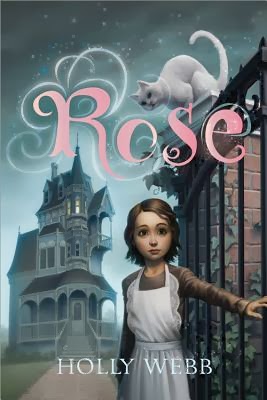
Rose

by Holly Webb
First sentence: “Rose peered out the corner of the window at the street below, watching interestedly as two little girls walked past with their nursemaid.”
Support your local independent bookstore: buy it there!
Review copy sent to me by the publisher for the Cybils.
Content: Aside from the creepy person kidnapping orphans (but it’s really not that scary), there isn’t anything untoward in this book. It would happily sit in the middle grade (3-5th grade) section of the bookstore.

Rose lives in St. Bridget’s Home for Abandoned Girls in London, with no idea, really, where she came from or who she is. (She’s named after the rose bush that was blooming the day she was found in a fish basket in the churchyard.) She really doesn’t have much hope of ever being adopted, so she trudges on, one day after another. Then one day, a housekeeper for a wealthy alchemist/magician arrives, and Rose ends up as a maid in the house. And she discovers that she has a talent for magic. It turns out, too, that orphan children are disappearing from the London streets. No one is really concerned — they’re orphans, after all — but when a friend of hers from St. Bridget’s goes missing, Rose knows she has to do something. And with the help of the magician’s apprentice, maybe she can.

This is, in many ways, a book that’s already been written. Orphan? Check. Plucky lower class girl outsmarting the gentry? Apprentice story? Check. Check. Evil magician stealing children? Check. It should have been by-the-numbers boring.

And yet, it wasn’t. Partially because of the writing — Webb does know how to keep the pages turning — but mostly because Rose is such an endearing character. She’s neither snarky nor plucky. She just does what Needs To Be Done. She’s hardworking, but doesn’t have any desire to be Great. She’s not terribly smart — she has no idea how she’s doing what she’s doing — but she is willing to learn. And she is, above all, loyal to those she calls her friends.

She is, for all purposes, a Hufflepuff.

And that is why I loved her. The story is good, as well. I think this is a first in a series, but it doesn’t need to be. I can see a lot of kids loving it — boys too, if they can get past the title and cover — because it’s quite accessible.

A true winner. (Go Hufflepuff!)

(Just for the record: because this is a Cybils nominee, I’ve been asked to make sure y’all know this is my opinion only, and not that of the panel.)

SideKicked

by John David Anderson
First line: “Captain Marvelous sighed.”
Support your local independent bookstore: buy it there!
Content: There’s some violence, and a bit of a body count. And there’s a budding love triangle (with a couple of kisses), though it’s all pretty innocent. It feels older than elementary school, though, so I’d put it in my YA (6-8th grade) section. However, I wouldn’t be opposed to handing it to a 10- or 11-year-old.

A long time ago (when M and C were little), we had a They Might Be Giant’s CD enttitled NO! On there was this particular song:

I didn’t think much of it at the time (it wasn’t my favorite on the CD by far), but when I started this book, that song kept playing through my head. See: Andrew Bean — Drew to his friends — was born with a “condition” that makes all of his senses amplified. He thought, growing up, that he was just Weird, but then he discovered the H.E.R.O program (that’s Highview Environmental Revitalization Organization. Their motto? We keep the trash off the streets.), which is, in reality a sidekick training program. For superheroes.

Which kept reminding me of another favorite of M and C’s when they were younger: Sky High. (My favorite line from that movie? “Holy (blank), (blank) Man!”) It’s essentially the same plot: Drew (and his sidekick friends) must Save the City from an Evil Genius (though in this case, there was a twist — that I saw, but didn’t mind  — that made it interesting) because the Superheroes aren’t able to. (Except, in this case, one is Reformed and Comes to the sidekick’s aid.)

I guess that makes it sound like I didn’t like this. Which isn’t true: I did. I don’t think it was wholly original (the superhero thing was done most excellently last year with Geeks, Girls, and Secret Identities), but it was fun. There was action (it starts out with a rescue scene), some romance, some angst, and some laughter. And Drew’s voice was spot-on for a sidekick with pretty useless superpowers. It may not be the best book out there this year, but it is an enjoyable read.

(Just for the record: because this is a Cybils nominee, I’ve been asked to make sure y’all know this is my opinion only, and not that of the panel.)
The Wells Bequest

by Polly Shulman
First sentence: “The Wednesday when the whole time-travel adventure began, I was fiddling with my game controller, trying to make the shoot button more sensitive.”
Support your local independent bookstore: buy it there!
Content: The main character is a bit obsessed with the girl (too much for my taste in a time-traveling, science fiction adventure book) and there’s a terrorist threatening to destroy NYC. It’s in the middle grade (3-5 grade) section of the bookstore, though I personally would hesitate before giving it to just any third grader, though I’m not sure I could pinpoint why.

Leo is the son of Russian immigrants who really only expect two things from him: excellence and to be scientifically minded. Leo — for better or for worse — is neither of those. At least not in the traditional sense. Leo is a Tinkerer. He loves taking things apart and putting them back together. He loves building new and better things. Which makes him perfect for the page program of the New York Circulating Material Repository. He gets there in a weird, round-about way, though: a time-traveling version of himself and an unknown girl (Jaya Rao, who was in the first book of this series The Grimm Legacy. Thankfully this one stands on its own, however.) stops in his room to tell him to read H. G. Wells’ The Time Machine.

I’d like to say that an adventure starts there, and there is a bit of an adventure that involves NikolaTesla, Mark Twain, and a crazed British page that has a raging crush on Jaya. I while I did enjoy reading this book, mostly I felt like it was a set-piece for Shulman to show off all the Really Cool Things that could come from reading science fiction books. There are many references to classic science fiction (which I got, but I wonder how an elementary school student would handle) and the inventions that come out of them are really neat. But I felt like that was the entire point of the plot. And I kind of wanted more action and less cool inventions.

(There’s also the side issue of Leo being Obsessed — though not in a crazy way — with kissing Jaya. I know he’s a hormonal pre-teen boy, but get on with it already. It’s a science fiction time travel book. I felt like it was a distraction.)

Even with my qualms, it was a fun story. And I’m curious about the first one as well.

(Just for the record: because this is a Cybils nominee, I’ve been asked to make sure y’all know this is my opinion only, and not that of the panel.)

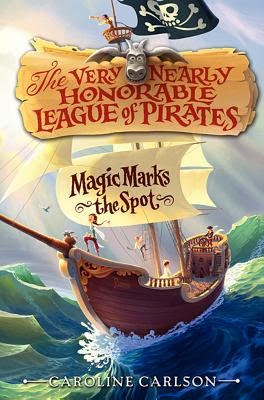
Magic Marks the Spot

The Very Nearly Honorable League of Pirates, Book 1

by Caroline Carlson
First sentence: “Ever since the letter had arrived from Miss Pimm’s, Hilary had spent more and more time talking to the gargoyle.”
Support your local independent bookstore: buy it there!
Review copy provided by the publisher for the Cybils
Content: There’s a couple of swordfights where no one gets injured. For a pirate book, it’s really quite tame. It’s shelved in the middle grade (3-5th grade) section of the bookstore.
Hilary Westfield has one dream: to become a pirate. Unfortunately the league of pirates in Augusta has one rule: no girls. Girls are sent to Miss Pimm’s finishing school, because that’s Where Girls Go. Thankfully, Hilary has Pluck and Determination and doesn’t let the Rules stop her. (This book insists you talk about Things in Capital Letters.) As soon as she gets a chance, she runs away from Miss Pimm’s and finds a pirate — Jasper, the Terror of the South Seas — who doesn’t care that she’s a girl. 
There’s more to this book — magic and treasure and an Enchantress and a Wicked Parent — but really, what I loved most about this book was that Hilary set out to be a pirate and succeeded ON HER OWN TERMS. No dressing up like a boy. No bowing to Tradition. No Resigning Oneself to her Fate and Making the Best of It. Nope. Not for Hilary. She (and her talking gargoyle, whom I really loved) decided that they wanted to be pirates, and Dang It, they became pirates. 
I liked this one an awful lot, mostly because of the above reason. But — aside from the unnecessary letters that were written in cursive, which is a real turn-off for kids These Days; the book got much better after I started skipping them — I really enjoyed all of it. There was humor (Miss Greyson, the governess/chaperone, was hilarious), sword fighting, a wee bit of romance (but not overstated; it was between the adults), and most of all Hilary being Awesome.
Yeah, it was a bit slow at the start, and I really don’t like that it’s yet another one in a series, but I thought the story wrapped up well enough, and I’d be willing to see where Hilary’s piratical adventures take her. 

(Just for the record: because this is a Cybils nominee, I’ve been asked to make sure y’all know this is my opinion only, and not that of the panel.)

The Real Boy

by Anne Ursu
First sentence: “The residents of the gleaming hilltop town of Asteri called their home, simply, the City.”
Support your local independent bookstore: buy it there!
Content: Some intense moments — both physically and psychologically — and the language and pacing are a bit slow, especially for a struggling reader. Still, it fits in the middle grade (3-5th grade) section of the bookstore.
Review copy snagged from the ARC shelves at my place of employment.

After I finished reading this, A took a look at it and said,”Huh.’The Real Boy’? Is that like Pinocchio?”

Well, yes. Yes it is.

The island of Aletheia is full of magic, even though there are no wizards anymore. There are magic smiths, and Oscar is the hand to one. Which means, he collects and chops the herbs and basically stays out of the way. That is, until the apprentice turns up dead and the magic smith go missing. That’s when Oscar’s world starts unraveling: everything he thought Aletheia was built on, everything he thought his master was turns out to be built upon a lie. And it’s up to Oscar and Callie, the healer’s apprentice, to figure out what the truth is, and how to set everything right. And, because I alluded to it, yes, the Pinocchio story does play a small role.

This was a lovely, lyrical book; Ursu is a magnificent, quiet writer. She knows how to evoke a feeling and a place — the forest is dark and magical and calming. And even though it’s never explicitly said, Ursu makes it obvious through little words and phrases that Oscar has some form of autism. That simple fact upped the tension when it was up to Oscar become the Hero of this story. How — if he doesn’t know how to interact with people — is he supposed to figure everything out? Enter Callie, who was a remarkable character. (In fact, all the characters, from the magic smiths to the bullies, to the people in the city who were Indulged and Coddled, were remarkably written.) She is the healer’s apprentice, magicless in a world where magic is everything, and yet she’s smart and plucky and brave, but most of all caring.

In addition to all that, and refreshingly, it’s not a start of a series! Hooray for stand-alone books! My only detriment is that I’m not sure this will appeal to many kids. But for the ones who are daring enough (or quiet enough) to pick it up, they’re in for a real treat.

(Just for the record: because this is a Cybils nominee, I’ve been asked to make sure y’all know this is my opinion only, and not that of the panel.)
The Garden Princess

by Kristin Kladstrup
First sentence: “Princess Adela laced her fingers under a clump of creeping Charlie and pulled, enjoying the satisfying crackle of roots ripping free of soil.”
Support your local independent bookstore: buy it there!
Content: Aside from your usual witches being Bad and princesses not wanting to be princesses and talk of Marriage for a 16-year-old, there’s not much here. It’d happily belong in the middle grade (3-5) section of the bookstore.
Review copy sent to me by the publisher for the Cybils

Adela, like many princesses in books like these, does not like being a princess. She would much rather muck around in the garden, creating landscapes, finding new plants. So, when the handsome gardener (whom she prefers hanging out with) gets invited to a garden party thrown by Lady Hortensia, Adela finagles her way along, mostly so she can see Hortenisa’s famed gardens. However, when she gets there, she finds that the gardens aren’t, well, normal. And Hortensia’s a witch, something Adela thought didn’t exist. It turns out that Hortensia’s plants are all actually beautiful girls. And Adela’s determined to set them all free.

So far, so good. It’s pretty run-of-the-mill, but nothing horrible. I actually kind of like Adela, and it’s not very often you get a princess obsessed with gardening. But, once at the garden, it went south for me. It got very lecture-y about Outer Beauty (which is bad!) and Inner Strength (which is good!), but I could deal with that. No, my problem came with the climax. See, Adela, for all her Heroism, doesn’t actually Solve the Problem. Nope, that goes to the guy/love interest in the story. And that bothered me. I wanted Adela to be Strong Enough and Smart Enough to beat the evil witch, but it turned out that she was only Good Enough to inspire the guy into figuring things out.

*sigh*

But other than that, it was a perfectly fine little fantasy.

(Just for the record: because this is a Cybils nominee, I’ve been asked to make sure y’all know this is my opinion only, and not that of the panel.)

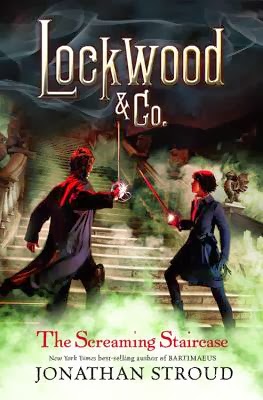
The Screaming Staircase

Lockwood & Co, Book 1
by Jonathan Stroud
First sentence: “
Support your local independent bookstore: buy it there!
Review copy snagged from the ARC shelves at my place of employment.
Content: It’s a ghost story and pretty scary at times, which means, while it’s on a middle grade reading level (and it’s shelved in the middle grade — 3-5th grade — section of my library), I’d be pretty wary about giving this to a Sensitive Child. There’s also a handful of mild swear words.

Even though I saw the rave reviews and the gushing praises, I put off reading this one for much too long. Even though I’ve loved Stroud’s books in the past, I was wary of the rave reviews: it couldn’t be THAT good, could it?

Well, yes. Yes, it was.

Set in a London where there is a Problem with ghosts — they’re everywhere, infesting the buildings and graveyards  — and where only the young can see, and subsequently fight, them. Usually, those with the Talent to see/hear the ghosts, are supervised by adults, but at Lockwood & Co. there’s no such oversight. It’s just Anthony Lockwood, George, and Lucy, teenagers and ghost fighters extraordinaire.

Okay, so it’s not that simple. Lucy and George constantly bicker, and Lockwood is more optimistic about the future of his company than actually capable of running it. But the three of them are talented ghost fighters (hunters? I wasn’t quite sure what to call them), and even though they’re not exactly careful, they get the job done.

Then, on a routine clearing, Lockwood and Lucy stumble on a particularly fierce ghost. It turns out that it was Annabel Ward, a socialite and actress who was murdered and shoved into a chimney. This captures the imagination of our narrator, Lucy, and she ropes the boys into helping her figure out what, exactly, happened to Annabel 50 years ago. One of the best things about this book is the way Stroud handles the mystery: he gives us enough clues as we go along to make a good guess, but it also isn’t the only element to the book. Neither is the ghost Problem. There’s enough layers and depth in this book to keep even the most reluctant of readers interested.

And even though it takes a good 2/3 of the book to get to where the title came from, it all comes together splendidly (fantastically, I might add) at the end.

Additionally, Stroud knows how to do atmosphere. It’s creepy, it’s funny, it’s haunting. It’s eloquent. One passage that stuck out (it’s near the end, but it doesn’t give anything away):

All around us rose the scream, issuing directly from the steps and stones. Its volume was appalling — as painful as repeated blows — but it was the psychic distress it carried that made it so unbearable, that made your gorge rise and your head split and the world spin before your eyes. It was the sound of the terror of
death, drawn out indefinitely, extending on forever. It spiraled around us, clawing at our minds. 

It’s not just good. It’s brilliant.

(Just for the record: because this is a Cybils nominee, I’ve been asked to make sure y’all know this is my opinion only, and not that of the panel.)