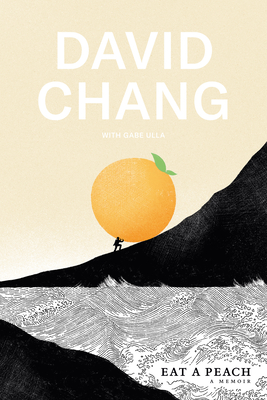
Audio book: Eat a Peach

by David Chang and Gabe Ulla
Read by the author
Support your local independent bookstore: buy it there!
Or listen at Libro.fm
Content: There is talk of suicide and mental illness. There is also lots of swearing, including many f-bombs. It’s in the Cooking/Food Reference section of the bookstore, but would also work in Creative Non-Fiction or Biography.

Chang starts his memoir stating that he’s too young to write a memoir, that this all feels too pretentious. And yes, in a way he’s right: he’s only 43, and his life — well his work life — has been a mix of luck and obsessively hard work. That said, since the only thin I know about him is Ugly Delicious from Netflix (which I really enjoyed), I was fascinated to learn all about Momofuku and the path that Chang took to where he is today.

It’s not an easy path. Chang had an okay suburban childhood, but not an especially happy one. And while he went to college, it wasn’t an especially good experience. It was when we worked in Japan (for a year? I think?) that he finally got an idea of what he wanted to do: he wanted to bring excellent food to the masses, and recreate the experience of Japanese noodle bars. And thus, Momofuku was born.

I really appreciate what Chang is doing: pushing the boundaries of food, mixing cultures and inspirations to come up with something wholly new. I really would love to eat at one of the restaurants, just to see what he and his team have created. I also appreciated that he was super candid about his mental health. He was diagnosed with bi-polar disorder, and was frank about the ups and downs and the medications. He’s his own harshest critic and is adamant that failure is an important part of growth. If one doesn’t fall down, then one can’t grow. And I get that.

And as a narrator, he wasn’t bad. He kept me pulled up to the table (metaphorically) to listen to his stories. I just wish I could have had a plate or two of his excellent food as I did.

We the Corporations

by Adam Winkler
First sentence: “In December 1882, Roscoe Conkling, a former senator and close confidant of President Chester Arthur, appeared before the justices of the Supreme Court of the United States to argue that corporations like his client, the Southern Pacific Railroad Company, were entitled to equal rights under the Fourteenth Amendment.”
Support your local independent bookstore: buy it there!
Content: It’s long and dense. It’s in the history section of the bookstore.

I heard about this book when it came out a few years back and thought that it’d be interesting to pick it up, just to see what Winkler meant by the subtitle: How American corporations won their civil rights. I reminded myself of this a few months back when discussion at a (virtual) book group lent itself to Citizen’s United and how people trust corporations more than government.

It took me a month to read this, not only because I was busy, but because it’s a lot more scholarly than I was expecting, and because there’s a lot of leagalese. That said, it’s a fascinating look at the history of the relationship between corporations and the Supreme Court, and how, over 200 years, corporations and corporate lawyers won corporations many of the same rights that individual citizens have, and how Citizens United and the Hobby Lobby birth control case are natural outgrowths of that.

Winkler leaves no stone unturned. He begins at Jamestown, which was essentially a corporate town, and how corporations of some sort have basically been part of US history since the beginning. He even calls the Constitution basically a corporate charter. And from the beginning, corporations have been pushing against government regulations and trying to exert their “right” to do as they please.

It’s dense, but it’s fascinating. I came away with a couple of thoughts: 1) the Supreme Court was never apolitical. If you think it’s apolitical, then you’re mistaken. They have always been influenced by outside sources, and since corporations have the money to be influential, then they have done much of the influencing. While the Supreme Court has done good things (enforcing desegregation, gay marriage, Roe v. Wade) they are also very much a problematic branch of government. Ordinary citizens have no say (as seen by the confirmations of Gorsuch, Kavanaugh, and Barrett) in who gets to sit on the court, and yet the court wields an undue influence over the laws in our country. (I”m not sure that’s a take-away everyone would get from the book; Winkler does a good job of being balanced. I don’t know for sure he’s against Citizen’s United; he just sets out to prove that it’s a logical outgrowth of 200+ years of Supreme Court rulings.)

And, in spite of number 1, there are some interesting justices who understood, over time, what might happen. For me, the most interesting one was Louis D. Brandeis, in the early 1900s, who basically predicted Amazon and Walmart in a dissent in 1933. Winkler writes:

Brandeis argued that the law [a Florida law designed to limit the spread of chain stores] should be upheld because the rise of nations chains. “by furthering the concentration of wealth and power” and reducing competitions was “thwarting American ideals; that is making impossible equality of opportunity; that it is converting independent tradesmen into clerks; and that it is sapping the resources, the vigor, and thee hope of the small cities and towns.”

He went on to write that the “great captains of industry and finance” were “the chief makers of socialism.” All of which I found fascinating. Later in the book, another dissenting justice basically predicted what we have now: drug companies putting out advertisements for individual prescription drugs in the hopes that consumers would ask their doctor for them by name.

Anyway. I’m not sure how much of this will retain, and at one point I was complaining to R that it all felt hopeless: how does one change something that’s been embedded in the system since the beginning. I guess the answer is: one step at a time. And knowing that the system is this way — pretty rigged in favor of corporations having “rights” and against regulation — is a step in the right direction.

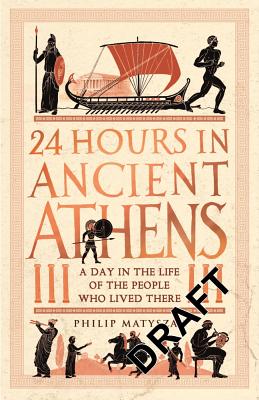
24 Hours in Ancient Athens

by Philip Matyszak
First sentence: “Welcome to Athens in 416 BC.”
Support your local independent bookstore: buy it there!
Content: There’s some frank talk about sex. It would be in the History section (I think) of the bookstore, if we had it.

This little book is a quick, accessible, peek into what life was (probably) like in ancient Athens. Beginning at midnight and going for 24 hours, each chapter (which is an hour on the clock) highlights a different person, from slaves to merchants, soldiers to priestesses, doctors to smugglers. There are “famous” people, like Sophocles and Hippocrates, but most people are invented by Matyszak, based on the research he’s done into Athens.

So, it’s not really history, because most of the people are fictionalized. But it’s also not really fiction, because the information is based in fact. It’s this weird grey area.

It’s also not something I’d usually read, but a friend of mine teaches a class about Ancient Greece and she picked it for our book group. I ended up finding it fascinating though. It’s not one that needs to be read straight through (the stories don’t really build on one another), but can be dipped into on occasion. It’s very readable and accessible, even though there are a lot of names of places and people that I had to let wash over me.

I’m not sure who I’d recommend it to, though. If you have an interest in the daily lives of the people who lived in Athens, then this is the book for you.

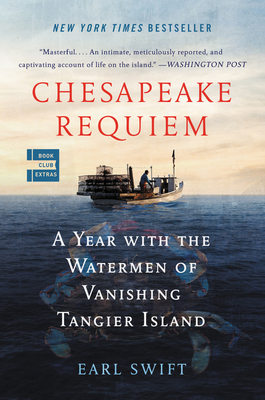
Chesapeake Requiem

by Earl Swift
First sentence: “A day after the storm passed, Carol Pruitt Moore climbed into her skiff and set off for the ruins of Canaan.”
Support your local independent bookstore: buy it there!
Content: There is some swearing. It’s in the history section of the bookstore.

There is an island on the Virginia side of the Chesapeake Bay called Tangier Island. It has a small population, mostly related (at least distantly), and most of them are crab and oyster fishers. (Is fishers the right word here?) They are extremely religious (there are two churches on the island — a Methodist and an offshoot of that Methodist), and their island is being overrun by water.

Swift has visited the island a couple of times, but in 2016-2017 decided to spend a year there with the people of Tangier Island (who call themselves Tangeirmen. Even the women). The thing is: their livelihood and their island are being compromised by climate change, and yet they have a complicated relationship with the people who want to save the bay, the crabs, and the oysters. Their island is disappearing (they say it’s due to “erosion”) at an ever-faster level, and yet they don’t want to relocate (I get that) and are frustrated the government won’t build them a seawall to help shore up the island.

It’s a fascinating book.

It’s less science and more sociology: Swift takes time to help us get to know the people on the island, their thoughts and beliefs, and helps us understand the conflict they have with the conservationists. It’s easy to say the people of Tangier Island are wrong (and they are), but it’s not simple: crabbing and oystering are their livelihood, and they just want to make ends meet. It’s a fascinating dichotmoy.

It’s not a book I would have picked up without a suggestion from a friend in response to the #ReadICT challenge, but I’m glad I did. It’s fascinating.

So You Want To Talk About Race?

by Ijeoma Oluo
First sentence: “As a black woman, race has always been a prominent part of my life.”
Support your local independent bookstore: buy it there!
Content: There is swearing, including multiple uses of the f-word, and the use of the n-word. It is in the Sociology section of the bookstore.

This has been on my radar for a while, at least since this summer when we had piles of it in the store. But, I didn’t pick it up until our discussion at one of my book groups led us to asking: “But HOW do we talk to other people about race?” We know, as white people, we need to be addressing racism. But how?

This book mostly answers this question. What it does more is go into depth about WHY it’s important to be talking about race, and what it is you’re talking about when you’re talking about race. But it does go into a bit of how. The answer? Just do it. You will do it wrong. But, if you listen to POC with an open heart and take their lead, then maybe we will make progress.

Because the thing Oluo stresses most is that we have to talk about race. We can’t just say “it doesn’t affect me so I don’t need to talk about it.” If you live in the world (not just the US), race and racism and White Supremacy affects you. Maybe not as much as it affects your Black or brown neighbor, but it does. I was grateful to hear her stories — I think that listening to the stories of Black and brown people is one of the things that moved me the most with all the reading I have done — and I am grateful for her advice for tackling talking about race.

Now to keep at it.

White Tears/Brown Scars

How White Feminism Betrays Women of Color
by Ruby Hamid
First sentence: “‘I am so uncomfortable having this conversation,’ said Fox News host Melissa Francis during a live broadcast of the network’s panel program Outnumbered on August 16, 2017.
Support your local independent bookstore: buy it there!
Content: There are some swear words, including a few f-bombs. It’s in the Sociology section of the bookstore.

I was scrolling through Instagram one day and one of the bookish accounts I follow (I wish I could remember which one) said that if you’ve read Hood Feminism, you really ought to read this one. So I stuck it on hold at the library.

And that account is right: as a white woman, and a feminist, this one is a must read.

Hamad — who identifies as an Arab-Australian — deconstructs what it means to be a Brown and Black woman in the world where the effects of colonialism and racism is still felt. Every day. There is some history here: understanding the history of how white men used white women’s bodies (and white women, knowing the power structure went along with it willingly) to control Indiginous and slave populations is important to understanding the power structure in today’s society. And there are contemporary examples, white women who have made gains in business politics, an society, but who use those gains to keep out their Black and brown sisters.

It made me think of the saying: “If we lift from the bottom, everyone rises”. Colonialism and, by extension, capitalism lifts from the top. (It’s not just America; it’s a product of all colonialism — any place a different population came in and displaced the Indigenous population, any population that enslaved another population are affected this way. So really, the entire world.) It benefits Whiteness and punishes everyone else. (Or at least that’s the way I see it.) And Hamad’s book was basically an invitation to explore how I, as a White woman, interact with Black and brown people, how I use my whiteness (to help? to hurt?), and how I can can do and be better.

So, yeah. A tough read. But a very, very important one.

The Truths We Hold

by Kamala Harris
First sentence: “Most mornings, my husband, Doug, wakes up before me and reads the news in bed.”
Support your independent bookstore: buy it there!
Content: It’s pretty policy-heavy. It’s in the biography section of the bookstore.

I picked this one up over the summer mostly because I was interested in what her story was. I didn’t get around to reading it until right after the election, when I figured that because she was going to be Vice President, I really ought to learn more about her.

Granted, reading a memoir that was mostly likely written because she was considering a presidential run isn’t the most balanced way to get information about a person. That said, I am interested in people’s stories and how they see themselves. Looking at it that way, I learned a few things.

1: Kamala really is her mother’s daughter. She rarely, in the book, talked about her father — he as a presence in her life for the first several years, but after her parents divorced, he was out of the picture (at least narratively). You can tell, as a reader, how much Kamala admires her mother, and how much she relied on her advice, and how big a loss it was when her mother passed away.

2: Although her mother was South Indian, Kamala and her sister were raised as Black women. They lived in a heavily Black neighborhood in Oakland, CA, during the late 1960s and 1970s. Her mother was involved in the Civil Rights movement and exposed her daughters to many of the leaders at the time. Kamala grew up around passionate Black women who not only believed in justice, but had each other’s backs as often as they could.

3: Kamala works hard. And she cares. Maybe sometimes her polices are a bit misguided (not that she would admit that), but I think they come from a good place. She wants justice and a better life for people. She wants to reform the justice system, but she also wants to try and stem off the things that lead people into the justice system. Maybe she doesn’t have the best ideas to do it, but she is willing to listen, to put herself into situations that allow her to listen, to advocate, and to do the work. I can respect that.

So, not, it’s not a brilliant narrative, and she’s not the most lyrical writer. But it was still good to read.

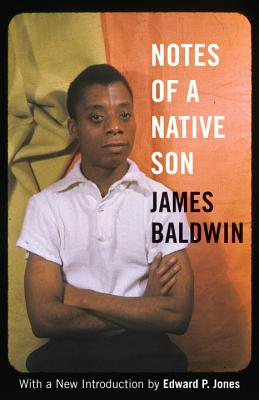
Notes of a Native Son

by James Baldwin
First sentence: “I was born in Harlem thirty-one years ago.”
Support your local independent bookstore: buy it there!
Content: There is some use of the n-word. It’s in the Biography section of the bookstore.

This is one of Baldwin’s earliest books, a series of essays reflecting on his life, thus far. I was published in the 1950s, and is really a product of its time, with the use of Negro and just the language in general.

Which means, I wanted to like it more than I actually did. I think the two best essays in the book are “The Harlem Getto”, a series of reflections after Baldwin’s father passed away, and “Equal in Paris” which is Baldwin’s experience on being arrested in Paris (for being an accomplice to steeling a sheet). Both are introspective and interesting. The rest, if I’m completely honest, I mostly skimmed.

Read The Fire Next Time. It’s the better book.

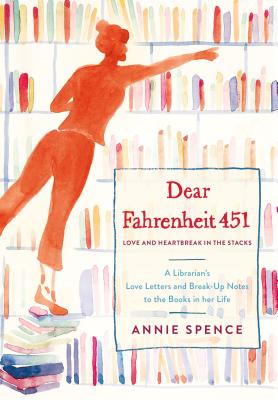
Dear Fahrenheit 451

by Annie Spence
First sentence: “Dear Reader, Welcome to Dear Fahrenheit 451.
Support your local indpendent bookstore: buy it there!
Content: There is some mild swearing and about a half-dozen f-bombs. It’s in the Literary Reference section of the bookstore.

This is really exactly what the cover says it is: a series of letters that Spence, a librarian in a suburb of Detroit, wrote to a bunch of different books. Some are to ones she loves, some to ones she’s weeded from the library (“The One-Hour Orgasm” is the best one of these), some about books she’d recommend to people (like her husband, a non-reader). I can tell, from reading the book, that she and I absolutely do not have the same taste in books. That said, it was still entertaining reading her little notes to the books. (That said, I skipped all the reading lists in the back for that exact reason.)

It’s not deep, but it is fun. And especially good for bookish readers.

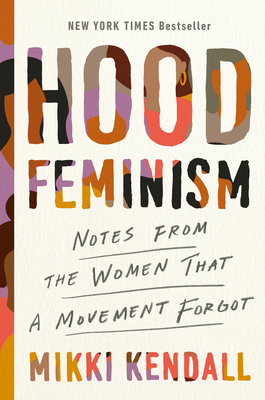
Hood Feminism

by Mikki Kendall
First sentence: “My grandmother would not have described herself as a feminist.”
Support your local independent bookstore: buy it there!
Content: There is some mild swearing. It’s in the Sociology section of the bookstore.

I’ve had this one on my pile for several months; probably since soon after George Floyd was murdered and I became more invested in reading books by Black (and other POC) authors. I also consider myself a feminist, so I figured this was a good merging of the two interests.

What it is is a series of essays by Kendall, where she reminds feminists — specifically (mainstream) White Feminists — that while the issues they’re fighting for — equal pay, reproductive rights, misogyny etc — are all fine and good, if they don’t think about the issues that are affecting women of color, then they’re not *truly* being feminists. Issues like housing and food availability, gun violence and single parenting. Things like making sure Black (and other POC) women are included in the conversation, and reminding White women that just because they’re oppressed by men doesn’t mean they can’t turn around and be oppressors as well.

No, it’s not an easy read. Kendall admits up front that she’s not out to be nice or polite. She’s is out to speak her truth (she grew up in the inner city, her first marriage was abusive and she admits that she had privileges that allowed her to get out of both situations and achieve a middle class-adjacent life, in her words) but also the truth for women, specifically Black women, who are not given the opportunity to speak.

But it’s an important read. It’s important to remember that the charity work we do is good but not enough if the government is taking away housing opportunities and punishing poor people for being poor. It’s a reminder that, as a White woman, I need to listen the voices of my BIPOC sisters and not just barge in there thinking I have the answers.

It’s definitely a book I will go back to and would love to discuss with others.