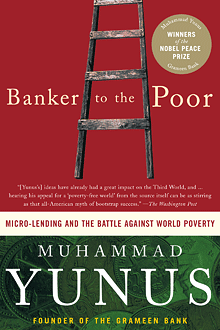
Banker to the Poor

Micro-lending and the Battle Against World Poverty
by Muhammad Yunus
age: any
First sentence: “In the yer 1974 Bangladesh fell into the grip of famine.”

I really don’t know how to write this review without sounding crass, selfish, uppity, obnoxious… because I didn’t finish the book. Strike that: couldn’t finish the book. It bored me. To tears.

It’s essentially a memoir by the man — Yunus — who founded Grameen Bank, an organization that gives micro-loans (those of piddly amounts that “normal” banks won’t handle) to people way, way below the poverty line. It’s less about his life, though, and more about the struggles and trials he had in setting up this idea and the challenges and experiences he had getting it to work.

I thought that would be interesting. But Yunus is a boring writer. He’s not maudlin, something which I appreciated, but it’s essentially a list: he had this idea, he set about getting it to work, he ran across some resisitance, he happened to know someone high up in the government, he got past the resistance. Yeah. Whatever.

As I said, I sound crass. I should be insterested and moved and touched by this man’s efforts to help those with much, much less. And I am; he’s going whatever good he can, working within the system rather than trying to reinvent it (mostly). But, his book, I am sorry to say, is not nearly as good as his ideas.

The Trouble Begins at 8

by Sid Fleischman
ages: 9-12
First sentence: “So often had Mark Twain suffered through bumbling introduction before he rose to speak that he sometimes chose to introduce himself.”

When I was in 7th grade, I had an abiding love for Mark Twain. We had read Connecticut Yankee in King Arthur’s Court (I had read Tom Sawyer the summer before), and I was totally and completely smitten. In short, I would have adored this biography, had it existed when I was in 7th grade.

Even now, I adored this book. Not just for the wealth of information about Sam Clemens aka Mark Twain, or for the illustrations/photographs that grace it’s pages, or even for the beautiful layout and font that it was written in (it was one of those rare times that I kept flipping pages because it was just so satisfying to flip the pages and gaze at the text). No, I adored this book because Fleischman was so, well, amusing.

He had me with this passage:

When I was the young writer of a novel, The New York Times reviewed my comedy with the news that I was no Mark Twain. I was astonished. I had already had myself fitted for a white suit, like the celebrated author of Tom Sawyer and Huckleberry Finn. I had been trying to track down the brand of cigars he smoked by the handful. His wit may have come from the noxious weed. Who knew?

I was gone. Hook, line, and sinker.

Fleishman spends the book recounting the origins of Mark Twain — from Clemens birth through his rough and wild days in Nevada and San Fransisco, through until he became famous. He’s not all that interested in what Twain did with the rest of his life — the later books (aside from Huck Finn) only get a passing glance, as do the last 50 years of Twain’s life. But, then, that’s not what’s important (or humorous) to the book. No, it’s the young Twain, the wild Twain, the one that’s observing, exaggerating, writing, figuring that’s the interesting Twain.

It isn’t a detailed book, though: there’s facts but Fleischman is more interesting, it would seem, in the story that is Twain’s life. It’s not as dry as a typical biography, but then it’s also not as detailed. Thankfully, Fleishman has a book list (in order of importance and relavance) in the back that will point anyone curious to know more about Twain in the right direction.

Most of all, though, Fleishman treats Twain probably excatly the way that Twain himself would want to be treated: with equal parts grace, humor and skepticism. Which makes it an absolutely wonderful read.

(It also made me want to go and re-read the works I’ve read in the past, as well as crack open Roughing It and Innocents Abroad, neither of which I’ve ever read. That says a lot about the book in and of itself, doesn’t it?)

A View of Jerusalem

by Erin Sheely Tolman
ages: adult (though it’s perfectly suitable for younger readers)
First sentence: “On August 22, 2000, I departed Salt Lake City, Utah with 175 other college age students to travel to the Brigham Young University Jerusalem Center for Near Eastern Studies located on Mount Scopus in Jerusalem, Israel.”
Review copy sent by the author.

I’ve never been to Jerusalem. Actually, to be completely honest, I’ve never really had much desire to go to Jerusalem. I’m just not a Middle Eastern, desert kind of gal. Even so, I do think, on some level, that religiously at least I ought to want to go to Jerusalem. Walk where Jesus walked and all that.

As such, I never expressed much interest in BYU’s Jerusalem Center while I was at BYU. I knew people who went — most notably Hubby’s older sister and younger brother — but I kind of thought, well, it’s there. That’s nice.

After reading Erin’s book, I think I’d like to visit; it sounds like being in Jerusalem (and at the BYU center) is a singular experience.

This book chronicles her time in Israel, from her classes in the center, to her wanderings around the city itself, to some of the field trips scheduled by the professors. It also happens that she was in Jerusalem in September of 2000, when the Second Infintada — the war between Israel and Palestine (though it seems like they are always at war) — began. I expected more about her feelings and experiences being there at that time, and I was a bit disappointed with what seemed to be just a travelogue (though I did enjoy seeing Jerusalem through her eyes). Erin did get more into her thoughts and feelings (and those of her family watching the news at home) near the end of the book. I also thought it was a nice touch to add her feelings as her husband left for Afghanistan three years later; it brought the story full circle. The book is best, though, when Erin writes down her observations and thoughts about the city and the sights she is seeing; it can be very evocative, almost poetic at times. My only real regret is that we didn’t get to see any of the photographs she so often talks about.

As a spiritual book, I wasn’t terribly touched (but that may just have been me; I’m a hard soul to move…), though I appreciated that Erin was trying to share her testimony about Jesus and the places he was with others. I just wasn’t able to connect on that level.

That said, it’s a worthy reflection on her time in Jerusalem, an interesting memoir of her time in an interseting place. And worth reading.

Becoming Jane Austen

by Jon Spence
ages: adult (though it could be read by 12+, if they’re interested)
First sentence: “In 1704, the presumed heir to the Austen family fortune, John Austen, lay dying of consumption at the age of thirty-four.”

Shall we start with another confession? (I’m in a confessional mood this week…) I picked up this book because I recently got the movie from Netflix and it made me curious about the book. (I saw the movie in the theater when it came out and had the same reaction, but never followed up on it.) I also recently saw Miss Austen Regrets, too, and between the two, I really wanted to know what was fact, and what was fiction.

Well, in the case of Becoming Jane, a lot was fiction. But that’s getting ahead of myself.

In this biography of Austen’s life, Spence takes a look at how Austen’s life is intimately reflected in her work. I haven’t ever read a biography of Austen before, so I’m not quite sure how it measures up scholarly, and I won’t say it’s a brilliant biography, but it’s a good one. Spence’s writing is accessible and interesting (though I think at times he gets a bit annoying with his perhapses and possiblys, but then since Cassandra burned most of their letters, it’s hard to know much about Jane, and a lot of it is perhaps and possibly…). And a lot of it is because Jane herself (probably much to her chagrin) is an interesting person. Or, at least, has become interesting because of her books.

So. What did I learn? Well, first off, the whole Jane-Tom Lefroy thing is only 15 pages in the book, and it’s all very sketchy. Spence asserts that, at least in Jane’s mind, they were in love (engaged possibly), and that affected her writing. She wrote “First Impressions” (which became Pride and Prejudice) around the time she knew Tom, and Spence writes this:

The energetic intensity of Pride and Prejudice attests to the effect that falling in love had on Jane Austen. It is an irrepressibly happy novel. Between October 1796 and August of the next year Jane wrote “First Impressions”; it was her unique way of thinking about Tom Lefroy and celebrate her delight at being in love — and at being loved. The novel that she later called “my own darling Child” was to be a gift of love for Tom Lefroy.

I have no idea if this is true, but it makes sense.

I also liked that Spence points out Austen’s propensity to switch genders from what she observes to what she writes. Tom — witty and clever — became Elizabeth, while she — reserved with strangers, seemingly haughty, yet loving to family — became Darcy. It happens others. I also enjoyed learning about the ebb and flow of her life and how it affected her work. Aside from P&P, Spence spent the most time on Mansfield Park, since that book had the longest gestation (10 years) of all her novels. He said this (which made me rethink at least my reaction to the novel):

We think we ought to like Fanny Price more than we do the fine, handsome Bertram girls and the warm, lively Mary Crawford. That it is difficult to do so, in our feelings and our reason, is precisely what Austen was determined to show. Our values tell us one thing, our hearts another. Mansfield Park is Austen’s most profound attempt to capture this inevitable confusion of feelings in human life — and her strategy was to make readers themselves confused in their own feelings about the characters in the novel.

And this:

Nothing is fixed and definite, and paradoxically the appearance of everything being so heightens our sense that it is not. Austen creates such a strong, distinct possibility in Mansfield Park that things did not have to turn out as they do that we are left in confusion. What might have happened is as real as what did happen. This disturbs us, makes us angry. We have been arguing vehemently with Jane Austen about the ending of Mansfield Park for two hundred years, exactly as she intended.

Fascinating, no? (Well, maybe not. But I thought so.)

Anyway. He does touch on all her other novels (though not so much on Northanger Abbey; it does tend to get slighted), as well her juvenalia and the fragment of the book she was writing when she died. I felt like the book ended abruptly, but overall I enjoyed the glimpse into Austen’s life; I think reading about her actually does heighten the enjoyment of her books, even if the whole Tom Lefroy thing was a bit blown out of proportion. And this is a good place for those of us without the desire to go and write a thesis on her, to get that knowledge.

The Four Agreements

by Don Miguel Ruiz
ages: any
First sentence: “Thousands of years ago, the Toltec were know throughout southern Mexico as ‘women and men of knowledge.'”

This begins with a confession: yesterday I completely and utterly lost it with the kids. It was over something ridiculous — they had eaten some cookies that I had set aside for a dinner I was taking to someone else yesterday evening — but I totally and completely wigged out. (No one was hurt, though all were scared.)

In the course of trying to calm down, my eyes fell upon this book, and I picked it up to flip through. And ended up reading the whole thing. I’m not saying it changed my life, but it did calm me down, give me a handle on what had just happened, and helped me focus on fixing what had just happened in a positive manner.

The basic premise is the Toltec principles of four agreements, things that can help you change your perspective and attitude toward others by changing how you react to others. Through these principles, if you apply them in your life, you will find a peace, a happiness, that alludes most people. Granted, I found a lot of the book a bit hokey and overly new-agey for my tastes, and the writing style was chatty and felt a bit off. I’m also not sure it should be taken as a “cure all” for everything. But. It did help calm me down. And the four agreements — being impeccable (careful) with your word, not taking anything personally, not making assumptions and doing one’s best — are good things to live by. And maybe, if everyone picked this up and read through it, if only to find out just exactly what Ruiz means, then maybe the world would be a happier place. (Though, I suppose I shouldn’t wish for world happiness, just personal.)

At any rate, it was food for thought.

The Geography of Bliss

by Eric Weiner
ages: adult
First sentence: “My bags were packed and my provisions loaded.”

The premise: self-proclaimed grumpy journalist decides to visit happy nations (as determined by the World Database of Happiness that’s kept in Rotterdam, the Netherlands. He visits a handful of countries for several weeks, interviewing people and sampling the culture trying to figure out what, exactly, makes these people in these particular countries especially happy. And how does it all (can it?) relate to him and his own personal search for happiness?

It sounds trite, and on one level it is. How can a journalist, one who insists upon remaining professional aloofness at that, actually get to the bottom of what makes people happy? And besides, there are millions of people in any given country (more or less), and not all of them are going to be happy all the time, right? Well, yeah. But, I don’t think Weiner is going for depth. Sure, he draws conclusions from the places he visits, and he tries to put it all into some sort of happiness formula, but I think he was just out to meet people and experience things. Which is all good with me.

As for myself, I enjoyed the journey. Weiner is a funny writer — maybe not as good as Bill Bryson or Tony Horwitz at their best (admission: I picked up this book because there’s a blurb on the back by Tony Horwitz, and I thought, well Tony Horwitz liked it and I like Tony Horwitz’s stuff, so maybe I’ll like this…) — but enjoyable. My favorite quote, from his visit to Switzerland:

Our fondue comes in a large bowl, not orange, and it’s good. After a few helpings, the euphoria is gone, but I’m feeling, I think, very Swiss. Satisfied. Neutral. Maybe this explains Swiss neutrality. Maybe it’s not based on a deep-seated morality but a more practical reason. Fondue and war don’t mix.

And I have to admit that I enjoyed the travel aspect of the book. I’ve never been to Bhutan or Qatar or Switzerland or Moldova (not that I want to go there now), and I enjoyed seeing the world, even in a limited sort of way. I found his stops and the people he met interesting, and the conclusions he came to about happiness fascinating. Maybe not life-changing. But definately worth mulling over.

Which pretty much sums up the book: not life-changing, but definately worth paging through.

A Year in the World

by Frances Mayes
ages: adult
First sentence: “The silhouette of Alghero rises from the Mediterranean.”

At one point, while reading this collection of travel essays, I thought, “When Frances Mayes is lyrical in her writing, I feel lyrical.” Not a very lyrical sentiment, true, but an honest one. As I discovered before, when Mayes writes well, you feel like saving her words. Her books are not ones to be rushed through.

The problem with this book is that it’s really a series of disjointed essays, each on a different spot, and while some of them are wonderful, others are well, banal. (That and I have issues with the title. It’s not a “year in the world”, more like “several years bopping around southern Europe, Morocco, and Great Britain.”)

As Mayes is a lover of all things Italy, those chapters are by far the best. I want to visit Naples, Sicily, Mantova and wander the streets, shop in the markets, taste the food. Lay on the sun-kissed beaches, swim in the sparkling ocean. (Her work also brings out the adjectives in me.) She makes Italy so accessible, luxiurious, desireable.

When reading books I am often reminded of people. This one — the Italy and England/Wales chapters especially — made me think of my mom. I can understand her long-held desire to go to Italy now: it is a marvelous place.

But, aside from her love-affair with Italy, the places Mayes visits have their ups and downs. She gushes about Andalucia in Spain, but is underwhelmed by Portugal. She stays in a crummy house in Wales, but has a good old time with friends in Scotland (which is by far her most indulgent, and my least favorite chapter). Her husband gets food poisining in Morocco, they go on a cruise around the Greek Islands (she alternates between gushing about the ocean, making fun of the passengers, and lamenting that they can’t spend much time anywhere. Sounds like my cruise experience), but have a much better experience with a guided boat tour around ancient ruins in Turkey.

Even with its many imperfections, it’s a book worth reading. I vascillated between jealousy and what she was able to do (and afford!), and soaking the words in and feeling like I was there myself. There were times when it read like a guidebook (a very good guidebook, but one nonetheless), but I can’t complain, coming away with garden and food suggestions, book recommendations, and CDs to listen to.

And still, I may be sad to see it go back to the library. I did enjoy my travels; Mayes is an impeccible traveling guide and companion.

Founding Mothers

I have mixed feelings about this one. A collection of stories and letters about the women behind (beside?) the men that were instrumental in founding the United States, it’s a work that could be seen as enlightening and entertaining. In fact, there were many times when I was enlightened and entertained. I did learn about some women that I hadn’t heard of before — my favorite was Eliza Pickney, a South Carolina woman who basically managed things on her own for most of her life. She was also a bit of an entrepreneur, coming up with the idea and the means to make indigo a cash crop. There were also the usual players: Abigail Adams, Martha Washington, Dolley Madison, and it was interesting to see the way that Cokie Roberts portrayed each of those women.

However, it was a hard book to get through. I think that the book had simultaneously a too broad and too narrow of focus. Too broad, because of all the people she tried to squeeze into 277 pages. Roberts organized her book chronologically, which was probably inevitable considering that it was the time period that drove all the people, but it also made it hard to keep everyone straight. She started Abigail Adams’s story in one chapter, dropped it after a few pages and didn’t pick it up again for another couple of chapters. There were also so many women — I couldn’t keep the Kittys straight to save my life — that Roberts focused on, however briefly, that I felt like I needed a flow chart to figure out who was who (and who was related to whom!).

It was too narrow because I felt that Roberts slighted the men. Sure, it’s a book on the women during the late 1700s, and yes, we want to give them the credit the history books have denied them all these years, but I felt that Roberts did it at the expense of the men. She poked fun at John Adams (I was not happy with that… especially after reading David McCullough’s biography!); portrayed George Washington as a competent leader, but an incompetent in his personal life… (I agreed with her assessment of Alexander Hamilton and Ben Franklin, though…) Perhaps it’s just personal biases getting in the way here, but I felt like she could have portrayed these women as working in partnership with their partners, rather than at odds with them.

And then there was Cokie Roberts herself. She peppered the book with asides, snide remarks, opinionated comments. Which is all fine and good; she’s the author, she can interpret the letters however she wants. But it drove me nuts. After a while, the extreme annoyance (I shouted at the book a couple of times!) I had at the beginning boiled down to a mild irritation, but it never left. There was a (very large) part of me that wished she’d just shut up and leave the letters and stories to speak for themselves.

That said, the letters and stories are fascinating to read. And I do appreciate that Roberts took the time to focus on these amazing women. Even with its faults, its a book worth reading.

Geeky Book Interviews

I had a ton of fun with this week’s Weekly Geek. I was paired with Heather of A Lifetime of Books… and thoroughly enjoyed chatting with her. As she pointed out — we both ended up reviewing books that were similar — memoirs/biographies — so it almost looked like we planned it that way on purpose.

First off, the book I read, John Adams by David McCullough:


Why did you decide to read this book?
Way back when my blog was young, I read Setting the World Ablaze. The one thing I got from that book was how under-appreciated John Adams is. In the comments, someone recommended this one to me. But… I forgot about it until my dad reminded me about it in March. It took the I Heard it Through the Grapevine challenge though to actually get me to read the book.

Did you watch the mini-series on TV a few months back? If so, how does it compare to the book?

I haven’t. It’s on my Netflix queue, but I wanted to read the book before I watched the mini-series. I’ve heard that it’s really good, though.

Was this a challenging read? Why/why not?

Yes, and no. Yes because it encompasses a HUGE amount of time — more than 50 years of detailed accounts — which is a lot to handle in any book. It’s 650 pages of John Adams. But no, because David McCulllough is a great writer. I usually have a problem with biographies because I find them stuffy, but McCullough makes the research and the letters incredibly accessible and engaging.

What are two or three things that you learned that really surprised you?

How much Adams did behind the background. He never was a charismatic leader or even a terribly popular one, but he was tireless. In the same vein, I was impressed how visionary Adams was. He saw the evils of party politics:

“There is nothing I dread so much as a division of the Republic into two great parties, each arranged under its leader and converting measures in opposition to each other,” Adams had observed to a correspondent while at Amsterdam, before the Revolution ended. Yet this was exactly what had happened The “turbulent maneuvers” of factions, he now wrote privately, could “tie the hands and destroy the influence” of every honest man with a desire to serve the public good. There was “division of sentiments over everything,” he told his son-in-law William Smith. “How few aim at the good of the whole, without aiming too much at the prosperity of parts.”

And he predicted that slavery would be a big issue, possibly leading to war. The other thing — that I knew, but was impressed with again — is that you can’t write a biography of Adams without making Jefferson a big part of it. Their lives, for good or ill, were intertwined. And I found that interesting.

Was the relationship between John and his wife, Abagail, typical of the time period or was it unique? Is that your own opinion or is there something in the book that led you to that conclusion?

I’ve long been impressed with Abigail Adams — she was a hero of mine since I read a biography of her in middle school. That said, I’m not sure if their relationship was unique. It probably was, but because we don’t know much about other relationships from the time, it’s hard to tell. What was unique was the amount of letters that they wrote. And it’s because they were both prolific writers that we even know about their relationship at all.

Did this book alter your impression of any historical figures? In what way?

Ah. Jefferson. He did some great things, but he was not a great man. The history books have unfailingly altered Jefferson. Same with Franklin, too. And I had no idea that Alexander Hamliton was such a creep. Brilliant, but really really warped.

Do you think the author gave an unbiased review of Adams’ life? Was there an apparent or implied message that the author was hoping to convey in this book?

No. I don’t think McCullough was unbiased. I think he was fair — Adams was not perfect (he had two alcoholic sons, one of whom died at age 30, and he was incredibly vain and easily hurt) — but you could tell as a reader about the affection that McCullough had for Adams. He really liked this man. And, by the end of the book, so did I. I think McCullough’s just attempting to change the perception — or lack of one, for who really thinks of John Adams — of Adams and put out there how much he really did for the country, not just during the revolution, but his whole life. (One little side note: he worked tirelessly — and was unpopular for it– for peace with France during his term as president. McCullough makes this statement later: “Bonaparte abandoned his plans and suddenly, in 1803, offered to sell the United States all of the vast, unexplored territory of Louisiana. It was an astounding turn of events and one that would probably not have come to pass had the Quasi-War burst into something larger. Were it not for John Adams making peace with France, there might never have been a Louisiana Purchase.”)

What type of reader would you recommend this book to? Why?

Definitely history buffs. But I think the average reader — one who is willing to invest the time in this book, because it does take time — will enjoy it. It’s enjoyable, it’s interesting, and hopefully, they’ll come away with as much respect for Adams as I did.

And the questions I asked Heather about her book, Life is So Good by George Dawson. (Be sure to check out her post with the interview; she’s got a picture of her Gram reading the book!)

I haven’t read the book (or even heard of it before — I’m slow!) so can you give me a bit of a summary without too many spoilers?

This is the true story of George Dawson, the grandson of a slave, who was born in the late 1890s and grew up on a farm in Texas. Age the age of 98 he decided to learn to read. Going back to school at that age brought him to the attention of the media, and this book is the result.
What led you to pick this book up?

I read this book after seeing it reviewed here. Because another review led me to read it, it was perfect for the Irresistible Review Challenge. I failed the challenge because I didn’t complete this one in time, but that’s perfectly ok with me (I had a really good reason – see my answer to the next question for details).

Easy one: did you enjoy it? Why or why not?
I LOVED this book. It was very readable and always kept my interest. I liked how each some of the chapters began with news from the time period, and continued with what was going on in George’s life at that time.
After just a few chapters I was telling my Gram (she’s 84) about it and she asked if she could borrow it. Of course I said yes. As I mentioned in this post, Gram isn’t a big reader so I was quite impressed when she finished it in just a few weeks. She says it was a wonderful book, and that George is a lovely man. She really enjoyed reading this book.

Was his life really “so good”? Why did the book have that title? Do you think it fit?
George had a difficult life, but he was always happy. He lived in the moment, not worrying about what tomorrow would bring. He didn’t expect things to be perfect, he didn’t expect people to be kind (at least, not all the time) and he didn’t believe that anyone owed him anything. Based on that, you may think that he was depressed, or pessimistic, or something like that, but he wasn’t. He just took life as it came and made the best of it every day.
For him, life really was “so good” … it’s a perfect title for the book.
Did you learn anything you didn’t already know?

Yes! I learned how different life really was for “colored” people [George’s word] in the South in the first half of the 20th century. Of course I knew about segregation, and the Klan, and things like that. But it’s the little things that I just had no clue about that really struck me.
I also learned a bit about “riding the rails”. Train-hopping-hobos make appearances in many novels of the time, but George’s experiences give a bit more life to these faceless masses of moving people.
There are so many things I learned from this book, but nothing that I would say is “profound” … it’s just the details of life that are often overlooked that were so fascinting to me.

Would you recommend it? Why or why not?

I would whole-heartedly recommend this book. I can’t think of any reason NOT to like it. Ok, maybe I’d like an “Afterword” that tells me when happened to George after the book was published, but hey, you can find that on the internet so it’s really not a big deal. This is a lovely book, an easy and captivating read, and I highly recommend it to everyone.

84 Charing Cross Road

I read a lot on our little jaunt to Portland… but to be fair, they were short, little books…

I picked this one up yesterday morning at the bed and breakfast we were staying in and read it while I was waiting for the proprietor to get breakfast ready. That’s how quick a read it is. It’s a series of letters between Helen Hanff, a New York writer, and a rare/used/antique bookshop in London, England. Their correspondence starts in 1949, and the letters go on for 25 years (or more; I can’t remember and I left the book at the bed and breakfast) until the death of her main corespondent, Frank Doel.

It’s a lovely little book; the letters are funny and sweet, and Helene, Frank and the rest of the “inmates” at the store are just wonderful. I loved the way Helene would talk about the books as if they were real people. There were so many little quotes about books and reading that I wanted to write down. As for the book itself, I couldn’t put it down. I finished it quickly not just because it’s a slim little thing, but also because it’s a captivating book. You come to care about the people — not just Helene and Frank, but Frank’s family, and the other people at the book store — and root for Helene to actually make it to England to meet them. It has a bittersweet ending, but I still loved it immensely.

Now to go find me a copy for my very own.