The Prince

by Niccolo Machavelli
ages: adult
First sentence: “All states, all dominions that have had and continue to have power over men were and still are either republics or principalities.”

My husband, bless his heart, has been trying to get me to read this book (and the Communist Manifesto) for years, since he discovered that I managed to get out of college without reading it (either one, really).

I had begged him to join my online book group, mostly because there was only one lone man and all us women, and I thought Russell would help balance out the testosterone. Unfortunately, that meant when it was his turn to host a book, he picked ones that he was interested in… which meant I would actually have to crack open the cover of a work of political theory. (I could have skipped, I know, but I live with the guy: do you think I’d live it down if I did?)

So… I got through it.

It wasn’t easy; the language was dense and I found that my usual reading situation (during the kids TV time) didn’t work: I had to actually focus on the words. Which meant reading later at night, which meant that I tended to doze off while reading the book. Not exactly ideal.

That said, I can see why this is one of Hubby’s favorite books to teach: there’s a lot to discuss in it. Machiavelli was a brilliant mind, and his ideas, although ruthless by modern standards, are quite, well, practical for the time period. I’m sure, though, that I didn’t get everything I could have out of it (though, when talking to Hubby, I realized I absorbed more than I thought I did!). Which means that maybe someday, I’ll actually have to sit in a class of Hubby’s and listen to him lecture on it.

That would be fascinating.

My Life in France

by Julia Child with Alex Prud’homme
ages: adult
First sentence: “This is a book about some of the things I have loved most in my life: my husband, Paul Child; la belle France; and the many pleasures of cooking and eating.”
Support your local independent bookstore! Buy it there.

Julia Child is an awesome woman.

Okay, yeah, I like food books and French books — and this book is both of those things — but mostly it’s the force of Julia Child’s personality that carries this book.

A forceful, entertaining, incredible personality.

It’s the story of Julia’s introduction to France, her discovery of her passion for French food, and the birth of Mastering the Art of French Cooking. It’s a fascinating journey, and it’s made all the more interesting by the way Julia writes about it. She’s full of joie de la vie, especially for all things French. She’s no-nonsense, methodical, and passionate. And, most of all, she writes like you’re sitting down next to her, sipping a cup of whatever, and she’s just rattling off memory after memory of her fascinating life, holding you spellbound.

Some basic highlights: She moved to France in 1946 — she was 36 — with her husband, Paul, who was stationed there with the USIS. She had never been there, and was totally ignorant in the ways of cooking and food in general. She shortly became passionate about the food, and decided about six months into their stay to study at Le Cordon Bleu.

While she appreciated the basic education that Le Cordon Bleu gave her, she was ultimately dissatisfied with the school. She did graduate, but only after having to go through some bureaucratic hoop-jumping. She had discovered that she was passionate about cooking, especially cooking French food, and so even though the school didn’t work out the way she wanted it to, she kept up with teaching herself.

One of the things that really impressed me was how methodical she was in her learning. She took the time to research everything, especially when she started working on the cook book (or “cookery-bookery” as she called it), and was more than willing to listen and learn from the experts. It took her — she collaborated with a couple of French women — 10 years to get the first Mastering book done and into the hands of a publisher, and another 9 on Volume 2. I found that immensely impressive.

On top of all that, she was as gifted linguist: she picked up French, German and Norwegian during her husband’s years in the service, before settling down in Cambridge, Massachusetts. She does get into how her TV show came to be, and dealing with the effects of celebrity, but I felt it was all almost an afterthought. The heart of the book, and the most interesting parts, are in Paris. Which is probably as it should be.

I loved the last paragraph, though:

In all the years since that succulent meal, I have yet to lose the feelings of wonder and excitement that it inspired in me. I can still almost taste it. And thinking back on it now reminds me that the pleasures of the table, and of life, are infinitetoujours bon appetit!

Bon appetit, indeed.

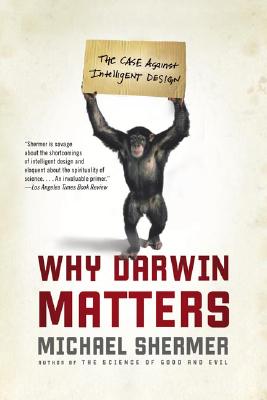
Why Darwin Matters

The Case Against Intelligent Design
by Michael Shermer
ages: adult (though anyone interested in this debate could read this)
First sentence: “In June 2004, the science historian Frank Sulloway and I began a month-long expedition to retrace Charles Darwin’s footsteps in the Galapagos Islands.”

Delivery, people, delivery.

When writing a book, SO much depends on the delivery, the tone, the way in which you present the information, characters, narrative, story.

In short: this book would have been much better if the author hadn’t constantly come off as a pompous ass.

It’s not that I disagree with his premise: that Intelligent Design is NOT science, that evolution is a fact and not a belief, that one can believe in God and accept evolution and not have it in conflict. But, I just don’t know who this man was trying to convince. He kept implying — and in some cases, he says it pretty explicitly — that the ID people are morons (which they might be, but that’s no way to present an argument), that they are crusaders (ditto), and that Science is Right and if you are a reasonable person, then you will accept that ID is bunk and Evolution is right.

Right.

Really, it’s no way to endear your reader to your position. And it’s no way to convince those who believe in ID, or are even on the fence, that you’re right and they’re wrong (even if you are).

Grrr.

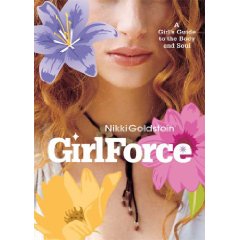
Girl Force

A Girl’s Guidebook for the Body and Soul
by Nikki Goldstein
ages: it’s meant for teenage girls, but can go as young as 9/10

Review copy sent to me by the publisher

When this book came in the mail, it was snatched out of the pile almost immediately. My two oldest daughters — M, age 12, and C, age 9 — read through it, and were enthralled with the ideas in it. It’s not only a personality quiz, which are always fun, but a program to help teen girls get a handle on their busy life. Even though they’re both slightly younger than the audience Goldstein probably had in mind, they decided to embark upon a program to see if the ideas that Goldstein put out really worked. I noticed them often pouring over the book, writing things down, trying different foods (and beauty concoctions), and exercising more frequently than they used to. I sat down with them, a month into their project, to chat about the book.

There are three body/personality types: Earth, Fire and Air. What are each of you?
M: I’m an Air… kind of a eccentric personality, everywhere at once, impatient, enthusiastic and quick to learn. It’s a petit, slim, small body type with out of control hair.
C: I’m a Fire…I’m open to other people’s ideas, but I like to put my ideas out first. A born leader, passionate, outgoing, confident, and competitive. It’s a medium size, athletic, strong body type. Fire’s usually have blonde or red hair, and brunettes are pretty rare. I’ve got dark hair.

I came out as an Earth; between the three of us, we’ve got the entire book covered. What I want to know is if you think the description fits you?
M: It’s actually one of those quizzes that are fairly right. Even though I’m more a fire skin type, with the red hair and fair skin, the Air type fits me really well.
C: I kind of have a bit of Earth in me — my skin and hair are more Earth — but yeah, I’m mostly fire.
M: Everybody has a little bit of everything. It’s just focusing on your dominant energy.

Tell me a bit about the program in the book.
C: Goldstein tells you more about yourself, and getting used to people around you. It helps you become a bit more confident, and makes you a better you.
M: It’s a journey to self-love using different eating habits and exercise plans to help you become healthy and fit, and to help you be happy with who you are.

How about specifics?
M: She has lists of food that are better for your body types. There’s a stress management plan.
C: There are exercise recommendations for each body types, as well as yoga poses for each body type.
M: There are schedules you can follow if you need helping coming up with your plan.
C: It’s there to help you become a better you.
M: It’s suggestions rather than recommendations. She does this in a way that makes you actually want to try this program.

Tell me what you’ve learned about yourself from the book.
M: I’ve learned a lot about exercise and eating, habits and the actual method that she uses — an ancient medical system of India called Ayurveda — that’s really neat. It says that, “everyone has a unique Body Type made up of the elements Air, Fire and Earth and when you tap into the elemental-energies that dominate your bod and mind you’ll be destined for a happy, healthy and balanced life.”
C: Yeah, I agree. I learned many tips about colors that will look best on me, and ways to take care of my skin. It was all very interesting.

You two have been following the ideas put out in the book for about a month now. Has anything in your life changed?
M: We really haven’t been doing everything for a month, and we haven’t tried a lot of the things the book mentions because we don’t have all the supplies, but what we have tried we’ve liked. It has helped me manage my stress more, and stopped me from eating chocolate 24/7. Which is good.
C: For me, I’ve learned more about my eating; I need to have less condiments than I used to. I need to also lower my amount of chocolate, too. Because chocolate isn’t as good for me as other things that are sweet but have less sugar.
M: I haven’t been able to try the exercise recommendations, because it’s been cold out and Airs aren’t supposed to be out in the cold.
C: I’ve been able to do some of my exercise recommendations, like jogging and biking, and I’ve liked them. But I haven’t been able to go swimming yet.

Any thing else you’ve learned from the book?
M: It’s helped me appreciate nature more.
C: It’s helped me be less stressed, and helped me try new things that I didn’t think I liked to do.

Has it helped you think about yourself better?
M: Goldstein’s given me the direction I need to figure out things about myself. She starts you on the path, and lets you find your own way. She’s very open that way. I do think about myself better than I did before.
C: I did think less of myself than I do now. Whenever I looked at myself before, I would think that I need to stop and put on makeup to be pretty. I also thought that I was a little fat. Now, I know it’s just my body type. I seem to be more open to other people’s types and ideas now, too.
M: Goldstein tells you to read all of the types so you can get a picture of each type. And because of that, she helped me understand C better, so it helped with our relationship.

So, are you going to keep trying the program she sets out in the book? Why?
M: Yes: because it’s helped me balance my life more, as she’s promised, and it’s fun.
C: I agree; also, it’s helped me enjoy many different things in my life.

Will you recommend this book to others?
M: It’s designed for teen girls, but any girl would probably benefit from this.
C: Yeah. It’s for older kids, because it talks about a lot of things for older kids, but I’ve enjoyed doing it, too, even though I’m younger than the age she wrote the book for.

Don’t Call Me a Crook!

by Bob Moore
ages: adult
First sentence: “It is a pity there are getting to be so many places that I can never go back to, but all the same, I do not think it is much fun a man being respectable all his life.”

I thought this one sounded interesting — the memoirs of a Scotsman — Glasgowian — who traveled the world, being, shall we say, less than respectable. So, when I was offered a review copy, I said yes.

But. Call it timing, call it mood, call it I’m not too into less-than-respectable characters, but three chapters in — after he’s gotten thrown off a ship, was disappointed that he couldn’t fly planes and kill people in WWI, stolen a bucket load of diamonds, married and all but abandoned his wife — I decided that Bob lived much too much of an adventuresome life for me. And I wasn’t all that interested in it, anyway.

Go see Suey’s husband’s review for a more positive outlook on the book, though. Maybe it’s just a guy book. 🙂

We Are the Ship

The Story of Negro League Baseball
by Kadir Nelson
ages: 8-12
First sentence: “Seems like we’ve been playing baseball for a mighty long time.”

I am not a baseball fan. I did not grow up in a baseball house (which is odd, since my dad played ball when he was a teen). Football and basketball were our sports of choice, with tennis and the Olympics following close behind. That said, I think I’m American enough to appreciate baseball, even if I hardly ever watch it. (I did pick up two things about baseball, though: 1) it’s better in person than on TV and 2) the minors are more entertaining to watch than the majors.)

Given that, I really wasn’t interested in reading a book about the Negro Baseball League. I knew about it, sure (I did watch a bit of the Ken Burns’ documentary, after all), but it didn’t really register on my list of things to read about. Then the Battle of the Books came along and, We Are the Ship won its match, taking down a book that I really enjoyed reading. Well, I thought, there must be something to this book.

And there is something to this book. First of all, it’s a lot more detailed than I expected it to be. From it’s size, and the cover, I figured it was a picture book. I was wrong. It’s a detailed history of the Negro League that just happens to have amazing (really, really amazing) photographs. I liked the layout of the book — because it’s so large, the illustrations become not just an accessory, but an integral part of the book — and that the chapters were titled “innings”. And then there’s the narrator. As judge Rachel Cohn said, the narrator has a folksy charm to it, so much that you can imagine the person telling the story.

And what a story. It narrates the story of the Negro Leagues from its inception through to when Jackie Robinson made the crossover into the minor leagues. It touches on the determination of the men to play the game, and play a good game, in spite of the segregation and racism they encountered. Nelson spares no punches: he tells the good along with the bad. And, in the end, I was left with nothing but admiration for the men who wanted to play a game, and found a way to do so.

Abby pointed out that Nelson left out the women who played for the Negro Leagues (something that I didn’t know until she pointed it out), but I’m not sure that detracted from the charm that this book had. At any rate, maybe Nelson will be inspired to write another book on the women who played ball.

I know I’ll definitely read it.

The Spirit Catches You and You Fall Down

by Anne Fadiman
ages: adult
First sentence: “If Lia Lee had been born in the highlands of northwest Laos, where her parents and twelve of her brothers and sisters were born, her mother would have squatted on the floor of the house that her father had build from ax-hewn planks attached with bamboo and grass.”

This book is incredibly complex, which makes it a difficult book to write about. It’s a medical tome — I now know more than I ever thought I would (not having any kids with epilepsy) about seizures and medical procedures of the early- to mid-80s. But it’s also a work of cultural observation — I now know more than I ever thought I would about Hmong history, religion, and culture. But what this book is, more than either of those things, is a testament to what happens when good intentions go bad because of cultural differences.

Lia Lee, daughter of Hmong immigrants, was eight months old when she first started seizing. Her parents (somewhat unusually for Hmong, who notoriously don’t trust American doctors), took her to the hospital. And there, her saga starts. There is time after time of misunderstanding, miscommunication (lack of interpreters only played a role in that), and tragedy after tragedy in the life of this little girl. What impressed me most (and this is something that I’ve heard often associated with this book) is that Friedman does an admirable job of portraying both sides — both the doctors’ and the parents’ attempts and efforts at helping Lia get better. I did feel, fairly often, that Friedman was more sympathetic to the Lees’s side of the story, but she does give the doctors (who often come off as arrogant jerks) equal time — both of her own in doing the research as well as in the book.

I often thought while reading it, too, that I was a bit of an outsider. That the people who really ought to be reading this are not lay readers, but rather doctors, social workers, adminstrators: people who could learn from the lessons that Friedman puts out in this book (not that I can’t learn about the Hmong — granted, I don’t know if there are any here in Wichita — but I’m not in a position to put that knowledge to use). It is a fascinating read, though (even if it was one of those dip in-dip out books — read a chapter or two, read a whole other book — types), and the lessons about respect for others’ culture, beliefs and traditions is a valid one.

The Sharper Your Knife, the Less You Cry

Love, Laughter and Tears at the World’s Most Famous Cooking School
by Kathleen Flinn
age: adult
First sentence: “As a little girl, while other children played house, I played restaurant.”

When, at age 36, Kathleen Flinn’s mid-level corporate job was eliminated, she was faced with a choice: get another mid-level corporate job somewhere, or… pursue a life-long dream of going to school at the cooking school Le Cordon Bleu in Paris. Encouraged by her boyfriend — who puts his life on hold to move to Paris to be with her — she chooses the latter. This is her story.

Equal parts food book, travel book and memoir, this book totally and completely engrossed me.

I think I liked the food parts best, though. Not only is the book littered with recipes (delicious, gourmet recipes that I will probably never make, but I can dream about), but Kathleen is meticulous with detail about her time in the cooking school. She doesn’t hesitate to tell about her failures (like the time the “Grey Chef” shouted at her, or the time she dropped the roast duck on the floor) but she doesn’t gloat over her successes (like when the head chef of Le Doyen singles her out over her classmates to chat with for 20 minutes). It’s all matter of fact: this happened, she had this amazing experience, she lived this dream, wouldn’t you like to read about it?

But more than the recipes, or even her cooking experiences (I’ve been inundated with French food in books lately; at least here she explains what it all means!), I enjoyed her trips into the Paris markets. The sights, smells, sounds, connections of European markets; it was sensory heaven. And it made me realize (not for the first time) that we’re really missing out with grocery stores here in the States…

I did enjoy the other aspects of the book, too: I liked her tales of the many house guests (even the horrible ones; they were good for a cringe and a laugh) they had while living in Paris; I liked the love story between her and Mike (whom she met and fell into a relationship before Paris), and their whirlwind marriage. I liked her relationships with her classmates, the different personalities and expectations and goals of each person.

It did get a bit too life-preachy for me, especially near the end, where Flinn was trying to make some Big Moral out of her experience, when I would have been happier with her experience as is, without the life morals. But, that said, there’s always something inspiring about people who leave the corporate track and do Something Different with their lives, pursuing a dream and, ultimately, succeeding. And that Flinn spins a good tale about her experience is just a happy bonus.

The Diary of a Young Girl

by Anne Frank
ages: 12+
First sentence: “On Friday, June 12th I woke up at six o’clock and no wonder; it was my birthday.”

Ack.

Let me say that again.

Ack.

If I had read this book when I was 12 or 13, I would have totally loved it. I would have completely identified with Anne, with her plight, with her suffering, with her angst, with her. I would have cried at the end. I would have swooned over her relationship with Peter, and the difficulties it presented.

But now…

I just felt like she’s a whiny teenager who wasn’t completely grateful that she didn’t end up in a concentration camp for the whole war, and that she spent too much time whining about how horrible her parents (and the Van Daans) are. I felt like the book is only famous because she (in a cruel irony) died in a concentration camp three months before the Allieds liberated it. Yes, it was human, and real, and sometimes insightful. But I couldn’t stand her. Or the book.

Which makes me feel guilty.

Oh, well. I missed the boat on this one.

So Many Books, So Little Time

A Year of Passionate Reading
by Sara Nelson
ages: adult
First sentence: “Call me Insomniac.”

This book will not be liked by everyone. Contrary to what the jacket flap says, I also do not think this book will make a “passionate reader out of anybody.” In fact, I think that in order to enjoy this book one has to be a passionate reader already. Otherwise, Nelson will sound uppity (a book a week? How absurd!), snobbish, and insufferable in her blathering about books.

Admittedly, I was suspicious intially — a book a week? Bah, that’s nothing! — but, soon after beginning, I discovered that writing about reading a book a week isn’t what Nelson was trying to achieve. In fact, the book is not a record of the books that she read over the course of 2002 so much as it is an ode to book love, to those who are passionate about reading, and the process of book choosing, sharing and reading.

And, as someone who is passionate about reading, that I could love.

I have to admit that at first I felt wildly unsophisticated and un-read, since I haven’t even heard of half of the books she was writing about. But I realized, after a while, that this book in many ways is like Reading Lolita in Tehran: the author writes so much about, and with such love, the books that she is reading and thinking about that you feel like you’ve read them. And, then, you’ll either figure that was enough exposure to the book, or you’ll stick it on your to be read list, just to see what made the author so giddy about it.

I also marked so many passages; it was full of bookish truisms that I felt hit home with me. A sampling:

People notice what you read and judge you by it. Which is why if I were goig nto read Danielle Steel, I wouldn’t do it at the office. But Nine Parts of Desire speaks to anyone listening: I’m smart, it says. I’m concerned with current events, it announces. I am a serious person.

Clearly she knew that between book lovers, a novel is not a novel is not a novel. It’s a symbol, an offering, and sometimes a test.

It seems to me that rereading — or claiming to reread — is just another way for some people to trumpet their intellecutal superiority. To wit: have you ever known someont to say they’re “rereading” the oeuvre of, say, Jackie Collins?

On reviewing:

His [Anthony Bourdain] subject is food and mine is books, but the same principles apply: you have to treat your subject with fearlessness and attitude and energy. Whether your industry’s sacred cows are beef, or, say, novels that are just said to be “well-done”, you have to skewer them.

You know you’re in a bad patch when the most interesting part of the book is the acknowledgments page.

That’s probably more than you wanted. But, maybe you can begin to see the charm the book had for me. She also tackles choosing a book (or having a book choose you), that headlong falling into love, erotic scenes versus erotica, first sentences (but not book covers), and (that problem we all have?!) the embarrassing problem when an author wants you to read their book and “tell them the truth”. Yes, Nelson does come off as a New York elite (which she is), and a bit of a snob (ditto; I worried when I got to the chapter titled, “Kid Stuff”, but it turned out okay), but she’s also observant, insightful, and passionate. And those three outweighed the previous two, and made this book an absolute delight to read.