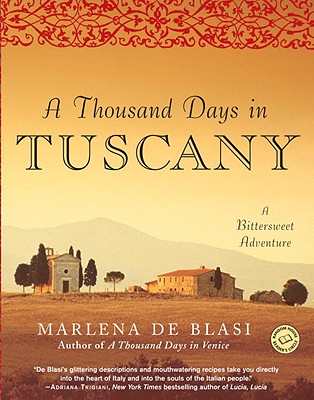
A Thousand Days in Tuscany

A Bittersweet Adventure
by Marlena de Blasi
Ages: adult
First sentence: “Ce l’abbiamo fatta, Chou-Chou, we did it,” he says, using the name he gave to me, clutching the steering wheel of the old BMW with both hands, elbows out straight like wings, shoulders hunched in glee, wheezing up a conspiratorial laugh.”
Support your local independent bookstore: buy it there!

A friend of mine loaned this to me last October, when I was effusing about my reread of Under the Tuscan Sun. I let it sit on the shelf for months, figuring I’ll get to it when the time is right.

When I started it yesterday, I despaired: perhaps I was destined to like only one book about Tuscany. But, where Frances Mayes book is about a love of a house and finding a place, de Blasi’s book is about a love of the people and the food of that place. It took me a while to understand what de Blasi was trying to tell me, but by the end I was hooked, luxuriating in the descriptions of the food, and submersing myself in the stories of the people.

She and her Venetian husband, Fernando, uproot their somewhat comfortable Venetian lives and head for Tuscany, somewhat on a whim: they need something new, something different to feel alive again. It’s scary and intimidating and exhilarating all at once. And once they got to their rented house in Tuscany, they find so much more than they bargained for: a friend in Barlozzo, an old curmudgeon who has opinions about everything, and yet is generous with his time and knowledge about the countryside and its charms (especially food-related!). They find a community in the town they’re living in, friends, kindred spirits, family. They find solace in simplicity and rusticness. (Okay, not a word, but you get what I mean.)

One quote that I thoroughly liked (she’s talking about her former profession as a food writer), and think is a good example of the goodness of simplicity:

Enticed neither by swirls of kiwi puree forced from a plastic bottle nor by teetering constructions built from a puff of pastry upon which rested a grilled lamb chop upon which was piled a roasted pear, the pillar secured by spears of asparagus, which leaned fetchingly against it, a few hard-cooked lentils strewn casually about with petals of a zinnia, I’ve always wanted food that sent a current straight to my loins. I’d find it exhausting, having to break down a still life before getting to my supper… And so it was that as chefs began to decompose the very molecular structure of food, recasting it into ever more bizarre forms and substances, it became harder and harder to stay excited about my job…. And now I’m wishing could I scoop up all those men and women who began their chef lives as purists and bring them here to wander these markets, to stand in front of the burners with some of these chefs who change their menus every night so as to reflect that morning’s market, and who are not quietly amazed by this fact as a proof of their own genius.

While the book is slow to show it’s charms (at least for me), it’s like an old friend, sitting down over a glass of wine (for those who drink wine, anyway), talking about everything and nothing all at once. It speaks to your soul (well, at least mine), and invites you to look at what you have and need, to reflect upon what is truly important.

And what better kind of book is that?

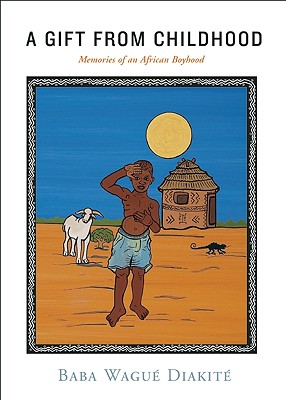
A Gift From Childhood

Memories of an African Boyhood
by Baba Wague Diakite
ages: 10+
First sentence: “A little boy sat on the dirt floor with a bowl of millet porridge between his legs.”
Support your local independent bookstore: buy it there!

I’ve been sitting here trying to figure out a way to summarize this book, and I’m coming up short. How do you summarize a man’s reflections on his childhood, his experiences in a small village in Mali, and the life lessons that taught him? You can’t.

His parents, for cultural if not financial reasons, sent Diakite and his siblings to live in the small village where his father grew up to be raised by their grandparents. He stayed for several years, until he was in his early teens, learning about the ways of the village. While there’s no real over-arching narrative, the stories do follow a bit of a timeline from when he arrived at the village through until he met his wife, came to American and settled in here. The stories themselves are interesting; none are very long, and they each shed light on what life in a small, rural African village is like. There’s some commentary on imperialism and on materialism, but it’s not heavy-handed, or even all that present. The art, done by Diakite as well, helps give the book the feeling of being told African folktales from the hand of an experienced and talented storyteller.

His is a fascinating life, and a good story about how differences, the “other” if you will, can enrich all our lives.

Mom

A Celebration of Mothers from StoryCorps
edited by Dave Isay
ages: adult
First sentence: “StoryCorps launched October 23, 2003, in Grand Central Terminal in New City.”
Support your local independent bookstore: buy it there!
Review copy provided by TLC Tours

I didn’t quite know what to expect, going into this one. It’s a series of conversations from the StoryCorps booths about mothers. Since there’s no coherent narrative, and since every story is just a snippet, really, I figured it’d be an easy, but not very substantial read.

On the one hand, I was right: it was an easy read. I breezed through it in an afternoon, but not only because it’s an easy read. It’s also an engaging one. Maybe it’s because I have an odd fascination with oral histories, but I found the stories, even if they were just snippets, to be fascinating.

There’s stories of mothers dying, of mothers caring, of mothers working, of mothers giving up babies, of mothers adopting children, of hard times and good times. It’s a broad collection of remembrances, from every walk of life. It was touching and interesting and sweet, even if it wasn’t especially memorable or life-changing. A lovely antidote to all the extreme mom stories: both the ones that make you feel guilty because you’re not doing enough, and the ones that make you feel smug because you’re so much better than that.

However, I think it was something Dave Isay wrote in the afterward that moved me the most:

I hope you’ll spread the word about our efforts. We want to encourage the entire nation to take the time to ask life’s important questions of a loved one — or even a stranger — and really listen to the answers. We hope to shower this country with more of the sorts of stories you’ve just read — authentic voices that remind us what’s truly important, that tell real American stories, and that show us all the possibilities life presents when lived to its fullest.

It made me want to seek out a booth for a conversation of my own. Which, I suppose, is the best thing you can get out of the book.

A Natural History of the Senses

by Diane Ackerman

ages: adult
First sentence: “Nothing is more memorable than a smell.”
Support your local independent bookstore: buy it there!

Going into this book, I didn’t quite know what I’d be getting from a “natural history” of the senses. It’s such a broad term; and how does one actually provide a history of something that’s been part of the human experience since the beginning of time?

What I got was one part history, one part science, and one part poetry. Ackerman divided the book into five sections, one for each of the senses. She started with smell, then worked through touch, taste, hearing and vision. I had a hard time at first, getting used to the style of the book, which seemed haphazard and disorganized. It seemed like it was a series of short essays cobbled together without much sense and flow. But, after the smell section — which was the worst for the disjointedness — it settled into a rhythm, a little bit of poetic description, a bit of science (most of which I wondered if still was “correct”, since the book was written in 1990), a bit of social history. Much of it was fascinating. Her descriptions (passages of which I would love to copy down, but are much, much too long), especially about how the senses work in relationships, were elegant and poetic. But, in the end, it wasn’t enough. I wanted something less thrown together, something that flowed more, something that was less disjointed.

Because when it was good, it was very good. I just wanted more goodness.

India Calling

by Anand Giridharadas
ages: adult
First sentence: “As my flight swooped down toward Bombay, an elderly Indian man leaned over and asked for help with his landing card.”
Support your local independent bookstore: buy it there!

M, actually, is responsible for choosing this book. I introduced her (mostly by accident) to the joy that are Hindi language movies, and she fell head-over-heels in love with them. As a result, she’s been requesting books on India for the past few weeks, trying to learn as much about the country as she can. This one just happened to catch my eye. And I’m glad it did.

Anand Giridharadas is the son of NRIs (Non-Resident Indians). His parents came to American in the 1970s, mostly because India wasn’t offering his father the kind of opportunities that he wanted. Anand, raised as a good Indian-American, with only brief trips back to India as a child, felt the siren call of India and shortly after college headed there to live and work. This book is his observations of the “new” India, the way India is reinventing itself, and the consequences — both good and bad — of that.

The book is divided into chapters exploring different emotions and hopes: dreams, ambition, pride, anger, love, freedom. Giridharadas explores how each one has had an impact on the India of his parents and grandparents, and through his observations, travels, experiences in the country, and interviews, he explores how each things are changing — because of capitalism and consumerism — and not changing — because India is an old country, and one with a billion attitudes to change. The book weaves history, culture and religion together, leaving, it seemed to me, no stone unturned. As an Indian himself, he was able to go places a Westerner couldn’t have, and yet as an outsider, he was able to make observations and ask questions that wouldn’t occur to someone who hadn’t been raised outside of India. It was the best of both worlds, that melded into a very thought-provoking book.

It was fascinating, to say the least, even for someone who has had very little exposure to the world that is India.

King of Bollywood

Shah Rukh Khan and the Seductive World of Indian Cinema
by Anupama Chopra
ages: adult
First sentence: “Dreams come true in Dalton.”
Support your local independent bookstore: buy it there!

First off, a disclaimer: four years ago, when I saw this on the shelves, I took a look and said, “Hmm… could be interesting.” But, since my older two girls and I have been on an Indian Cinema bender lately (don’t ask how many movies we’ve watched in the last month…), I put a hold on this one. M read it in one sitting, devouring information about Shah Rukh. I took it a bit slower.

It’s basically one of those Hollywood tell-all biographies; Chopra did sit down an interview Shah Rukh and those closest to him, so it’s an “authorized” version. Reading it reminded me why I prefer memoirs over biographies: I like hearing the stories by the person themselves, rather than being interpreted through someone else. That, and questions I had (like: why is his name Shah Rukh Khan when his dad’s last name was Mohammed? Why did he change it? When did he change it?) weren’t really answered.

That said, even with the meandering and slightly clunky writing style, it was a fascinating look into Indian cinema. To explain how Shah Rukh became the massive superstar he is, Chopra felt it necessary to explain the history of Hindi film, and with that, a bit of Indian history as well. Some really interesting stuff. That’s not to say that Shah Rukh isn’t fascinating: the amount of naked ambition he has is boggling. And yet, he’s an incredibly down-to-earth individual (or at least Chopra made him seem so). Additionally, he’s a halfway decent actor, if a bit on the goofy side. Other than that, there isn’t much to say about this book.

Good for those who are slightly obsessed with Indian cinema.

The Disappearing Spoon

Madness, Love, and the HIstory of the World from the Periodic Table of the Elements
by Sam Kean
ages: adult
First sentence: “As a child in teh early 1980s, I tended to talk with things in my mouth — food dentist’s tubes, balloons that would fly away, whatever — and if no one else was around, I’d talk anyway.”
Support your local independent bookstore: buy it there!

Me and science aren’t exactly friends. (Or is it science and I? Bad grammar day.) I’ve taken a few science classes, and while I think I liked chemistry the best (who doesn’t like blowing things up in a beaker?), I really haven’t given science (or it’s application) much thought over the years. In fact, save visits to hands-on science museums (my favorite), I haven’t given it any thought.

Enter Sam Kean and this book. It’s perfect for people like me: those who kind of like science (especially chemistry) in a passing sort of way, but aren’t scientists by any stretch of the imagination. It’s a sweeping book, one that explains basic chemistry as well as looking at the history of how different elements were discovered, the periodic table was put together, and about the scientists behind both. All the famous people are there: Einstein, Pierre and Marie Curie, and… that’s all I can think of off the top of my head. But, he goes beyond the famous people, and delves into the all the stories. One I loved was how x-rays were discovered. Or about the kid who decided he needed to help the world break its oil addiction and built a nuclear reactor in his mother’s backyard. Or how elements influenced pen making. Or the politics of Nobel Prizes and naming elements. Or this throw-away line: “Still, chefs and chemists tended to distrust one another, chemists seeing cooks as undisciplined and unscientific, cooks seeing chemists as sterile killjoys.”

It’s got everything, and yet, it’s an incredibly balanced book. It’s amazingly accessible (a must), and even though I think I only understood maybe a third of what Kean was explaining, I found I was never bored. Kean knows how to talk science to unsciency people, so that even if we didn’t understand all the technicalities, we still can thoroughly enjoyed the book.

And that’s a feat unto itself.

The Lincolns

A Scrapbook Look at Abraham and Mary
by Candace Fleming
ages: 10+
First sentence: “I’m an Illinois girl, raised in the very heart of the ‘land of Lincoln.'”
Support your local independent bookstore: buy it there!

Everyone knows the story of Abraham and Mary Lincoln. We learn about it in school, all the stories and events that made up their lives. So, really, why do we need yet another biography of them?

That’s the question I asked when I opened this book. And, surprisingly, while I didn’t learn much new information — and most of what I learned was about Mary Lincoln and not Abraham — I did thoroughly enjoy this book.

The book is laid out like old newspapers, complete with photos and different type faces. The stories themselves are short, just snippets and overviews of events. There’s very little that is in-depth here, but then it’s not aiming to be anything more than what it is: an introduction for elementary-age kids. It’s engaging reading, even if the stories aren’t in-depth or new: Fleming has a accessible and engaging writing style. It’s simple without being simplistic.

What I did learn was all about Mary; she seems to have gotten a bad rap in the history books (unsurprisingly). Fleming did much to paint Mary as human (she did much to paint Abraham as human, too; he was not a larger-than-life figure), with faults, yes, but also with many virtues as well. She was a spitfire, someone who was a good companion to her husband. I was amazed at their child-raising habits (very modern, and thus were looked down upon back then), and at the amount of tragedy that Mary had in her life. Sobering, to say the least. It made me curious to read a good biography (if there is one) solely about Mary.

I’m glad I read the book, even if it wasn’t in-depth or enlightening. It’s definitely something I’d recommend to anyone looking for a good overview of the Lincolns.

Same Kind of Different as Me

by Ron Hall and Denver Moore (with Lynn Vincent)
ages: adult

First sentence: “Until Miss Debbie, I’d never spoke to no white woman before.”

Support your local independent bookstore: buy it there!

I would have never, in a million years, have picked this up if it weren’t for my in-person book group. I don’t to religious books, I especially don’t do evangelical books. It’s not that I have anything against religion or even evangelicalism, it’s just that I prefer to escape when I read.

I’d love to say that I loved the book, in spite of my hesitations. But, I didn’t. I liked it. I thought the story was interesting. But I wasn’t moved by it, or even motivated by it.

It’s the story of two men: Ron Hall, who came from a lower-middle-class Texas upbringing and turned himself, by luck and the grace of God into a millionaire art dealer; and Denver Moore, the product of Jim Crow laws and a Louisiana sharecropping upbringing, who was homeless in Fort Worth when Ron and his wife Debbie first met him. Debbie insisted that Ron reach out to Denver, and it eventually turned into a friendship. One that helped Ron make it through his wife’s cancer and eventual death (yep: it’s one of those cancer books). It’s basically their witness and testimony: look what God wrought in their lives.

The most inspiring person (obviously, since it’s their story about her and because she’s passed on) is Debbie: how she took the money Ron made and put it to better use. How she got involved in her community and worked to make it a better place. But, even that wasn’t enough to salvage the book for me.

Now, I suppose this is me being all hyper-critical: just because the writing wasn’t the most elegant, just because the story was a bit cliche, should I take apart these men’s beliefs? Because I do believe that they believe they were doing good by writing this book. No. That wouldn’t be fair. I guess my fundamental problem was that I just never got what I was supposed to get out of their story. (There’s class issues here as well, I discovered: I have a problem with wealthy people throwing their money at good causes and saying “Look at me doing good! Aren’t I wonderful?” And I felt like I got a lot of that.) In the end, though, I felt like I feel in those tear-jerker movies: manipulated. And that rankled me.

That said, there is good in this book. There’s a good story. There’s redemption and forgiveness and grace. I just didn’t feel it. But maybe you will.

Guests of the Sheik

An Ethnography of an Iraqi Village
by Elizabeth Warnock Fernea
ages: adult
First sentence: “The night train from Baghdad to Basra was already hissing and creaking in its tracks when Bob and I arrived at the platform.”
Support your local independent bookstore: buy it there!

I’m perfectly sure, even with Amira’s high recommendation, that I would have never picked up this book without it being chosen as a book group selection. I am also perfectly sure that, even though it took me a lot longer to read than I wanted it to (for various reasons), it’s a fascinating look at a specific segment of of the Iraqi women population in a specific time in history.

Our author, amazing woman that she is, was brave enough to spend the first years of her marriage in a backwater tribal village in southern Iraq in 1957 and 1958. Her husband, Bob, was there to do some research, and she went along for the ride. It was good, as well, since Bob had no access to half the population: the women. Through trial and error, Elizabeth (or Beeja as they referred to her) made her way through the intricacies of daily life for a Shiite Muslim woman in that particular tribe. It was an interesting insight to the Islamic faith, to the traditions and strictures and customs of both the faith as well as the tribe.

That’s one of the things I had to keep reminding myself: this ethnography (so hard to spell!) is of a particular village in a particular time, and while it’s fascinating, it really can’t be applied broadly. I kept wondering how things have changed, not just for the village, but for women in Iraq in general.

Given that, it was an interesting story. I kept admiring Beeja for her gumption: I’m not sure, newly married, if I would have been that adventuresome. (Yes, I want to travel, but generally “travel” for me includes flushing toilets and mattresses.) But, she did what any sensible person would do: she threw herself into her situation and made the best of it. Can’t ask for more than that. It was interesting to read about her ups and downs of adapting, and how her relationships with the women in the village evolved and flourished in spite of the cultural (and, initially, linguistic) barriers.

But it wasn’t until the end of the book that I found something that truly resonated with me:

How many years would it take, I wondered, before the two worlds began to understand each other’s attitudes towards women? For the West, too, had a blind spot in this area. I could tell my friends in America again and again that the veiling and seclusion of Eastern women did not mean necessarily that they were forced against their will to live lives of submission and near-serfdom. I could tell Haji again and again that the low-cut gowns and brandished freedom of Western women did necessarily mean that these women were promiscuous and cared nothing for home and family. Neither would have understood, for each group, in its turn, was bound by custom and background to misinterpret appearances in its own way.

For better or for worse, this still is the case. And, at the very least, helping bridge that misinterpretation is something good that this book, even out-of-date as it is, can do.