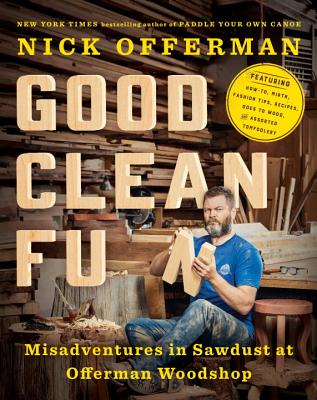
Audio Book: Good Clean Fun

by Nick Offerman
Read by the author
Support your local independent bookstore: buy it there!
Content: There’s some mild swearing. It’s in the humor section (I think) of the bookstore.

This is, basically, Nick Offerman’s homage to Offerman Woodshop, his woodworker’s collective in L.A. It’s a portrait of the craftspeople who work there, as well as those people Nick has come across in his “career” (the acting just pays the bills) as a woodsmith.

So, no, it wasn’t the best book to 1) start reading Nick Offerman (I think I’m going to try Paddle Your Own Canoe next) or 2) listen to in audio. That said, Nick is delightful to listen to read a book (not as delightful as Neil Gaiman), and there were lots of delightful anecdotes about Nick’s colleagues, as well as his opinions about working with your hands (pro: I felt justified, since I really enjoy canning) and the joy of working with wood, specifically.

I do have to say that while listening to this, I kind of wanted to learn how to build things (not a new desire for me; I should have taken shop class). I enjoyed Offerman’s enthusiasm for the art of woodworking, and his sense of humor. Even though I wish it has more of a narrative, I still found it enjoyable to listen to.

Audiobook: Hillbilly Elegy

by J. D. Vance
Read by the author
Support your local independent bookstore: buy it there!
Content: There’s a LOT of swearing, including f-bombs. It’s in the biography section of the bookstore.

J. D. Vance didn’t have the best upbringing. That’s putting it mildly. The grandson of Kentucky to Ohio transplants, people who moved to work in factories to find a better life, he grew up in a small manufacturing town in southern Ohio. His mom, one of three kids, was a drug addict who bounced between guys, and so J. D. ended up with his grandma, whom he called Mamaw. He eventually found his way out of the poverty and abuse cycles, joining the Marines, going to Ohio State and Yale Law. But, as he points out in his memoir, his story is atypical.

It’s mostly Vance’s memoir of his childhood (insane as it is) and his family. But he also ties it into the larger issue of rural poverty. It’s something I’ve thought since the year we lived in Mississippi: it’s not (just) about race, it’s about class. And if we don’t do something about the working poor — and I don’t have the answers here — things will just get worse.

J. D. doesn’t have the answers either; just a lot of first-hand observations. The most striking of which is that interventions that happen in high school often come too late. They need to sooner. (Honestly, I saw a lot of our foster daughter in this story. And he’s right: if someone had intervened when she was younger, it would have saved her a world of hurt and trauma.) But it’s also complex: the politicians and agencies don’t always know or understand or assume things about the poor.

A fascinating book. And listening to him read it (he has a slight Southern twang) was a great way to experience this book.

Highly recommended.

The Tao of Pooh

taoofpoohby Benjamin Hoff
First sentence: “‘What’s this you’re writing?’ asked Pooh, climbing onto the writing table.”
Support your local independent bookstore: buy it there!
Content: It’s a primer on philosophy and the Tao Te Ching. If that sounds interesting, then it’s probably your speed. It’s in the Religion/Philosophy section of the bookstore.

Of COURSE one follows up Winnie-the-Pooh with The Tao of Pooh, right?

Right.

I’d read this once, a long time ago (probably after I was first married because the copy we have is Hubby’s), and honestly didn’t remember it much at all.

It’s an interesting hybrid of imitating the Pooh stories, an analysis of the stories and a comparison to the Tao Te Ching. I enjoyed the comparisons of Pooh to the principles of Tao, because it helped explain these admittedly foreign (at least to me) principles in a way I could understand. It reinforced the idea that meditation — the act of actively doing nothing — and being present in the moment are Good Things. And it reinforced the idea that not getting caught up in Ideas and letting your brain run away with itself is not healthy.

The only downside is that while Pooh (and sometimes Piglet) gets all the Praise, he kind of knocks Eeyore, Rabbit, and Owl, and I do have a soft spot for them. So it was kind of sad to see that, at least in the Way, they’re less valued.

Even so, it was a good reminder of helpful practices and good ideas that I needed.

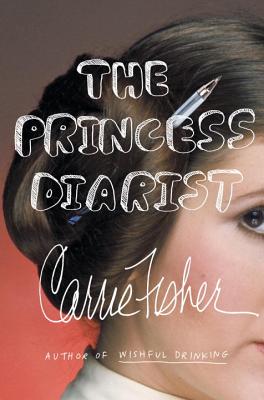
Audiobook: The Princess Diarist

princessdiaristby Carrie Fisher
Read by the author and Billy Lourd
Support your local independent bookstore: buy it there!
Content: There’s about a dozen f-bombs and other mild swearing, plus  some talk of sex (but nothing graphic). It’s in the Biography section of the bookstore.

I downloaded this to listen to on audio soon after Carrie Fisher died, thinking that I might as well find out what everyone’s been talking about (well, maybe not everyone, but people I trust) when it comes to her writing.

First of all, she’s a delightful narrator. She’s sardonic and funny (not just in the writing, but also READING the book), and I loved listening to her gravely voice reminisce about her experience in making Star Wars. And while the gossip (of sorts) about her and Harrison’s affair was interesting, it really wasn’t, for me, the highlight of the book. (In fact, the actual diaries, which Billy Lourd reads, were kind of, well, lame.) No, the highlight was Fisher. I’m sure I would have enjoyed this book in print, but hearing her read this was like sitting in a room and listening to her reminisce. It was delightful and fun, and while not perfect, highly enjoyable.

Probably much like Ms. Fisher herself. (I imagine anyway.)

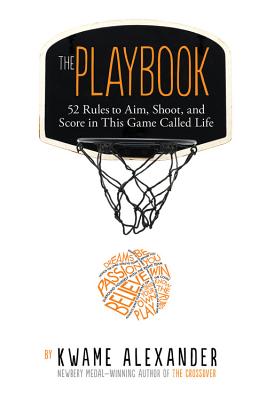
The Playbook

theplaybookby Kwame Alexander
First sentence: “In 1891, James Naismith invented the game of basketball with a soccer ball and two peach baskets to use as goals, he also had to create some rules; 13 of them in fact.”
Support your local independent bookstore: buy it there!
Release date: February 14, 2017
Review copy mysteriously appeared in my mail box at work.
Content: The biographical information and poems are written simply enough for a 9- or 10-year-old, but the content is interesting (and valuable) for everyone.

I don’t know what I was expecting from Alexander’s latest book: it’s sports, there’s poetry, pretty much what he’s delivered over the past few years. And yet, this was completely different. Springboarding from his own experiences with sports, Alexander has put together a guide book for, well, for succeeding in both sports and life. Divided up into four “quarters” (with a halftime) of thirteen “rules” each consisting of a short poem and a quote from an athlete (or some other notable person, many of whom are persons of color), this slim book packs a powerful punch.

In fact, the whole design of the book (if the ARC is reflective of the final package) is amazing. I loved the photography, the layout of the words on the page. And while it was inspirational — each of the sections was preceded by a short biographical sketch of an athlete — it never fell over into the maudlin. It’s perfect for sports fans, for kids, for those who are graduating and want a “guidebook” for succeeding — or at least wanting something to reflect on. It’s fun, gorgeous, and, ultimately, eloquent and inspiring.

Definitely one I’ll keep around for a while.

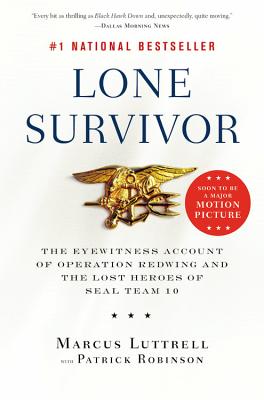
Lone Survivor

lonesurvivorby Marcus Luttrell with Patrick Robinson
First sentence: “Would this ever become easier?”
Content: It’s a non-fiction military book so there is a lot of harsh situations and swearing. It’s in the biography section of the bookstore.

No, this is not my usual reading. But I figured I’d branch out and give something that’s completely outside of my comfort zone a try. And I was willing to read this story of a Navy SEAL and their mission to capture and kill Osama bin Laden. I’d like to think I went in with an open mind, willing to hear Luttrell’s story, to listen to the justifications for war, and to try and understand what makes someone become a Navy SEAL.

And at the beginning I was mostly okay with it. I was fascinated and impressed with his recounting of his training, of the hardships he had to endure. But, the longer I read this the more one thing bugged me: this book didn’t have an editor. And it was driving. me. nuts.

“Didn’t have an editor” is an assumption. I’m sure someone went through for spelling and punctuation. But what was missing was a cohesiveness, a tightness to the story. Luttrell would repeat himself time and time again. He’d go off on a pages-long rant on the “liberal media” (two words I’m tired of hearing together; what they really mean is corporate east-coast based media, and that includes Fox News). He would quote someone and then have a paragraph explaining how this wasn’t accurate but you get the gist. In short: the publishing company did Luttrell a disservice for not giving him a good editor and making him tighten up his writing: Luttrell sounded much less intelligent than I am guessing he is. No, he’s not a writer. I get that. That’s why publishing houses hire ghost writers (and if this is Robinson’s doing, then he’s not a very good ghost writer): to make the “celebrity” story more cohesive.  It just got to a point where I couldn’t stand the circular writing, the opinionizing, and the plain bad editing.

Which is sad, because I think Luttrell’s story is a valuable one. I just wish I could have gotten through the book.

Tetris: The Games People Play

tetrisby Box Brown
Support your local independent bookstore: buy it there!
Review copy pilfered off the ARC shelves at my place of employment.
Content: It’s a history, so if you’re not into Tetris or video games, it won’t be interesting. That said, it’s not a super-high reading level, so kids as young as 10 or 11 might be interested in this. It’s in the Graphic Novel section of the bookstore.

First, a confession. One of my roommates the winter of 1991 had a Nintendo (I’m assuming, after reading this), and Tetris was on it. I don’t know how it started (and I may have been playing it in the arcade for a while already; I don’t remember), but I became obsessed with Tetris. Obsessed. I would stay up until 1 or 2 in the morning, playing it, forgoing going out, homework, eating… Eventually, after a month or so of this, my roommates staged an intervention and banned me from playing Tetris. They may have even gotten rid of the game; I don’t remember that either. The game (and my obsession) fell by the wayside, and I haven’t really thought much about it.

That is, until this book showed up in the store and a co-worker pointed it out, saying I might be interested.

It’s the history of how Tetris came to be. A couple of software developers in the USSR thought of this game, worked to program it and sent it around the department where they worked. It became a hit with their friends, and that was the end of it. Or so they thought. But, a developer for Atari and another for Nintendo got their hands on it, and, well, Things began to happen. It’s really kind of convoluted; there was a lot of legal problems, and negotiating business with the USSR wasn’t the easiest to do. But, in the end, Nintendo ended up with the rights, and the rest is history.

Choosing a graphic format to tell this story was interesting, though I’m not sure how well it worked for  me. I kept forgetting who was who (since, after the initial introduction, I only saw their faces and couldn’t remember their names), and the black and yellow color palate got a little old after a while. But, that said, the story was a fascinating one.

Not a bad read.

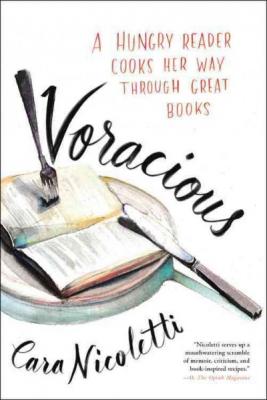
Voracious

voraciousby Cara Nicoletti
First sentence: “Growing up in a family of butchers and food lovers, I was surrounded by the sights and sounds and smells of cooking from an early age.”
Support your local independent bookstore: buy it there!
Content: There’s nothing. Hand it to anyone who loves books and food. It’s in the cooking reference section of the bookstore.

The premise of this book is simple: Nicoletti, who studied English and Latin in college but whose professional life has been as a chef (and currently a butcher), has a passion for food scenes in books.  This is something she’s always enjoyed in books, especially since she grew up in a house surrounded by both books and food. So, pairing them both — first a blog, and then in this book — is a natural thing for her.

The book itself is a series of short vignettes, each about a particular book, followed by a recipe that, for her, fits each book. It’s a delightful read; she writes about experiences in her life, about where she is when she reads each book, and about what the books mean to her. I haven’t read a lot of the books (especially as Nicoletti moves into her adult years), but it didn’t seem to matter. She doesn’t go through plots and she doesn’t make you feel on the outside if you haven’t read them. This is what these particular books mean to her, and hopefully, it will resonate with you. (It did me.) And the recipes sound delicious! From donuts and cakes to soups and blinis and caviar, it all sounds delicious, and I will probably get around to making at least a few of them (hopefully). Even if I don’t, I thoroughly enjoyed reading the recipes. (Is that just me?)

An excellent read for those of us who prefer a little food with our books.

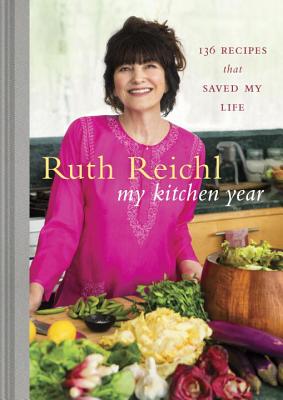
Audio book: My Kitchen Year

mykitchenyearby Ruth Reichl
Read by the author
Support your local independent bookstore: buy it there!
Content: There’s no swearing. It’s a cookbook, so it’s not something one typically reads, but her story is fascinating. It’s in the cook book section of the bookstore.

I picked this one up because I was looking for something to read. I knew it was a cookbook, but it’s Ruth Reichl, and I have loved her writing in the past. I figured it was worth my time.

And, for the most part, it was. It’s the story of the year following the folding of Gourmet magazine, of which she was editor, and how she found purpose again. And, because it’s Reichl, she found it through food.

I think, when I picked it up, I hoped there would be more stories and less recipes, but I was surprised to find that I didn’t mind the recipes. Reichl reads them as if she’s your friend, telling you how to make something (no list of ingredients at the top; I wonder what the print version looks like…), complete with advice and variations, in case you don’t like things the way she does. She has such a comfortable, familiar writing and reading voice, it was almost like spending time with a friend.

She made the food sound delicious, as well; thankfully, tis was a cookbook of the month at the store a while back, and so I know the recipes are good (especially the chocolate cake!). And the stories that accompanied the recipes — the book is organized by timeline rather than by recipe — are classic Reichl: simple and yet evocative.

So, even though listening to a cookbook is an unusual choice, I don’t regret picking this one up at all. It was delightful to spend some time hearing Reichl’s story.

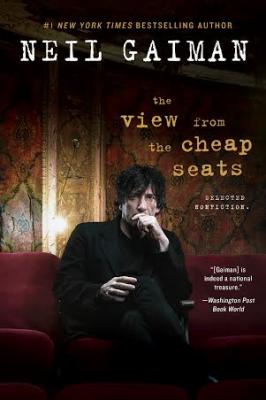
Audiobook: The View From the Cheap Seats

viewfromcheapseatsby Neil Gaiman
Read by the author.
Support your local independent bookstore: buy it there!
Content: There’s a handful of f-bombs scattered throughout the book. It’s in the creative nonfiction section of the bookstore.

I’ve often said (many times) that Neil Gaiman can come to my house and read my grocery list and I’ll be happy to listen to it. That is still true. I will listen to Gaiman read anything, including works of short non-fiction, from articles and interviews to book introductions and speeches. He has a fantastic reading voice, and I love that it gives depth to his words.

That said, this was more of a dip-in, dip-out book rather than a read straight through one. Even though I love Gaiman on audio, I found myself kind of impatient with the sections (like the one on comics) that didn’t interest me. If I had actually read this one (and many of the pieces are worth reading), I would have picked and chosen the ones (like “What the Very Bad Swear Word is a Children’s Book, Anyway?” or “Make Good Art”) that I was interested in, and left the rest alone.

But, like anything Gaiman writes, when he was good, he was interesting, and the observations were thoughtful and thought-provoking. Though audio maybe wasn’t the best choice for this one.