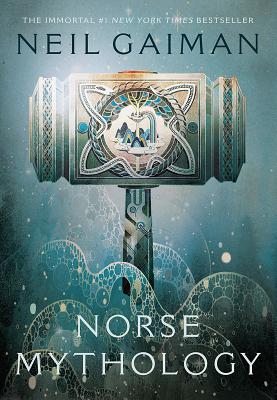
Norse Mythology

by Neil Gaiman
First sentence: “Many gods and goddesses are named in Norse mythology.”
Support your local independent bookstore: buy it there!
Content: There’s some odd situations, and a bit of violence. It’s with the other mythology books in the bookstore, but I’d give it to anyone who likes Norse mythology (like K, who wants to read this next).

This is exactly what it says it is: retellings of old Norse myths. Gaiman goes basically chronologically, beginning with with the creation of the nine words and the gods and the creation of Yggdrasil, the world-tree, and goes through to Ragnarock, and what that will be. There are stories about Thor and Loki and Frey and Freya and the giants.

It’s a good retelling, as far as retellings go — Gaiman is a talented writer, and it shows in this — though to be honest, I’m not fond of reading the myths in their original form. It’s kind of like reading short stories; I want something longer, something more cohesive. That said, I’m glad I read them, if only because I could see how Rick Riordan worked the myths into the Magnus Chase series.

I picked this up for book group, which is probably the only way I would have read it. It’s just not something I’m interested in reading. But, that said, I’m glad I read this.

Kitchen Confidential

by Anthony Bourdain
First sentence: “Don’t get me wrong: I love the restaurant business.”
Support your local independent bookstore: buy it there!
Content: There is a lot of talk about drug use and a lot of swearing (including many, many f-bombs. Kitchens are not “clean” places to work.) It’s in the Creative Non-Fiction section of the bookstore.

This is one of those books that I’ve said to myself many times over the years (it was first published in 2000) that I need to read it. I like food books. I like books about restaurants and I have heard nothing but good things about this one. Why haven’t I read it before?

Good question. And I’m glad I fixed it. And for the record: I read the original hardcover (because that’s what the library had) and not the updated paperback.

This is, essentially, Bourdain’s personal story of how he became a chef in New York. It’s not a pretty story. He wasn’t a nice guy. But, he worked hard, and he was a reliable employee, and so he climbed the ladder. And, after he went to the Culinary Institute of the Arts, he moved to New York and began making a name for himself. It was an up and down process, the downs fueled mostly by his drug use, but eventually, he landed a decent stable chef position. He talked about the people he met, and all the jobs he worked, and the dynamics of the (mostly male) kitchen. It’s crass and vulgar and foul, but I loved reading his stories. It made me slightly nostalgic for the time I worked in a restaurant kitchen (worked my way up from dishwasher to prep cook), because there really is a family dynamic to working in a kitchen. I was glad I didn’t pursue it as a career, though, because I don’t think I had the stamina it takes to actually make it in the business.

But this was a fun trip through the New York City restaurant world of the 1970s and 1980s and I really enjoyed Bordain’s version of it.

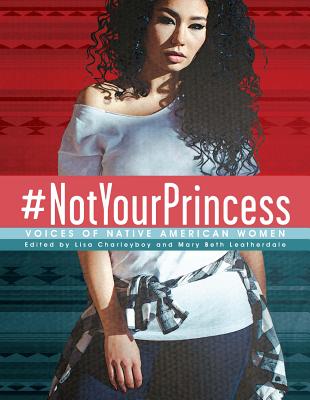
#NotYourPrincess

edited by Lisa Charleyboy and Mary Beth Leatherdale
Support your local independent bookstore: buy it there!
Content: It’s tough content, talking about abuse and rape. It’s in the Teen Issues (Non-Fiction) section of the bookstore.

This is not the sort of thing I usually pick up: a book of art and poetry and essays. But, my biggest take-away from the Multicultural Literature class I just finished was that 1) there isn’t a whole lot of Native literature out there and 2) I don’t read any of it. So, I decided that I need to try and fix that. At least to some extent. I remembered that this one had recently come out (I had ordered it in for the store), but didn’t know anything about it. So I checked it out.

It’s a compilation from Native women artists, all from different nations, who are expressing themselves. From connections to their past and future, and what their heritage means to to them; to the challenges of being a Native woman today. It covers all of North America, so there are voices from Canadian indigenous women as well as those here in the U. S. It’s sometimes harsh reading, especially for an outsider looking in, but it’s ultimately uplifting and empowering. I’m incredibly glad a collection like this exists, and I’m glad I was compelled into picking it up.

Audiobook: Save Me the Plums

by Ruth Reichl
Read by the author
Support your local independent bookstore: buy it there!
Or listen at Libro.fm
Content: There is some swearing, including multiple f-bombs. It’s in the biography section of the bookstore.

I adore Ruth Reichl and have since I read Tender at the Bone a very long time ago. (While I was listening to this, I was wondering if I knew who she was before she became the editor in chief of Gourmet, or after. I’m still not quite sure.) She has a way with telling a story (granted: I have not read her work of fiction) and with writing about food. And this book — the memoir of her time as Gourmet editor in chief from 1999-2009, when the magazine folded — is no exception.

Reichl weaves the story of how she became the editor in chief and her experiences with Condé Nast with memories of growing up and her family, both her parents and her husband and son. She tells stories of how stories came to be, of working with editors and art directors and photographers and chefs. As someone who once studied journalism and who has an affection for the profession, I adored this. I loved seeing the inner workings of a magazine (and was wistful: in another universe, I am a food and travel writer, I think) and I thoroughly enjoyed the way she talks about food.

I know some of my co-workers haven’t enjoyed this as much as they liked her other books, but I disagree: this is quintessential Ruth Reichl, talking about what she knows best: food and community.

I especially loved it on audio: she is a fantastic narrator, and knows how to make you feel like you’re sitting with her as she spins these tales. I absolutely loved it and am very sad that it’s done.

The Library Book

by Susan Orlean
First sentence: “Even in Los Angeles, where there is no shortage of remarkable hairdos, Harry Peak attracted attention.”
Support your local independent bookstore: buy it there!
Content: There is some mild swearing and a few disturbing moments. It’s in the History section of the bookstore.

In the spring of 1986, in between the Challenger explosion and the Chernobyl disaster, the Central Library in Los Angeles caught fire. It was a huge fire, burning for hours and destroying hundreds of thousands of books. It’s something that people in LA remember, but outside of LA? Who knew? So Orlean, who is a masterful non-fiction writer, tackled the story. It’s not just an investigation into the fire — they suspected someone and arrested him, but they never had enough evidence to charge him, and then he later died from AIDS — but a history of the LA library system and an exploration of what the LA library is now.

It’s probably no surprise, but I loved this one. It’s incredibly well-written and utterly fascinating. I think part of me was hoping that she’d “solve” the arson — though she did have a chapter talking about arson crimes, and how investigating them has changed in the last 30 years, and speculated that maybe the LA fire wasn’t arson — but, really, I was just along for the wonderful ride.

And do pick up a real copy of this book. The package is absolutely beautiful. It’s a reminder why books — and libraries! — are important.

Audio book: Kitchen Yarns

by Ann Hood
Read by Nina Alvamar
Support your local independent bookstore: buy it there!
Listen at Libro. fm
Content: There is some mild swearing and one f-bomb. It’s in the creative non-fiction section of the bookstore, but it could just as easily go in with the cookbooks.

This is a collection of (previously published?) essays and recipes as Hood recalls her life, from her childhood in her Italian American family, through her first marriage and death of her daughter to her current marriage. It’s a very chatty book (which I liked a lot), and while it’s not incredibly linear (she jumps around in time and repeats herself some), it is thoroughly enjoyable.

I’m not sure what made me pick this one up… I do like foody books and memoirs and maybe the combination of the two? (And while the narrator was excellent, I felt let down that it wasn’t Hood narrating her own book.)

As for listening, while I enjoyed it, I might also want to pick up a paper copy, because I want to try out a couple of the recipes, and that’s difficult with just the audio version! But it was a delightful listen, being immersed in food, especially during these winter days.

Audio book: My Life as a Goddess

by Guy Branum
Read by the author.
Support your local independent bookstore: buy it there!
Listen to it at Libro.fm
Content: There was a bunch of swearing, including many f-bombs, and frank talk about sex. It’s in the humor section of the bookstore.

I have, in fact, mentioned my weakness for celebrity memoirs, especially if I can listen to it on audio. They just hit my happy button. And I’ve just found out that I enjoy them, even if I don’t know who the celebrity is! (As in this case.) I found out about thins one through Pop Culture Happy Hour when it was recommended by my favorite crank, Glen Wheldon. (Who actually has a reference in this book…) Anyway. This is basically Guy’s story about how he went from the boring farm town in the Sacramento Valley (I really enjoyed his diversions about agriculture!) to being a stand-up comic and a comedy writer. It was quite hilarious, but also introspective and touching. I think one of the things I like best about these kind of books is hearing someone else’s story, learning how they got to where they are today. Branum didn’t have an easy life; he was often ostracized as a child (not to mention his sister, who was really only alluded to) and his parents — especially his father — cut him off when he came out. He made a wrong turn going to law school, and I liked knowing that other people make wrong turns and turn out okay. I also thought his rant about the cultural biases against clubs (I may never listen to Shape of You by Ed Sheeran the same way again. Or Bohemian Rhapsody).

I loved every moment listening to Guy tell his story (the best bits where when he cracked himself up). A delightful book.

Sissy

by Jacob Tobia
First sentence: “I never really got to have a childhood.”
Support your local independent bookstore: buy it there!
Review copy provided by the publisher.
Release date: March 5, 2019
Content: There is swearing, including multiple f-bombs, and some talk of sex. It will be in the Biography section of the bookstore.

Jacob Tobia (they/them) is a lot of things: a writer, an activist, a performer, a producer. What they are not is someone who fits into what society has defined as “male” and “female”. This memoir, which is absolutely delightful to read, follows Tobia through their childhood, as they struggle with their “male” body and their desires to present more feminine.

To be honest, I have no idea if I’m even talking about this correctly. I really did enjoy reading Tobia’s book, and it made me think about the way I was raised and the things that I have either consciously or unconsciously inherited from society, and the way I look at other people. But, aside from being challenging — not a challenging read, but it did give me things to think about — it was highly entertaining. Tobia has a great writing voice, and the book is fun and funny as well as heartbreaking at times. It’s made me think about trans people (especially since my nephew is trans) and the ways in which society at large just isn’t equipped to handle people who don’t feel they fit within a binary system. (And it’s little things, like gendered bathrooms, or a pregnant co-worker who says “We found out the gender; it’s a boy!” that are making me think.)

I think Tobia has an important story that is not only relevant, but entertainingly told and highly engaging as well.

Audiobook: The New Farm

by Brent Preston
Read by: Chris Henry Coffey
Support your local independent bookstore: buy it there!
Or listen at Libro.fm
Content:  There’s some swearing, including a handful (6 or so) f-bombs. It’d be in the sociology or gardening section of the bookstore, if we had it. 

To be honest, this is usually the sort of book that my husband would read: the story of a couple of Canadians who got tired of working the office grind and city life, and decided to head out to the country and start an organic farm. I don’t know if that’s something he would like to do, but it’s definitely something he admires. I don’t know what made me pick it up; I suppose I was curious to see what went goes into making a sustainable, small, organic farm work and survive as a business. And I guess it just sounded interesting. 

And it was, for the most part. Preston and his wife Gillian had a super huge learning curve with this farm, and he doesn’t mince words about all the things that went wrong. Or how much money they lost during their first two or three years. He was also pretty frank about how running a small, sustainable, organic farm is a community effort: they started making progress financially when they reached out and found communities to be a part of, and ways to increase their reach. Growing excellent produce isn’t enough (though it’s important); you also need to have ways to reach people, and ways to get help working the farm. 

I did pick up some good gardening tips, things to help with the soil in our little garden, and things to help with growing plants better. And I did find the narrator entertaining (though I assumed it was the author reading it; I was mildly disappointed when I found out it wasn’t). My only real complaint is that it only went through the first couple of seasons, and it just kind of … ended. That may have been my version of the audiobook, but the narrative just stopped. But, if that’s the only complaint, it’s not that bad. 

American Dialogue

by Joseph Ellis
First sentence: “Self-evident truths are especially alluring because, by definition, no one needs to explain why they are true.”
Support your local independent bookstore: buy it there!
Content: It’s a work of scholarship, even if it’s written for a mass audience. There are footnotes and endnotes, etc. It’s in the history section of the bookstore. 

I picked this one up because I was curious after hearing an interview with Ellis on the New York Time Book Review podcast. I’m not quite sure what it was that he said that made me want to pick it up, but after hearing it, I put it on hold at the library. 

The basic premise is this: Ellis takes a look at four of the American founders — Jefferson, Adams, Madison, and Washington — each through a prism of an issue that is both relevant back then and today. Jefferson gets race; Adams, equality (monetary, not gender); Madison, law; and Washington, war. Ellis dissects each man’s letters (easiest to do with Adams, most difficult with Washington), speeches, and papers, in order to come up with what they were thinking about when they framed the country — from the Declaration to the Constitution, but especially the latter — and what we can learn from that. 

And I think that the take-aways are striking. Ellis starts from the position that slavery and the genocide of the indigenous peoples are America’s original sin, the things that we have yet to redeem ourselves from. We (especially today) have forgotten that the Constitution was never meant to be written in stone, but is, in fact, a living document that’s supposed to change and adapt to the needs of a growing and changing country. He admits that the founders were geniuses, but they were also human, with flawed logic and changing opinions. 

I’m not sure it’s a book everyone Must Read, but I found it fascinating to learn about these men and the ideas they had.