Black is the Body

by Emily Bernard
First sentence: “This book was conceived in a hospital.”
Support your local independent bookstore: buy it there!
Content: There is swearing, including a few f-bombs. Also, an entire chapter is devoted to teaching and talking about the n-word. It’s in the biography section of the bookstore.

This has been on my radar for a while; everyone — well, all my coworkers — said it was a really good exploration of one person’s experience as a Black woman moving through White spaces.

And it was that. Bernard grew up in Nashville, but went to college at Yale, and teaches in Vermont, so she is often the only (or one of the only) Black people in a space. In this series of essays, she explores what that means. She talks about an act of violence she experienced, the adoption of her daughters, her relationship with her White husband, and tells the stories of her mother and grandmother’s lives.

It’s an interesting book, one that is very personal to Bernarnd’s own experience. She doesn’t pretend to have answers, but does ask a lot of questions about how White people treat and react to Blacks. It was worth a read if only to think about how I am reacting to others.

That, and it’s a series of personal stories, which I always enjoy. So while this was not my favorite book about race, it was a good book. Because everyone’s perspective is worth hearing.

Audiobook: Wandering in Strange Lands

by Morgan Jerkins
Read by the author
Support your local independent bookstore: buy it there!
Or listen at Libro.fm
Release date: August 4, 2020
Content: There is some swearing including a few f-bombs and the use of the n-word. It will be in the biography section of the bookstore.

Morgan Jerkins is a writer, but she’s also the daughter of a New Jersey woman and a North Carolina man. The central question she grapples with in this book is this: how has moving away from her families’ roots in the South (after slavery, but mostly during the Great Migration) affected their connection to the land, to their communities, and to each other? She explores this question by visiting South Carolina and talking with and trying to understand the histories of the Gullah people there. She heads to Louisiana to talk to Creole, and to Oklahoma to explore connections between African American freed slaves and the Cherokee nation. And she finally heads to Los Angeles. Through all this, she unearths her family history and stories, as much as she can, and that it was White Supremacy and Institutional Racism that was the driving force for much of what her ancestors experienced.

A friend once told me that you can talk statistics and data at people, but it’s the stories that really matter. And this book brings that home. Yes, I knew there was (and is) Institutional Racism and white people were (and are) discriminatory and prejudiced against black people to the point that they want to push them out. But, hearing Jerkins’ stories gets that point home in a way data just doesn’t do. It also reminded me of the importance of knowing where you’re from and knowing your family’s stories. (I have been very bad about passing this on to my children.)

It’s an interesting story, and Jerkins is an interesting narrator to guide the story along its path. I’m glad I read it.

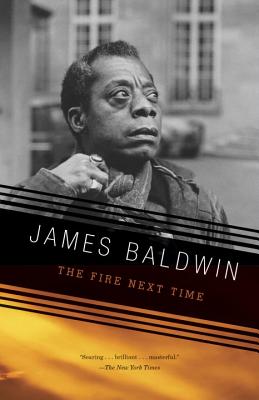
The Fire Next Time

by James Baldwin
First sentence: “Dear James: I have begun this letter five times and torn it up five times.”
Support your local independent bookstore: buy it there!
Content: There is some mild swearing and use of the n-word. It’s in the sociology section of the bookstore.

This is two essays — or one essay and a letter to Baldwin’s nephew — on the state of being Black in America. In 1962. Short version: It wasn’t easy. And it’s a sign of my privilege that I am just now realizing two things: 1) that life for a Black person in the early 1960s was not an easy or enjoyable one and 2) that it’s not changed very much for very many people in nearly 60 years. That’s the thing that stood out to me most about this book: it’s still relevant. And it shouldn’t be. This book should never have had to be written. This book shouldn’t have to be still relevant. And yet, it was and is. And it’s a sign that I am a privileged person that I am just NOW realizing this.

I think I enjoyed this more than If Beale Street Could Talk, because I think Baldwin’s style is more suited to essays and rumination than fiction. He has a very thoughtful, lyrical prose style which I thought suited both the impassioned letter to his nephew (which brought to mind Between the World and Me) and his essay about his youth and experiences with the Nation of Islam.

It’s definitely an excellent book.

Audio book: The End of Policing

by Alex S. Vitale
Read by Michael Butler Murray
Support your local independent bookstore: buy it there!
Or listen at Libro.fm
Content: There is some description, none graphic, of abuses by police officers over the history of policing in the United States. It’s in the sociology section of the bookstore.

When all the protests started happening around the death of George Floyd, one of the things I heard and saw was a call to defund the police. I had no idea what that meant, and so (as I do), I found a book — the author was in a story on NPR — to explain it to me.

Vitale, a sociology professor at Brooklyn College, collects data in various areas, from homelessness to the war on drugs to protest policing, about how effective the police force and criminal justice system is in the United States. The short answer: the police are completely and utterly ineffective in dealing with problems in communities. They are there to protect those who have property (usually white people) from those who don’t (usually poor, non-white people). And the methods they use are, to be frank, racist and ineffective.

The data in the book is a bit old; the most recent is from 2014-2015, but I don’t think much has gotten better. Vitale asserts that without real reform — and not just more “diversity training” — to communities and the way they tackle things like poverty, joblessness, mental illness, and immigration then searching for “criminals” and arresting Black and brown youth are not going to solve the problems. In short: defund the police and send the money into the social programs that we have been starving for 40 years.

The thing is: this isn’t a Republican/Democrat thing. Vitale reminds readers that Clinton and Obama were as bad promoting policing as the answer to being “tough on crime” as Reagan and the Bushes were. It’s a policy thing. Which reminds me of something else I’ve seen: the system isn’t broken. This IS the system. The way policing has developed in this country is inevitably skewed against the poor and the non-white. And to change it will take an overhaul of not just policing, but the whole system. It’s not going to be fixed with short-term, “look at us we’re doing ‘reforms'” bills, but a constant holding politicians and elected leaders accountable for the money that is going into the policing system.

And I think Vitale has convinced me that we really do need to #defundthepolice.

Audio book: Me and White Supremacy

by Layla Saad
Read by the author
Support your local independent bookstore: buy it there!
Or listen at Libro.fm
Content: There is some mild swearing. It is in the Self-Help section (I think?) of the bookstore.

I am going to say this up front: I read this book wrong. It was meant to be an interactive 28-day journey with journaling and extensive deep reflection. However, that just doesn’t work (for me) in audio format. I listen in the car or doing a puzzle, and it’s just not conducive to a lot of serious reflection. So. I am going to purchase this book (when it’s reprinted; it’s on backorder now) and do the actual work.

Some thoughts though:

This book, by a Black woman, centers on how white people are privileged by the system we live in. Saad asks some tough questions, explains some tough concepts (like white privilege and white fragility), and encourages readers to do the work to become anti-racist and more inclusive. She also asks about concrete commitments we (white people!) can make in order to continue the lifelong pursuit of becoming anti-racist. It’s a challenging book to read, if only because she (very calmly and eloquently) challenges the very fabric of the society white people are used to.

And for that, it’s very much worth reading.

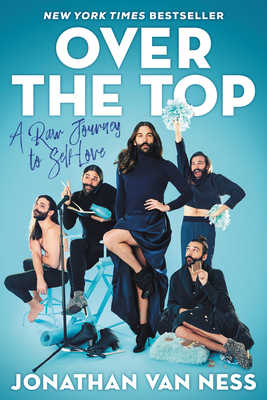
Audiobook: Over the Top

by Jonathan Van Ness
Read by the author
Support your local independent bookstore: buy it there!
Or listen on Libro.fm
Content: Jonathan has not lived a PG-13 life, and his book reflects that. It’s in the biography section of the bookstore.

Much like Tan France’s memoir, I listened this for the sheer pleasure of getting to “know” another person’s story. Jonathan grew up in Qunicey, Illinois, as one of the few out gay people in the town (as he said: “Hunny, I was never in!”). It wasn’t easy. He’d experienced sexual abuse at a young age at the hands of a family friend, and spent most of his childhood and 20s trying to suppress the shame and trauma that came along with that abuse. It doesn’t make for a light, fluffy, fun book, but that’s the point. JVN is known on Queer Eye for being the positive, optimistic one, and he sets out in this book to share all the parts of himself with us. Part of that is bubbly and optimistic, but there’s a lot that isn’t. He’s been through a lot. And I’m glad he’s talking about it.

He was absolutely delightful as a narrator, as well. I liked that he made himself giggle at times and that his voice was choked with emotion at other times (the death of his stepdad, whom he loved, was particularly hard). It’s a very personal story, and I’m glad I chose to experience it in this personal way.

It’s not high literature, but I never expected it to be. It is engaging and entertaining and enlightening, though. And I loved it for those reasons.

Why We’re Polarized

by Ezra Klein
First sentence: “‘I’ve spent a part of every day since November 8, 2016, wrestling with a single question,” writes Hilary Clinton in What Happened.”
Support your local independent bookstore: buy it there!
Content: There’s some mild swearing. It’s in the Current section (it’s where we put all political books) at the bookstore.

I don’t usually read political book. I leave that to my husband, who then (sometimes) summarizes them for me. But the title of — and the idea behind — this one captured my attention. I have noticed over the past four years (though probably longer, if I’m really honest) that we’re just getting more and more polarized politically, and I wanted to know what to do about it.

Well the bad news: Klein doesn’t have a whole lot of ideas about “what to do about it”, and what ideas he does have probably don’t have much chance of getting passed (get rid of the Electoral College, increase the Supreme Court to 15 people, and so on). But what he did do was help me understand how we got to this place. And the reason? It’s actually a logical growth from the way politics has been headed since the 1960s. In short: political parties could agree and compromise more because they both basically agreed that black people were the worst. Change things so black people have rights, and suddenly (well, over time), one party becomes a haven for everyone who thinks that’s a Bad Thing and the other party becomes more open to diversity. Sure, that’s simplifying, but it has a lot to do.

There are other reasons: how politics have become national (can you name your state representative?) instead of local, and that’s more polarizing. Or how parties have become less about politics and more about identities and how we identify. It’s less about concrete policies and more about ideologies, which isn’t a great way to run a country.

So, even though it’s not terribly helpful on the action end of things, it was quite fascinating to understand how we got to this point. Especially for someone who doesn’t read a lot of political science scholarship.

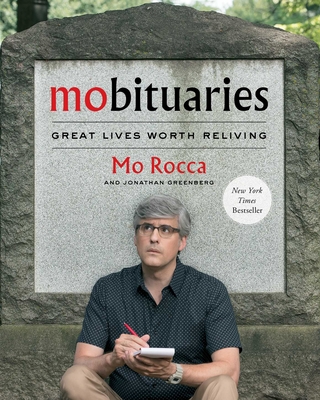
Audio book: Mobituaries

by Mo Rocca
Read by the author.
Support your local independent bookstore: buy it there!
Or listen at Libro.fm
Content: There may be some mild swearing. And sometimes the topics are kind of gross. It’s in the biography section of the bookstore.

I picked this one up because I like Mo Rocca on Wait Wait Don’t Tell Me. Which is also the reason I picked to listen to it rather than read it. I enjoyed listening to Mo tell these stories — some of which I knew, most of which I didn’t — about people and ideas that have passed on. The problem? In audio, while it was going, I was interested and entertained. Afterward, though, I couldn’t tell you a single thing about what I heard. Maybe it’s just how I retain knowledge, maybe it was a bit the way the book was structured (it was more a trivia book than anything else), but I didn’t retain a single thing. It’s very much a bathroom book: read a story while you go to the bathroom, and then put it down.

That does’t mean it was bad. Mo is very entertaining, both as a writer and a reader, and some of these stories were quite fascinating. But it just didn’t stick with me in the long run.

So: entertaining, but not really informative.

Stamped From the Beginning

by Ibram X. Kendi
First sentence: “Every historian writes in — and is impacted by — a precise historical moment.”
Support your local independent bookstore: buy it there!
Content: There is some swearing, including a few instances of the f-bomb and many of the n-word. It’s in the history section of the bookstore.

I picked this one up after listening to Stamped, which is a remix for younger readers of this history. I didn’t know what to expigect, but what I got was a book that made me rethink my perceptions of race, race relations, and class, and rethink what I was taught in history classes.

The basic idea that Kendi sets out to demonstrate is this: racial discrimination leads to racist ideas which lead to ignorance and hate. It’s the reverse of everything I had been taught which is: ignorance and hate lead to racist ideas which lead to discrimination. It’s a lot to wrap a (racist) brain around at first, but over the course of the 500 pages, Kendi does an excellent job showing how, throughout history, racism starts with racist people being self-interested and creating racist policies. I learned a ton.

I don’t know if there are any solutions to be found in the book. Except for the conclusion that self-sacrifice (of Blacks) and uplift suasion (Black people being “more like White people”, which is a racist idea), and educational persuasion (if white people just had “all the facts” about racism they wouldn’t be racist) don’t work. It will take a concerted effort of White people and Black and Brown people to realize that it’s in the best interest of ALL people to do away with racist policies.

I don’t know what the political and economic solution for this is (except maybe tax the wealthy and refund all the social programs that have been axed over the years). But I do know that it is important for corporate media (!) and White people to stop generalizing and stereotyping Black people.

As for me, this book made me rethink ideas I’ve had in the past, rethink the way I interact with the media and politics, and perhaps made me a little more antiracist. I can only hope.

Audiobook: Catch and Kill

by Ronan Farrow
Read by the author
Support your local independent bookstore: buy it there!
Or listen at Libro.fm
Content: This book is about sexual predators, and Farrow doesn’t pull back from descriptions of sexual harassment, assault, and rape. It’s not prurient and it’s not graphic, but it may be triggering. There is also swearing, including multiple f-bombs. It’s in the True Crime section of the bookstore.

I heard a story about this book somewhere, in a report about the Harvey Weinstein trial. The report said that they were having trouble finding neutral jurors, mostly because so many of them had read this book and had already made up their minds about Weinstein.

And they’re right. You come out of this book knowing that not only is Weinstein and evil man, every single person, corporation, or entity that protected him and enabled him (and other predators, like Matt Lauer) are also completely and totally corrupt.

This book is Farrow’s story about getting his 2017 New Yorker article about Harvey Weinstein published. See, it didn’t start out as a New Yorker article; Farrow was an on-air reporter at NBC news when he first started looking at leads and conducting interviews about Weinstein’s history of sexual predation. Farrow interviewed several women, corroborated their stories, and was set to put something on air, when NBC pulled it. It goes deeper than that: Weinstein had private investigators tailing Farrow, looking for dirt that he could use to kill the story. NBC has its own history of talent and others harassing, abusing, and raping women in vulnerable positions. It all adds up to not only a toxic male culture, but one in which I end up mistrusting corporate journalism. I don’t blame the journalists — Farrow (and others) did his job to the best of his ability. But, at many points, his bosses were telling him to cancel interviews and tried incredibly hard to kill the story, and if Farrow hadn’t 1) been a male and 2) he hadn’t had a couple people on his side urging him to keep going. It’s so easy for corporations and advertisers and powerful individuals to kill stories they don’t like.

It wasn’t an easy book to listen to because of the subject matter, but Farrow was a compelling writer and an excellent narrator. I know it sounds odd to say I enjoyed every minute of this, but I really did. I kept wanting to know what happened next, and Farrow’s narration kept me engaged.

It’s not only an important book, it’s a good one.