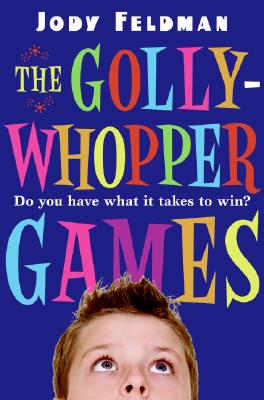
The Gollywhopper Games

I was totally charmed by this book. Sure, it’s a book about a kid who solves puzzles to win stuff (my initial thought was “oh, dear, ANOTHER puzzle book?”) but the feel of the book completely won me over. I smiled. I cheered. I was thoroughly entertained.

The Gollywhopper Toy Company is having a contest to celebrate its 50th anniversary. only 2500 kids, ages 11 to 15, will be allowed to compete, and Gil Goodson is one of those kids. The son of a former Gollywhopper executive (he was arrested under suspicion of embezzlement, but ended up wtih a not guilty verdict after a trial), Gil is determined to win. Partially to “get back” at the company that made his father’s (and his) life so miserable, but partially because he’s made a deal with his dad: if Gil wins, they’ll move.

The book is mostly about the games — a series of questions and puzzles that Gil (and the decreasing number of contestants) have to solve. It’s a bit like Mysterious Benedict Society that way, except that Gil isn’t one of those pretentious geniuses figuring everything out. In that way, I think that The Gollywhopper Games is more accessible: Gil’s just a regular guy who happens to be pretty good at deductive reasoning. The puzzles were tricky, but nothing over the top. And yeah, they were kind of fun to figure out. But it’s also about Gil making peace with the past, about working together, and about gaining the confidence to do not only what is right, but what you think you can do. It’s not an especially challenging or even plot-heavy book, but I’m not sure that’s the point. I think it’s more about the mood — about having fun and doing your best, and enjoying the ride while you’re at it.

Of course Gil wins in the end– like Charlie Bucket, there’s no doubt that he would. But getting there is a whole lotta fun. Which makes it charming, fun, and ultimately quite satisfying.

(Just for the record: because this is a Cybils nominee, I’ve been asked to make sure y’all know this is my opinion only, and not that of the panel. Thank you.)
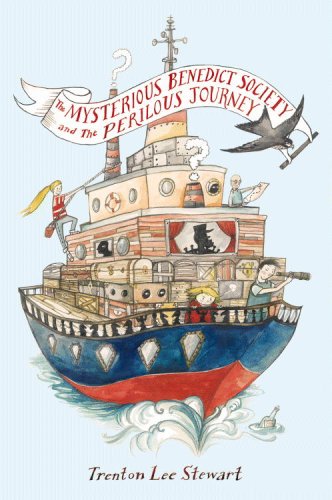
The Mysterious Benedict Society and the Perilous Journey

I picked this one off the library shelves because it was a Cybils nominee, but I knew nothing beyond that. Turns out that it’s a second-in-a-series, but, hey, I found out that it works well as a stand-alone. I’m curious to know what happened in the first adventure, but Stewart did a smashing job working it into the plot of this book, so I really didn’t feel too left out. (Which, I suppose, could be a complaint: I wonder if it came off as too heavy-handed on the back story for those who’ve read the first one?)

The basic plot surrounds four children — Reynie, Sticky, Kate and Constance (who’s only three, an important point to remember) — who are geniuses, children with “special” talents, and part of a society founded by their patron, and friend, Mr. Benedict. This book takes place a year after the first adventure, when the four were going to meet Mr. Benedict for a special surprise. However, it turns out that Mr. Benedict, along with his assistant, Number Two, has been kidnapped by their nemesis, Mr. Curtain, and is being held for ransom. And (because it is the way in these books), it’s up to the four to follow Mr. Benedicts clues and rescue him. And (because it is the way of these books), it doesn’t go exactly to plan, ensuring that adventures, near-scrapes, and some close calls will occur.

Sounds corny, but I really enjoyed this book. Sure, my sophisticated brain was saying “These kids are precocious twerps” and “yeah, right” but, as is the way with blow-em-up-movies, I was having too grand a time to care. I liked the precocious kids, especially how they worked together. If there ever is a book about mind over matter (brains over brawn!), this is one. Hooray for the geeky genius kid who knows everything. But beyond that, the book screams for it not to be taken seriously. A random passage:

“How do you know all that? Constance asked.

Milligan glanced at her. She was sitting up straight in the passenger seat — unlike the others she hadn’t needed to duck — and Milligan frowned as something occurred to him. “You should be in a child’s car seat. It’s dangerous without one.”

Constance looked at him incredulously. “Are you joking?”

“A bit. Still, let’s do buckle up, everyone.” Keeping his eyes on the road, Milligan reached across and pulled down Constance’s seat belt strap, which because of her height (or lack thereof) ran diagonally across her face. She glared at him with her one visible eye.

“Feel free to adjust that,” Milligan said, giving her a lop-sided grin.

I think it’s meant to be all in good fun (nobody gets killed, for heaven’s sake), and for the sense of adventure — and friendship, and working-together-ness — to win out over anything more sinister. And I think the book is better for it. If it had been serious (think, oh, Alex Rider), I probably would have mocked it for its pretentiousness. But because it’s lighthearted, because it invites you to laugh along with the story, it’s able to tell a pretty far-fetched story without seeming heavy-handed. (And come off with a good “moral” in the end.) As and added bonus: no cliff hangers, no to-be-continued; the story nicely wraps itself up, while leaving just the slightest thread that could be spun into yet another book.

Which makes it that much better.

(Just for the record: because this is a Cybils nominee, I’ve been asked to make sure y’all know this is my opinion only, and not that of the panel. Thank you.)
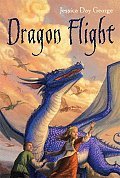
Dragon Flight

I’m on a bit of a middle grade kick right now…

I actually stayed up a bit late last night finishing this one, partially because I could, but mostly because I was enjoying myself and I lost track of the time. A sequel to
Dragon Slippers, this essentially picks up a while after it left off. Since it’s been eight months since I read the first, I was a bit fuzzy on all the details, and I was actually hoping I could read this one okay as a stand-alone, and that I wouldn’t be missing too much if I didn’t re-read the first book.

Thankfully, George spins a good stand-alone tale, weaving in just enough details to remind me of the basic plot of the first book, without bogging the plot of this book down. It picks up basically where Slippers left off, with Creel as a fairly successful dressmaker and Prince Luka off to a neighboring land as ambassador. We find out that the dragons — Shardas and his mate, Velika — are alive but seriously wounded. Then Luka sends word that the neighboring country is planning on attacking Feraval… with hundreds of dragons. This shocks everyone, not least Creel, and she (with her trusty sidekick and friend, Marta) heads off to figure out what the big deal is. (This is not just because if she didn’t, the book wouldn’t work, but because Creel has been deemed a “dragon expert”.) From there, they discover deeper, more sinister plots, and work to not only save themsevles, but the dragons.

I think it works well as an action book, though I was a bit disappointed in the climactic battle scene. I remember liking the budding romance between Creel and Luka, and this, while lacking the intensity I usually like, built nicely upon their relationship and has a good (or perhaps it should be silly?) proposal. I’m sure there’s more that I could nitpick, but honestly, I’m tired and so I won’t.

In all, though, it was a fun way to spend an evening.

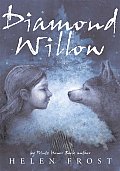
Diamond Willow

After reading Sarah Miller’s enthusiastic review of this today, I went upstairs and plucked it off my pile (it being there because it’s one of the Middle Grade Cybil nominees). I’m so very glad I did.

It’s a beautiful book — both to look at and to read. There are no illustrations, but the poems themselves are works of art. Each poem is a shape of the diamond willow sticks (for a picture, either go to Sarah’s or to Helen Frost’s website), with a darker hidden message in each one. I loved paging through the book, just looking at each individual shape (I don’t think there are two alike). But in addition, the words themselves are carefully, simply and yet powerfully chosen. I like how each poem each builds the story towards a most satisfying conclusion.

The story is pretty simple: Willow, a 12-year-old part-Native Alaskan who lives in a remote town, is struggling with herself, with school, with finding happiness. She begs her parents to drive the sled (with three dogs) to her Grandparents house one weekend, and on coming back there’s an accident. From there, it builds and to go on would spoil your experience, so I won’t.

There are so many things to like in addition to the simple beauty of the book. There’s the ancestors spirits who are guiding and helping Willow along her path. There’s a subtle, understated humor about it. There’s a respect and love of nature. There’s a wonderful human-dog relationship (which made me think of my sister, who would love this book). And I think Frost captured the insecurities and hopes and determination of a 12-year-old who is trying to find herself.

In all, it was one of the best hours I’ve spent in a long time.

(Just for the record: because this is a Cybils nominee, I’ve been asked to make sure y’all know this is my opinion only, and not that of the panel. Thank you.)
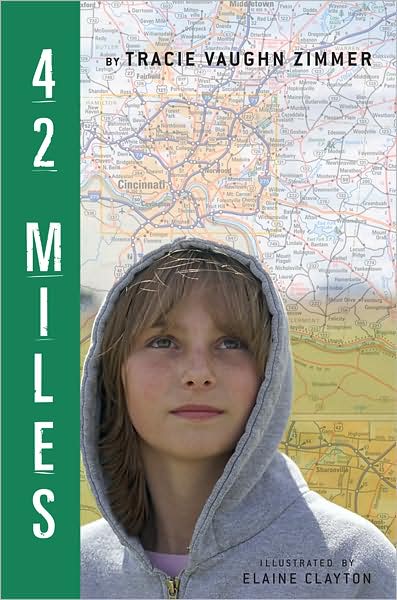
42 Miles

Continuing my light, quick and delightful reads…

JoEllen is the child of a divorce. With her mother, she is Ellen, lives in the city, going to movies and eating Chinese take-out. On weekends, with her father, she is Joey, and lives a carefree life on the farm. It’s hard keeping up a dual life, and shortly before her 13th birthday, JoEllen decides to take charge and not only bring her two halves of her life together, but forge a new one for herself.

This book’s charm, however, isn’t in its plot. It’s written in verse, and while I still have a “thing” about poetry, I’m finding that I manage to “get” novels written in verse. I liked JoEllen’s voice, I loved the poems. I am always amazed that an author, in this case Tracie Vaughn Zimmer, can pack so much into so few words. I also felt that Zimmer caught the feelings of a divorced child (or what I imagine a divorced child must feel, not having experience there myself), being torn between two parents, two worlds.

While I wasn’t blown away with excitement over it, I did enjoy the time spent, and I even managed to come away with a favorite poem, which interestingly enough is about poetry, and which I think captures the essence of the book perfectly:

The Poems I Like Best
The poems I like best
wear classic black
with vintage accessories
and smell like a new book,
and the spine just cracked.
They’re the chitchat overheard on a city bus
or nonsense
volleyed between toddlers
on swings at the park.

My favorite poems
squeeze your hand
on a crowded street and say:
Look.

The poems I like best
wear blue jeans
and smell
like the tack room of a barn:
worn leather and horse.
They’re the varied verses
of a mockingbird’s song
or syllables traded between brothers
scratching scruffy chins
over the dark mysteries of an engine.

My favorite poems
hold a wooden spoon of words
and whisper:
Taste.

(Just for the record: because this is a Cybils nominee, I’ve been asked to make sure y’all know this is my opinion only, and not that of the panel. Thank you.)

The Dragon’s Son

I picked this one up to round out Becky’s King Arthur Challenge, mostly because I felt bad that I didn’t finish the John Steinbeck book. I found it through a random search of the library’s catalog; I knew I wanted a young adult or middle grade book, but that was all. After a bit of looking, this one popped out at me. Sarah Thomson takes a new and interesting approach to the legend: not only does she go back to the earliest Welsh stories of Arthur, she tells the story from the point of view of the lesser-represented characters (Nimue, Morgan, Luned and Medraud/Mordred) rather than from the usual perspectives.

Essentially a collection of four short stories (everyone gets a few chapters to tell their tale), I was impressed not only with the stories themselves, but with the way they were used to propel the entire myth forward. Thomson manages to tell the entire Arthur story — from conception to death — in 181 pages, and while it wasn’t as in-depth as it could have been, I don’t feel like I missed anything.

The book begins with Nimue, and tells her story from her meeting Myrddin through their relationship to his death. It covers a huge amount of time, but her primary role is to tell about the conception and birth of Arthur. Morgan comes next, but her fundamental character has been changed: she’s not a witch or even a Lady of Avalon. Instead, she’s a bitter, slighted sister of Arthur. She saw her father’s murder by Uther, and she was never able to forgive Myrddin for that. So, when she married Arthur (interesting twist, I thought) and he took her to the castle, she left him because he wasn’t willing to get rid of Myrddin. The story then switches to Luned, who is the handmaid to Elen, Morgan’s sister. This one I found the most fascinating. It involves Lancelot, called Owain here, and how he came to marry Elen/Elaine. Thomson made Elen terrified of men, mostly because she was married off at 12 to a brute of a man. Luned is Elen’s voice, her strength, her solace. It’s only after Luned brokers a marriage to Owain for Elen’s saftey (after her former husband’s death), that Elen learns to love. Unfortunately, Owain’s heart belongs to another, and Elen pines away in a monestary. It moves the story forward, though, because Elen is given Gwydre, who is Arthur’s heir (another interesting twist; Morgan had twins) to raise. The last story is Medraud/Mordred. His is the most tragic, the most bitter. Growing up as the son of Morgan, he is not only influcenced by her mother’s wanton ridding of sons (she gives up Gwydre to Arthur without any complaints), but by Arthur’s neglect. He resolves to kill Arthur, not just because his mother is bitter and wants revenge, but also because Arthur is unwilling to recognize Medraud as his rightful heir. He wages a war of words, rumors against his own brother, and eventually after a confrontation with Arthur, leaves and comes back with an army. And we all know how that turns out.

I liked the changes to the traditional story that Thomson made– the basics were the same, but details were different. I found that interesting and, yes, refreshing. It was nice not to read the same story hashed out. Seeing the story from the minor characters point of view also made it more intersting. A lot of the other elements we usually associate with Arthur were done away with, too: magic, aside from Myrddin’s few prophecies, was essentially non-existant. As were most elements of Druid worship (there were some references to “old ways” but that was it).

I always feel good when I manage to find a book on my own that I like. So, I’m feeling pretty good today, because I liked this one. A lot.

Coraline

I think I did this one wrong. I could see, as I was reading it, what captivated many people. I could see, how if I had read it the right way, I could have been, if not scared, then delightfully weirded out.

However, I read the graphic novel first.

My bad.

(Ooh. I can’t believe I just wrote that.)

See, I knew the plot — I knew what Coraline was going to experience on the other side of the door and how she was going to get out of it. I knew all the weirdness and the suspense, and so I think on some level I missed out on the experience that should have been Coraline the novel.

I have to admit that the graphic novel did an excellent job of adapting Gaiman’s work. It caught the spirit of the book, and surprisingly, didn’t leave any detail out. I knew what was going to happen — there were really no surprises — because I had seen it all before. On the other hand, the novel was wonderfuly descriptive (hence the really good graphic novel adaptation), and had an interesting feeling of foreboding and adventure all rolled up into one.

Still. I think I might have expected too much from the book; I know if I had read this one first, I would have enjoyed it that much more.

Lesson learned. If there’s a graphic novel adaptation of a novel, read the book first.

Just So Stories

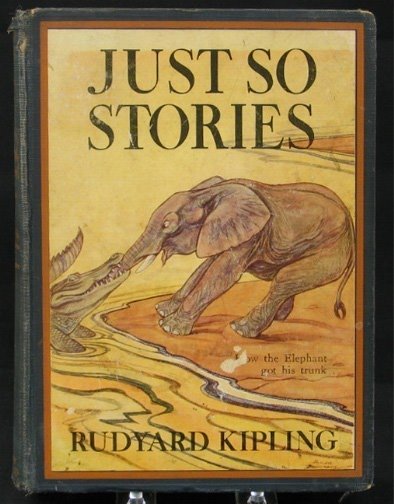
The Just So Stories, by Rudyard Kipling, are, I think, some of the most retold stories in English language. I know I’ve heard most of them (though not all) in some form or other before I ever picked up this collection of the original tales to read. Not all the stories are equal: the most famous ones — about how the elephant got his nose, or how the camel got his hump — are justifiably so, being timeless, funny, and enjoyable to read. Some of the others are clever, but kind of silly (like how the alphabet was made… Cute, but… kind of dumb). Some — like the first story about the whale — were just weird. Even so, it was an enjoyable experience.

Although I enjoyed reading the stories, and I could tell the affection Kipling had for his daughter (whom the stories were written for), I really think these stories are better enjoyed told, or with a lot of illustrations, then read straight through. Kipling has an almost Seussian grasp of the language, inventing words to suit his needs. I often resorted to reading out loud just so I could hear what Kipling was trying to do with a certain passage.

It was definitely worth the time, though.

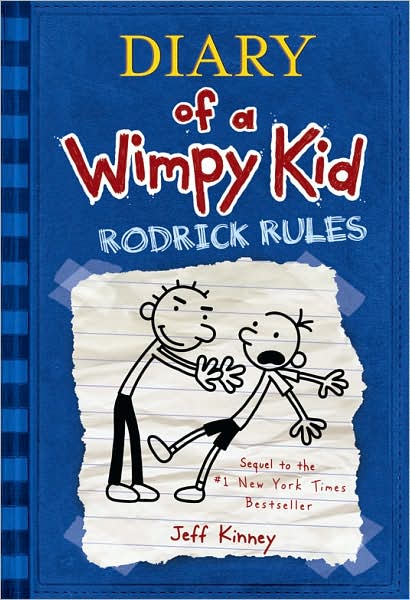
Diary of a Wimpy Kid: Rodrick Rules

I read the first Diary of a Wimpy kid last year, and absolutely loved it. So, I had high hopes for this book. Possibly a mistake. Because, in spite of my best efforts, this one just did not make me laugh.

I think I just found it annoying. As a narrator (and illustrator), Greg was more irritating than witty. As were his family (shoot me if I ever act like his parents) and friends. The story was kind of lame, too — not that I expected more there — as was the ending. I ended up rolling my eyes more than chuckling (though there were a few chuckles). I guess it just didn’t live up to the expectations I had for it.

To be fair, though, my 8-year-old, C, loved it. Perhaps this is one of those situations where I’m just too old.

Ah, well.

Millicent Min Girl Genius

I picked this one up ages and ages ago (another one off the TBR pile! YAY!) because I’m a frequent lurker at Lisa Yee’s blog, which I think is hilarious. After a while, though, I felt kind of silly loving someone’s blog — especially when that someone is a published author — and never having read anything by them. So, I mooched this one (no, I didn’t actually pay for it; I’m horrid) and finally got around to it yesterday.

It’s a really cute book. I think I was expecting something more laugh-out-loud funny –kind of like her blog can be — but I wasn’t disappointed. It was a very sweet, fun, cute book.

Millicent Min is a genius. She’s 11 years old, and just finished up her junior year in high school. She’s the captain of the math team, routinely routs everyone at chess, has multiple awards and articles written about her, and has… no friends. She tells herself that this doesn’t bother her — she’s bonding with her the professor of her college poetry class after all — and there’s just too much to learn and do in a day for her to actually have friends. Besides, everyone’s usually intimidated or turned off by her genius status for her to get close to anyone. Then, her life changes. Her mother decides that she needs to go out for team sports, and signs her up for volleyball. She meets Emily, who’s new in town and doesn’t know Millicent is a genius. And, on top of that, she is asked (and paid) to tutor Stanford Wong (her nemesis) in English so he can pass the 6th grade. And because of these two simple things, her life will never be the same.

That makes it sound more ominous than it really is. She does manage to have a good summer, in spite of not wanting to play volleyball or tutor Stanford, but beyond that, she learns how to have friends. I liked that about the book. That Yee didn’t set out to do something huge or grand, but rather choosing to have someone — someone very bright, but very backward — learn something really simple, but something that you can’t learn from books.

And so, I read it with a smile, thoroughly charmed by everyone in the book. I’m glad I mooched it, too. It’s a keeper.