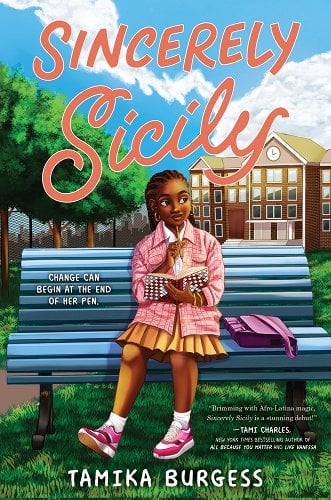
Sincerely Sicily

by Taika Burgess
First sentence: “Demanding to see the email only shows me how real this all is.”
Support your local independent bookstore: buy it there!
Content: There is bullying and microaggressions. It’s in the Middle Grade (grades 3-5) section of the bookstore. I read this book for the Cybils, and this reflects my opinion and not that of the whole panel.

Sicily is upset: for her 6th grade year she is going to a new school, away from all her friends. She doesn’t want to, but she doesn’t have a choice. It’s made worse by the fact that there isn’t many non-white kids at her school. It’s made worse because she is a Black Panamanian – and the kids at school don’t understand that heritage. Then there’s her Abuela, who is critical of Sicily’s box braids, calling them “low class”. Sicily just feels picked on from all sides. How will she ever figure out this new school?

I liked this one a lot. I liked that Burgess focused on the Black Panamanian heritage, but also that she gave Sicily some friend problems as well as a new crush. It made the book well-rounded, capturing every part of Sicily’s journey. I also learned quite a bit about Panama and the heritage of Black people there, which I also liked. It was a really good book!

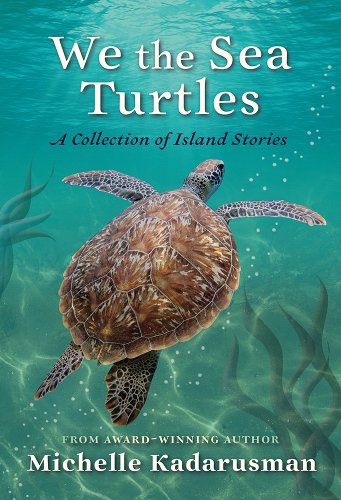
We the Sea Turtles

by Michelle Kadarusman
First sentence: “In 2003, a leatherback turtle traveled from a remote island chain in Indonesia to the Oregon coast in the western United States of America.”
Support your local independent bookstore: buy it there!
Review copy provided by the publisher.
Content: The chapters are short, and pretty easy to comprehend I read this book for the Cybils, and this reflects my opinion and not that of the whole panel.

This book is a series of short stories connected because they are all set on islands, with mentions of turtles. They are all environmental in nature, either with concerns about climate change or how to better live on the land. They range around the world – from children in Canada and the US to Indonesia and Australia. The stories were pretty simple, most only a few pages long. I liked that there was a book addressing the environmental concerns of children this age, though I do wish the stories were longer and delved more deeply into the issues that were brought up. I liked the diversity in the book, and I did appreciate that most chapters had a land acknowledgment before them. I just wish there was more to it.

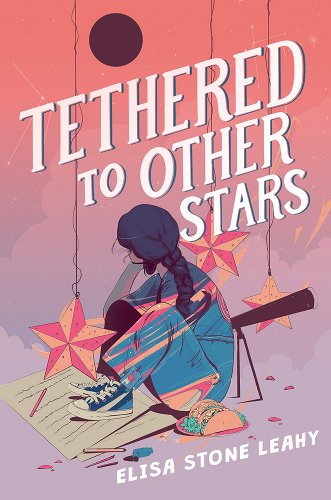
Tethered to Other Stars

by Elisa Stone Leahy
First sentence: “Wendy and Tom sat on the plastic-wrapped sofa in the middle of the sidewalk and stared up at the crooked house.”
Support your local independent bookstore: buy it there!
Content: There is bullying and name calling and both racist microagressions as well as racist behavior. It’s in the Middle Grades (grades 3-5) section of the bookstore.I read this book for the Cybils, and this reflects my opinion and not that of the whole panel.

Wendy’s family used to live in a bustling Latine neighborhood of their Ohio town, one where there were lots of families like hers. But then La Migra – ICE – started taking more and more people; parents would disappear, families gone overnight. And Wendy’s parents became unnerved. So they found the cheapest fixer-upper in a nearby town, one that was more white, in hopes that La Migra would leave them alone. Because, while Wendy’s dad was adopted by an American relative when he was little, and Wendy and Tom were born in America, Wendy’s mom has a green card, and maybe that’s not quite enough for ICE. The best thing is to keep their heads down and not make any waves.

Except, at Wendy’s new, mostly white, school for gifted student, she’s finding it hard to keep her head down. She make friends with a Black girl, K. K.; and a Muslim one, Yasmin; and the daughter of a white pastor who is giving sanctuary to a woman whom ICE is trying to deport. And when their little group becomes targets for the richer, whiter kids in school, things get, well, a bit messy.

It sounds like a lot, and it is, but Leahy makes it work. Wendy is the first-generation daughter of immigrant parents, and Leahy weaves that in. She weaves in treating those who are looking for a new, better home in America humanely. She weaves in STEM – Wendy is fascinated with space and astronomy and wants to be an astrophysicist. And she weaves in the real ways in which white kids absorb the opinons and actions of their parents. You can tell what kind of parents the kids have by the way their kids treat those not like them.

It’s a good book with a good heart, and some tense moments. And in the end, I loved how everyone grew, learned, and changed for the better.

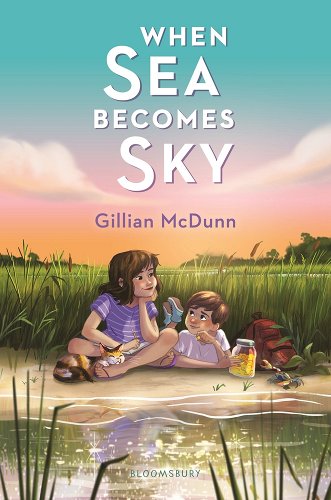
When Sea Becomes Sky

by Gillian McDunn
First sentence: “Some summers are the funnest and some summers are the longest but last summer was perfectly ordinary until the day we found the hand.”
Support your local independent bookstore: buy it there!
Content: It’s got short chapters and some illustrations. It’s in the Middle Grade (grades 3-5) section of the bookstore. I read this book for the Cybils, and this reflects my opinion and not that of the whole panel.

Bex and Davey have always been a duo, biking together or rowing around the marshes of their island. And this summer starts like every other one, except it hasn’t rained in 313 days and the water levels are lowering. And with the lower water levels, a hand appears in the marshes. Not a dead hand (ew), but a metal one. And with developers wanting to build a bridge to the island from the mainland, Bex and Davey are afraid that would mean the end of the statue they found before they even had a chance to figure out who made it.

Thus begins an adventure as Bex and Davey try to figure out what the statue is, and who the artist was that created it. And the answers they find will surprise everyone.

I like McDunn’s books. They’re quiet and sweet and portray everyday challenges in a very accessible light. This one is no exception, though it packs a bit more punch than I’ve come to expect from her. I do think the developer plotline was a bit underused, but I liked how the artist’s plot was resolved, and how it all came full circle in the end. I also like the environmental angle with the drought. It was well done and quite enjoyable.

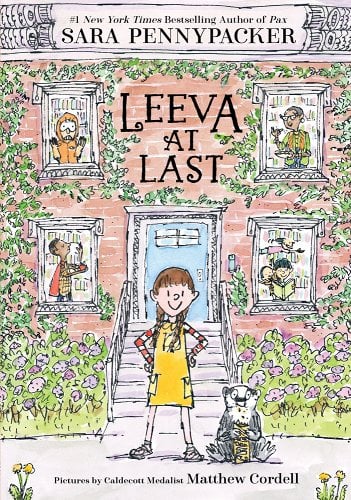
Leeva at Last

by Sarah Pennypacker
First sentence: “Leeva Thornblossom flew outside the instant she heard the Nutsmore Weekly thunk against the door.”
Support your local independent bookstore: buy it there!
Content: There is some exceptionally bad parentingbordering on neglect and abuse, but if you’re reading Roald Dahl, this one will be fine. It’s in the Middle Grade (grades 3-5) section of the bookstore.

Last week my 17-year-old daughter and I watched the movie version of Matilda again. It had been a while since we had seen it, and we were in the mood for something fun and familiar. We talked the whole way through – about how horrible the Wormwoods were (and how much fun Danny DeVito and Rhea Pearlman were having playing them) and how despicable Miss Trunchbull was. We talked about how Dahl loved to write terrible adults and sometimes terrible children, but how there’s always one good adult to help the good children through. 

I know it sounds odd to begin a review about Pennypacker’s book this way, but that’s what I thought about quite a lot while reading Leeva at Last. Leeva Thornblossom is the good child, self-educated (not magical though), smart, and kind with absoutely despicable parents. Her parents are obsessed with Fame and Money, so much so that they make Leeva do everything else. Her mother is the mayor of the town, and is practically a facist dictator. Her father is the town treasurer, and is embezzling money (or rather, having Leeva do it becuase she’s Good at Math) becasue he’s obsessed with having it (yes, he is storing it all in boxes in the attic). One day, though, Leeva sneaks out through the hedge, discovers the libary and the kind librarian and her nephew, and her life changes for the better. 

I kept comparing it to Matilda because it felt so much like it, from the plot and the characters to the illustrations done by Matthew Cordell (which felt very Quentin Blake-y). It evoked the spirit of Roald Dahl, and yet… I’m not sure it quite succeeded. Dahl is not a kind writer. He is not a sweet writer, and he doesn’t pull any punches. Miss Trunchbull is, simply put, evil. And the children in Charlie and the Chocolate Factory are atrocious. There is nothing redeemable about them, and there is something quite terrrifying. Pennypacker got the unredeemable bits about Leeva’s parents – in the end, while they don’t get their comuppance, they are not redeemed – but they’re not terrifying. They’re just silly. And kind of annoying. Which, if you’re trying to channel Dahl, kind of misses the mark. 

Even so, Leeva was a fun little book, and I think it’s admirable that Pennypacker attempted to write something that tried to be like Dahl. I’m sure there will be many people over the years who come to thoroughly love this one. 

What Happened to Rachel Riley?

by Claire Swinarski
First sentence: “Ms. O’Dell, I hope that you’re having a good winter break.”
Support your local independent bookstore: buy it there!
Content: There is harassment by middle school boys. It’s in the Middle Grade (grades 3-5) section of the bookstore. I read this book for the Cybils, and this reflects my opinion and not that of the whole panel.

Anna Hunt is the new girl at her middle school in Madison, Wisconsin, and she’s noticed something odd: no one talks to Rachel Riley. Not a word. This is weird because Anna’s discovered – through the miracle of social media – that Rachel used to be popular. So, Anna – nominally as part of an application to a podcasting camp – decides to get to the bottom of why no one will talk to Rachel anymore.

Everyone seems reluctant to talk about what happened at the end of 7th grade. But as Anna digs deeper, what she finds might just shake up their 8th-grade year as well.

I love a good story told through found documents, and this one was fun. There were some prose sections, so it wasn’t entirely found documents, but much lot of it was. And it’s a smart story as well. I liked how Anna had to piece things together, and how the reader was never too far ahead, so I never felt like I was waiting for Anna to catch up. I loved the dynamic of Anna’s family, and how she slowly made friends at her school – moving right before 8th grade is hard, and I liked how Swinarski portrayed that.

When I finished, my takeaway to my kids was “Middle school boys are the worst”, to which they said, “You just now figured that out?” Which is sad in its own right. Still, I like a good book where girls stand up to the harassment that is ignored in middle schools and hopefully, make their school a better place.

A good story.

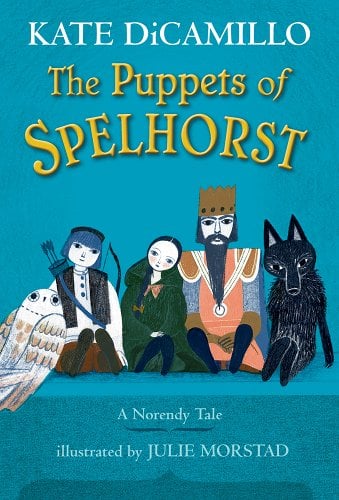
Audiobook: The Puppets of Spelhorst

by Kate DiCamillo
Read by Allan Corduner
Support your local independent bookstore: buy it there!
Or listen at Libro.fm
Content: It’s a short book, and there isn’t anything objectionable. It’s in the Beginning Chapter section of the bookstore (grades 1-2) but it could go older.

Once upon a time, there were five puppets: A girl, a boy, a wolf (with very sharp teeth), an owl, and a king. They were happy in the shop of the puppet maker, but they longed to go on adventures. Then one day, an old man saw the face of his lost love in the eyes of the girl puppet, and the toymaker would sell just her, so they all were bought. From there, they had adventures, first at the old man’s house, then with the junk man, after the old man died, and finally in a home with two young girls who put on a play with the puppets.

That’s it for the plot. And yet, because it’s Kate DiCamillo, it’s a lovely fairy tale, one I enjoyed listening to, even as an adult. Much like The Tale of Despereaux or The Miraculous Journey of Edward Tulane, it’s a story to be read aloud, to be enjoyed together. It’s a simple story, but there are profound moments, silly moments, and tender moments. It’s probably not my favorite DiCamillo out there, but it is a lovely one that will delight many children (and their parents/guardians/teachers).

The Fire, the Water, and Maudie McGinn

by Sally J Pla
First sentence: “I learned this great calm-down trick recently.”
Support your local independent bookstore: buy it there!
Content: There is on-page physical abuse by a stepparent as well as neglect and shaming by a parent. It’s in the YA section (grades 6-8) of the bookstore, but I’d give it to some 4th and 5th graders. I read this book for the Cybils, and this is a reflection of my opinion and not that of the whole panel.

For Maudie’s whole life, she has spent summers with her Dad in his cabin in California and the rest of the year with her mom in Texas. But her mom recently go remarried, and her stepdad, Ron, has an explosive temper. So much so that he hurts Maudie, whom he doesn’t seem to want around. And her mother isn’t doing much to help. Especialy since Maudie has autism and needs more time and allowances to get things done. But her mother told her not to tell her dad, so she’s keeping the secret.

This summer, though, there’s a wildfire in the mountains around her dad’s cabin, and they have to flee. They’re left with nothing, so they head south to the beach to stay with one of her dad’s high school friends. There, Maudie discovers surfing, makes friends, and gains confidence. Will she have enough to tell her dad the secret and to tell him what she really wants: not to go back to Texas at all?

I really liked the autism representation in this. I liked the way Pla described what Maudie was feeling, and the sensations that made her anxious and unsettled. She had panic attacks and meltdowns, and the author described them just as if they were parts of life, which they are. I liked that her dad was also neurodivergent. And I liked that Maudie found something she could focus on in the surfing, and that the community was so welcoming.

Things were unsettling though. I disliked Maudie’s mom, who didn’t care about what Maudie needed to thrive, but more on what she (the mom) wanted. I think one could blame it on Maudie’s mom being a teenager when she had Maudie, but maybe not. She was horrible, her new husband was horrible, and Pla leaned into that. I also wondered about the representation. I liked that the town was populated with all sorts of people, but some of it felt stereotypical. Maudie’s dad is half Venezuelan, and his mom died soon after Maudie was born, so he doesn’t really have a connection to that. His friend is Latine, and they meet an Indian/Pakistani (assuming from the name, there’s nothing that gives it context) woman who runs an alternative school for neurodivergent kid. And Maudie’s surving mentor is Etta Kahuna, who is Black? Polynesian? Her only defining feature is her gray “dreadlocks” which is a big red flag.

That said, I did like how the overall message was trusting yourself and believing in (some of) the adults around you. And I did like watching Maudie learn to surf. I’m just not sure it’s that great with representation.

Hands

by Tony Maldonado
First sentence: “You promise?”
Support your local independent bookstore: buy it there!
Content: There is violence, domestic and fist-fights. It’s in the YA section (grades 6-8) of the bookstore, but I’d give it to a 5th grader. I read this book for the Cybils, and this is a reflection of my opinion and not that of the whole panel.

Two years ago, Trevor’s stepdad was arrested and sent to jail for beating Trevor’s mom. On his way, he said that he would come back for her, and Trevor’s been on edge ever since. Now at 12, his stepdad is about to get out of jail, and Trevor is determined to become the sort of person who could protect and defend his mom and sisters. Which means he needs to be stronger, better at fighting.

But, in his quest, he discovers that maybe there is more to, well, everything than he thought. There are other ways of using your hands. There are other ways of confronting the bad things in his life, his neighborhood. And that “promise” means a lot of things.

I really liked this one. Maldonado captures not only what it’s like to be 12, and have to grow up before you’re quite ready, he captures the spirit of a neighborhood and a family. It felt real, and yet it was hopeful at the same time. There was violence and danger, and yet there are Other Ways that may be better. I liked the inner conflict that Trevor had: he wants to be a Man, and protect his family, and yet he really is just a kid and he wants that, too. And a bonus: Maldonado didn’t use extra words: The short book packs a powerful uch.

Quite a remarkable small book.

Not an Easy Win

by Chrystal D. Giles
First sentence: “Expelled.”
Support your local independent bookstore: buy it there!
Content: There is some fighting. It’s in the Middle Grade (grades 3-5) section of the bookstore. I read this book for the Cybils, and this is a reflection of my opinion and not that of the whole panel.

Nothing has gone right for Lawrence since his dad left and his mom moved the family from Charlotte to her small hometown in rural North Carolina. He got into Andrew Jackson middle school, where most of the white kids go, but didn’t seem to fit in. That’s an understatement: he gets expelled for getting into fights (which he didn’t start). His grandma says “A man that don’t work, don’t eat”, so Lawrence needs to figure out what to do with his days. Enter neighbor Mr. Dennis, who helps run a rec center in town where the Black kids go after school. He lets Lawrence come along and work (for free), hang out, and eventually, teaches him chess.

I liked this book a lot. I am always in for a good metaphor, and I liked the way Giles used chess not only to teach non-violence, but also how to be patient, think, and connect with people. I liked Lawrence, and his growth arc, from being an angry 11-year-old kid, to learning and being one of the better chess players. I also really like that Giles didn’t give the book a Hollywood ending: while the kids make it to a chess tournament in Charlotte, it doesn’t magically solve Lawrence’s problems, and they don’t come away winning the whole thing (sorry: spoiler there). But it gives the book depth and makes it more realistic. A really solid story.