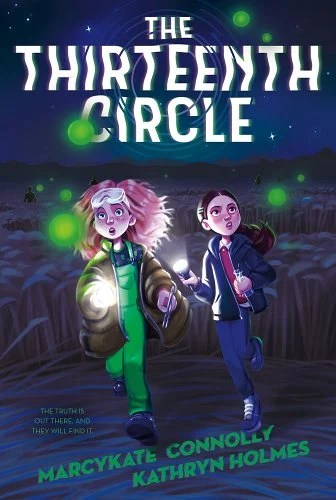
The Thirteenth Circle

by MarcyKate Connolly and Kathryn Holmes
First sentence: “There was an alien in Cat Mulvaney’s bedroom.”
Support your local independent bookstore: buy it there!
Content: There are some intense moments. It’s in the Middle Grade section of the bookstore.

Dani desperately wants her parents to take her interest in science seriously. Cat desperately wants her father to pay attention to her. And so both need to win the McMurray Youth Science competition and get into ScienceU. The problem: they’re working together and Cat wants to prove that aliens exist, and Dani knows that they don’t. It just so happens that every 13 years crop circles appear in a nearby field, and they’re due to appear this year. And Cat’s figured out when and where. All they have to do is gather evidence… and see whose theory is the solid one.

It’s a mild spoiler to say that this is solidly realistic fiction; there are, in fact, no aliens. But, Dani and Cat do uncover a conspiracy and they do end up realizing that working together is better than working against each other. I liked this one well enough; I liked how Dani and Cat would gather evidence and then work out hypotheses based on the evidence. It was unbelievable how much time these 13-year-olds spent running around the town late at night, but I can forgive that. And the whole conspiracy was a bit over the top, though it fit the story.

Will it be my favorite book this year? No, but it’s a good one.

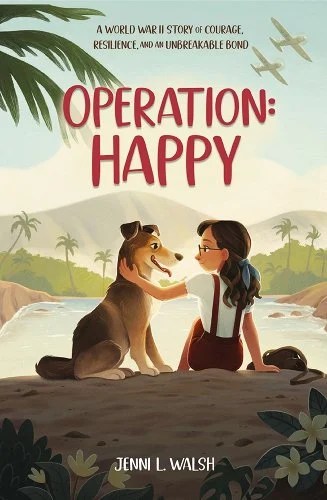
Operation: Happy

by Jenni L. Walsh
First sentence: “A dog is at the top of my wish list.”
Support your local independent bookstore: buy it there!
Content: There are some intense moments – bombs dropping on Pearl Harbor, and an attempted assault – though it is short and age-appropriate. It’s in the Middle Grade (grades 3-5) section of the bookstore.

Jody is the daughter of a Marine, who is stationed in Pearl Harbor in 1940. If you know history, you know where this is going. The book is divided into two: before the attack, where Jody is enjoying living in Hawaii and having her family around, and then after, when she, her mom, and her sister are evacuated to San Francisco, dealing with the aftermath of the attack.

It’s a slim book to handle all that’s in there, but Walsh handles it quite beautifully. As a reader, you get a sense of the idyllic Hawaiian life before the attacks, how Jody loves spending time with her dog and her family. And then the intensity of the attacks and the spiral afterward, when Jody’s mom becomes overwhelmed and depressed and Jody and her sister have to figure out how to deal with creating a livable life for themselves in San Francisco. And I appreciate that while Walsh didn’t sugarcoat the panic or the fear, she made it age-appropriate.

The only thing I didn’t get was the purpose of the chapters written from the dog’s perspective. While it never veered into speculative, I didn’t feel like they added much to the story. But, aside from that, it’s a charming historical novel that addresses some intense subjects.

Unstuck

by Barbara Dee
First sentence: “Okay, here we go.”
Support your local independent bookstore: buy it there!
Content: There is some friendship drama, anxiety depictions, and mild crushing. It’s in the Middle Grade (grades 3-5) section of the bookstore.

Lyla loves to write. She’s got a whole novel inside her head, and when her ELA class comes to a creative writing unit, she’s super excited. The excitement only intensifies when her teacher mentions a short-story contest that gives actual money prizes. Lyla just knows she can win this. Except, when the time comes, Lyla is paralyzed. She can’t put anything down on paper. And it seems like external pressures – the fight she’s having with her best friend and the secrets she’s keeping for her older sister – are just making her even more anxious.

On the one hand, the fact that this was about something simple – Lyla’s inability to write the story in her head on paper – was quite refreshing. Her parents were loving, if a bit helecopter-y; she was having friend trouble, but it wasn’t all-consuming; her sister was having problems motivating herself to go to college – nothing life-shattering. It all felt very normal and authentic. That said, it was also often very anxiety-inducing. (Which is probably a sign of good writing.) I had to put it down quite a bit because I just couldn’t handle Lyla’s anxiety spirals. But, she does learn coping mechanisms, and she does learn to accept things and communicate her feelings, so in the end, I think the depictions of anxiety were a good thing. They were just hard to read.

I did really like this one, in the end. It’s good for kids who are thinking about being writers, or ones who just like good stories.

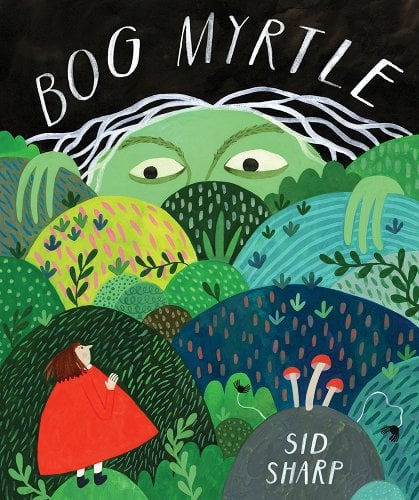
Bog Myrtle

by Sid Sharp
First sentence: “Two sisters lived alone in a hideous, drafty old house on the edge of town.”
Support your local independent bookstore: buy it there!
Release date: October 8, 2024
Content: It’s a short book, probably about beginning chapter level, with a lot of pictures. It’ll probably end up where The Wolf Suit did, in the Middle Grade Graphic Novel section.

Sisters Magnolia and Beatrice lived in a drafty house at the edge of town and didn’t have a lot of money. Magnolia, who was grumpy and just a bit mean, was always cold, so Beatrice, who was nice and kind, decided to go buy some yarn to make her a sweater. They didn’t have money (see: cold, drafty house) so Beatrice decided to go find treasures in the forest to trade for yarn. When that doesn’t work, she meets the Bog Myrtle and the course of the sisters’ lives changes. For both good and bad.

I didn’t know I needed a charming fable about kindness and sustainability with a strong anti-capitalist sentiment, but I guess I did. I adored this one quite a bit. It’s got a quirky sense of humor, much like The Wolf Suit, and it’s both sweet and a bit edgy at the same time. I do hope that there are kids who find this one, and who love it as much as I do.

A lot of fun!

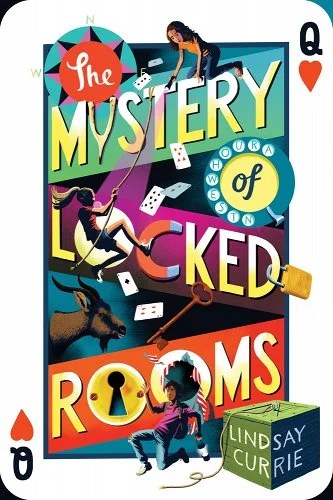
The Mystery of Locked Rooms

by Lindsay Currie
First sentence: “‘Angle it the other way!’ West screeches, holding his mirror up in the air.”
Support your local independent bookstore: buy it there!
Content: There are some mildly intense moments. It’s in the Middle Grade (graes 3-5) section of the bookstore.

Sarah and her two best friends West and Hannah love doing escape rooms, and they’re good at them. So, when Sarah’s house gets foreclosed and she learns about the Triplet Treasure in an abandoned funhouse outside of town, Sarah decides – and of course, West and Hannah come along – that she’s going to break into the funhouse and find the treasure.

This book is fantastic! It’s tight – it takes place mostly over one day, as we follow the kids through the funhouse as they solve the riddles and face their fears to get to the end. It’s everything I like about a middle grade books – no romance, not super high stakes, and a tight story that pulls the reader through the book. I liked that the parents were good; the house was being foreclosed because Sarah’s dad has been diagnosed with chronic fatigue syndrome and couldn’t work anymore, and her mother couldn’t quite make enough money to make the mortgage payments. It’s smart, it’s fun, and I think there’s a lot of kids out there who will enjoy it. Give it to those who liked Mr. Lemoncello’s Libraray, and they’ll enjoy figuring out these as well.

Bridge to Bat City

by Ernest Cline
First sentence: “Once upon a time down here in Texas, in part of the Lone Star State known as the Hill Country, hidden at the edge of a rolling green forest, there was this bold old beautiful cave.”
Support your local independent bookstore: buy it there!
Content: Some younger kids might be turned off by the references, though there are illustrations, and it’s not overly long (or dealing with crushes or puberty!). It’s in the Middle Grade (grades 3-5) section of the bookstore. 

To understand the tall tale part of this book, you kind of need to know the history (which Cline helpfully puts in the back of the book).  In 1982, the city of Austin re-did and expanded the Congress Ave bridge, so that it could expand and contract with the weather better. Soon after this, a bunch of Mexican free-tailed bats took up residence, and by 1984, the population had grown to over a million. 

This is Cline’s version of how the bats got there. It involves a girl named Opal Flats, from Lubbock, whose mother dies and whose uncle takes her in at the family farm in the Hill Country outside of Austin. The TV show Austin City Limits plays a role, as does ‘zines, former governor Ann Richards, and Willie Nelson. There’s also a pet armadillo, a flying saucer, and – oh, yeah – Opal can talk to the bats.  

The subtitle of this one is “A mostly true tall tale” and that fits perfectly. Although it’s set in the 1980s and a lot of kids won’t get the music references (who’s Buddy Holly?!), I think it would make a perfect read-aloud. Cline says in the afterward that it’s based on a tall tale he’d tell his kids when they were small, and I think that’s the best way to approach the book. It feels like someone’s telling you a story, and I think it’s meant to be read aloud. It started slow for me, but the more I read, the more I liked it. It’s kind of silly, and it’s definitely over the top (the part where the bats – who also love music – discover ZZ Top, Run DMC, Selena, and Willie Nelson is pretty hilarious). But it’s got a good heart, and in the end, is all about just accepting new things and having an open mind (oh, and corporations are bad). 

You kind of have to love a book like that. Which I did. 

Across So Many Seas

by Ruth Behar
First sentence: “The sound of trumpets coming from the direction of our town gates tears me from sleep, my dreams forgotten as I jolt out of bed.”
Support your local independent bookstore: buy it there!
Content: There are some instances of hatred toward Jews, deaths of parents, and overly strict fathers. It’s in the Middle Grade (grades 3-5) section of the bookstore.

These inter-connected short stories follow girls in the same Sephardic Jewish family from their exile in Spain in 1492, to their lives in Turkey and one girl’s exile from there to Cuba, to finally landing in Miami in present times. Three of the stories follow a direct mother-daughter line; the fourth is their ancestor in Spain. While there isn’t much of a plot except for these girls’ experiences, there is a lot of history here, much of which I didn’t know. 

Behar is a talented writer, capturing quite a lot in a few words. It’s an elegant little book, and I appreciated that it was interconnected stories rather than trying to be one long novel. It was just enough to keep me interested and yet dense enough that I felt I connected with the characters are well as learning something new. 

I’m not entirely sure it’s for kids, but maybe some out there will find an interest in this story. It’s a good one. 

City Girls

by Loretta Lopez
First sentence: “My body is still getting used to hers.”
Support your local independent bookstore: buy it there!
Content: While this is super short, and the main characters are eleven, it deals with some pretty heavy themes (including sexual and physical abuse, divorce, sickness, and death). It’s in the Middle Grade (grades 3-5) section of the bookstore.  

This slim book is three interconnected short stories, each one following a girl in a Manhattan Middle School. Elisa is fresh from El Salvador and is petitioning the US government for asylum so she can stay in the United States with her mom, so she doesn’t have to go back to her abusive grandmother and the predator she calls “chicken man”. Lucia accidentally catches her father in an affair and has to deal with the weight of that, and then the aftermath when she confronts him. Alice is constantly acting out in class, but her father is distant and her mother is dying of cancer. The three girls become friends over their sixth-grade year, as they deal with their trials individually and collectively. 

I wanted to like this book. (Well, I started out listening to the audiobook, but the first narrator, the one who voiced Elisa, made some annoying narrative choices.) I like the idea of interconnected short stories, I like the idea of looking at race and culture from different perspectives. And I do understand that children go through trauma. But I wonder who the audience is for this book. The trauma is not spelled out, though a smart reader could figure it out (maybe not an 11-year-old one, though). It’s short, so maybe it’s geared at younger readers? But, the content isn’t really appropriate for 2nd and 3rd graders. It’s a conundrum. 

That said, I think the book is good to have out there, and it’s always good to have stories about Hard Things for kids who need them. 

Just Shy of Ordinary

by A. J. Sass
First sentence: “Day one of my new normal began on the Sunday before I started my first-ever day of public school.”
Support your local independent bookstore: buy it there!
Content: There is some talk of crushes and like-liking people, there is mention of anxious self-mutilating behaviors, and it’s on the longer end for the age range. It’s in the Middle Grade (grades 3-5) section of the bookstore.

Shai has a plan to create their new normal: come out as non-binary to their mom and their closest friends (done), wear sleeves to cover their arms so they stop picking and pulling out the hairs when they get anxious (their best friend Mille designed and made the sleeves as an added bonus), and start 8th grade at a public school. They believe that the change of routine will help with the picking. Except they test out of 8th grade (they’ve been homeschooled up until now), and get put into 9th grade. High school! 

So while Shai is anxious about starting something new, they meet a couple of people -Nia and Edie – who seem nice enough to be friends. (And maybe even tell them that they’re non-binary!)And then their English teacher assigns a long-term project that has Shai thinking about their Jewish heritage. It’s all complicated and difficult, but maybe this new normal will turn out for the best. 

This is a simple tale – the conflict is mostly internal, with Shai struggling with anxiety and the compulsion of picking, as well as the distance they feel from their mom, who has been studying and working to get a new job. But Shai was an enjoyable character to spend time with. I think Sass did a good job portraying the uncertainties that a kid would go through when they’re redefining who they are, as well as the added challenge of skipping a grade and starting something really big, like public school. I appreciated the inclusion that Shai’s mom, grandparents, and friends showed, as well as the diversity in their small-ish Wisconsin town. While it’s not a book that really blew me away, it is one that made me smile, and I enjoyed until the end. I’m glad it’s out there for the kids who need it. 


Finally Heard

by Kelly Yang
First sentence: “‘Mom!’ Millie, my sister, protests, banging on the door.”
Support your local independent bookstore: buy it there!
Others in the series: Finally Seen
Content: There is talk of puberty, crushes, and social media. It’s in the Middle Grade (grades 3-5) section of the bookstore, but I’d give it to the older end of the age range.

Lina’s mom’s business making bath bombs has stalled, and the thing that they need to save it? Social media. It’s also taken over the 5th grade- everyone in Lina’s class seemed to have gotten phones over spring break, and there’s no stopping the posting, looking at the phones, and worst of all: the bullying in the Discord chats. And Lina’s no exception. She, her sister, and her friends discover that they’re good at making content for people, and her mom becomes obsessed with answering every comment posted. On top of that, Lina’s starting to go through puberty and has no idea how to deal with her changing body. It’s all spiraling out of control.

Yes, it’s a treatise against 10- and 11-year-olds having phones and access to social media, but Yang has woven a good story here. I like Lina’s confusion both with puberty and with social media. It felt honest and real: kids don’t know what they’re getting into at that age. Yang touches on all aspects of social media: the addiction, the bullying, the misrepresentation, and does it in a way that’s very accessible for kids.

I liked the first book in the series better, but this one was a solid story.