Audiobook: The Lion, the Witch and the Wardrobe

by C. S. Lewis
ages: 7+
read by Michael York
Support your local independent bookstore: buy it there!

I don’t quite know where to start with this. I read the books for the first time in college, and I think I liked them. Though I’m nowhere near the Lewis devotee as some. (Including Hubby.) I saw the movie, but wasn’t impressed. And, honestly, I didn’t remember much about the story.

But, there had been some talk around the house about the Narnia books, mostly because we’d just watched The Voyage of the Dawn Treader movie. A and K were curious about the stories, so I picked up this one to listen to while we were on the trip.

And, to be thoroughly honest, it didn’t stick with me. Sure, I enjoyed it while I was listening to is, as did A and K. But, two weeks later (there is a reason I put posts up right after I finish things), all I can remember about the story was that it was nice. And that I was surprised at how little the Pevensie kids actually did. Mostly it involved them reacting to events, getting caught up in events and watching events unfold. Very rarely were they actual active participants in the story, which disappointed me.

But the younger girls enjoyed it, and Michael York did an admirable job reading it. And it kept everyone from arguing in the car for a few hours. So it wasn’t really time wasted.

The Penderwicks at Point Mouette

by Jeanne Birdsall
ages: 10+
First sentence: “The Penderwick family was being torn apart.”
Support your local independent bookstore: buy it there!

How can I express my love for the Penderwicks?

Honestly? I can’t. I adore them, I want to be a part of their world.

Though I’ve noticed something: I think the Penderwicks are better when they’re on vacation than when they are at home.

This time, newly wed Dad and Iantha are off to England for a conference/honeymoon and Rosalind is off to a much-deserved vacation with her friend Anna to New Jersey. The rest of the Penderwicks — acting OAP (Oldest Available Penderwick) Skye, Jane and Batty, plus honorary Penderwick brother Jeffrey — are off with their Aunt Claire to a lovely little cottage in Maine for two weeks.

Perhaps it’s the lovely little cottages that make the books so wonderful? I’m beginning to think that everyone should have a vacation at a lovely little cottage.

Things happen at Point Mouette, of course. They meet a lovely next-door neighbor, Alec, who has an annoying dog but a wonderful piano; some more honorary siblings and a first-love in Mercedes and Dominic, who are staying at the Inn with their grandparents. They have adventures, discover things, bond, fight, and are just thoroughly wonderful.

I know this has been said many times, but it’s really the main charm of the book: I love how Birdsall combines an old-fashioned feel with the modern times. These books aren’t historical, they aren’t set anytime other than present, and yet they feel timeless. You could picture Anne Shirley or the March sisters having the adventures that the Penderwick girls have, and yet threaded through the books are modern themes like divorce and bad mothers and cancer. It’s a wonderful balance, something which gives these books their charm, and pulls readers in (and it’s not just adults; my daughters adore the Penderwicks) and holds them there, making them fall in love with the characters.

This is why I read.

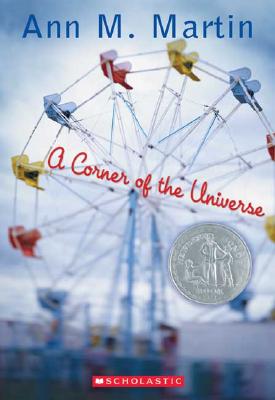
A Corner of the Universe

by Ann M. Martin
ages: 10+
First sentence: “Last summer, the summer I turned twelve, was the summer Adam came.”
Support your local independent bookstore: buy it there!

It’s the summer of 1960, the summer Hattie turns 12. She lives in a small town in Connecticut (I think; I was never really sure), and she enjoys her little life: she helps her mom and dad with the boarding house they live in, in spite of Nana and Papa’s disapproval. She wanders around town, talking with her friends — none of which are her age — reading, enjoying the lazy summer days. But this summer is different: it’s the summer she finds out she has an uncle, Adam, who she never knew existed.

See, Adam, who is 21, suffers from an unnamed mental illness. And in those days, especially for people like Nana who like things just so — from insisting upon Sunday dress at the girls’ lunches she hosts, to the china plates at the Fourth of July picnic — mental illness was seen as a disgrace, something to be tucked away.

And therein lies the central conflict of the novel: Hattie doesn’t “get” Adam much of the time, but she likes him, and she understands that all he really needs is love and attention, not to be hidden away. She doesn’t understand Nana’s (and to a lesser extent, her mother’s) embarrassment of Adam. He’s her friend, and she wants him to be happy.

It doesn’t have a happy ending, however. It’s still 1960, and Adam’s problem which today could be correctly diagnosed and helped escalates into something not so happy. It’s necessary, though, to see the bad in order to see the good: Nana’s not as cold-hearted as Hattie things, and everything is infinitely more complex than an 11-year-old would like it to be.

It’s a moving novel, slim but effective in expressing one girls search for belonging and understanding of both herself, her family, and the world around her.

Nerds Heart YA, Round 1: 8th Grade Super Zero vs. MindBlind

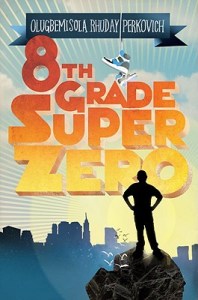
8th Grade Super Zero
by Olugbemisola Rhuday Perkovich
ages: 12+
First sentence: “Everyone know’s what’s up, because it’s the first day of school and I set the tone.”
Support your local independent bookstore: buy it there!

Reginald Garvey McKnight did not start the school year off well. Which means, for this eighth grade year, he’s stuck in loserville because of an unfortunate vomiting incident on the first day of school. Reggie’s content putting his head down and just surviving, even with the constant (nasty) teasing by his former friend Donovan. But then his church youth group does a service project at a local homeless shelter. For many reasons, this moves Reggie, and suddenly what was going to be a low-key year of just surviving becomes something more. And as he gets involved, he finds that he’s becoming something more.

I loved the characters of this one — the ethnic and religious diversity, as well as just their genuine heart — as well as the issues it discussed. It’s very broad: there are issues of homlessness and community responsibility, as well as religion, bullying, race relations, sibling rivalry, as well as a parent that’s unemployed. You wouldn’t think with so much going on that it would work, but it does. Perhaps because it’s a slice of life: the conflict is minimal, though real, and lets Reggie’s inner struggle and questions shine. I also liked how it treated everyone (even the bullies) with respect.

MindBlind
by Jennifer Roy
ages: 12+
First sentence: “Open File: C:\MyFiles\genius\first_time.avi (Date: 1/14/99)”
Support your local independent bookstore: buy it there!

Nathaniel Clark is not a genius. He’ll be the first to tell you that. Sure, he’s 14 and has graduated from college already, and yeah, so he has Asperger Syndrome, but in order to be a “genius”, he needs to have use his talents to make a contribution to the world.

Getting through daily life seems to be quite all he’s able to do, with his math, and the friends he does have — Molly, his bowling partner; Cooper, the boy next door; and Jessa, a friend that Nathaniel wants to be more than a friend — and keeping everything in check, so he can appear “neurotypical.” And that’s not even mentioning his stubbornly obtuse father.

As we follow Nathaniel around, we get to know him and his quirks, how he thinks and feels, and experience the world from his fascinating perspective. We learn about his life through flashbacks (he accesses his memories as computer files and watches them like movies). We experience good times, when he’s doing well, as well as times when he crashes and retreats into N-world, his own safe place.

It’s all very captivating and interesting, but Nathaniel is also more than that: he’s a winning character, a sympathetic person: fascinating and engaging and cheer-worthy.

Decision:
It was difficult to decide between these two books, both of which were fantastically written and captivating to read. But, in the end, I think I’m going to go with Reggie and 8th Grade Super Zero for breaking the mold, for giving us a story of a God-fearing, caring, interesting, black boy, who wants to help and not be shoved into any of the black male stereotypes. That definitely is something to cheer about.

The Trouble With May Amelia

by Jennifer L. Holm
ages: 10+
First sentence: “My brother Wilbert tells me that I’m like the grain of sand in an oyster.”
Support your local independent bookstore: buy it there!

It’s just a few months after our last adventure with May Amelia, and nothing much has changed. She’s still the only girl on the Nasel. She still has a bucketload of brothers, even if her oldest brother, Matti, off and married an Irish girl (in secret because their father would highly disapprove) and moved to San Francisco. It’s still a tough life for them.

And things don’t get easier in this book. (I hate the cover, by the way. She’s too old, and what’s the deal with the chicken?)

The land is still hard to work, and when an a man interested in buying their land to incorporate a town comes along, it’s up to her to translate for their father. It sounds like a good deal, so they opt in, thinking about all the things they can get with their riches. It sounds like the Jackson’s boat has finally come in.

Of course, it wouldn’t be much of a book if that were the plot. There has to be conflict, right? And so things happen to May Amelia and her family: her brother loses a hand at the logging company; Matti comes back which creates tension with her second oldest brother, Kaarlo; her cousins come to America, after a horrific event in Finland, and there’s finally another girl, which is not exactly all that May Amelia had hoped.

And, most of all, there’s her father. I know this is 1900, but her father is so old-fashioned, so male-centric it’s painful. There are times when he treats May Amelia so badly that you just cry out for the poor girl. And yet, her resilient spirit and hope shine through. She is hurt, she is sad, but she doesn’t stop loving her family. May Amelia is a remarkable girl, and that shines through.

Like Our Only May Amelia, there’s not a whole lot of plot; it’s essentially just snippets from May Amelia’s life on the Nasel at the turn of the 20th century. It doesn’t matter, though: Holm captures us with her storytelling, with the spirit of the book, with a captivating picture of a way of living and a community.

Historical fiction at its best.

The Heart of a Samurai

by Margi Preus
ages: 10+
First sentence: “Manjiro squinted across the expanse of glittering sea at the line of dark clouds forming on the horizon.”
Support your local independent bookstore: buy it there!

I wanted to like this one. The cover is pretty, it won a Newebery Honor this year, and the cover calls it a “novel inspired by a true adventure on the high seas.”

Manjiro is a 14-year-old Japanese boy in the mid-1800s. He’s from a small fishing village, and doesn’t have much chance for a future. He signs on with a fishing boat, which gets lost at sea in a storm. Eventually, they get washed up on an island, and a while later are rescued by an American whaling ship. Manjiro spends the next 10 years away from Japan, most of it on a ship, learning English and experiencing everything from the freedom of the open sea, to new technology, to racism, to the opportunities that America offers that Japan doesn’t. He eventually returns to Japan, to a less-than-amiable reception, but eventually helps the Japanese end 250 years of isolationism.

The story is all fine and good, but the book just fell flat. (At least it was a quick read.) All the things I was interested in: being stranded on an island, experiences on a whaling ship, racism in mid-1800s New England all got glossed over. While there was conflict, there wasn’t enough to keep the story interesting enough. And it was basically just a retelling of the years Manjiro was away from Japan, with an epilogue about his time in the government after his return. It would have worked better as non-fiction, if that’s all the author was going to do.

It could have been an interesting book. Disappointing.

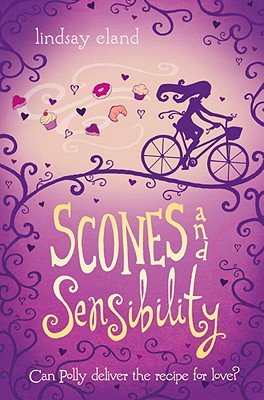
Scones and Sensibility

by Linday Eland
ages: 10+
First sentence: “It was upon turning the last delicate page of my leather-bound copy of Pride and Prejudice that my transformation into a delicate lady of quality was complete.”
Support your local independent bookstore: buy it there!
Review copy sent to me for the Cybils (2010, I think.)

Polly is a twelve year old girl, with aspirations to live in the nineteenth century, stuck in the twenty first. She is also a bit of a budding matchmaker. And a lover of All Things Austin.

My thought process as I read this book went something like this:

“Oh, Polly’s talking like she’s in an Austin book. Though maybe it’s more like Anne Shirley. I loved Anne Shirley. Maybe this will be cute.”

(reads about 30 pages)

“Okay, this stilted dialogue out of a 12-year-old’s mouth, even one who’s going through an Anne Shirley phase sounds a bit, well, forced.”

(reads about 30 more pages)

“No, not forced. Dang annoying.”

(reads about 30 more pages)

“I wish Polly would just shut up now. And stop trying to set everyone else up. This is just like Emma but not nearly as well written.”

(reads about 2o more pages)

“GAH! She’s driving me INSANE! I quit.”

(Reads the end to figure out if what I thought would happen, happens. It does.)

The end.

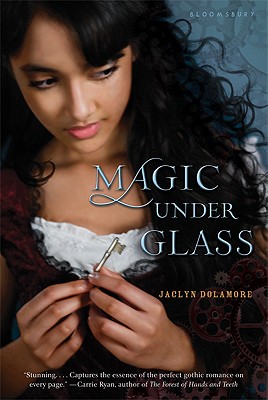
Magic Under Glass

by Jaclyn Dolamore
ages: 12+
First sentence: “The audience didn’t understand a word we sang.”
Support your local independent bookstore: buy it there!
Review copy provided by the publisher.

I have to admit: I’ve had this on my shelf for a long time. But, ever since the whole cover controversy, I really didn’t have much desire to read it. I guess because it was so popular, or maybe it was because it had come on the heels of the Liar cover controversy, but I really had no desire to read this one at all. I didn’t toss it, however, choosing to let it linger on the TBR shelf.

I’d like to say I was pleasantly surprised by the book, and in some ways, I was. I thought it was a clever premise: Nimira was a respected singer and dancer in her country, before she ran away because of troubles at home. She became a “trouser dancer” in a new land, plying her art for pennies. Then she meets Hollin Parry, who hires her as a singer for his automaton pianist. However, it turns out that the automaton is really a captured fairy prince, someone she falls in love with and finds she needs to rescue from the organization of sorcerers determined to declare war on the fairies, wiping them out once and for all.

But, it just kind of hit the middle ground and stayed there. I never really connected with Nimira as a character (maybe I was tired?), or ever really felt the growing attraction between her and the prince. It was unevenly paced, ending with things left unsolved. It felt unelegant, choppy, and committed the sin of telling more than showing me what was going on.

Disappointing.

Alibi Junior High

by Greg Logsted
ages: 11+

First sentence: “

Support your local independent bookstore: buy it there!
Review copy provided by the publisher for the Cybils (2010, I think?)

Every kid, at some point in their lives, has imagined what it would be like to be a spy. Or the kid of a spy. Right?

Well, Cody Saron knows first-hand. The son of a CIA operative, he’s traveled the world, is home-schooled in not just the usual subjects, is fluent in five languages. He’s comfortable and happy traveling with his father. Then one of his father’s jobs goes bad, and he ships Cody to live with his Aunt Jenny, in rural Connecticut. To go to regular school. To assimilate.

Which turns out to be the most difficult assignment of his life.

He has to deal with teachers (predictably obnoxious and clueless, especially the male gym teacher), bullies (again, predictable: perhaps there’s a reason everyone goes in for picking on the new kid?), girls (*sigh*) and (most interestingly) the Army vet next door, Andy, who was involved in military intelligence in Iraq before losing an arm in battle and being sent home. The best parts of the book are when Cody’s in operative mode: there’s someone sneaking through the woods at night, and he teams up with Andy to figure out what’s going on. It makes for a bang-crash ending, that feels quite rushed, but is exciting nonetheless.

That said, the dialogue felt a bit wooden, and the situations Cody found himself in once getting to Connecticut, were not at all innovative. And the ending was just too out of nowhere.

But, the spy stuff? That was cool. Just not enough to make the book memorable.

Waiting for Normal

by Leslie Connor
ages: 11+
First sentence: “Maybe Mommers and I shouldn’t have been surprised; Dwight had told us it was a trailer even before we’d packed our bags.”
Support your local independent bookstore: buy it there!
Review copy provided by publisher for the Cybils (2008, I think).

Some people just shouldn’t be parents.

Seriously. That’s what kept running through my brain throughout this whole book.

Twelve-year-old Addie has spent her whole life waiting for normal. She almost had it, once, when her mom was married to Dwight, and her two half-sisters were just born. But then her mom, who’s an “all or nothing” sort, divorced Dwight, and abandoned Addie and her two sisters. True, it was only for three days, and Addie was managing things okay, but she told Dwight, and the State took her sisters away from her and her mom gave custody to him. Which was okay, except the money he sent to Addie and her mom never seemed to go very far, and they ended up in a trailer on the corner of a couple of streets, underneath a train overpass.

Which was okay; Addie made new friends with the owners of the gas station next door (and at school) and was doing fine. Except it just wasn’t normal. She wanted to be with her sisters, and with Dwight — who was reliable, unlike her scatterbrained (which is really too nice) — but she also felt a responsibility toward her mom. And Addie’s just finding it hard to be torn like that.

Connor captures all this pain and heartache and hope in such simple and eloquent language, you can’t help but hope for Addie at the same time your heart is breaking. Addie’s so resilient, and as the reader, you can see her hope and faith and optimism just shining through. Even when she can’t. My heart broke for her so many times while reading this — how can anyone be so selfish and unthinking? — and yet, this was more than just another Bad Mom Book. (Though it was that.) Connor takes something that is so horrible and so difficult and infuses it with humor and light (and yes, it does have a happy ending) to take the edge off the difficult situations this child has ended up in by no fault of her own.

It’s a hard book to read, but a good one. And one which will make you grateful for all the good you have in your life.