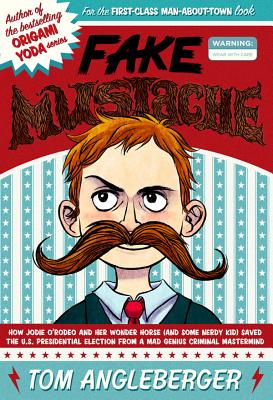
Fake Mustache

by Tom Angleberger
ages: 10+
First sentence: “You may remember seeing me on TV when Jodie O’Rodeo saved the world.”
Support your local independent bookstore: buy it there!

One mustache to rule the world.

(Seriously.)

One kinda nerdy seventh grader to stop the evil master plan (spurred on by his ex-best friend) from happening.

(Granted, he had help from a teen TV singing sensation.)

Will they be able to do it?

(Stop Fako Mustacho, the evil genius, that is. Though they also fall in luvvv along the way. Possibly. Keep in mind that this is a tall tale, though.)

Will I find this book to be as funny as others have?

(No.)

Will it be as epic as it sounds?

(Possibly for some.)

M and C both thought the idea sounded quite awesome, however. For what it’s worth.

(It means that my sense of humor just didn’t jive with this one.)

And while I’m sad that I didn’t like Fake Mustache as much as I’ve enjoyed Angleberger’s other books, I am in no way hindered in my enjoyment of his books.

(Mostly.)

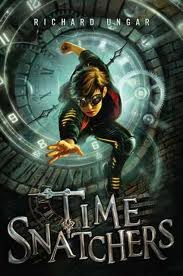
Time Snatchers

by Richard Unger
ages: 11+
First sentence: “I can’t stop crying.”
Support your local independent bookstore: buy it there!
Review copy provided by my place of employment.

Caleb steals things.

Not just anything: artifacts from history.

See: he works for Uncle as a time snatcher, someone who goes through history procuring important artifacts for clients.

On the one hand: this is way cool. The idea of time travel for theft is a clever one, and Unger comes up with some pretty neat technology to make it happen. In addition, Unger finds some great minor moments in history to feature in the book.

The hitch: Caleb doesn’t do this by choice.

He and all the other snatchers in Uncle’s employ — including Caleb’s love-interest, Abby, and his arch-nemesis (we need a nemesis?), Frank — are orphans, and Uncle is, shall we say, less than a kind benefactor. Caleb and his fellow snatchers are there until death, pretty much. There is no way out. 

And this is the other hand: it all sounds quite grim and hopeless. This book is one bit of drama on top of another: Frank is stealing Caleb’s snatches out from under him, he’s being groomed to be the next Uncle, and then he kidnaps (for Uncle, of course) a kid — Zach — Caleb befriended on one of his snatches. That’s not even mentioning the fact that Caleb thinks that Abby like-likes Frank. It’s not a happy book. It’s not a light book. And while the premises is a good one, it’s not even a fun book.

So, of course, Caleb has to risk everything to get Zach back to his family. It’s the only human thing for Caleb to do. And here we come to my real problem with this one: it just petered out. I’m not sure how it could have done anything else, but a good third of the conflict that was introduced wasn’t resolved. Which I don’t mind, generally speaking, but it kind of seemed pointless.

And in the end, I didn’t like this one as much as I hoped it would.

(Just for the record: because this is a Cybils nominee, I’ve been asked to make sure y’all know this is my opinion only, and not that of the panel.)

The Books of Elsewhere: The Second Spy

by Jacqueline West
ages: 9+
First sentence: “If you believe that death is about to spring upon you at any moment, you won’t spend much time watching television.”
Others in the series: The Shadows, Spellbound
Review copy provided by the publisher.

Hm… how to do this without spoiling the other two? Well, first go read the other two! (Seriously: you won’t regret it. This is one fine middle grade series.)

Olive has managed to thwart the evil McMartins so far, a little bit by chance and luck, and a little bit through skill. However, thwarting is not the same as getting rid of. And, so Olive has been creeping around, hoping that Annabelle McMartin doesn’t kill her. That, and she’s starting sixth grade, and middle school, which is its own beast. Granted, the two — being afraid for your life and starting middle school — aren’t necessarily compatible. But, thankfully, Olive has the cats and Rutherford on her side.

Or does she??

Another fine, deliciously creepy, intriguing, fun addition to this clever series. I liked that West used trust and friendship as the backdrop for this tale, exploring this pretty traditional and mundane (though important) topic in such a unique way. But, beyond that, every book is well plotted, and wraps up nicely (my favorite thing!), while leaving room for yet another adventure with these fun characters.

And now that I’m all caught up, I have to wait for the next one to come out.

(Just for the record: because this is a Cybils nominee, I’ve been asked to make sure y’all know this is my opinion only, and not that of the panel.) 

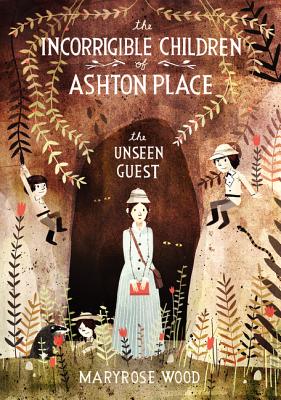
The Incorrigible Children of Ashton Place: The Unseen Guest

by Maryrose Wood
ages: 9+
First sentence: “‘Lumawoo, look.'”
Support your local independent library: buy it there!
Others in the series: The Mysterious Howling, The Hidden Gallery

The best thing about this one is that finally (!) some of the questions I’ve had are finally being (slowly) answered.

See, Lord Frederick’s mother and her suitor, Admiral Faucet, show up at Ashton Place, with an ostrich. (Seriously.) The ostrich gets looks, and Admiral Faucet, intrigued by the Incorrigible’s tracking skills, takes them into the woods to find said runaway ostrich. Of course, their governess Penelope — somewhat daunted by the idea of taking the children into the woods, where there are scary bears and other animals — comes along.

Once in the woods, Strange Things happen. Penelope sees where the Incorrigibles were living before they came to Ashton Place, and discovers their relationship with the wolf, Mama Woof. Additionally, she learns of Admiral Faucet’s Grand Plan, which involves taking the Incorrigibles on the road as a freak show. After he squanders the Ashton fortune, of course. To stop him, Penelope turns to her friend Simon to hold a seance for Lord Frederick’s mother.

The best thing about these, still, is the narrator. Long, hilarious asides explaining words and meanings. Nudges to the reader about the characters. Silly, silly plot twists. I’m still not sure how many kids will like/get this one, but I sure find them enjoyable. Bring on the next installment.

The Book of Three

by Lloyd Alexander
ages: 9+
First sentence: “Taran wanted to make a sword; but Coll, charged with the practical side of his education, decided on horseshoes.”
Support your local independent bookstore: buy it there!

This is one of the titles I remember having fond memories of as a kid. I don’t really remember the act of reading it, though I know I must have: I remember talking about it with friends, especially after the Disney monstrosity of a movie came out. (We were purists, if you can’t tell…) I know I’ve reread the story before this, but I don’t have any record of it, so it’s good that I was asked to reread it again (and write up a lengthy review…)

Taran is just an Assistant Pig Keeper at Caer Dallben, charged with taking care of the oracle pig, Hen Wen. He longs for adventure, and then one day, quite unexpectedly, he gets it: the Horned King and his minions (in service of the Big Baddie, Arawn — yes, that does remind me of Lord of the Rings, thanks for asking) make Hen Wen uneasy and she escapes her pen. Taran, because he’s just impulsive that way, takes off after her, falling in with Prince Gwydion for a bit before they get separated and Taran is on his own.

But he’s not alone: he collects a rag-tag band of friends:the half-animal, always hungry Gurgi; the headstrong Eilowny; the ever-exaggerating bard Fflewddeur Fflam (who will always be “flewder flam” instead of “fleoothur flam”); and the grumpy dwarf Doli. Together they find their way back to Gwydion, fight the Horned King (though Taran rightly asserts in the end that he didn’t do anything worthy of being called a hero), and realize there’s no place like home.

On the one hand, the book is really simplistic: boy leaves, boy has adventures, boy comes home a Wiser and Better person. And yet, I found it to be incredibly compelling. Perhaps it was because I loved it as a kid, but I don’t think that’s entirely it. I think it’s because Alexander is a master storyteller, and he knows how to create characters that we can relate to and root for, ones that are flawed even in a black-and-white world.

And that is really the best kind of middle grade book. And yes, I am going to make the time to read the rest now.

The Books of Elsewhere: Spellbound

by Jacqueline West
ages: 9+
First sentence: “Everyone who lived in the big stone house on Linden Street eventually went insane.”
Support your local independent bookstore: buy it there!
Others in the series: The Shadows

As a result of events in the first book, Olive is no longer able to get into the paintings — the doorway to Elsewhere — on her own. She needs the help of the cats — Horatio, Harvey and Leopold — to get in and out. And, increasingly, they are unwilling to help her. That, and her friend Morton is getting more and more cantankerous because Olive can’t find a solution to get him out of the painting for good.

Then a boy moves in two doors down, and starts asking questions he shouldn’t (or, rather, Olive doesn’t want to answer), but he puts an idea in her mind: if she can find the grimorie (book of spells), then maybe she can figure out not only how to get to Elsewhere by herself, but maybe she can figure out how to get Morton out.

Except, things don’t go the way Olive wants them to.

The best thing about this one is that it’s delightfully creepy. There’s a point when you, as the reader, know something bad HAS to happen, and yet West drags it out, bit by bit (but not in a painful way), stringing us along just enough for us to sit at the edge of our seats, wondering when the resolution will come.

And come it does.  (It’s quite satisfying, too.)

While it’s a continuation of the previous book, it’s also a stand-alone story of its own. You don’t really need to have read the first one to enjoy this one, and there really isn’t any threads left undone (well… not entirely true, but the undone thread isn’t entirely relevant to the story). And that truly makes this a winner of a series.

The Books of Elsewhere: The Shadows

by Jacqueline West
ages: 9+
First sentence: “Ms. McMartin was definitely dead.”
Support your local independent bookstore: buy it there!

Eleven-year-old Olivia, the daughter of two absent-minded mathematicians, has lived her whole life in boring apartments. That is, until her parents by a creepy, old, drafty, mysterious stone house on Linden Street. It’s not only got character, it’s got paintings that Olivia swears are moving.

Not to mention the talking cat.

Soon, Olivia discovers a pair of old spectacles (great word, that), and finds that she can climb into the paintings. Once there, she discovers something more sinister: not only are these paintings in Elsewhere real, the people were once real people. They’ve been trapped there. And, inadvertently, Olivia has let free the person who trapped all these people — including her new friend, a 9-year-old boy named Morton. How is she going to set things to rights?

The jacket flap compared this one to Neil Gaiman and Roald Dahl, and I have to agree: there is the same dark undertones, same sense of foreboding that you get with Gaiman, and the same sense of the unusual you get with Dahl (not to mention the same underwhelming parental figures). But it also has a feel of it’s own: it won the Middle Grade Science Fiction/Fantasy Cybils for 2010 because they liked the pacing and humor and world building. I have to agree: I read this book quickly not just because it was a breeze to get through, but because I didn’t want to put it down.

And I can’t wait to see what other adventures Olivia and Morton will have.

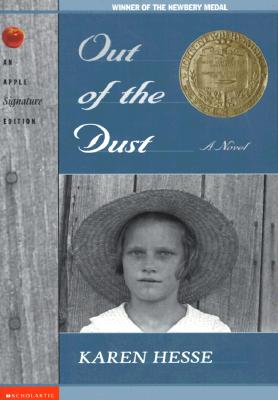
Out of the Dust (reread)

by Karen Hesse
ages: 11+
First sentence: “As summer wheat came ripe, so did I, born at home, on the kitchen floor.”
Support your local independent bookstore: buy it there!

My original “review”, from a long, long time ago was this: “Out of the Dust, Karen Hesse: Free-verse poetry about the Dust Bowl in Kansas. I’m not crazy about the free-verse idea; I found it difficult to ‘get into’ the story.”

First off: I was wrong. It’s the pan-handle of Oklahoma, not Kansas. Now that I live here, that’s a very important distinction to make. We’re not just all plains states lumped into one category out here.

Secondly: I’ve come to  actually really like novels in verse. And I think it suits this book; it’s spare like the environment is out here, especially during the Dust Bowl in the 1930s. It works as a form, and it doesn’t bog the story down.

That said, this book is SO depressing. 

It’s the story of Billy Jo, age 14, in 1934, the height of the Great Depression. It’s just her and her parents, out on the prairie; her father keeps trying to beat the odds and grow some wheat. Her mother is pregnant when tragedy strikes and both she and the baby die. Billy Jo, who is also injured in the accident, and her dad stick it out, trying to make everything work, even as it all is falling apart.

See? Not exactly cheery.

Other than elegance of the form and the depressing story, there isn’t much to say. It’s not my favorite out of the Newbery winners, but it’s not too bad, either.

Calling on Dragons

by Patricia Wrede
ages: 9+
First sentence: “Deep in the Enchanted Forest, in a neat gray house with a wide porch and a red roof, lived the witch Morwen and her nine cats.”
Support your local independent bookstore: buy it there
Others in the series: Dealing with Dragons, Searching for Dragons

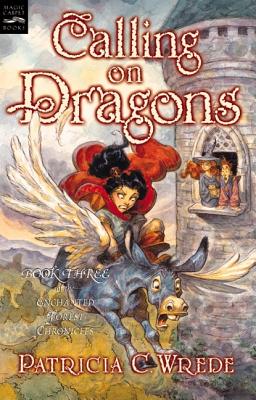
It’s about a year after Cimorene and Mendenbar got married, and things are afoot in the Enchanted Forest. Again. (Yes, it is the wizards. Again.) This time, Morwen was clued into the problems by a six-foot-tall rabbit named Killer. Things get a little trickier when they — Morwen, the cats, and Killer, of course — get to the castle to find out that the wizards have stolen the sword that the magic of the Enchanted Forest is tied to.

Unfortunately, that means Mendenbar (unfortunately, in A’s opinion) has to stay in the forest, while everyone else (including Killer) goes off to find the sword and get it back from those nasty wizards. They end up on a few adventures, and in some interesting pickles. Eventually, the six-foot-tall rabbit ends up a six-foot-tall blue floating donkey with wings, but that’s neither here nor there, really.

In fact, that’s kind of what we thought of this book, as well. A lost interest in it; even though I read it out loud to her, she bailed about 2/3 of the way through. And the ending — which practically requires you to read book 4 — was highly irritating.

We should have bailed at the last book, but now that I’ve come this far, I think I’m just going to have to read the next one just to see how it ends.

Spy School

by Stuart Gibbs
ages:10+
First sentence: “‘Hello, Ben,’ said the man in my living room.”
Support your local independent bookstore: buy it there!

Ben is basically your average kid. He goes to a regular school, is a regular loser, and aside from being a math whiz, there’s really nothing special about him.

So, it’s to his surprise when Alexander Hamilton, of the CIA, shows up at his house, inviting Ben to join this super-secret, super-exclusive spy-in-training school.

Well, who wouldn’t jump at the chance?

 Except, once he gets to spy school, Ben realizes that things aren’t exactly what they seem. Sure, he makes some friends, develops a crush on a super-hot 3rd year girl (who also happens to be a great spy), but it turns out that he’s well, a fall-guy. And there’s a mole in the school. And people are out to kill Ben.

The question is: will he survive long enough to find out who?

I hoped this one would be all the fun of Belly Up and maybe more. I mean: espionage, a cool cover, a spy school, and a mystery? What could go wrong?

Well…. it’s not that it went wrong, it’s more that it just didn’t go right enough. Ben was a bit of a wash as a main character; it’s not that I never connected with him, it’s just that Erica — his crush, and the one who makes the plot move — so outshines Ben that it’s hard to really connect with him. I felt like he was the loser sidekick for most of the book (sure, he comes through in the end), which is okay, but not what I was expecting. On the other hand, Gibbs never really quite got the fish-out-of-water thing quite right either.

Still, the mystery is solid, and while the Big Reveal comes a little out of left field, there are enough clues that perhaps someone who was paying better attention than I could figure it out.

It was a decent second effort; I just wish is was more.