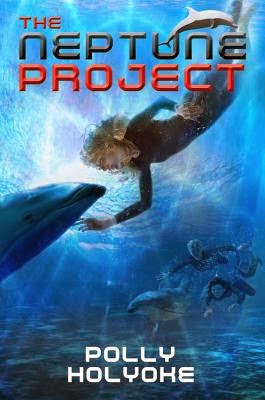
The Neptune Project

by Polly Holyoke
ages: 10+
First sentence: “I wake to an urgent tap at my window.”
Support your local independent bookstore: buy it there!

Nere Hanson (a terrible name, that, as A pointed out) has never understood why she felt more at home in the sea, with the dolphins. Her parents are scientists who study the ocean, but that’s not the whole picture. Nere has problems breathing on land, and it’s just getting worse. Then the government of the Western Collective (roughly some futuristic dictatorship that came out of the US; this is set along the Pacific coast) demands that everyone who lives by the ocean move inland, to help with “food production.” So, Nere’s mom pushes forward her plans, breaking the news  to Nere and her friends Robry and Lena that the reason why they struggle to live on land is that they’re genetically altered to survive — like breathe seawater and everything — under the ocean.

I’m going to stop here for a minute. I’ve read books about exploring the ocean as an option for when global warming takes over and turns this planet into one gigantic mass of water, and I’ve read books that deal with genetic mutation of people (and I think I’ve read one that combines the two in some search for Atlantis, now that I think about it), but this one struck me as unique. Holyoke has done her research and this one felt, well, authentic. I appreciated that. I also enjoyed her use of dolphins; they weren’t props, but rather their own characters, which added another interesting layer to the story.

After they make the change, and get away from the Marine Guard (read government thugs), Nere, Robry, and Lena have to figure out how to survive in their new environment. They meet up with another group of kids who have had this change done to them — Nere is resentful for a good part of the book because her mother did this to her, without her consent, and didn’t give her the time to adjust to this. I love Bad Mom Decisions in Middle Grade books — and set out for the rendezvous point. From there, they head north to Vancouver to the colony that Nere’s father is setting up.

Even though it’s a first in a series — I really would love a stand-alone speculative middle grade fiction book sometime — and it’s just an elaborate set-up, Holyoke does a fantastic job creating her world. And I liked the dynamics she created in the group. It wasn’t as middle school-ish as the jacket flap led me to believe, but a genuine portrayal of kids thrown in a new situation and forced to survive. And Holyoke isn’t afraid to kill characters off or have characters betray one another. It was complex, and I enjoyed that.

I only wish I had more of a sense of closure with this one; I’m not sure I’m all excited to read further adventures of Neve and the Neptune Project. But this one was definitely enjoyable.

(Just for the record: because this is a Cybils nominee, I’ve been asked to make sure y’all know this is my opinion only, and not that of the panel.)
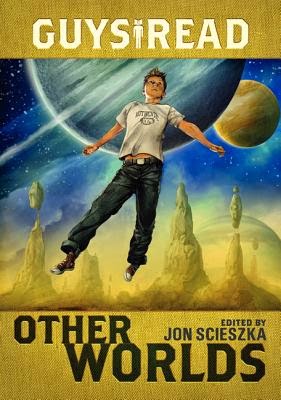
Guys Read: Other Worlds

edited by Jon Scieszka
ages: 10+
First sentence: “What would happen if invading warlords from another planet landed on your school’s basketball court?”
Support your local independent bookstore: buy it there!

I have off and on luck with short stories; sometimes I am really entertained by them. Others, not so much. This collection, however, worked for me. Not all of the stories worked equally well, but overall, it was a good collection.

It may have something to do with my fondness for Ray Bradbury stories.

Scieszka was nice enough to include a Bradbury short story that I hadn’t read (or at least don’t remember reading) as the last one in this collection. And it was a joy to read the weird, wonderfulness that was Bradbury. This time it was about a planet where, due to the radiation from the sun, humans only lived for 8 days. And one boy’s determination to make it off the planet. Brilliant, and by far my favorite story.

The others weren’t bad, either. I liked Tom Angleberger’s “Rise of the RoboShoes” (with illustrations), and found “The Klack Bros. Museum,” by KEnneth Oppel to be delightfully creepy. “Plan B,” by Rebecca Stead had a great twist on the end, and both “Bouncing the Grinning Goat,” by Shannon Hale and “A Day in the Life” by Shaun Tan were delightful.

Sure, I think Rick Riordan phoned it in for his short story, but it was still cool to read about a Percy/Grover adventure, since it’d been quite a while since I’d read about those two together. There were some that didn’t work for me — most notably “The Scout” by D. J. MacHale — but I guess that’s a side-effect of a collection of stories by multiple authors. There are some you like; there are some that fall flat.

There’s a little something for everyone. But get it for the Bradbury story.

(Just for the record: because this is a Cybils nominee, I’ve been asked to make sure y’all know this is my opinion only, and not that of the panel.)

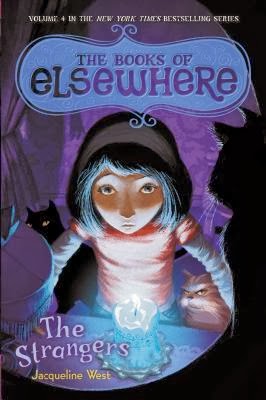
The Books of Elsewhere: The Strangers

by Jacqueline West
ages: 9+
First sentence: “Houses are good at keeping secrets.”
Support your local independent bookstore: buy it there!
Others in the series:The ShadowsSpellbound, The Second Spy

I’m going to be honest. At this point in the series, if it hadn’t been nominated for the Cybils panel I’m on, I wouldn’t have read it. Because I feel like the series is kind of dragging on. Just how many more times can Olive go up against Annabelle McMartin in order to save the house? How many threads can not be wrapped up by the end of a book? Why can’t they find Morton’s parents? And how completely dense are Olive’s?

In this one, some neighbors show up: a Brilliant Professor married to a Slightly Batty Medium (it’s too bad she wasn’t a Small Medium at Large), and an Incompetent Apprentice. They weasel their way into Olive’s life when her parents get kidnapped on Halloween. The main focus of this one is figuring out where Olive’s parents are and getting them back, while still protecting the house from Nasty Annabelle.  As far as that goes, I called who the Bad (or Misguided) Guys were early on, and so it was just a matter of time until Olive caught up to what I already knew.

It’s not that it was a poorly written book — it wasn’t. It’s just that the premise is getting old by book 4, and even the talking cats that were so much fun in book one aren’t making me laugh. And to be totally, completely honest: I skimmed this one, mostly, because I just wasn’t interested in Olive anymore.

(Just for the record: because this is a Cybils nominee, I’ve been asked to make sure y’all know this is my opinion only, and not that of the panel.)
A Grimm Conlcusion

by Adam Gidwitz
ages: 11+
First sentence: “
Support your local independent bookstore: buy it there!
Others in the series:  A Tale Dark and GrimmIn a Glass Grimmly

If you’ve read the other two books, you pretty know what to expect with this one. Some pretty grisly awesome bloody violence, a winding fairy tale-inspired story, with a very snarky narrator. This time, it’s twins Jorinda (YOUR-inda) and Joringle (YOUR-ingle) whose story we follow.

I should say up front that if C’s language arts teacher last year hadn’t been insistent on her students learning some of the more obscure Grimm tales, I wouldn’t have believed that this one was really based on a real fairy tale. But it is, and it’s one of the more, um, gross ones. See, the twins’ stepfather doesn’t like them, and so he kills off Joringle, makes Jorinda feel like it’s her fault, and then cooks Joringle and serves him to his mother. Seriously. Ew.

But, since that one is not enough, Gidwitz smashes it up with the real Cinderella (actually, the narrator’s side notes on the meaning of Cinderella — or, rather Ashputtle — is quite hilarious), Sleeping Beauty, and several tales I don’t even know. It’s all very gruesome, all very weird.

In the middle, however, this one turned… well… odd. Gidwitz went meta on me, and Jorinda and Joringle left the story world, and actually started interacting with the narrator, who turned out to be an elementary school teacher named Adam. He read the characters A Tale Dark and Grimm and In a Glass Grimmly in order to help them solve their current crisis. Additionally, the narrator/Adam got all moralistic on us. He had Lessons that Needed to Be Taught, and was actually — surprisingly — heavy-handed with them. And, for the first time in this series, I got pulled out of the story. The intrusive narrator was no longer funny and witty, but rather truly intrusive. And it bothered me. I didn’t mind how the story resolved itself; Jorinda and Joringle were actually good Middle Grade Heroes and did what they needed to do to resolve the story happily. But, after the point where they met the narrator, I wasn’t that interested in how the story resolved itself.

Which is too bad. Because, for the most part, this is a really good series. And I do like the way Gidwitz plays with the Grimm tales. I just wish he could have gotten there without bringing the narrator fully into the story.

(Just for the record: because this is a Cybils nominee, I’ve been asked to make sure y’all know this is my opinion only, and not that of the panel.)

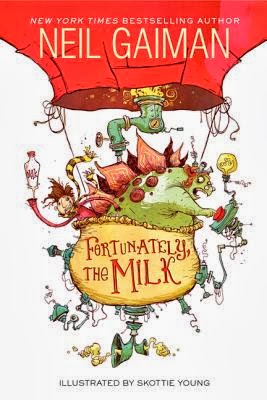
Fortunately the Milk

by Neil Gaiman, illustrated by Skottie Young
First sentence: “There was only orange juice in the fridge.”
Support your local independent bookstore: buy it there!

Two things up front: First, this is a tall tale. Second, because it’s a tall tale (and because it’s meant for beginning(ish) readers), there’s not much substance to it.

That doesn’t mean it’s not enjoyable; it is. I enjoy Gaiman’s stuff normally, but I really do think I prefer his whimsical works for younger kids. This one is basically the tale of a dad who went out to get milk for the morning cereal, and had a wild adventure getting back home. There are hot air balloons (or rather “Professor Steg’s Floaty-Ball-Person-Carrier”), pirates, piranhas, aliens, time travel, and even sparkly ponies. Of course, the kids don’t believe the dad, because he’s obviously telling a story. Or is he?

As I said, this is delightful. The illustrations are brilliantly funny, and I laughed aloud at many parts. My only problem with the book is that I would have liked it better if it had been a true middle grade novel, and one of the kids had had the adventure, rather than their father doing all the cool, fun stuff.

But that’s such a minor quibble. I’m going to hand this one to K to see what she thinks. I have an inkling that she’ll like it.

(Just for the record: because this is a Cybils nominee, I’ve been asked to make sure y’all know this is my opinion only, and not that of the panel.)
Pi in the Sky

by Wendy Mass
ages: 9+
First sentence: “Okay, first off, the quotes that start each chapter are from real people who know a lot of really cool things.”
Support your local independent bookstore, buy it there!

Joss is the seventh son of the Supreme Overlord of the Universe. He lives in the realms, and even though he’s a billion years old by our count, he’s really only just entering teenage-hood by theirs. His six older brothers are established in their jobs in the Realms: managing afterlife, creating planets, observing said planets. Joss, well, he delivers pies. (They’re really good pies, though.)

He doesn’t think much about his existence, going about his daily life with his friend Kal, until one day when someone from some planet (it turns out to be Earth) spies the Realms through their telescope. This is, to put it mildly, a Big Taboo. Usually, the planet in question gets destroyed. But, since this is Earth and Kal’s parents were there as Onworld observers, Earth isn’t destroyed, it’s just taken out of time. And, for some reason unknown to Joss, it’s his job to put it back to rights.

To complicate matters, an Earth girl named Annika has showed up in Kal’s place (I forgot to mention that he summarily disappears along with his parents, who were on Earth), and is tasked with the job of helping Joss recreate the Earth. From scratch.

Like many of Wendy Mass’s other books, this one was thoroughly enjoyable. I especially liked — and I’m not sure it was intentional or not — the blending of  science and “religion”. As Joss worked through the scientific application of the Earth’s creation — and I don’t doubt that Mass’s science is spot on; she’s known for her research — from the big bang through evolution, it occurred to me (granted this is an adult, and a religious, perspective) that you could see God in what Joss was doing. Sure, Mass called it the Supreme Overlord of the Universe and cloaked it in the mask of kids speculative fiction. But, why couldn’t God have used science to create the world?

Sorry. I got off track.

At any rate, I really enjoyed Joss’s learning of evolutionary science. And physics and chemistry as well. And I thought Mass was clever to frame it as a fantastical adventure. It made the science less… boring. There was a sweet ending as well.

In short: a very fun book.

(Just for the record: because this is a Cybils nominee, I’ve been asked to make sure y’all know this is my opinion only, and not that of the panel.) 

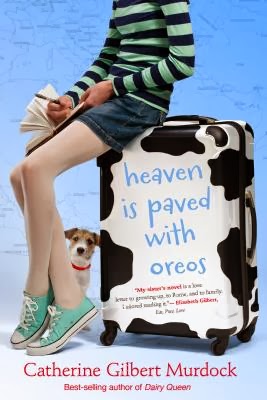
Heaven Is Paved With Oreos

by Catherine Gilbert Murdock
ages: 11+
First sentence: “Darling Sarah!”
Support your local independent bookstore: buy it there!

When I heard that Catherine Murdock wrote a new book in D. J. Schwenk’s world, the first thing I did was put in on hold at the library. It’s been years since I’ve read Dairy Queen and it’s companion books, but I have fond memories of them. And while I didn’t love this one as much as the originals, it didn’t disappoint.

Fourteen-year-old Sarah Zorn is best friends with Curtis Schwenk. And since that’s not really acceptable in middle school (as C finds out more often than not), they’ve come up with their “Brilliant Outflanking Strategy”: let everyone think that they’re dating, even if they’re not. Except, that doesn’t really work: right before Sarah goes to Rome with her grandma, Z (yes, that’s what everyone calls her), Curtis “breaks up” with her.

But, as things go, Lessons Are Learned in Rome (Italy is a good place for Lessons), and Sarah comes home a Wiser and More Mature person, one who is more willing to face the unknown. A lot of that is due to her grandmother’s story, which we learn over the course of the book.

Told in journal-style (is there a name for that?), we see the world, both Wisconsin and Rome,  through Sarah’s eyes. She’s a lovely person to have as a companion through this journey. And even though Z’s story is a non-traditional one, I found it hard to judge her for it. She was who she was, and even Sarah’s questioning of that didn’t stop me from enjoying Z. (Maybe it’s because I’m a hippie at heart.) My favorite part was the Rome section. Murdock only had Sarah and Z spend a week there; I wished it could have gone on much longer, and in more detail. But, I did like how the act of going changed Sarah, and the results that came out of that.

So, no, it’s not as strong a novel as Murdock’s original series; in many ways it feels tacked-on after the fact, an unnecessary cousin tagging along. But that didn’t stop me from really liking it.

Texting the Underworld

by Ellen Booraem
ages: 10+
First sentence: “Death stalked the spider, pre-algebra book in hand.”
Support your local independent bookstore: buy it there!

Conor O’Neill has fears. Spiders, safety, his father pressuring him into taking the entrance exams to one of the elite high schools in Boston. Even with his fears, Conor’s managing. Until his worst fear comes true: a banshee shows up in his window, waiting to keen for a death of one of Conor’s family.

At first, Conor tries to keep the banshee — whose name is Ashling — a secret, but (of course) that doesn’t work. She’s bored waiting for the death to happen and it’s her first time out of the Underworld since her death 1600 years ago. She wants knowledge, and (of course) middle school is a good place to get it. Except for the whole “if people see you keening when something dies, they die too” thing.

It’s more complicated than that, obviously. There’s a side story about one of Conor’s former lives in which he had a relationship with Ashling. And there’s a trip to the Underworld so that Conor can cheat death (not his own; and he doesn’t, really, in the end. Spoilers, I know.).

While I liked Booream’s treatment of Celtic mythology (and other; there’s some Greek and African mythologies in there as well) and her modernizing of banshees (and the Underworld, for that matter), in the long run, this just didn’t work for me. I think my main problem with it was Conor. He was so insecure, so unsure of himself, that I felt that, for most of the book, he was just spinning his wheels. I wanted him to be proactive and DO something instead of just being reactive to everything around him. And by the time that happened, I felt like it was too little, too late. (And his younger 10-year-old sister Glennie was just annoying.) I did like Ashling, however; I thought Booream caught the idea of a supernatural being — especially one who wouldn’t have encountered the modern world — enthused with the mortal world. I liked Ashling’s discovery of cell phones, computers, buses, even sidewalks. That charmed and amused me.

I’m just disappointed it wasn’t all like that.

(Just for the record: because this is a Cybils nominee, I’ve been asked to make sure y’all know this is my opinion only, and not that of the panel.)

Flora and Ulysses

by Kate DiCamillo, illustrated by K. G. Campbell
ages: 8-12
First sentence: “In the Tickham kitchen late on a summer afternoon…”
Support your local independent bookstore: buy it there!
Review copy pilfered from the ARC shelves at my place of employment.

Flora is a cynic. Her mother is a romance writer and Flora is positive that she loves the shepherdess lamp more than her own child. Her father is awkward, his opening line being, “George Buckman. How do you do?”

Then one day, a squirrel gets vacuumed up by Flora’s neighbors ultra-spiffy vacuum, and (after they determine that it’s not dead) gains superpowers. Well, he can communicate with Flora, type out poetry, and fly. Flora is convinced that means the squirrel — which she named Ulysses after the vacuum — is meant to save the world.

I wanted to love Kate DiCamillo’s latest with my whole heart. I didn’t. I liked it well enough; Flora is clever, and Ulysses is cute. But, I never felt like I connected with the characters. I felt that while it was clever and sweet, it lacked heart and depth. (Yeah, I know: it’s for younger readers. That doesn’t mean it can’t have depth.) I did like the illustrations, quite a bit, and I liked what DiCamillo was trying to get across here.

So, chalk it up to me and my slight reading slump. It may be a lot better than what I ended up thinking it was.

(Just for the record: because this is a Cybils nominee, I’ve been asked to make sure y’all know this is my opinion only, and not that of the panel.)
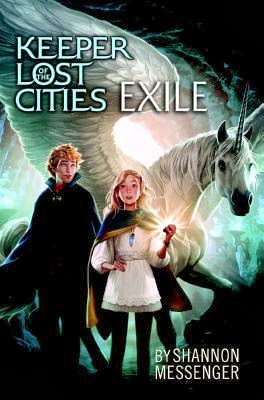
Exile

by Shannon Messenger
ages: 9+
First sentence: “Sophie’s hands shook as she lifted the tiny green bottle.”
Support your local independent bookstore: buy it there!
Others in the series: Keeper of the Lost Cities
Review copy snagged off the review shelves at my place of employment.

First off: kids like this series. So, take everything I say about it with a HUGE grain of (adult) salt. Also: spoilers for the first one. Obviously.

Sophie is still living with the elves. She’s still multitalented, which many of her age-mates find annoying. She’s still trying to get used to living with her adopted family. And she’s still trying to figure out who the Black Swan are, and why they created her.

It’s a lot for a 12-year-old to handle.

Especially since she found a rare alicorn — part unicorn, part Pegasus — in the woods and brought it home. It could “reset the timeline” (no, I have no idea what that means), and so Sophie’s been given charge (reluctantly) by the Council to tame and train the alicorn. Which, of course, she forms a bond with.

Much like the first one, this one was TOO long. Sure, there was a lot of white space and the text is big, but at 570 pages, I was exhausted before I was halfway through. And, much like the last one, I feel like Messenger has a good story in here. This time, though, she needed an EDITOR to hack her stuff down to 250 pages. (Especially all of Sophie’s anxiety moments. ENOUGH ALREADY.) I did like some of the characters — Keefe, especially– and I thought Messenger tied up the story nicely while leaving some threads for the next book.

(Can I hope for that one to be shorter??)

But, as I said at the first, kids do seem to like this series. It’s good for those who aren’t old enough for Harry Potter or want more like that. But it’s just not doing it for me.