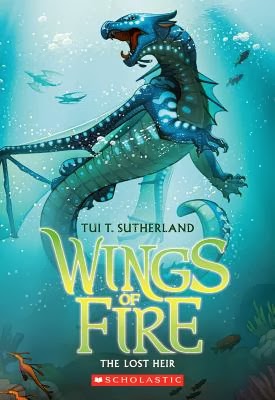
The Lost Heir

Wings of Fire 2
by Tui T. Sutherland
First sentence: “Underwater, Webs couldn’t hear the screams of dying dragons.:
Support your local independent bookstore: buy it there!
Others in the series: The Dragonet Prophecy
Content: There’s some dragon violence — a few battles, some one-on-one fighting, and a baby dragon egg is smashed — but other than that, it’s pretty low-key. It resides in the middle grade (3-5th grade) section of the bookstore.

Spoilers for the first book, obviously.

When we last left our dragonets — the five dragons that were taken when they were eggs and raised by the Talons of Peace to stop the war that’s been going on for too long — they had escaped their captors/guardians and were setting off to find the clans. They’d interacted with the Mud Wings, to some dissatisfying results, and been captured by the Sky Wings (and their bat-crazy queen), but got out of there. Now they’re headed to the Sea Wing palace, presumably because Tsunami, one of the dragonets, is the queen’s daughter. They figure they can find refuge and protection there.

Except — probably predictably — things aren’t what they seem. Sure, Tsunami’s mother, Queen Coral, is happy to see Tsunami. But she’s not very happy to see Tsunami’s friends, and shoves them off to a cave. It’s slowly revealed that Queen Coral’s not a little crazy. And that there are traitors in the midst. And that Tsunami doesn’t fit in as well as she thought she would.

I’ve decided — partially because books three and four are already out, but also because it just makes sense — that the purpose of each of these books is not only to tell an overall story, but to highlight a specific tribe of dragons. And in that latter purpose, Sutherland does a fantastic job of creating an individual world. The Sea Wing palace and world are fascinating — they have their own language that involves flashing stripes, which is pretty cool — and even though Tsunami starts out as a complete brat, she develops into a fairly confident leader by the end. What I found myself growing impatient with was the overarching plot of the war and the prophecy. The menacing posturing by Coral’s friend Queen Blister, the suspicion and automatic mistrust of the Talons of Peace.

I’ve not disliked this series, and it’s perfect for those who enjoyed Warriors or Guardians of Ga’hoole. But I’m probably not going to keep reading. I just don’t have much interest in the overarching storyline.

(Just for the record: because this is a Cybils nominee, I’ve been asked to make sure y’all know this is my opinion only, and not that of the panel.)
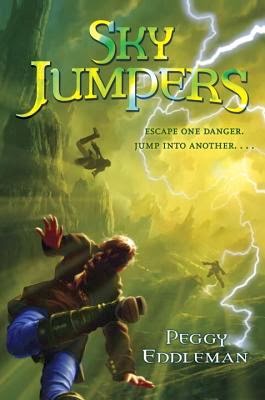
Sky Jumpers

by Peggy Eddleman
First sentence: “You would think I’d never jumped off a cliff before, based on how long I stood there.”
Support your local independent bookstore: buy it there!
Review copy snagged from the ARC shelves at my place of employment.
Content: There are some intense moments, but other than that, it’s pretty tame. It’s shelved in the middle grade (3-5th grade) section of the bookstore.

It’s a future after World War III, which devastated the world. The scientists thought they were doing good in creating “green” bombs, but (because, you know, BOMBS) it still wiped out many cities and destroyed most of the population. In addition, they changed the properties of metal and magnets, and while they made some ground more fertile, it made other places toxic. And — perhaps worst of all — it created the Bomb’s Breath: pockets of air that if you breathe, it’ll kill you.

This is the world that Hope has grown up in.

Living with her adoptive parents in White Rock, a town in a fertile valley, she has discovered that the thing that is most highly prized is Inventing. Since the war destroyed all our technology, it’s up to everyone, really, to invent gadgets and come up with ideas to make life less, well, primitive. Except Hop is terrible at it. What she’s good at is being daring: she’s figured out that if you hold your breath in the Bomb’s Breath you won’t die and that the thicker air has a slowing quality to it. She has taking to jumping off cliffs (sans parachute) through the Bomb’s Breath for fun. (No, she didn’t ask permission.)

Then, one day in winter, some bandits infiltrate their previously safe town and take hostages, demanding access to the town’s one true commodity: the antibiotic they’ve developed. The only hope for the town — since their guard and the weapons are guarding the next town over — is to go fetch the guard back. And the only way to do this is to go over the mountain and through the Bomb’s Breath. And the only one who can do this is Hope.

I’m a bit torn on this one.

On the one hand: I love Eddleman’s take on the dystopian genre. It’s so overdone that it really needs something unique to grab my interest. And Eddleman did just that. I also liked how Hope was a fierce girl, taking the initiative in spite of her misgivings, and using her strengths to not only get the guard but also help outwit the bandits.

On the other hand: I’m not sure. It’s not something I can pinpoint, but I felt disconnected from the book the entire time. Like I was on the outside, looking in, rather than being grabbed and immersed into the world. Perhaps I was turned off  by the BOOK ONE on the back of my ARC. I don’t know if it’s truly going to be a series — this one wrapped up just fine — but the idea of that just set me on edge. I really am so tired of series books.

I shouldn’t let that prejudice interfere with my reading of this one, though. It was a good book. One that I think will appeal to both genders. And there’s a lack of “magic” that was refreshing as well; Hope got by on her wits and her ingenuity and her reliance on her friends. I can get behind that.

(Just for the record: because this is a Cybils nominee, I’ve been asked to make sure y’all know this is my opinion only, and not that of the panel.)

The Real Boy

by Anne Ursu
First sentence: “The residents of the gleaming hilltop town of Asteri called their home, simply, the City.”
Support your local independent bookstore: buy it there!
Content: Some intense moments — both physically and psychologically — and the language and pacing are a bit slow, especially for a struggling reader. Still, it fits in the middle grade (3-5th grade) section of the bookstore.
Review copy snagged from the ARC shelves at my place of employment.

After I finished reading this, A took a look at it and said,”Huh.’The Real Boy’? Is that like Pinocchio?”

Well, yes. Yes it is.

The island of Aletheia is full of magic, even though there are no wizards anymore. There are magic smiths, and Oscar is the hand to one. Which means, he collects and chops the herbs and basically stays out of the way. That is, until the apprentice turns up dead and the magic smith go missing. That’s when Oscar’s world starts unraveling: everything he thought Aletheia was built on, everything he thought his master was turns out to be built upon a lie. And it’s up to Oscar and Callie, the healer’s apprentice, to figure out what the truth is, and how to set everything right. And, because I alluded to it, yes, the Pinocchio story does play a small role.

This was a lovely, lyrical book; Ursu is a magnificent, quiet writer. She knows how to evoke a feeling and a place — the forest is dark and magical and calming. And even though it’s never explicitly said, Ursu makes it obvious through little words and phrases that Oscar has some form of autism. That simple fact upped the tension when it was up to Oscar become the Hero of this story. How — if he doesn’t know how to interact with people — is he supposed to figure everything out? Enter Callie, who was a remarkable character. (In fact, all the characters, from the magic smiths to the bullies, to the people in the city who were Indulged and Coddled, were remarkably written.) She is the healer’s apprentice, magicless in a world where magic is everything, and yet she’s smart and plucky and brave, but most of all caring.

In addition to all that, and refreshingly, it’s not a start of a series! Hooray for stand-alone books! My only detriment is that I’m not sure this will appeal to many kids. But for the ones who are daring enough (or quiet enough) to pick it up, they’re in for a real treat.

(Just for the record: because this is a Cybils nominee, I’ve been asked to make sure y’all know this is my opinion only, and not that of the panel.)

Beholding Bee

by Kimberly Newton Fusco
First sentence: “The way I got the diamond on my face happened like this.”
Support your local independent bookstore: buy it there!
Content: There’s some bullying, both by (insensitive and stupid) adults and mean girls. But there’s no language, and the language isn’t difficult at all. It sits quite happily in the middle grade (3-5th grade) section of the bookstore.

It’s in the middle of World War II, and things are tough for those who work at the carnival. Especially for Bee, who works the hot dog stand with her makeshift guardian, Pauline. It’s difficult for Bee not only because she’s an orphan and the carnival owner, Ellis, is a world-class creep, but because she’s got a birthmark in the shape of a diamond on her face that everyone (EVERYONE!) stares at and/or makes fun of.

So, when Ellis takes Pauline away from her and threatens to put her on display as a sideshow attraction, Bee decides to run away. She makes it to a town with a perfect house, and finds a couple of women whom she ends up calling “aunts” there. The catch? Only Bee can see her aunts.

Of course life in her new town isn’t easy: there are busybodies who want to know who Bee’s caregivers are. There are mean girls who are dealing with Issues themselves. But there’s also good people who reach out to Bee and make her feel at home.

In so many ways, this was just a plain, regular middle grade fiction book. And it’s a good one at that. Fusco writes lyrical, short chapters; ones that make you want to keep turning pages. There’s the backdrop of hardship with the war, there’s bullying, there’s Bee’s “disfigurement” and shyness that places her in the special-needs class. It really is quite a lovely little novel about Overcoming, finding family, and creating a home.

The question I had, though, while reading this book is this: why the ghosts? It was a great novel without them, and I didn’t feel that the ghosts added anything to the story. They felt, well, contrived. And I wished that Fusco had found another way to get Bee into the town and the house that didn’t involve the supernatural. That way the book would have had a broader appeal, more power, and been absolutely perfect.

But, I guess, you can’t win them all.

(Just for the record: because this is a Cybils nominee, I’ve been asked to make sure y’all know this is my opinion only, and not that of the panel.)
The Garden Princess

by Kristin Kladstrup
First sentence: “Princess Adela laced her fingers under a clump of creeping Charlie and pulled, enjoying the satisfying crackle of roots ripping free of soil.”
Support your local independent bookstore: buy it there!
Content: Aside from your usual witches being Bad and princesses not wanting to be princesses and talk of Marriage for a 16-year-old, there’s not much here. It’d happily belong in the middle grade (3-5) section of the bookstore.
Review copy sent to me by the publisher for the Cybils

Adela, like many princesses in books like these, does not like being a princess. She would much rather muck around in the garden, creating landscapes, finding new plants. So, when the handsome gardener (whom she prefers hanging out with) gets invited to a garden party thrown by Lady Hortensia, Adela finagles her way along, mostly so she can see Hortenisa’s famed gardens. However, when she gets there, she finds that the gardens aren’t, well, normal. And Hortensia’s a witch, something Adela thought didn’t exist. It turns out that Hortensia’s plants are all actually beautiful girls. And Adela’s determined to set them all free.

So far, so good. It’s pretty run-of-the-mill, but nothing horrible. I actually kind of like Adela, and it’s not very often you get a princess obsessed with gardening. But, once at the garden, it went south for me. It got very lecture-y about Outer Beauty (which is bad!) and Inner Strength (which is good!), but I could deal with that. No, my problem came with the climax. See, Adela, for all her Heroism, doesn’t actually Solve the Problem. Nope, that goes to the guy/love interest in the story. And that bothered me. I wanted Adela to be Strong Enough and Smart Enough to beat the evil witch, but it turned out that she was only Good Enough to inspire the guy into figuring things out.

*sigh*

But other than that, it was a perfectly fine little fantasy.

(Just for the record: because this is a Cybils nominee, I’ve been asked to make sure y’all know this is my opinion only, and not that of the panel.)

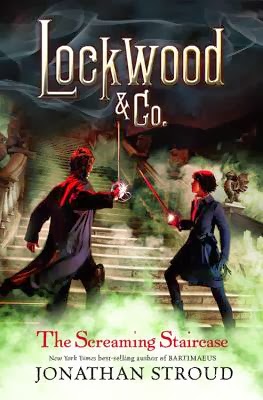
The Screaming Staircase

Lockwood & Co, Book 1
by Jonathan Stroud
First sentence: “
Support your local independent bookstore: buy it there!
Review copy snagged from the ARC shelves at my place of employment.
Content: It’s a ghost story and pretty scary at times, which means, while it’s on a middle grade reading level (and it’s shelved in the middle grade — 3-5th grade — section of my library), I’d be pretty wary about giving this to a Sensitive Child. There’s also a handful of mild swear words.

Even though I saw the rave reviews and the gushing praises, I put off reading this one for much too long. Even though I’ve loved Stroud’s books in the past, I was wary of the rave reviews: it couldn’t be THAT good, could it?

Well, yes. Yes, it was.

Set in a London where there is a Problem with ghosts — they’re everywhere, infesting the buildings and graveyards  — and where only the young can see, and subsequently fight, them. Usually, those with the Talent to see/hear the ghosts, are supervised by adults, but at Lockwood & Co. there’s no such oversight. It’s just Anthony Lockwood, George, and Lucy, teenagers and ghost fighters extraordinaire.

Okay, so it’s not that simple. Lucy and George constantly bicker, and Lockwood is more optimistic about the future of his company than actually capable of running it. But the three of them are talented ghost fighters (hunters? I wasn’t quite sure what to call them), and even though they’re not exactly careful, they get the job done.

Then, on a routine clearing, Lockwood and Lucy stumble on a particularly fierce ghost. It turns out that it was Annabel Ward, a socialite and actress who was murdered and shoved into a chimney. This captures the imagination of our narrator, Lucy, and she ropes the boys into helping her figure out what, exactly, happened to Annabel 50 years ago. One of the best things about this book is the way Stroud handles the mystery: he gives us enough clues as we go along to make a good guess, but it also isn’t the only element to the book. Neither is the ghost Problem. There’s enough layers and depth in this book to keep even the most reluctant of readers interested.

And even though it takes a good 2/3 of the book to get to where the title came from, it all comes together splendidly (fantastically, I might add) at the end.

Additionally, Stroud knows how to do atmosphere. It’s creepy, it’s funny, it’s haunting. It’s eloquent. One passage that stuck out (it’s near the end, but it doesn’t give anything away):

All around us rose the scream, issuing directly from the steps and stones. Its volume was appalling — as painful as repeated blows — but it was the psychic distress it carried that made it so unbearable, that made your gorge rise and your head split and the world spin before your eyes. It was the sound of the terror of
death, drawn out indefinitely, extending on forever. It spiraled around us, clawing at our minds. 

It’s not just good. It’s brilliant.

(Just for the record: because this is a Cybils nominee, I’ve been asked to make sure y’all know this is my opinion only, and not that of the panel.)

EMGSF Smallish Books

The Lonely Lake Monster
by Suzanne Selfors
First sentence: “Pearl smacked the alarm clock until the loud beeping stopped.”
Content: Nothing objectionable or difficult at all. My only problem is deciding whether or not it’s happiest in the middle grade (3-5) section or the beginning chapter book (grade 1-2) section. It could go either way.
Others in the series: The Sasquatch Escape

I really liked the first one of the series; and this was more of the same. It wasn’t bad; Pearly got to shine as her own heroine, saving her friend Ben from a lonely lake monster. She came up with and executed a solution on her own, which I was very proud of and grateful for. It just lacked substance, which is just me as an adult talking. It’s perfect for the target age group.

The Ghost Prison
by Joseph Delaney/Illustrated by Scott M. Fisher
First sentence: “For pity’s sake, get up, lad.”
Content: Lots of ghosts. Would sit in the middle grade (3-5) section of the bookstore.

This is a ghost story. For kids. It’s got (duh) ghosts, and kid-eating monsters, and atmosphere coming out the wazoo. Except, it wasn’t scary. At all. Even the twist at the end wasn’t a surprise. Perhaps it was because I am an adult, and it’d be terrifying to a 7-year-old. But, honestly? You want something scary? Read Coraline.

Mickey Price: Journey to Oblivion
by John P. Stanley
First sentence: “Every great adventure starts with a moment.”
Review copy sent to me for the Cybils.
Content: Seventh-graders being put in dangerous situations. But other than that, nothing. Would reside in the middle grade (3-5) section of the bookstore.

Mickey Price — confusingly telling this story to his kids when he’s older — is a seventh grader who gets chosen to be a part of a super-secret astronaut program in 1977. They get sent to the moon and Save The World. There’s science and math because, you know, they’re Useful. And I spent the entire book alternately wondering WHY this was in the Speculative Fiction category — was it because it’s unrealistic to send seventh graders into space — and wishing Stanley had gotten a better editor. Good idea, lousy execution.

(Just for the record: because this is a Cybils nominee, I’ve been asked to make sure y’all know this is my opinion only, and not that of the panel.)

Hoot

by Carl Hiaasen
First sentence: “Roy would not have noticed the strange boy if it weren’t for Dana Matherson, because Roy ordinarily didn’t look out the window of the school bus.”
Support your local independent bookstore: buy it there!
Content: There were a few mild swear words (which A found amusing), and some instances of bullying and domestic violence. It feels like a genuine middle grade book, with real middle grade heroes (yay!) and happily sits in the middle grade (grades 3-5) section of the bookstore.

Ah, Florida. The air is hot and humid, it rains a ton, and Roy Eberhardt hates it. With a burning passion. He most recently lived in Montana, the land of the huge vistas and great snowboarding, but because of his dad’s job, he’s stuck in boring Florida. Until the day he notices a strange boy with dirty feet running away from the bus stop. His curiosity piqued, Roy follows the boy and discovers Something To Care About. See: Mother Paula’s Pancake House is building a new restaurant. On top of some burrowing owl dens, and the boy is bound and determined to stop the company. And Roy, for better or for worse, finds that he Cares enough to get involved.

I remember reading this ages ago — probably when it first came out — and liking it. Though, I seem to remember it being funnier than I found it this time. It was amusing, sure, especially when Bully Dana Matherson gets his come-uppance at the hands of Beatrice Leep, Tough Girl Extraordinaire. But, mostly, it’s a quiet book about Making A Difference. I like how Roy finds out that while vandalism is one way to get a corporation’s attention, there are other — possibly more effective — ways of handling it. It’s not only a fun book, it’s a lesson in civics and awareness. There are layers of complexity; Roy is bullied (a lot) and there’s some domestic issues with Beatrice. But Hiaasen did it without being preachy; this is NOT an issue book.

Which, honestly, is a mark of a talented writer. And for that reason alone more than worth the time it takes to read it.

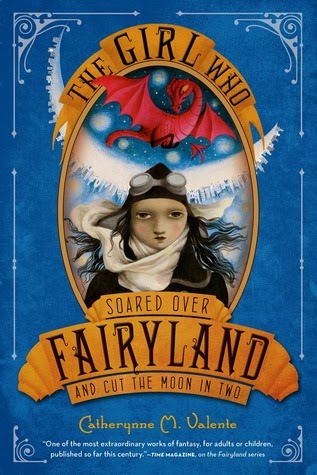
The Girl Who Soared Over Fairyland and Cut the Moon in Two

By Catherynn M. Valente
ages: 11+ (I’m not sure the younger set would like this one. Just saying.)
First sentence: “
Support your local independent bookstore: buy it there!
Others in the series: The Girl Who Circumnavigated Fairyland in a Ship of Her Own Making, The Girl Who Fell Beneath Fairyland and Led the Revels There
Review copy snagged off the ARC shelves at work.

It’s been a year since September has left Fairyland Underneath, and she aches to return. The Real World just isn’t as fun or as interesting as Fairyland. And she’s been told that she can return every year, so she waits. And waits. But no one comes. Until, one day, long after she’s expecting them, someone does come, but won’t let her in. So, desperate as she is, she breaks in. Which means she’s a Criminal. She finds that things aren’t the same as they were, encounters the Blue Wind (who’s quite obnoxious), gets sent on a Mission, and tries to fight a Yeti on the moon. Yes, it is as weird as it sounds.

But, even though there were passages I found amusing (most specifically, the description of the Lopsided Library) and characters (like the car Aroostook) I liked, I just wasn’t as charmed with this one as I was with the other two. Maybe it’s because September is Getting Older, and Valente tried to bring in not only romance (Saturday, the Marid, is in love with September), but also the Trials of Getting Older, and it just didn’t Work. (This book makes me want to Emphasize with Capital Letters. It’s an unfortunate side effect.) I skimmed more than I read, I rolled my eyes more than I laughed. I wanted to Love Ell the Wyvery and Saturday again; I wanted to Enjoy September’s journey. But my heart wasn’t in it.

I don’t know if that means it’s the writing or just that I’m getting tired of this series. Could be either. Or both.

(Just for the record: because this is a Cybils nominee, I’ve been asked to make sure y’all know this is my opinion only, and not that of the panel.)

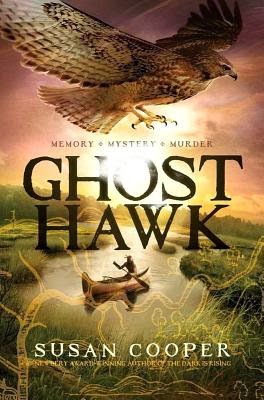
Ghost Hawk

by Susan Cooper
ages: 11+
First sentence: “He had left his canoe in the river, tied to a branch of a low-growing cherry tree.”
Support your local independent bookstore: buy it there!

I should start with this: the woman can write. A random passage: “John went off to their allotted acre of land beyond the houses, where corn and pumpkins were growing. He did not point out to Daniel Smith that the swelling ears of corn were more at risk from night-prowling raccoon than from daytime birds.”  Or: “We gutted the deer, and tied their forelegs together and then their hind legs, and we carried them home, each one hanging by the legs form a pole carried by two strong men. It took all night and half the net day, but it was a triumphal procession, and our return was greed with cries of praise and delight.” It’s one of the things I’ve always enjoyed about Cooper’s writing: she knows how to evoke a place, and with the simplest of words, create a mood.

But.

I knew about the inaccuracies and controversy surrounding this one before starting it. In some ways, I think it was inevitable: a book about a Wampanoag young man (especially a children’s book, it seems; was there the same sort of backlash around Caleb’s Crossing? If so, I missed it.) written by a white person is bound to create backlash. And to be fair, I understand that. But I have to admit that that’s not my primary problem with the novel. No: for me, it was because it was boring.

Cooper went into detail about the life of both Little Hawk as well as a Puritan boy, John Wakeley, and even though there were a couple of surprises (let me just say, I found out a third of the way through why it’s a SFEMG nominee), I was bored. I could care less about the characters, the story. I wanted to care. I wanted to see people like Daniel Smith and William Kelly — who were in favor of exterminating the Native Americans because they were savages (which always brought to mind the savages song from Pocahontas) — I just didn’t. It’s not because I didn’t recognize that their views were wrong. I just didn’t feel it.

And the last third? (The epilogue and post-epilogue as I think of them.) I basically skimmed them. Because once both Little Hawk and John stopped being kids, I lost interest. It’s a middle-grade book, for heaven’s sake. Have we forgotten what that means??

I wanted this to be better, just because it’s Susan Cooper. And I was disappointed that it wasn’t.

(Just for the record: because this is a Cybils nominee, I’ve been asked to make sure y’all know this is my opinion only, and not that of the panel.)