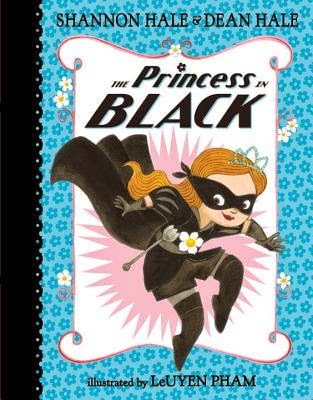
The Princess in Black

by Shannon Hale and Dean Hale, Illustrated by LeUyen Pham
First sentence: “Princess Magnolia was having hot chocolate and scones with Duchess Wigtower.”
Support your local independent bookstore: buy it there!
Review copy provided by the publisher.
Release date: October 21, 2014
Content: Yeah, there’s nothing but good fun here. And it’s simple enough for the younger set. It’ll be in the Beginning Chapter Book (grades 1-2) section of the bookstore.

Princess Magnolia has a secret. She’s a superhero, rescuing innocent and unprotected goats from the Big Bad Monsters. The thing is: princesses aren’t supposed to be superheroes. They’re supposed to be princesses. Right?

Well, aside from the stuffy Duchess Wigtower, no one tells Princess Magnolia she can’t. So, even though the Duchess is trying to snoop into Princess Magnolia’s business, she finds a way to sneak out of the castle to go whip those pesky monsters into shape.

As an aside, yes, Princess Magnolia is white. (Shannon Hale has said that’s partially for marketing reasons — if I heard her correctly — and partially because she’s modeled on Hale’s daughter, who is blonde and blue-eyed.) But the goat boy is not, and Hale promises further diversity (of race, at least) in the next book. (In fact, she showed us at KidlitCon a mock-up of the drawings, and they’re quite gorgeous.)

Liberally and cheerfully illustrated, this short chapter book was a delight to read, Hilarious and silly and just perfect for those who can’t get enough of Kate DiCamillo’s Mercy Watson series. (Same sort of humor and silliness as those as well.)

If Princess Magnolia has any other adventures, I’d love to read them.

The Iron Trial

by Holly Black and Cassandra Clare
First sentence: “From a distance, the man struggling up the white face of the glacier might have looked like an ant crawling slowly up the side of a dinner plate.”
Support your local independent bookstore: buy it there!
Content: There’s some intense violence at the start, but nothing worse than, say, Harry Potter. It’s in the middle grade (grades 3-5) section of the bookstore. We’ll see how the series goes; it might change.

Callum has grown up believing that magic is bad, that the mages at the Magisterium only put their interests in front of the students, that his leg which was injured as a baby and never healed right was the fault of the mages. His father — once a mage himself — has told Call this among other things. So when Call gets summoned for the Iron Trial — the selection process for the Magesterium — his father tells him to throw the entry. And, because Call is only 12 years old, he tries. And fails. He gets into the Magesterium and is exposed not only to the dreaded magic, but also the story of his past that his father never told.

I’m just going to come out and say it: it’s Harry Potter. The similarities are really numerous — a boy raised as an outsider finds out he’s magic, he has a special calling, he was at the death/disappearance of the Enemy and has a connection to him (um… bit of a spoiler, there. Sorry.), the story takes place over a school year, he has two friends (a boy and a girl), there’s a rich snob bully boy, and on and on.

Except, for all the similarities, it works. I’ve been looking for a (good) Harry Potter read-alike for years, and this one — Black and Clare are superb writers in their own right — fills the bill. The world building is solid, the magic interesting. And there’s a bit of a twist that caught me off guard. So, even though there’s solid Harry Potter similarities, it’s definitely worth reading.

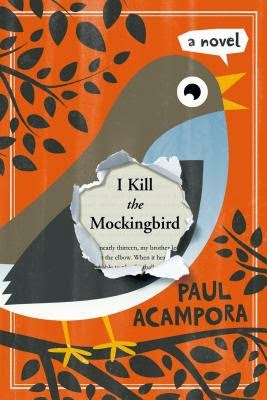
I Kill the Mockingbird

by Paul Acampora
First sentence: “My mother’s wheelchair does not fit through the bathroom door, and I don’t know what to do about it.”
Support your local independent bookstore: buy it there!
Content: There’s nothing objectionable, but it feels a bit old for the section it’s in (middle grade, grades 3-5) but it’s not really quite old enough for the YA section (grades 6-8). It’s kind of one of those in-between books.

It’s the summer before high school, and Michael, Lucy, and Elena have a summer reading list they’re assigned. None of them really wants to do it, partially because they’re the sort of precocious readers who read Dickens in 8th grade, and partially because, well, no one like summer reading.

One of the novels on the list is To Kill a Mockingbird, and Lucy comes up with a brilliant (or so they think) idea to get people reading and talking about this classic: what if we made the novel scarce. Not steal it from libraries or bookstore, but just reshelve it so no one can find it. (As a bookseller: *grumble*) And then start a web campaign — iKILLtheMOCKINGBIRD.com — to feed it.

What they’re surprised at (and I don’t know why they would be), is how well it works. It goes viral (thanks to Wil Wheaton) and To Kill a Mockingbird starts disappearing from shelves all over the country.

It’s not just all about their viral marketing scheme (which I doubt would work. It’s plausible, if improbable), though. Lucy’s mother is in remission from her bout with cancer, which stresses Lucy out. And she and Michael might be going from friends to more-than-friends, which is awkward for both of them.

On the one hand, this was a sweet little book. There were some funny bits — the scene near the beginning where Lucy and Elena are doing a Nativity shoot for Lucy’s mom had me laughing — and some sweet bits. I liked that it was religious without being preachy (which will go over well in my heavily Catholic town). My problem is that I really didn’t feel it had a specific audience. It’s a bit old for my 5th grader, who won’t understand the whole viral bit or even the discussion about the novel. But it feels a bit… young… for an 8th grader, who would understand those things.

Even with that qualm, it was a good, quick read.

The Night Gardener

by Jonathan Auxier
First sentence: “The calendar said early March, but the smell in the air said late October.”
Support your local independent bookstore: buy it there!
Content: It’s a very slow, very atmospheric book. Probably not good for those struggling, though I think it would make an amazing read-aloud. It’s in the middle-grade section (grades 3-5) in the bookstore.

It’s the late 1800s, and Molly and Kip are siblings are in England looking for work because of the potato famine in Ireland. They’re desperate, so they’ll take anything, even a job at the Windsor house… a place which many people say are haunted. Molly — who is a storyteller at heart — and Kip don’t really have much of a choice, so they accept the job and head to the house, not knowing the fate that awaits them.

The family — father Bertrand, mother Constance, and two children, Alistair and Penny — is a strange one. Guarded, pale, and most of all, adamant that Molly and Kip stay away from the green door.

And then there’s the tree: the gnarled, old, dead, black tree that takes up a good portion of the yard.

Of course, things don’t go well for Molly and Kip: they soon notice that every night a tall, shadow man comes to water and take care of the tree. And to dig holes. And no, none of this is a happy thing. It comes down on Molly and Kip to figure out a way to not only get out of there, but to stop the evil from perpetrating.

The jacket flap compared this one to Washington Irving and Edgar Allen Poe, and I don’t think it was that. (Maybe Irving; I haven’t read him in a long time.) What it was, however, was a ripping good yarn. Auxier utilized storytelling in the writing of this, and it showed. I could imagine someone standing in front of an audience, spinning this tale out, having everyone on the edge of their seat: will they make it? It’s a long tale, sure, one for multiple nights, but one that will have the listeners engrossed.

But as a reader? It was good, sure, but not great. I liked it, yes, but didn’t love it. I was gratified that Molly (and Kip) ended up being heroes of their own story; there was a time I was worried adults would step in and solve the problem, but Auxier is smarter than that. It was a good read, but I think it’d be a better one if read aloud.

Rhyme Schemer

by K. A. Holt
First sentence: “First day of school.”
Support your local independent bookstore: buy it there!
Review copy snagged off the ARC shelves at work.
Release date: October 14, 2014
Content: Aside from the bullying (which made me uncomfortable), there’s nothing difficult about this book. It’ll be in the middle grade (grades 3-5) section of the bookstore.

Kevin is the youngest of five brothers who are all a lot older than he is. He likes some of his brothers; others, not so much. His parents — both doctors — are gone a lot. So, somehow, he’s become that guy at school who laughs when people fall down. He’s the kind that gets in trouble for tripping a Loser. And he does, often.

But he has a softer side: one that writes free-verse poems (which is the format for this book). He keeps them in a notebook, that he takes with him. He also rips pages out of library books, creating poems by circling words, and sticks them up around the school.

Then his world comes down around him. The kid he usually bullies finds his notebook, and uses it against him, slowly making Kevin into the kid being bullied.

It’s a quiet little book, but one that packs a punch. I appreciated seeing Kevin from both sides: the bully-er and the bullied. It was interesting to see his transition, and to realize that all people are just that: people. And with the backstory — his parents really aren’t the greatest — it was easy to see where the bullying came from.

But what I loved (LOVED!) was the way the librarian (!) saw past everything Kevin was doing and made him feel like a person. Yay for librarians!

Compelling and engrossing and all those other good adjectives.

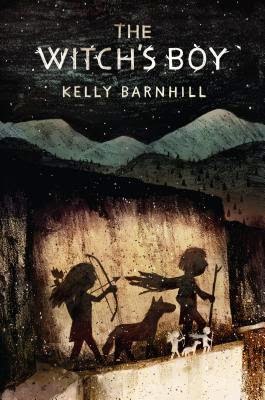
The Witch’s Boy

by Kelly Barnhill
First sentence: “Once upon a time there were two brothers, as alike to one another as you are to your own reflection.”
Support your local independent bookstore: buy it there!
Review copy snagged from the ARC shelves at my place of employment.
Content: There really isn’t anything objectionable. The pacing is slow, however, which is something that might turn more reluctant readers off. It’s in the middle grade (grades 3-5) section of the bookstore.

Ned has been “the wrong boy” since the fateful day when he and his twin brother, Tam, tried to sail to the sea and ended up drowning in the river. Or nearly drowning, in Ned’s case. See: his mother is the witch of the village, and she has been the keeper of the magic — dangerous, unruly magic which Ned is never to touch — for most of Ned’s life. And although she couldn’t save Tam, she saved Ned… by sewing Tam’s soul inside of Ned.

Fast forward a few years — ones in which Ned doesn’t have much strength, where he has a stutter, and where he can’t read — to when the Bandit King comes into their lives with the intention to steal the magic for his own. This is where Ned does something remarkable: he takes the magic into himself, and sets off on an adventure. One in which he’ll meet a friend — his first since his brother died — and change the course of the world.

It’s a slow, quiet book; one that reminded me strongly of Anne Ursu’s books. That’s a good thing, except it’s not one for people who are expecting Grand Action and Adventure. Much of the book is spent inside Ned’s head (mostly because he can’t talk, though I did like Barnhill’s methods for portraying Ned’s stutter), which doesn’t lend itself to fast reading. That said, given time, this book is really a fantastic read. I loved how Barnhill portrayed the magic; it had its own personality, one that can be controlled by it’s “owner”, provided the person is strong enough. And I really enjoyed seeing Ned come into his own. Yes, he was pushed around by (some of) the adults in his life (I loved his mother; she’s fantastic), but it’s a true middle grade novel in that Ned (and his new friend, Áine) face the conflict on their own, without adult help.

Speaking of Áine: she’s a remarkable character, too. Self-sufficient, yes, and strong, but she also finds it in her heart to be a friend and a true companion.

I think this is one that will stay with me for a while.

The Whispering Skull

by Jonathan Stroud
First sentence: “‘Don’t look now,’ Lockwood said.”
Support your local independent bookstore: buy it there!
Release date: September 16, 2014
Review copy snagged out of the box sent by our Hachette rep.
Others in the series: The Screaming Staircase
Content: There’s lots of ghosts, obviously, and some scary situations. Also a couple of deaths and a couple of instances of mild swearing. It’s in the middle grade (grades 3-5) section of the bookstore, but I’d be wary about giving it to an overly sensitive child.

It’s not very often, I think, that the second book in a series is as good (if not better) than the first one. This is one of those rare instances.

First off, it was wonderful to be back with Lockwood, George, and Lucy. Lockwood was as reckless and charming as ever; Lucy was still the glue that held the company together. But George was really the focus of this story. He got his moment in the spotlight, and was something more than the bookish, slightly overweight Other Guy.

The mystery this time is centered around a body Lockwood, Lucy, and George are hired to help secure.  A couple of grave excavators have found a grave site that wasn’t supposed to be there, the body of one Edmund Bickerstaff, who was a leading paranormal and psychic experimenter in Victorian times. It turns out that he was experimenting with things he shouldn’t have been, creating a Bone Glass which was supposed to give you a view into the afterlife, but instead kills anyone who looks at it.

Soon after the excavation, however, the Bone Glass is stolen, and Lockwood & Co are in a fierce competition with their rivals at Fittes to solve the mystery.

Oh, and yes, the whispering skull of the title (and the cover; love it!) does play a fairly major role.

There are so many brilliant things about this book. From the pacing (I couldn’t put it down!) to the hilarious asides, to the action-adventure feel.  It’s wonderful that you don’t really have to read The Screaming Staircase to enjoy this one. There are a few references to the previous book, but nothing happened in it that you Have to know before picking this one up. Additionally, even though there are teasers for the next book (which can’t come out soon enough) the story in this one wraps completely up. I love it when series books are like this.

I can’t wait for the next one.

The Misadventures of the Family Fletcher

by Dana Alison Levy
First sentence: “Eli sat on the wooden porch steps, crammed in with his brothers, while Pap fiddled with the camera.”
Support your local independent bookstore: buy it there!
Review copy given to me by our Random House Children’s rep.
Content:  The typeface is pretty big and the words are simple without being simplistic. Also, there’s a hint of liking girls, but no real romance. I’d say it’s pretty happy in the Middle Grade (grades 3-5) section of the bookstore.

I’ve been sitting here thinking about how to pitch this one (especially in conservative Kansas), and I think I’ve come up with it: it’s The Penderwicks, but with boys.

The similarities are there: a classic, homespun feel; a family of four siblings ranging from the cute young one (Frog, age 6, in this case) to the wise, older one (Sam, just starting 6th grade); simple, true-to-life challenges, rather than huge conflict; and a charming, whimsical feel that just makes you smile when you’re done reading.

The book follows the Fletcher family — Dad, a history teacher; Papa, who stays at home and does consulting work while the boys are at school; and their sons, Sam and Frog (who is Indian, by the way), but also Jax (age 10 and African American) and Eli (also age 10, but Jax is older by some months) — through the course of a year. As I said, none of the conflicts are huge and overarching, (except, perhaps, their grumpy neighbor Mr. Wilson) but rather small, realistic ones. Eli deals with a starting a new school for “scholarly minded” students and realizes pretty early on that he hates it. Jax deals with a best friend who is growing up and whose interests are changing. Sam is dealing with being on the cusp of teenager hood as well as the idea that something he discovered he likes — acting — may not be “cool”. And Frog has to deal with his family not believing him when he says he has a new friend whose name is Ladybug.

It’s a charming, sweet little book, one that I think will be able to reach a number of readers. In fact, the diversity of this one is my second favorite thing about it (my first favorite being the old-fashioned feel). I loved how Levy had a hugely diverse cast and showed how everyone is just. like. me. (Duh.) But she did it in such a way that wasn’t preachy. And I loved that.

In fact, I want to hand this one to all the kids and say: “You know that person who is different from you? This will help you understand them.” I’m not sure that will sell this book, so I may just have to stick to “Penderwicks with boys.” I just hope kids read this one.

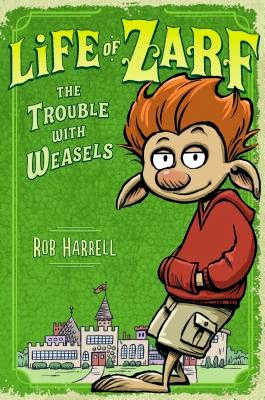
Life of Zarf: The Trouble with Weasels

by Rob Harrell
First sentence: “Zarf.”
Support your local independent bookstore: buy it there!
Review copy downloaded from Edelweiss.
Release date: September 2, 2014
Content: It’s pretty basic, and there are a lot of pictures. I’ll probably shelve it in the Middle Grade (grades 3-5) section of the bookstore, though it’d work for an advanced 1st or second grader. There’s nothing objectionable.

Zarf is a troll. That means, at this middle school of his, that he is the bottom of the bottom on the social ladder. Even his friends Kevin (of Littlepig fame) and Chester (the Jester) are higher up the social ladder than he is. But then, what do you expect when your the kid and grandkid of the trolls who bugged the billy goats?

Zarf’s pretty okay with his social nothingness. That is, until King Cheznott goes missing, presumably dead, killed (or kidnapped) by huge Snuffweasels. And his bully son (at least bully to Zarf), Roquefort, takes over. And throws Zarf  in the dungeon. Where he (somewhat inadvertently) finds himself on a rescue mission. And, of course, hilarity ensues.

Actually the plot is really secondary in this book. It’s mostly just about silliness. Serious silliness. Like:

“How can I explain that voice? It was so deep, it sounded like a cross between Darth Vader’s voice and someone farting through a tuba.”

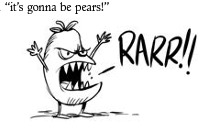
or odd creatures, like attack pears!

Or Chester’s really jokes (“How many wobble gnomes does it take to massage a swampfrog?” We never do find out the punchline to that one.)

Or the clever asides:

As you can tell, this slim book is liberally scattered with pictures. Making it perfect for the reluctant reader. And it’s hilarious, which makes the appeal that much greater. At any rate, I laughed quite a bit and read it all in one sitting. Perfect, silly, stupid fun.

The Fourteenth Goldfish

by Jennifer L. Holm
First sentence: “When I was in preschool, I had a teacher named Starlily.”
Support your local independent bookstore: buy it there!
Review copy snagged from the ARC shelves at my place of employment
Release date: August 26, 2014
Content: I think it’s geared towards younger readers: larger font, lots of white space, and everything is pretty much spelled out. It’ll go in the middle grade (grades 3-5) section of the bookstore, but could go for strong younger readers.

Eleven-year-old Ellie has a pretty normal life. Her parents — both Theater People — are divorced, but get along. She is dreading middle school, especially since she and her best friend since Kindergarten seem to be drifting apart. But, mostly, it’s just your normal, every-day life. That is, until her mom gets call to go pick up “Melvin”. Who happens to be her father, Ellie’s grandpa. Except now he’s 13. Turns out, he discovered a new species of jellyfish, one when ingested, gives you back your youth.

But things aren’t all roses and unicorns for Melvin: being 13 is not the same as being in your 70s. There are some upsides: a good digestive system, and the lack of a need to pee in the middle of the night. But the downside is that Melvin has lost access to his lab, which means if he can’t get the jellyfish, he can’t prove his theory, and he won’t win the Nobel Prize.

While Ellie is our narrator, it’s Melvin who drives the action. He’s the one who introduces Ellie to Science; gets Ellie to talk to her new friend, Raj; the one who needs to break into the building. One of my problems with this (aside from being Too Old; I do think younger readers will love it) is that Ellie is not proactive, but rather reactive in her own life. She’s a sweet girl, and a nice person to read about. But the book just wasn’t exciting.

It was, however, charming and informative. Holm managed to put a ton of science in her science fiction book: everyone from Galileo and Newton to Oppenheimer and Einstein make an appearance. And she explains some basic scientific concepts in pretty general — and clever — ways. So, while it wasn’t exciting, it was interesting. It did take me a while to figure out the title, why it was called the 14th goldfish (since goldfish didn’t play much of a role), but I thought the ending was sweet and Holm did explain it.

Not my cup of tea, but I’m glad I read it.