Dory

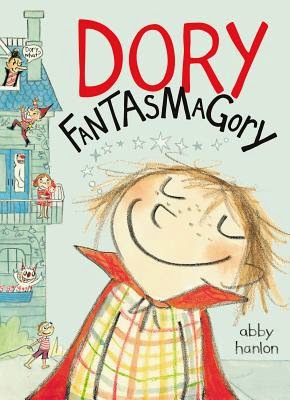
Dory Fantasmagory
by Abby Hanlon
First sentence: “My name is Dory, but everyone calls me Rascal.”
Support your local independent bookstore: buy it there!

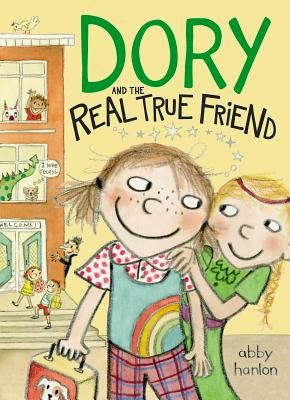
Dory and the Real True Friend
First sentence: “My name is Dory, but everyone calls me Rascal.”
Support your local independent bookstore: buy it there!
Review copy snagged from the publisher rep.
Release date: July 2015
Content: It’s pretty basic, short, and liberally illustrated with pencil sketches throughout. It’s in the beginning chapter book (grades 1-2) section of the bookstore.

I don’t often read beginning chapter books anymore. K is past that age (and prefers graphic novels, anyway), and it’s just not where my interest lies. That said, every once in a while, a book comes along that I just have to pick up, and in the end, just makes me smile. I ended up reading this one becuas while it’s been on my radar for a while, it was making it as a finalist for the Cybils that convinced me  I really ought to read it.

And I was thoroughly charmed.

Dory is a 6-year-old with a VERY active imagination. She’s the youngest child, and her two older siblings don’t ever really want to play with her. So, she plays with her imaginary monster friend, Mary, and goes on a ton of adventures. That’s really all there is to the plot. (Well, in the second book, she goes to first grade and eventually makes a “real” friend, whom everyone thinks is imaginary.) But what these have going for it is that Hanlon gets first graders. Seriously. She gets their quirks, their habits, their curiosity, their silliness. And she makes Dory an absolutely fantastic character. She’s someone you want to spend time with, laugh with, and who just makes you happy.

My only criticisms are superficial: I’m going to have a hard time getting boys to read this. But, much like Princess in Black, I think that boys are really going to enjoy Dory and her crazy imagination. And secondly, everyone’s white. It’s a little thing, but Dory didn’t have to be white, and her best friend didn’t have to be white, but they are.

Even so, they are adorable books. And adorable wins every time.

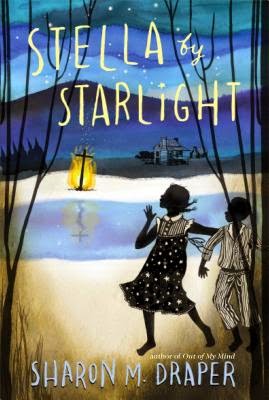
Stella By Starlight

by Sharon M. Draper
First sentence: “Nine robed figures dressed all in white.”
Support your local independent bookstore: buy it there!
Review copy snagged off the ARC shelves at my place of employment.
Content: There’s some pretty intense stuff going on in this book, by Draper never lets it get too dark. She knows her audience and (rightly) assumes they can handle anything that is thrown at them. Be prepared, however, for some discussion. It’s in the middle grade (grades 3-5) at the bookstore.

It’s 1932, North Carolina. The whole country is in the throes of the Great Depression, Franklin D. Roosevelt is running for office. For Stella and her family, this doesn’t really matter. They’re more concerned about making ends meet. And avoiding the local Klu Klux Klan.

And they’re doing a pretty good job until Stella’s dad, pastor, and a family friend decide to exercise their constitutional right and vote. Then, all hell breaks loose.

There’s actually a lot more going on than that: Draper knows her history, and paints a picture of what life was like for African Americans struggling to get ahead in the 1930s. The one-room school, with a teacher who handles all grades next to the white school where they get new books. The small houses and hand-me-over clothes. Having to enter in the back door of shops. Or, most tellingly, a white doctor who won’t come help Stella’s mother after she’d been bitten by a rattler.

And Stella is such an engaging character to go through all this with. She’s an observant, smart girl, but one who also struggles with writing in school. She’s trying to figure out her place in life, how to navigate the injustices of her situation, and still come out ahead. She’s got fantastic parents, and a supportive community. There’s so much that I found admirable about the way she deals with her situation. And so much to discuss (I know; I ended up talking to my family) when you’re done.

Absolutely Almost

by Lisa Graff
First sentence: “Not everybody can be the rock at the top of the rock pile.”
Support your local independent bookstore: buy it there!
Content: It’s pretty basic: short chapters, nothing too difficult plot or language-wise. It’d be good for reluctant readers as well as stronger ones. It’s in the middle grade (grades 3-5) section of the bookstore.

Albie has spent his life being almost. Almost smart enough. Almost good enough. Almost observant enough. But not quite. In fact, he’s been kicked out of his fancy prep school because he wasn’t smart enough, and his parents sent him to a public school. It’s never said what kind of learning disorder Albie has, but he definitely has one: math is hard, spelling is near impossible, and he just can’t live up to his busy parents’ expectations.

But things are going to change for Albie — not drastically, but some — because of a couple of teachers and a nanny who truly see potential in Albie. Not for just almost, but on his own terms.

It’s a simple story, following Albie over the course of most of a school year. He does learn and grow, and figures out things about friendship and how to stand up to his overbearing parents. It’s one of those affirming books: kids can be successful on their own terms and in their own way, and we need to appreciate that without making them measure up to some sort of standard. It’s all fine and good and sweet (and I did like Albie, quite a bit), but it lacked depth for me. Sure, it’s a middle grade novel, but that doesn’t mean that there can be some bite, some seriousness to it.

I don’t know if I was looking to shed tears, or to be Truly Moved, but I did feel like this one felt a little flat. Not bad, but not amazing, either.

The Map to Everywhere

by Carrie Ryan and John Parke Davis
First sentence: “Fin crouched behind a rack of bootleg flavors, trying hard to ignore the taste of rat fur and broccoli juice seeping from the grungy bottles.”
Support your local independent bookstore: buy it there!
Content: It’s kind of long, there’s some difficult made-up words, and it does take a bit of time to get into, so not really for a reluctant reader. Then again, there’s some great illustrations… Either way, it’s i the middle grade section (grades 3-5) of the bookstore.

Marrill has lived a life of adventure, following her parents around the world. Now, what was supposed to be a temporary stop in Arizona has become (mostly) permanent: her mother has cancer, and they need to stay close to doctors. But the prospect of school and a stable home doesn’t make Marrill happy.

Across the universe, Fin is the opposite: stuck in the Khaznot Quay, where he was dropped off as a baby by his mother (who then disappeared), Fin has become a master thief, mostly because he’s the guy who can’t be remembered. Literally: people look at him and as soon as they look away, they don’t remember him anymore. It’s very convenient when you tend to steal things.

But when Marrill’s and Fin’s paths cross — it has something to do with the Pirate Stream (a magical time/space continuum thing; you can sail a ship almost anywhere in the universe on it) — they end up teaming up to stop a rogue wizard from destroying the stream, and therefore the universe.

This is a perfectly fine fantasy adventure, once it got started. The main problem for me was that it took too long to get started. I almost put it down several times as I was waiting for the adventure to start, wading through the new world, and how everything connected. However, once the people and things were in place, I really did enjoy Marrill and Fin’s adventures.

I’m not sure if I’m invested in the series, but I think the kids will like it.

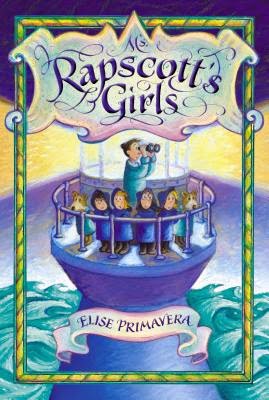
Ms. Rapscott’s Girls

by Elise Primavera
First sentence: “Attention, Busy Parents!”
Support your local independent bookstore: buy it there!
Release date: March 10, 2015
Review copy handed to me by the publisher rep.
Content: It’s a good mix of illustrations and print; while it’s out of the beginning chapter book phase, it’s a good one for reluctant readers. It will be in the middle grade (grades 3-5) section of the bookstore.

Ms. Rapscott likes things rough. An orphan at an early age, she figured out how to make her Way in Life. And this is a skill she wants to give to young girls. Especially young, neglected girls of Extremely Busy parents. At the start of this summer school term (though you wouldn’t know it by the weather at the lighthouse that serves as the school; it’s always storming), five girls are on their way — arriving by pre-paid post (yes, in boxes) — for Ms. Rapscott to mold. There’s angry Beatrice, lazy Mildred, timid Fay, and competent Annabelle as well. And, of course, Dalhlia, who was so tiny (and her parents so absent-minded) that she fell out of the box and went missing.

At first glance, it’s easy to call this one a modern-day Mary Poppins. Ms. Rapscott serves as a kind, but firm nanny (or boarding school mistress) who gives the girls cake and ice cream for dinner and pie for breakfast, and yet demands tidiness and hard work. There’s a slight magical element — flying boxes, for one, but also her assistants, two dogs who handle the day-to day operations. It definitely feels like one of those books. (I felt chastised, reading it as a busy parent, for not being more attentive to my kids. And I’m pretty attentive. Maybe I was just having a down day when I read this.)

But it’s more than that: Ms. Rapscott doesn’t just straighten up these unruly daughters of busy parents; she helps them learn to be parents. I’m not quite sure what kids will think of this — I need to get K to read it — but as a parent, I saw that Primavera was advocating for the need for variety in a kid’s life: too much pie is bad, but some pie is good. Too much TV and staying in PJs all day is bad, but sometimes, it’s what is needed. Adventure, exploring is good, and can be Learned From. But, mostly, being helpful, cheerful, and optimistic is the best. And, perhaps, that’s something we all need to be reminded of.

It’s a delightful little read.

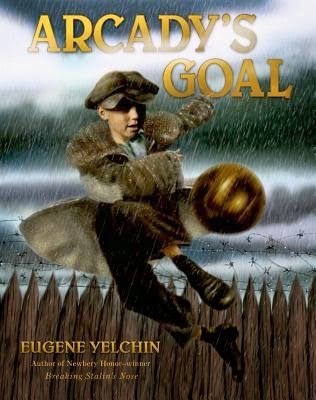
Arcady’s Goal

by Eugene Yelchin
First sentence: “I’m a risk taker.”
Support your local independent bookstore: buy it there!
Content:

Arcady is the best soccer player. Period. So much so, that when the inspectors of the home he’s been placed in come, the director makes a show out of Arcady’s skills. He — Arcady calls him Butterball — puts Arcady up against increasingly larger players, expecting him to beat them. And he does.

But, when one inspector, who’s not quite like the others, comes to visit, Arcady ends up being adopted. Which is not something Arcady bargained on. Nor he he bargain that his new father, Ivan Ivanovich, comes with secrets of his own.

One of the things Yelchin does best is humanize Stalin’s Russia. It’s so easy to push everything from that era off into Things/People were Bad. And Stalin put everyone in concentration camps. But, Yelchin gives us the stories of the children — Arcady ended up in a home because his parents were taken for being enemies of the state — and how Stalin’s policies affected everyday life. They’re simple stories, but they paint a picture of a people who were wronged — even if they weren’t taken — by their leader.

It’s a simple little book, full of illustrations. And there’s a lot of talk about soccer, so there’s an appeal for the soccer lovers. But mostly it’s a portrait of a relationship between to damaged people, and the path to healing.

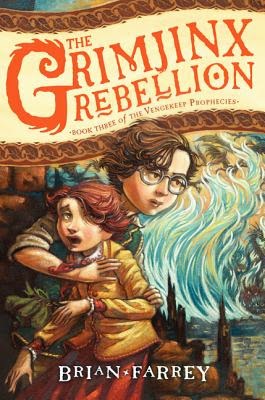
The Grimjinx Rebellion

by Brian Farrey
First sentence: “Of all the wisdom passed down through the generations of the Grimjinx clan, the bit I think about most came from Jerrina Grimjinx, wife of Corenus, our clan father.”
Support your local independent bookstore: buy it there!
Others in the series: The Vengekeep Prophecies, The Shadowhand Covenant
Content: There’s some action, and a few intense moments. The length will probably deter less confident readers, but (aside from the made up words) it’s really a page-turner. It’s in the middle grade (grades 3-5) section of the bookstore.

Jaxter thought, after he defeated the Shadowhand, that his troubles would be over. But, the High Laird has been raising taxes, and the population of the Five Provinces are getting restless. None of this bothers Jaxter very much, until the mages kidnap his sister. Who happens to be a powerful seer.

Jaxter, of course, can’t let this happen. So he, his parents, and some of his friends, head off to rescue Aubrin from the power-hungry mages and discover that they’re plotting to overthrow the High Laird and take over the provinces. Once again, Jaxter (and the whole Grimjinx clan) is in over their heads. But, true to form, they rally and figure out a way to Save the Day.

This is such a solid series: a great overarching story (elements of the first book came back again in this one), that involves themes of freedom and who has the right to rule. But it’s also grounded in family: I love the whole Grimjinx clan (even the wayward uncle) and how they pull for each other. They can do things individually, true, but as a family unit, they’re unstoppable. And I love how Jaxter’s friends got adopted into the family: they’re as important to him as his actual family. I especially like his relationship with Callie: you can tell he’s concerned about her, but there’s no romance. They’re just friends, and that’s great.

I also loved how this wrapped up, but didn’t tie everything up in a nice, neat bow. Farrey chose to leave things hanging; and I appreciated the ambiguity. Anything could happen, and that’s just great.

It’s a fantastic end to a fantastic series.

The Terrible Two

by Mac Barnett and Jory John, illustrated by Keven Cornell
First sentence: “Welcome to Yawnee Valley, an idyllic place with rolling green hills that slope down to creeks and cows as far as the eye can see.”
Support your local independent bookstore: buy it there!
Review copy snagged from the ARC shelves at my place of employment.
Release date: January 13, 2015
Content: It’s a bunch of silly pranks. Simple writing and lots of illustrations make it good for younger and reluctant readers. It will be in the Middle Grade (grades 3-5) section of the bookstore.

Miles Murphy is The King of the Pranks. Or, at least he was back in his old school. But in his new one? Not so much. Oh, he tries to become the king again. But in small Yawneee Valley, Miles is finding it difficult to get a good prank in. He keeps being thwarted by someone else. Soon, it’s an all-out prank war, the like Yawnee Valley has never seen.

As soon as I saw this one, I snagged it; Mac Barnett is one of my favorite picture book writers, and I figure he and his friend (or so the bios say) Jory John had to produce something worth reading. I was right (of course!). It’s hilarious. Silly and stupid. Dumb and amusing.

It’s perfect.

Really. It’ll be great for the reluctant readers who need something silly to keep them turning pages. (Plus: illustrations!) It’s got some great conflict, a hilarious buffoon of an adult to root against, and the best. ever. prank. at the end.

What more could you ask for in a book?

Absolutely nothing.

Sugar

by Jewell Parker Rhodes
First sentence: “Everybody likes sugar.”
Support your local independent bookstore: buy it there!
Bought and signed by the author at KidLitCon 2014
Content: This one would be appropriate (and probably okay, difficulty-wise) for kids third grade and up. It’s in the middle grade section (grades 3-5) of the bookstore.

It’s 1871, and slavery is supposed to be over. However, for ten-year-old Sugar, on a sugar plantation in Louisiana, it doesn’t feel like it. Sure, the former slaves are free to go if they can, but they’re paid so little that it’s almost impossible for them to leave. And then the plantation owner, Mr. Wills, decides that he needs more workers, so he hires some Chinese to come and supplement the former slaves.

For Sugar, her life revolves around sneaking out to play with Billy, the owner’s son, and trying not to get under Mrs. Beale’s feet. And planting and cutting sugar cane. Once the Chinese arrive, however, Sugar’s world is expanded: one of them speaks English and she befriends them. In fact, she is the bridge that gets the whole working community to work together rather in competition. There’s a passage about halfway through that pretty much sums up what I think Rhodes was getting at in this book:

“How come I ca’t decide who I can see? How come I can’t decide my friends?”
“We don’t trust these men, Sugar.”
“I like Chinamen. Reverend, don’t you preach ‘Treat folks like you want to be treated’?”
“Well, now,” says Reverend, not looking at me, twiddling his thumbs.
“Sugar,” says Mister Beale, “folks get along best with folks like them. Always been that way.”
“Seems cowardly.”

Of course, things aren’t easy for Sugar and her friends: it is 1871 in the South, and white people — especially the former Overseer — are reluctant to change and adapt. There is some tragedy in this book, but it is a middle grade book, after all, and the tragedy is kept simple and appropriate.

It’s the overall message of friendship and inclusion that made this slim historical fiction book worth reading.

Greenglass House

by Kate Milford
First sentence: “There is a right way to do things and a wrong way if you’re going to run a hotel in a smuggler’s town.”
Support your local independent bookstore: buy it there!
Content: There’s nothing in the usual objectionable categories. However, it’s a slow book, especially at the start, and there’s some confusion sometimes when the characters switch names. That said, a good reader who loves mysteries would really like this one. It would be in the Middle Grade (grades 3-5) section of the bookstore, but I wouldn’t be adverse to putting it in the YA (grades 6-8) section either.

Milo and his parents run an inn at the top of a hill overlooking a river just outside of the fictional town of Nagspeake. The thing that makes their inn special is that it’s a safe having for smugglers. Milo and Mr. and Mrs. Pine know how to keep secrets.

However, it’s winter break, and Milo is looking forward to spending time alone with his parents. Without guests. So, he’s predictably disappointed when four guests, one right after another, show up for the winter.

Soon, they are in full swing, and have to bring up their usual cook, with her daughter, who just happens to be Milo’s age. Soon he and Meddy find themselves embroiled in an adventure and a mystery: figuring out why each of the four guests are there, their connection with the old house that Milo’s parents inherited, and who keeps stealing stuff.

The comparisons to Westing Game that I’ve read are valid. There is a mystery to solve, and it’s a quietly clever one, with a twist that I should have seen coming, but didn’t. (As we all know, I’m not the most careful of readers.) But it’s more than a mystery: it’s a lovely book, full of stories and quiet adventures (Meddy and Milo play a Dungeons & Dragons-like game for most of the book). I’m impressed that Milford wrote such a compelling book on such a small scale; because of the weather, Milo and Meddy hardly ever leave the house. It’s a very bleak landscape (Think The Dark is Rising bleak), but Milford infuses it with both warmth and mystery.

One more thing: Milo is adopted. He’s of Chinese nationality with white parents, and he feels that difference keenly at this point in his life. So, it’s not only a book with a mystery, it’s a book about belonging and family.

I loved it.