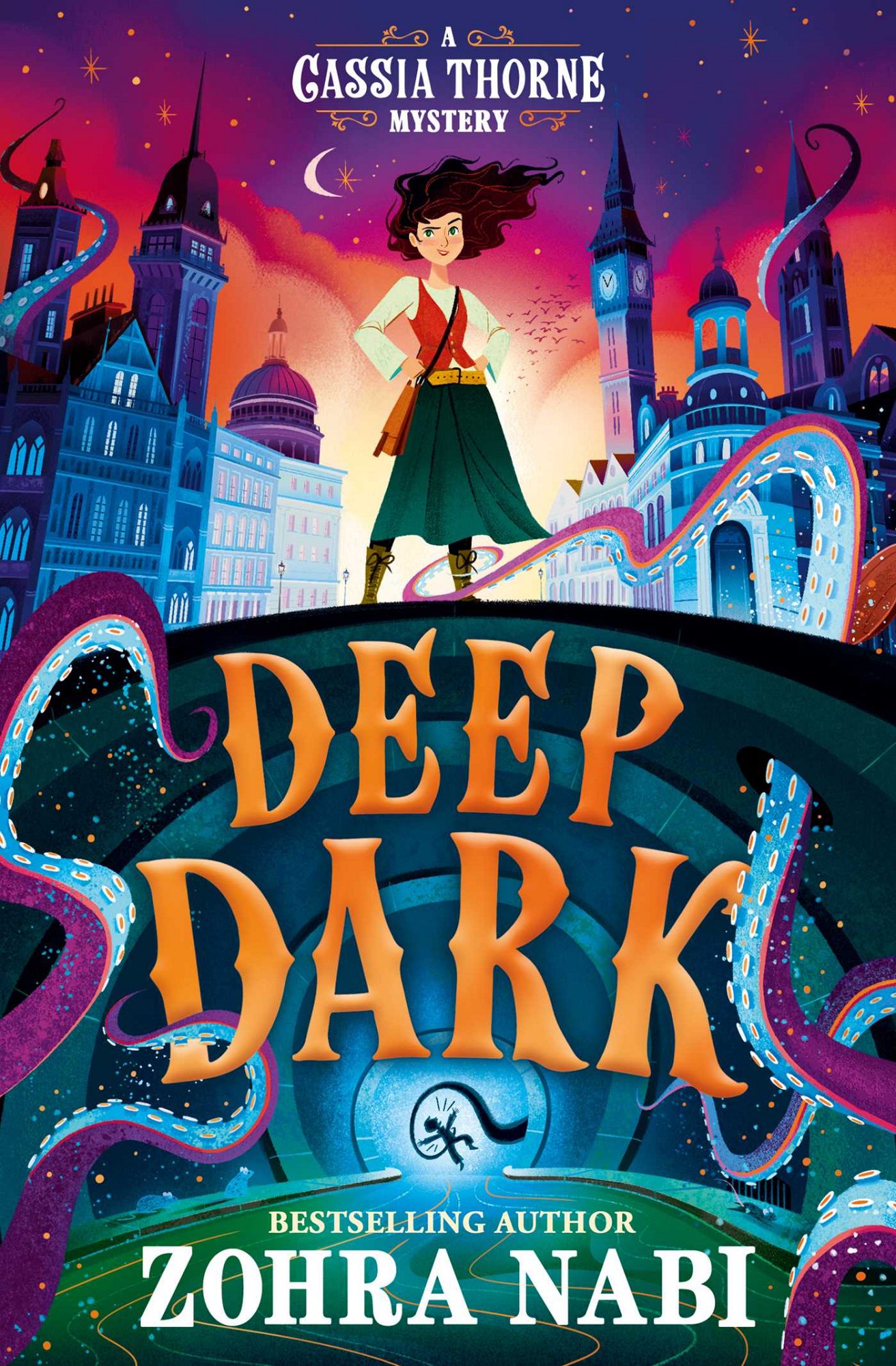
Audiobook: Deep Dark

by Zohra Nabi
Read by Sarah Ovens
Support your local independent bookstore: buy it there!
Or listen at Libro.fm
Content: There are some intense parts, jump scares, and neglectful/bad parenting. It would be in the Middle Grade (grades 3-5) section of the bookstore if it existed in physical form.

Cassia Thorne has spent half of her life in a debtor’s prison in London, eking out what living she could while her father slowly descended into madness. She has made her way as a flute player at the Bartholomew Fair, but this year, she has hopes of something grander: to write and sell the songs that everyone sings. But, her quest for a grander life is waylaid when her friend’s younger brother goes missing. And suddenly Cassia is thrust into the underworld of London, a world of monsters and greedy men, a world where poor children go missing solely because no one will think to go looking for them.

Can Cassia help before it’s too late?

I pitched this one to my coworkers as Dickens with a kraken, and they all agreed: who wouldn’t want to read that? I do have to admit, I was a little disappointed there was an actual monster; I was kind of hoping for a straight-up historical mystery. That said, Nabi did a fantastic job weaving both the speculative aspect of an actual monster in the tunnels under London with the historical elements of class and the way poor people had to scrape to make it.

Ovens was a fantastic narrator, though, keeping the story moving forward, and keeping me engaged enough to keep wanting to listen. I’m sad there isn’t a physical publication of the book in the US; I can think of a handful of kids who would love this one.

But it’s fantastic on audio.

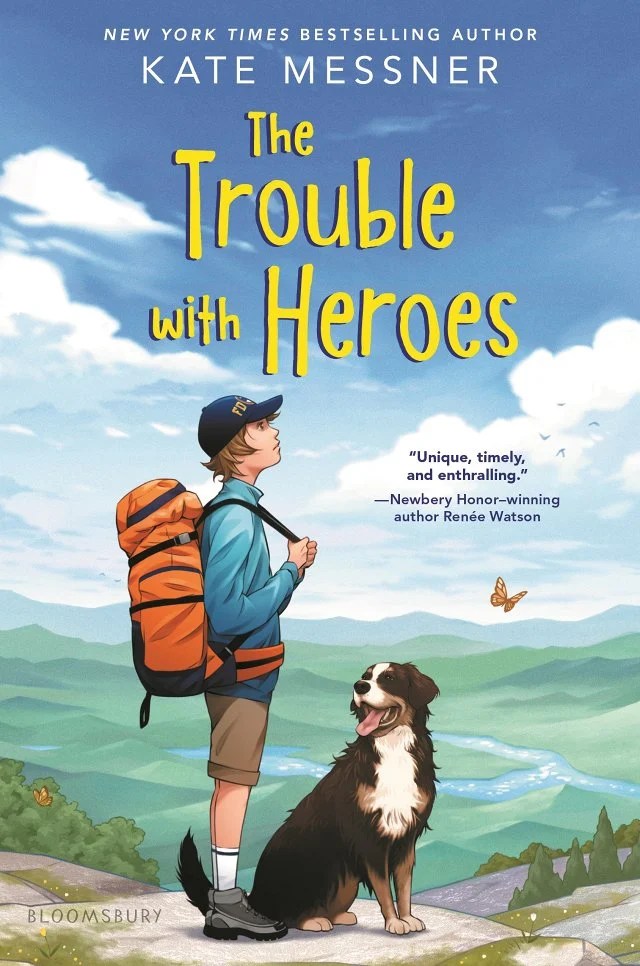
The Trouble with Heroes

by Kate Messner
First sentence: “If I were a better kid, this story would begin with my seventh-grade diploma.”
Support your local independent bookstore: buy it there!
Content: There is PTSD and the death of a parent. (But not the dog.)

Finn Connelly is angry. So angry that he kicked over the tombstone in the local graveyard of his small town. Except, it turns out that the tombstone was the one of a locally famous mountain hiker. And her daughter offers Finn a deal: hike all 46 of the Adirondack HIgh Peaks, taking her mother’s dog, by Labor Day and she’ll dismiss the charges. Finn doesn’t have a choice: he and his mother can’t afford to replace the tombstone. So, it’s off to the mountains for reparations.

At first it’s not fun – he doesn’t like the “nannies” that have been assigned to accompany him on the hikes, he doesn’t want to wear hiking boots, he doesn’t like the dog…. but as the summer goes on, Finn finds out that maybe nature is healing. And he’s got healing to do – his father was a first responder on 9/11 and died couple years ago during the COVID-19 pandemic, and Finn has yet to process that death. And, maybe, hiking the mountains will help.

This one was absolutely stunning. I loved the verse format – it’s partially because Finn needs to finish an ELA assignment to write 20 poems on heroes – and felt that it helped with the emotional impact of the book. Because this book packs an emotional punch. It’s funny and heartwarming, and yet the grief and loss is palpable. I just hope it’s one of those books that kids will actually like.

Because I loved it.

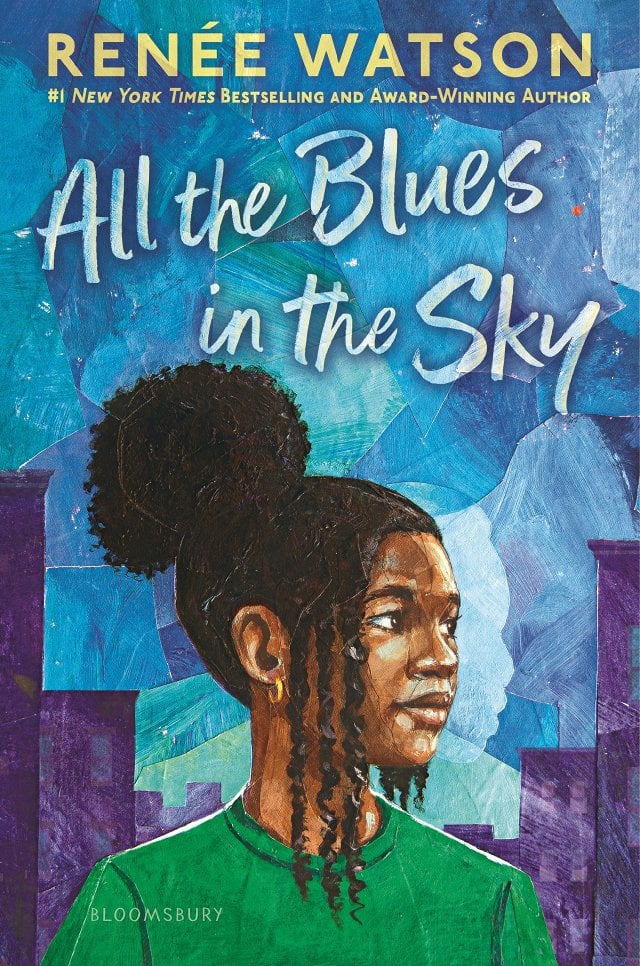
Audiobook: All the Blues in the Sky

by Renée Watson
Read by Bahni Turpin
Support your local independent bookstore: buy it there!
Or listen at Libro.fm
Content: This talks pretty explicitly about the violent death (due to a hit-and-run) of a beloved friend. It may touch some nerves with sensitive readers. It’s in the Middle Grade (grades 3-5) section of the bookstore.

Sage’s thirteenth birthday party was supposed to be a fun afternoon and evening with her best friend. Except that, on her way to Sage’s party, her best friend was killed in a hit-and-run by a drunk driver. Suddenly, Sage’s world is turned upside down as she deals with the tragic death of her closest friend. It’s not easy: she’s dealing with survivor’s guilt, with the sympathy (and pity) of her classmates, and just learning to make new friends. It’s not an easy journey, and even as she grieves, new, good things come into her life.

Watson is a remarkable writer, and is able to capture so much emotion and pain and sadness in so few words. Sage’s pain and heartbreak and grief came through the page (well, audiobook) loud and clear. Some of that, though, is Turpin’s excellent narration. She’s long been one of my favorite narrators, mostly because she captures the essence of the characters and the words so well. I felt Sage’s pain. And yet, the book was hopeful. Sage was beginning to work through the grief and guilt, good things were happening. And when more bad news came, Sage was better equipped to deal with it. I know kids shouldn’t “have to” deal with things like this, but the truth is they do. And having a book that can help them see what the grieving process might look like is an incredibly helpful thing.

It’s also an excellent book for its own sake.

Not Nothing

by Gayle Forman
First sentence: “Actually, it’s two stories, one you will recognize and one you won’t.”
Support your local independent bookstore: buy it there!
Content: There is anger management issues, abandonment by a parent, and an act of violence. It’s in the Middle Grade (grades 3-5) section of the bookstore.

Alex, by a combination of chance and choice has landed a community service assignment at Shady Glenn Retirement center. He doesn’t want to be there (obviously) and is determined to have a terrible time and just grudgingly do his work until a longtime resident, Josef – nonverbal, 107 years old, and basically waiting to die – breaks his longtime silence to tell Alex his story. The book goes back and forth – Josef is our narrator the whole way, though – between telling Alex’s story and Josef’s, but the theme is the same: how can a person, through their choices, make a difference for good or ill, in the lives of others.

On the one hand, I really loved this book. I loved the way it was written, I loved the connection Josef and Alex had, I loved that Forman was exploring the idea of being better than the sum of their actions. It’s heartwarming and even though it deals with the Holocaust, it’s not a Holocaust book. It’s about connection and redemption and making our lives matter, in spite of our past choices.

On the other hand, I’m thinking, as much as I loved it, that it’s a kids book for adults. It’s the sort of book written in the sort of way that I think more adults who read kids books will like than actual kids. (Maybe some kids; I might have been able to convince a couple of mine to read it.) That’s not a knock; it’s just an observation.

It’s still an excellent book, though.

Tig

by Heather Smith
First sentence: “We’re different now, me and Peter.”
Support your local independent bookstore: buy it there!
Content: There is abandonment by a parent, and destructive behavior by a child. It’s in the Middle Grade (grades 3-5) section of the bookstore.

Tig and her older brother Peter have been living in their abandoned house – their mother up and left with her boyfriend – for four months before their Uncle Scott and his partner Monty find out and take them in. The thing is, though, Tig feels like they would be better off on their own. She hates the new house, the new town, and the new rules. She fights back at every opportunity. But, when things get a little out of hand, Tig is forced to realize that maybe the grass isn’t always greener on the other side.

I wanted to like this book more than I actually liked it. It’s a tough pill to swallow, from the mom’s abandonment (four months! FOUR months!) to Tig acting up and being cruel to the people who took her in. Maybe it’s a bit of PTSD from when we ended up taking in a friend of our daughters, and the stress and trauma that brought into our house (and 7 years later, we’re still trying to unpack). But, I just couldn’t with this book. I finished it, but I didn’t like it.

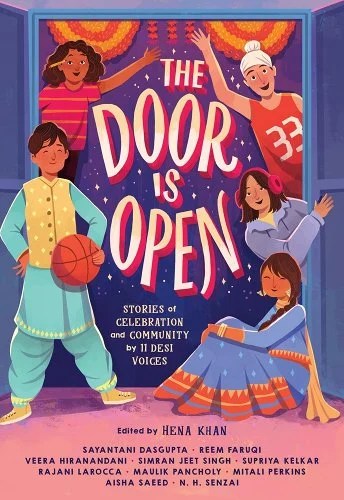
The Door is Open

Edited by Hena Khan
First sentence: “I pick up the queen and twirl her between my forefinger and thumb.”
Support your local independent bookstore: buy it there!
Content: There is some talk of domestic abuse and racism. It’s in the Middle Grade (grades 3-5) section of the bookstore.

In this series of interconnected short stories, we get a portrait of the Maple Grove community center and some of the people who use it. There are chess tournaments and spelling bees, basketball games and cooking classes, and celebrations, including festivals and banquets. It is very much the heart of the city, especially the Desi community, and when it is proposed to be knocked down instead of renovated, the community – especially the kids who find value in having it be a community meeting spot.

I liked this collection a lot. I liked getting the perspectives of a number of children; it helped emphasize just how diverse the Desi community is. I liked the role the center played in the lives of all the kids; in Wichita, the budget for the Parks & Rec department and the community centers have been slashed, so we don’t have anything like that here. But, I respect it, and am glad that the authors of these stories portrayed the community center as a vibrant and vital part of the community. I liked how all the stories connected; characters and situations in one would appear in another.

It’s a solid short story collection.

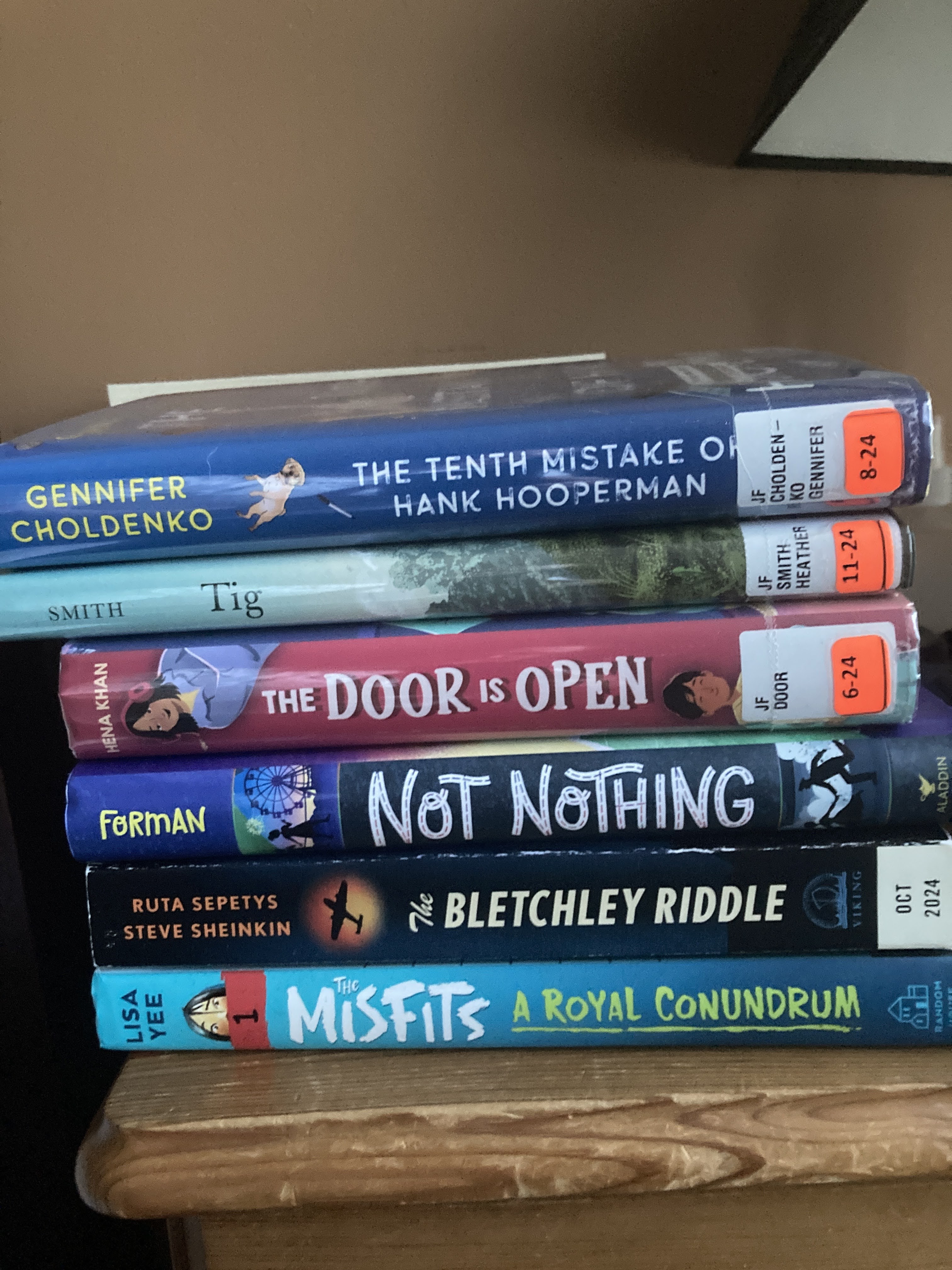
It’s Cybils Day!

And, being on the Round 2 panel for Elementary/Middle-Grade Fiction, this is my to-read pile for the next 6 weeks:

Not pictured: Grow Up, Luchy Zapata by Alexandra Alessandri because I gave away the ARC and another copy hasn’t come in yet.

You can see all the lists here!

Audiobook: Let it Glow

by Marissa Meyer and Joanne Levy
Read by Gabi Epstein & Rebecca Soler
Support your local independent bookstore: buy it there!
Or listen at Libro.fm
Content: There is the relative safety issue of the girls switching places that some parents might have a problem with. Also, one of the grandparents in the story has a fall and ends up in the hospital. It’s in the Middle Grade (grades 3-5) section of the bookstore.

Aviva Davis wants to have the perfect Hanukkah, something which her not-very-observant Jewish family doesn’t seem to do. She wants everything perfect from the menorah to the latkes. And while she wants to participate in the pageant her grandmother’s retirement center is putting on, she’s not sure she’s quite qualified to be the Jewish representation. Holly Martin is just at the retirement home because her mom is trying to convince Holly’s grandpa that he needs more help than they are able to give him at home. Holly has no intention of being a part of the pageant, but then she stumbles on Aviva, who is a carbon copy of Holly. They’re both adopted, they both have the same birthday, they both look alike… is it possible they are twins?

From there, the plot spins out in a very Parent Trap-like direction: Aviva and Holly trade homes to experience what the other holiday is like (Holly celebrates Christmas), while trying to figure out if their parents knew about being twins and just didn’t tell them. It’s a lot about blood family versus adopted family,

This was a very sweet holiday story, made better by the narrators, who were just amazing. I liked how they brought both Holly’s and Aviva’s personalities to life, how they made all the improbabilities of the whole situation make perfect sense. It was charming and adorable, and I enjoyed every minute of the audiobook.

The Bletchley Riddle

by Ruta Sepetys and Steve Sheinkin
First sentence: “First things first: a riddle.”
Support your local independent bookstore: buy it there!
Review copy pilfered from the ARC shelves at work.
Content: There are some intense moments, and talk of a small crush. It’s also a bit on the longer side for middle grade books. It’s in the Middle Grade (grades 3-5) section of the bookstore, but is probably for the older end of the age range.

Lizzie Novis is supposed to get on a boat to America to be with her grandmother because London is evacuating in preparation for Hitler’s invasion. Except she believes her mother is not dead and wants to look for her, so she evades getting on the boat and heads to Bletchely Park (or rather, the address she has for her brother which turns out to be Bletchley Park) to be with her brother Jakob, who has been working at the top-secret code-breaking facility.

Once there, Lizzie has the unwelcome job of trying to convince Jakob of her belief that their mother is still alive, and part of that is finding proof. All the while, Jakob is part of the team that is trying to figure out the codes for the Enigma machine so they can break the coded transmissions they’re getting from Germany. And Hitler’s army is on the march, coming closer to Great Britain. It’s all a lot to handle.

I have been selling this book for months solely on the basis of the authors’ names. Seriously: any book written by Sepetys and Sheinkin HAS to be good, right? And, dear reader, it was. Of course it was. They just have a way of writing historical fiction and history that makes it seem exciting, that brings it to life. And this book – with spitfire Lizzie and anxious, concerned Jakob, plus the rest of the cast of kids and code breakers – did exactly that. It was fun, intense, often funny, and a page-turner. It didn’t exceed my expectations, which were admittedly high, but it did absolutely meet them.

And you can’t ask for more than that.

The Wildcat Behind Glass

by Alki Zei
Translated by Karen Emmerich
First sentence: “Winter Sundays are the most boring days of all.”
Support your local independent bookstore: buy it there!
Content: It’s a little long and talks bluntly about fascism. It’s in the Middle Grade (grades 3-5) section of the bookstore.

It’s 1936 in Greece and all Melia wants is to run and play, listen to their grandfather tell stories about his “ancients”, and hang out with her sister, Myrto. But, it’s 1936, and the adults are all concerned about the rise of fascism and the overthrowing of the king. It really doesn’t help when their older cousin Nikos ends up in hiding because he’s wanted by the government. Or, when, in the fall, they go to a public school for the first time (they were homeschooled before), and Myrto gets sucked into their school’s phalanx, which is kind of like the Hitler Youth Program. Melia doesn’t quite know how to process everything.

And, honestly, after finishing this book, neither do we. It was initially written in 1968, and you can feel that when reading it. It’s a lot of everyday stuff happening, and not a lot of conflict and resolution. In fact, the book just kind of ends, and peters off without any real resolution. (Well, spoiler: Nikos gets away, but that’s about it.) Also, a bone to pick with the marketing: the back reads as if the titular wildcat- a taxidermied cat in Melia’s house – was magical and took them on adventures. It’s not. I wanted it to be. But there is no magic adventures here. I think the author wanted to tell Nikos’s story, but someone told her that it would be better if you made a young girl the protagonist and so she did that. Nikos was a much more interesting (and less whiny!) character. Oh well.

At least it wasn’t terribly long.