Indian Shoes

by Cynthia Leitich Smith
First sentence: “Ray and Grampa Halfmoon traipsed down the cracked sidewalk of a steel and stone city.”
Support your local independent bookstore: buy it there! (So, this says a release date of 2021. The book is currently out of print — I bought a used copy — but I guess they’re bringing it back?)
Content: It’s a series of short episodic chapters, with illustrations. If we had this, it would be in the beginning chapter book (grades 1-2) section of the bookstore.

This is a series of short stories — well, episodes really — featuring Ray, a member of the Seminole and Cherokee tribes, as he grows up in Chicago with his Grampa. His parents died in a crash (I think) when Ray was very young, and he and his Grampa can’t afford to go to back Oklahoma very often. There’s not a lot to the, Ray buys moccasins for his Grampa (well, he trades his shoes for them), they go to a wedding (in which there are mishaps), they celebrate Christmas alone, Ray gets a bad haircut (and then dyes his hair to match his little league team colors), and they finally go home to Oklahoma and go fishing.

Even with is simplistic nature (it’s definitely written for younger kids), it’s a good portrait of one Native life. It’s a good reminder that Native peoples aren’t all the same, that they aren’t just historical figures, that they don’t all live on the reservation, and that they have lives and hopes and dreams.

I definitely need to read more of Smith’s work, too.
Return to Sender

by Julia Alvarez
First sentence: “Tyler looks out the window of his bedroom and can’t believe what he is seeing.”
Support your local independent bookstore: buy it there!
Content: There’s a bully, and some conflict. And it’s a bit on the longer side. It’s in the middle grade (grades 3-5) section of the bookstore.

So, I’m taking a mulitcultural children’s literature class, and this one is on the list. I was a little way in, and I thought it felt familiar, so I looked it up, and yep: I’ve read it before. Except this time, because it’s for a class, I felt a need to finish it.

It’s told in two voices: Tyler, the son of white dairy farmers in Vermont who are going through a rough patch and need to hire people to help out. They go with the cheap option, and hire a family of migrant workers, who are in the U.S. illegally. And Mari, the daughter of the Mexican family.

There are Things Going On: not just the threat of a raid since they hired undocumented workers, but Mari fitting in at school, the fact that Mari’s mom has disappeared (she went home to Mexico for her mother’s funeral and hasn’t come back yet, even though she started), and just general pre-teenage angst in general.

I found it less preachy this time — mostly because I hadn’t remembered that issues of undocumented immigration or the wall was an issue back in 2005-2006. I found that aspect of it interesting. The idea of The Wall isn’t new, it’s just the most recent manifestation of people who want to enter this country and our extreme dislike for letting them in.

But it was’t a great story either. I didn’t like the format; Tyler’s chapters were odd (written in the present tense) and Mari’s chapters were all letters, which I found a bit hard to suspend my disbelief. I don’t usually mind epistolary novels, but this one was just a bit much.

I finished it this time, sure, but it’s not one of my favorites.

Glory Be

by Augusta Scattergood
First sentence: “What was taking Frankie so long?
Support your local independent bookstore: by it there!
Content: There’s some physical violence. It’s short and the chapters are short. It’s in the middle grade section (grades 3-5) of the bookstore.

Glory, the youngest daughter of a Southern preacher, has grown up all her life in Hanging Moss, Mississippi. She hasn’t thought much about how her cook, Emma, is black. Or why she doesn’t see any black people at the pool or library. But, it’s the summer of 1964, and things are changing. The pool closes “for repairs”, but it’s because the pool committee doesn’t want “those people” sullying the waters. They try to do the same with the library, but the librarian stands up and keeps it open. And Glory’s best friend, Frankie, is on the line because his older brother and father are leading the charge against desegregation.

This had a lot of the same feeling as The Help did: white southern people being enlightened and standing up to their racist neighbors, but not really doing much else. I don’t know. It wasn’t bad, and I’m glad that white people have this kind of awaking story, but it kind of left a sour aftertaste. It was a very white book (I am surprised it was on my list for a mulitcultural children’s literature class…) and I wanted, well, more. Emma, the cook, didn’t play a huge role, and the whole book had a white savior narrative to it: Look! White people can recognize that black people are people too. Ugh.

I wanted more.

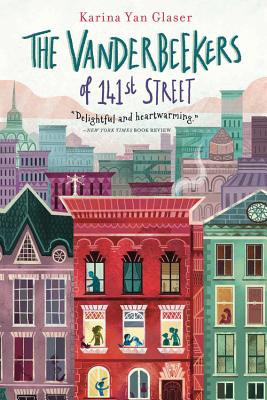
The Vanderbeekers of 141st Street

by Karina Yan Glaser
First sentence: “In the middle of a quiet block on 141st Street, inside a brownstone made of deep red shale, the Vanderbeeker family gathered in the living room for a family meeting.”
Support your local independent bookstore: buy it there!
Review copy provided by the publisher.
Content: There’s a wee bit of “romance” (one of the siblings “likes” a boy and ends up going to the 8th grade dance). The chapters are short, and there’s a lot of white space. It’s in the middle grade (grades 3-5) of the bookstore.

The Vanderbeeker family — mom, dad, and five children (four girls and a boy) — are perfectly happy in their brownstone apartment (one of three) in Harlem. They know the neighborhood, and even though they’re a bit squished, they love their home. That is, until their landlord, Mr. Beiderman, tells them a few days before Christmas, that he’s not renewing their lease for the next year and that they have until December 31st to get out. The Vanderbeeker parents are upset and resigned. The kids? Upset, but they’re going to do something about it! They being Operation Beiderman, They set about doing nice things for their grump of a landlord, in hopes that he will realize what a wonderful family they are and not kick them out.

You can probably already guess how this will end, but the plot really isn’t the point of the book. It reminded me of All of a Kind Family or The Penderwicks, where the actual point of the book was this charming, boisterous, delightful family that I loved getting to know. It was sweet and delightful and I loved the family dynamics between all the characters. This one is perfect for those who want a classic feel to their books. And I’m sure this would make a fabulous read-aloud to younger kids.

Definitely recommended.

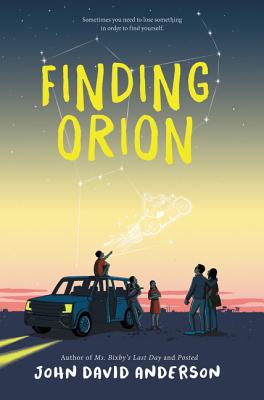
Finding Orion

by John David Anderson
First sentence: “The night we found out about Papa Kwirk, I had a jelly bean for dinner.”
Support your local independent bookstore: buy it there!
Release date: May 7, 2019
Review copy provided by the publisher.
Content: There’s a brief mention of kissing. And this one feels more weightier than Anderson’s usual fare. It’s still in the middle grade (grades 3-5) section of the bookstore, but it might be better for older readers.

Orion (call me Rion, pronounced Ryan, please) is the middle child — and only boy — in a very, well, quirky family. His mom runs the local planetarium (hence being named after a constellation; his sisters are Cassiopeia and Lyra) and his dad invents jelly beans at the local candy factory. Cass, his older sister, is super into theater and Lyra is a 10-year-old brainiac. The only person Rion can relate to is his grandfather, Papa Kwirk: he, with is stories of Vietnam and Harley Davidson, at least seems “normal.” The only downside is that they only see Papa Kwirk once a year, at Christmas.

But then, Papa Kwirk suddenly passes away. And Rion and his family head to his dad’s hometown for the funeral, and come to realize that they don’t know Papa Kwirk as well as they thought they did. The next couple of days, as they head around town on a scavenger hunt (no one said the Kwirks do things the easy way), they discover that there is more to Papa Kwirk than they could have ever imagined.

I have adored Anderson’s books — some more than others — for a while now. He’s always a bit odd, and he tackles big subjects (like the death of a grandparent) with humor and heart. It’s not as funny as some of his other books, but I really loved the way the family worked together (chalk this one up with The Penderwicks as a good family book!) to solve the scavenger hunt. It embraces the importance of family and telling family stories, which I also appreciated. There was a slight subplot that was a bit hokey, but it set up a great climatic scene where the entire family worked together.

So, maybe this isn’t a true middle grade book, but it’s still a fun read.

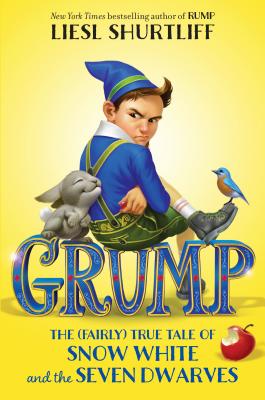
Grump

by Leisl Shurtliff
First sentence: “I was born just feet from the surface o the earth, completely unheard o for a dwarf, but it couldn’t be helped.”
Support your local independent bookstore: buy it there!
Content: It’s got a longer chapters, and some challenging words, but nothing too outrageous. It’s in the Middle Grade (grades 3-5) section of the library.

Borlen is a very unusual dwarf: he was born near the surface and is more curious about the human world than digging for gems. He carries around a pet bat, and spends his time reading about the human world and trying to go above and see it. His Fate Stone — the stone that all dwarves get when they come of age — is a mirror, which is unheard of. And so, when he’s placed as a Seventh (the worst position) on a mining team and there’s a chance for him to see what the humans are like, he takes it. 

Once above ground, Borlen stumbles into the clutches of Snow White’s power-hungry stepmother, the Queen Elfrieda Vronika Ingrid Lenore (let’s see if you get it), who unfortunately mis-interprets the word “fairest” to mean most beautiful instead of most fair. That creates a problem for Borlen, when he’s tasked with seeing Snow White killed.

The rest of the plot follows the fairy tale pretty closely, and I enjoyed it. I’m not entirely sure why giving Borlen — Grump of the seven dwarves (I recognized Sneezy, Bashful, and a couple others in the mix) — a backstory was necessary to retell Snow White, but it did make for an entertaining little book.

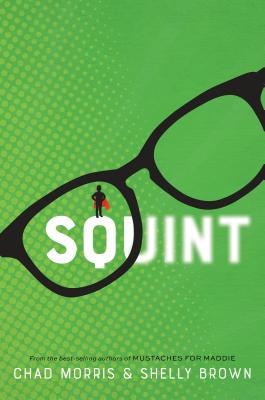
Squint

by Chad Morris and Shelly Brown
First sentence: “Double vision stinks.”
Support your local independent bookstore: buy it there!
Content: It’s not terribly long, but there are some more mature themes. It’s in the middle grade (grades 3-5) section of the bookstore.

Flint is a seventh grader, but because of his degenerative eye disease, everyone calls him Squint. Which he doesn’t really like. So, he’s channeling it into a graphic novel he’s drawing for a competition, because his grandmother has always said that he’s good at drawing. But, since he can’t really see, he doesn’t really know.

Yes (of course) he’s bullied by the popular kids at school, because middle school is a horrible place. But McKell, a new girl at school who’s joined the popular clique, isn’t feeling it. Her brother has a terminal illness, and so she reaches out to Flint, in order to do her brother’s “challenges” (via his YouTube channel). They have a rocky start, but eventually Fint and McKell learn that taking chances are a good thing, that a real friendship is the best thing, and maybe making good experiences is what life is really all about.

This was a super charming little book. My only real complaint was that the comic book sections were actually prose. I think it would have been MUCH better if the comic book sections were, well, actually comics. I think that would have increased the readability for kids (I skimmed those sections, too!) but would have added overall. But aside from that, it really was a sweet little story.

The Three Rules of Everyday Magic

by Amanda Rawson Hill
First sentence: “There’s something about that moment right before the first star appears in the sky.”
Support your local independent bookstore: buy it there!
Content: It’s got a lot of more mature themes, but they’re handled at an age-appropriate level. It’s in the middle grade (grades 3-5) section of the bookstore.

Kate has a lot (a LOT) going on in her life. Her dad left five months ago because his depression got too much and he needed to go away. He didn’t want Kate to contact him, and she doesn’t know where he is, so mostly she just ignores the guitar she used to love to play and writes him letters that she can’t send. Her grandmother has developed dementia that’s advancing, and is no longer able to live on her own, so she’s come to live with Kate and her mother. And (as if that wasn’t enough!), Kate’s best friend, Sofia, has decided that she’s much better friends with another girl, shutting Kate out.

It’s a lot. I know that it’s better to have a lot of conflict in one’s book, but really: depressed and missing dad AND best friend problems AND a grandmother with dementia (and that’s not even mentioning the burgeoning crush on home school friend) is a LOT to tackle in one book.

Hill manages it pretty well. It’s not perfect, though I did appreciate she didn’t tie everything up in a nice little bow at the end. It’s hopeful, but the problems aren’t solved, which is nice.

I liked this one, but didn’t love it.

Resistance

by Jennifer A. Nielsen
First sentence: “Two minutes.”
Support your local independent bookstore: buy it there!
Content: There is a lot of violence, and talk of death. It’s in the middle grade (grades 3-5) section of the bookstore.

Chaya is a teenager in the Krakow ghetto during World War II, and after her younger sister and brother disappeared (presumably put on a train to the death camps), Chaya decided that she wasn’t going to sit idly by and let the Nazis destroy her world. So, she joined the resistance as a courier. She could pass as a Polish (non-Jewish) girl, so she took to smuggling supplies into the ghetto and people out.

But her path didn’t end there: when things on a raid go wrong, Chaya and her friend Esther find themselves on the road to Warsaw, dodging Nazis and Nazi sympathizers until they get to Warsaw and are able to join the Jewish resistance for the Warsaw Ghetto uprising (which was a real thing).

This is really good historical fiction, if you’re not already tired of World War II stories. I got the distinct impression that Nielsen was trying to use this as a lesson for the climate in the US today — there were multiple references to people who just sit idly by and watch the horrors of the world being on the wrong side of the fence — but honestly? I’m tired. I know Holocaust stories are important. And I believe that everyone should learn about them, so we don’t repeat history. I’m just, personally, quite done with them. I liked Chaya well enough, I respected her journey, I got that Nielsen was telling me that I needed to be more pro-active in resisting hate and evil in this world.

But all that said, I didn’t quite like the book. I think it’s me, though, and not the book.

Ben Braver and the Incredible Exploding Kid

by Marcus Emerson
First Sentence: “Sixty miles per hour.”
Support your local independent bookstore: buy it there!
Others in the series (it’s probably better if you read this first): The Super Life of Ben Braver
Content: There’s fart and poop jokes (of course). There’s also lots of illustrations and white space with short chapters. It’s in the middle grade (grades 3-5) section of the bookstore.

This is a second in a series, and for many reasons (well, time mostly) I didn’t read the first. From what I can tell: Ben Braver is a perfectly normal kid who got sent to this boarding school for kids with superpowers. And he saved them from an evil supervillain. Except no one at the school knows that Ben doesn’t have powers (well, except for the Headmaster — who’s about as reliable as Dumbledore — and his best friends). It’s the new year, and there’s a new menace — sort of — and Ben’s doing his level best to hide his lack of powers while he gets more and more popular.

Actually, this one is more about the ability of fame to go to one’s head. Ben gets SUPER obnoxious while he gets more and more attention, but (of course) everything comes crashing down around him. And when the real threat presents itself, he does what he can to save the other students, but in the end, it’s an outside person (whose appearance was explained away in a sentence) who solves the problem. (Yeah, I have a problem with easy solutions like that.)

I really wanted to like this one more than I did. I think I was hoping for something fun and funny, and while there were some amusing points (humor is REALLY hard to do), it kind of all just fell flat for me. (There was one one-page comic that made me laugh, but that was it.) It’s probably great for the Diary of a Wimpy Kid crowd (I didn’t like those much either) and for those reluctant readers who want a lot of illustrations in their stories. But it really wasn’t my thing.